Notre Dame de Paris: back to the drawing board

notre-dame-de-paris-mk2

It is now nearly a month since I last did any painting, and I have missed it. Either because of festivities or through illness, I have not been able to get to my easel. Even last week, I had a relapse and have been given a second course of antibiotics which I have to say, have made me feel much better.

The next item on my to-do list, was to rework the painting that I did last year of Notre Dame de Paris in the Rain, except leave out the rain and inject some sunshine. I showed this painting a couple of times last year, without any interest being shown. Although to paint a scene in rain is skilled in its way, nevertheless the subject matter in itself is quite depressing . The colours become muted and everything looks dark. Would you want to buy a painting that lowered your mood? Probably not, so I am going to try to paint the same subject on a bright day, with colours more vibrant. Still could be autumn or winter time, but one of those bright days with long shadows.

What I have done more or less immediately, is to remove that unsightly marquee from the left of the picture. You may remember it, or you can scroll back in the gallery and find the original. I managed to find on the net, the buildings to the left of the cathedral, distant apartments and shops possibly, and these have been substituted

I have also rearranged the figures in front of the cathedral. By removing some, I have taken out the queue that was filing towards the entrance to get in. Looking back on this, it seemed quite mournful, like figures queuing for the dole. I have given the crowd, I hope, a more random look, so that hopefully they do now look like tourists, and consequently looking more interesting.

To the right of the cathedral, and out of sight, is the wonderful statue of Charlemagne. I considered moving it into the picture, but decided not too. Too much of a statement, which would have competed for attention with the cathedral itself

So, a start has been made which is always the hard part. I’ll get on with some painting and come back when I have something more to say

Chichester and Pallant House Art Gallery

chichester-market-cross-and-cathedral

Chichester Market Cross and Cathedral

We were here on the 31st. A lovely cathedral town with its c14 market cross, and one I remember from my youth. Pedestrianised many years ago and rightly so, I remember when traffic drove round the cross, and double decker buses clipped bits off it. Now it is safe from that sort of damage. There are still a few of these market/preaching crosses about, Winchester has a good one for example, and they need to be cherished

The city is Roman originally. Noviomagus, the new market, I believe. There was a straight road to London built by the Romans, called Stane Street. It is still there, but now called A24 and A29. It has one or two kinks in it, as it had to get through the gap in the Downs for example, but basically is straight as a die from Chichester to London Bridge.

The cathedral needs a separate chapter, and is one of the finest in England, but our main reason for going there was to visit our old favourite , the Pallant House Art Gallery, which houses a wonderful collection of modern art.. The collection includes names like Hepworth, Moore, Piper and Sutherland. Incidentally in the cathedral, there is a magnificent tapestry backdrop to the altar, designed by Sutherland. There is also a wonderful window by Marc Chagall, not always remembered for stained glass, although he did many. But I digress from the art gallery

Founded on the collection made by Dean Hussey of Chichester Cathedral , it was bequeathed to the city in 1977, on condition that it was housed in Pallant House, a Grade 1 listed Queen Anne townhouse built in 1712, for a wine merchant called Peckham and his wife Elizabeth.

The collection was added to by further donations over the years, and the impressive collection of artists represented, includes now Cezanne, Leger,Sickert,Lucien Freud, Richard Hamilton and Eduardo Paolozzi

As well as paintings, there is an excellent collection of c18 Bow porcelain

The new wing, a superb example of a modern building blending well with a Queen Anne townhouse, won the 2007 Gulbenkian Prize and was also listed for a RIBA award the same year

I try to stop after 300 words but have rattled on

Thanks for your comments on Bosham Harbour, now framed up and in store ready for the March exhibition. Thank you to those of you who enquired about this exhibition. The details are:

Guildford Institute, Ward Street, Guildford, Surrey, UK in the Assembly Rooms

Dates from 13th to 31st March this year

Thanks again


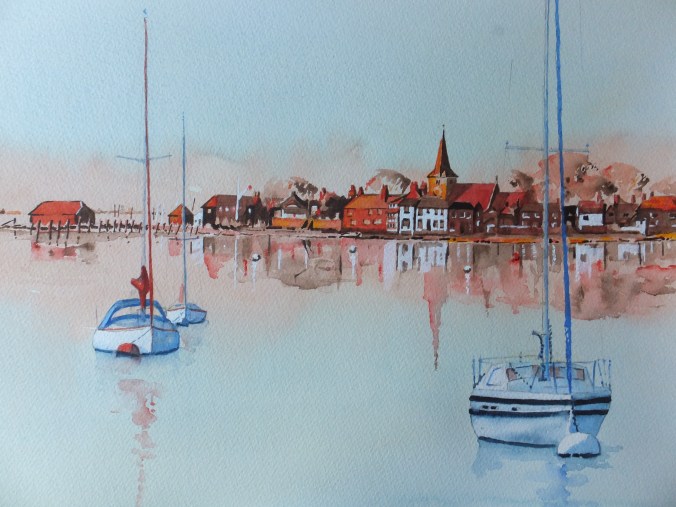
Bosham Harbour and Church: the finished painting

bosham-harbour-finished-painting

The finished painting finally!

There wasn’t too much to do since the last post. The boats had to be detailed and their reflections put in.

The boat in the foreground had a dark blue spinnaker tightly wrapped, which is probably the wrong word. I am not a sailor, and although I enjoy painting them, I am not up in boating terminology. The next nearest boat, had a spinnaker in orange and red which was highly convenient for the colour composition. I used a red buoy, and the reefed sail was also red. Again apologies to sailors if I have that term wrong. The furthest boat almost did itself really

So there it is. After the commissioned painting of Bosham worked out so well, I really wanted one myself for the March exhibition. This one, I think, will frame up well. Incidentally this is one of those occasions when the jpeg does not do justice to the original, which is softer somehow.

I have been looking at my list for the exhibition, for which I want fourteen framed pictures in all. I need to repaint the Notre Dame with Pigeons picture in a different mood, probably in bright sunshine and also missing out that dreadful marquee, which will make it look more attractive to people

One of my existing local pictures needs to be reframed, and there is also a painting I want to do of Sicily which I hope will turn out well. With what I have already, I could put fourteen pictures into the field, without doing more

Not that I will stop, of course, because I never do, and anyway there are other exhibitions coming up throughout the year, so still much to do. Inevitably if I have something better, I will change the entries for the March exhibition too

Hopefully in the coming weeks I will be talking about more work as I complete it

Bosham Harbour: continue with the painting

bosham-harbour-continued

It seems a long time ago that I touched this painting, and in fact it is the best part of a month, which for me, in between stages this is too long. I have totally lost the thread of what I had planned for this picture, so I shall have to rethink it

We went to Germany for the markets, where I became ill with some virulent chest infection, and then celebrated a family Christmas over three days. Now different branches of the family have flown off to Spain and to Thailand, and so peace descends.After a morning sorting a few things out, I started to look at my easel again, and with confidence surprisingly ebbed away, I picked up my brushes and started to get my mind round the picture and how to tackle it.

If you remember the first post that I did on this painting, you will see that I have added the reflections of the quayside houses and the Saxon church. It may not look much for an afternoon’s work, but that is what it took me

I find with reflections that I do an awful lot of zooming in and out again. That is, I paint a bit and then go to the door and look back. I don’t do a mirror-image reflection, I never do. Some people do and do it well. I like a reflection to look as though it is on water, and not on glass. In other words, it has to wobble a bit, and the colours don’t reach the same intensity as the buildings themselves. But that is me!

I altered some of the houses and gave them a white facade. They were a bit too gloomy, and no distinction between any of them. There were also some flagpoles and masts of boats outside the yacht club to be added.

I am generally happy with the reflections. I think they look like reflections, although one or two need tidying up

The other thing I did was to put shadows into the boats. That has to harden and then I can start on detailing them which will be a long job. I still have to decide on colours. Red for one of the reefed sails and also the spinaker, as that will make a nice reflection. The others to be decided

Decisions, decisions!

Monschau in the Eifel Mountains, Germany

monschau-in-the-eifel-mountains

The very pretty and old village of Monschau on the river Rur ( without an h). Very cold in the valley but nice where the sun caught. We were expecting to find a Christmas market open that day, but it wasn’t. The village itself was very attractive though, high in the Eifel Mountains, an area of Germany I hadn’t visited before. Very sparkly at this time of year, with the sun on the frost.In fairness I should say that some shops were open, and they were of a high standard, so our visit there was generally enjoyable

I took a lot of reference pictures whilst I was there. The lights and darks were good and the tumbledown buildings would be fun to draw. I haven’t painted German villages before and maybe I will. I tend to paint places that people buy at exhibition, which perhaps is wrong as nothing worse than a bored artist.

In all, our trip to the Christmas markets was not successful. Monschau was lovely, but the Christmas markets in Liege, Belgium the following day were poor, and even in Bruges on the way home, a city so beautiful normally, the markets were disappointing.

But what really marred the trip, apart from the disgusting food in our hotel, was the fact that we both became ill partway through the holiday, and towards the end all we wanted was home. I have no doubt that this jaundiced our view of the trip

I found, when I went to my own doctor,( and at my wife’s insistence), that I had developed bronchitis, so no wonder I had difficulty breathing! Thank heavens for penicillin, and now partway through my course, I am feeling much better, and interested enough to write my blog, which I have neglected.

I have done no more on Bosham Harbour sadly, not having had the will to take up a brush, but now I am looking forward to getting started again

One little ray of sunshine to brighten my gloom this week, was to hear that my charity card, Christmas Shopping in Guildford High Street, which is described somewhere in the archive of this blog, actually sold out. That was 250 packs of ten, so very pleased at that. That in addition to the original painting which I donated as well, which they sold for £150, so delighted about that too

I hope to get back to normal soon

Bosham Harbour: the painting started

bosham-harbour-interim

Some while ago now I finished the drawing of Bosham Harbour and Church, and I posted that. I left it, as I completely messed up the initial wash. It wasn’t something I could correct, so I abandoned the whole thing. Very,very rarely do I do that, but sometimes it is the only way.

I find in situations like that, that walking way is the best thing to do.  Walk round the block, metaphorically speaking and then come back, otherwise you just get more and more frustrated, and make more and more mistakes

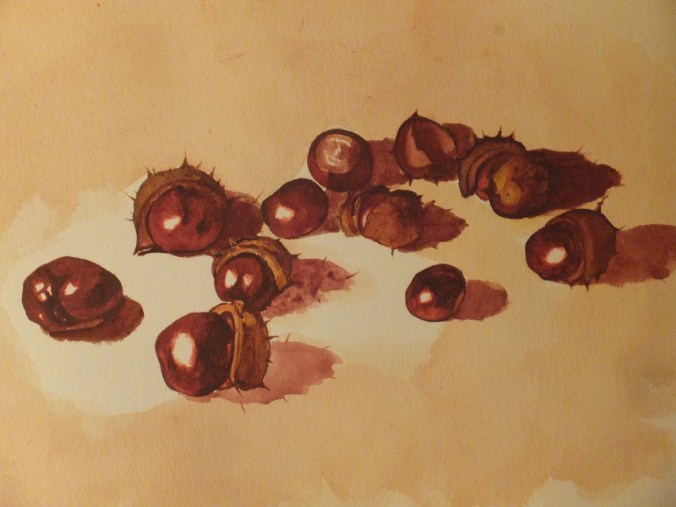
My way of walking round the block, was to do the Conkers painting. Completely different and completely unimportant, I was able to unwind and get myself back into finding the colour recipe for conkers which was in my head somewhere. After all that, my little bit of therapy produced a quite usable painting, and I framed it not so long ago, and was pleased with the result. This will go towards my next exhibition which will be in the Guildford Institute in March, not that far away now, so I need to work.

Back to Bosham Harbour, after redrawing the village with sailing boats, I put in a different wash, and played safe. I have no time to experiment. Phthalo blue and Cobalt produce a nice sky/sea colour and across the horizon a band of sunset produced with permanent Rose and Cadmium Orange. I started the blue wash downwards whilst at the same time starting the sunset colour at horizon level and worked upwards so the two met, and blended comfortably. Tricky using two brushes and two palettes at the same time, but it seemed to work

As you can see, I have just been detailing the church and other buildings in various reds and browns. I needed to get those roof tops really bright, and after several different glazes used cadmium red to give them some zing, so that they looked as though bright red evening sun was bouncing off them.

Still a lot of work to do, on reflections and those boats, but that is to come

Still Life with Conkers: Finished Painting

still-life-with-conkers

This is the finished painting. Rather laborious but we got there in the end! Every now and then I quite enjoy tackling something like this, not botanical painting exactly, but painting a specimen of fruit or flowers, with some expression thrown in. Textures are tantalising, and making an object look solid on a two-dimensional plane likewise.

I hope I have succeeded. One or two conkers, I feel, I can pick up, but I will let others judge

I talked about the story of conker-playing when I last posted, and how sadly, the gentle art has disappeared amongst schoolchildren, thanks to the interference of the health and safety police. No need for me to dwell on that anymore, only to lament the passing of part of our heritage, which had continued effortlessly from generation to generation. Too easy to blame the iPad! Children that I know like traditional games and playing with their iPads

But enough ranting. Let’s get back to the painting and how it takes shape. I remembered to take a picture of an interim stage, so let’s have a look at that

dscf3502

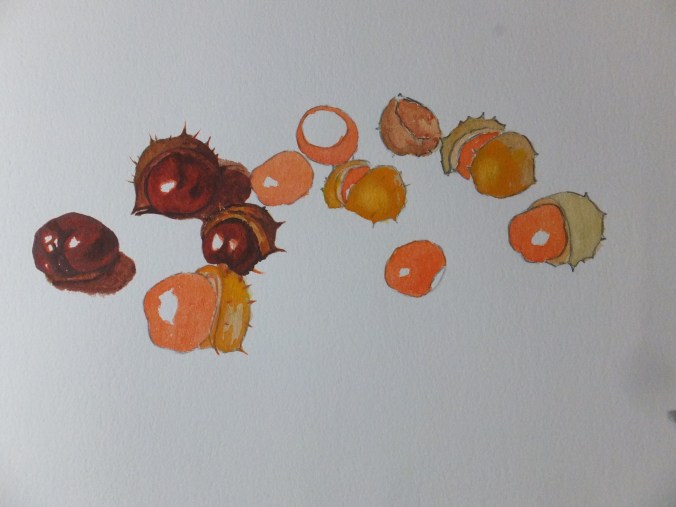
This is the stage following on from where I left the last post. I have completed a couple more of the conkers, this time with their husks, just to make sure the recipe is actually working. It seems to be!

As a base coat, I painted all the conkers with a bright orange, leaving a soft white spot on each, where the bright light is being reflected. I had already used a pale green for the husks, and had they been fresh from the tree. I could have continued with more green, but they had already gone a yellowy-brown colour, so true to nature, that is what I am doing.

The finished conker colour, I achieved using a succession of reds and browns. I did this wet-into-wet, so it is hard to give a blow by blow account. It is rather like sculpting. Do a bit, stand back and do a bit more

I can tell you, that I used light red, burnt sienna and burnt umber. At the very end, I gave nut and husk a unifying wash of light red, which I think gave them the colour I was looking for. And there it is

Thinking ahead, I have two projects taking shape in my head. One is to carry on with the painting of Bosham Harbour which I drew up and went no farther with. The other is to look back at Notre Dame with Pigeons, and redo the whole thing, removing that ghastly marquee on the left, and also improve the weather, and make the whole thing brighter and sunnier, albeit still winter time

I could also be going to Germany soon for the Christmas markets, so may be able to bring some interesting subject matter back with me

All for the future………….

Conkers:producing the painting

dscf3500

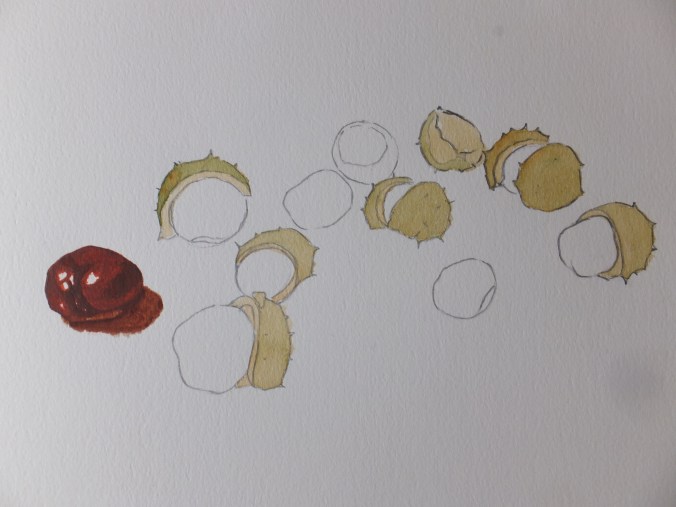
I managed to dig back into one of my old reference books and remind myself how I painted my first conkers still-life originally. As you can see, I have just drawn the nuts with their husks from the photograph. I have also put a base coat of yellow/green over the husks, and for this I have mixed sap green with raw sienna, which I find produces quite a natural green, for want of a better word

They look unassuming, and quite uninteresting, do they not. So I thought, what I would do, would be to finish off one conker, one nut, completely just to see if I could still do it.

This was the method I used.

I gave the nut, a base coat of bright orange, in this case Cadmium Orange with a touch only of Cadmium Red, and then let it dry hard. I should have said that I left a soft spot of white paper, working from the photograph, to simulate the point where strong light bounces off a glossy surface.

I then worked a succession of reds and browns wet-in-wet, almost sculpting the shape of the conker, finishing with Burnt Umber for the very dark surfaces. I also put in the shadow and darkened up the right-hand side. I let that dry hard, and put a unifying wash of Burnt Sienna across the whole of the conker, and left it until the following day

The next day, I felt quite pleased with the result. This was probably the nearest that I had come to trompe-l’oeil, where something painted in two dimensions looks solid enough to be picked up. I am not saying that every artist would be pleased with this, but I was, and confident enough to go on

The paper I am using is worth a mention. It is made from pressed rag, and I believe comes from Pakistan. It is similar to hot pressed paper, so that the surface is smoother than the cold-pressed paper that I normally use. It was sent to me as a sample some time ago, and I never used it, but it has proved perfect for this type of work

I shall probably finish the painting completely now and post again when it is done

Conkers

dscf3456

I painted “conkers” a few years back, and the painting sold fairly quickly, and can be seen on my website davidharmerwatercolour.co.uk. I thought I would do another version, so assembled this little still life from a neighbouring tree, a few weeks ago, and photographed it, to do later at my leisure. It is very important that the conkers are fresh from their husks so that the finish is nice and glossy in order to reflect the light. These are beautiful like polished mahogany

If you were a schoolboy in the 1950s like me, these were highly prized as they would be used every autumn in the game of yes,…conkers. They are, of course, the nut from the horse chestnut tree, the non-edible version. We would drill each one with a skewer, and thread them with string, tying one end off with a large knot. Then let combat commence. Players would take it in turns to bash each other’s conker until one split and fell off the string. The one left intact was the winner. Players would count the number of “kills” and accord them to their own champion, so it would be a “sixer” or “tenner” or whatever.

Competition was fierce and led to devious practices, like baking your conker in the oven to make it rock hard, or soaking it in vinegar so that it pickled. I was never sure that helped, but people did it nonetheless

Sadly, in this millenium, the game was banned by several schools, thanks to a jaundiced view of people’s safety. Headmasters thought a piece of nut could fly off and hit someone in the face! Anything is possible, but in my long experience of the game, nothing like this ever happened. Someone even suggested that players were at risk from “nut-allergy”!! Absolutely no evidence for that whatsoever. Incredible when one thinks of the disabling injuries from playing rugby or from boxing, which young people are encouraged to play

I haven’t seen anyone playing conkers now for years, probably because a generation have never known what it is, so the tradition hasn’t been handed down. I believe that the game of conkers has resurfaced in the United States, so maybe it will come back to us from across the pond.  Comments appreciated if you have any information on that

In the event, my interest for now is in the aesthetic as much as the nostalgic. I have made a drawing from this grouping, which is rather too faint to show, so I will get some colours together, and post another time about the painting exercise

Paul Nash Exhibition at Tate Art Gallery

the-menin-road-1918-19

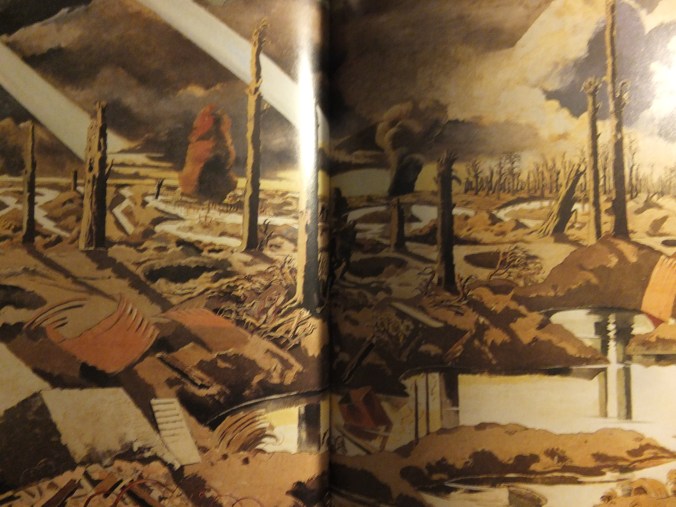
The Menin Road 1918-1919

This was the best picture I could get taken from my guide book. This was prominently displayed in the exhibition being one of his best known WW1 paintings. A very big painting and naturally surrounded by people, so no chance I could photograph the real thing, and nor should I.

This painting was commissioned by the Ministry of Information, and was destined for inclusion in a Hall of Remembrance, which was never built. Today it is part of the Imperial War Museum’s collection

His style is starting to alter. He has become fascinated by geometric shapes, which will take him down the road to cubism and abstraction

However, to start at the beginning, we drove into London yesterday in the driving rain. Fortunately you can still park just outside the Tate which was useful considering the weather

The first section dealt with his early work and his comparatively comfortable existence in Iver Heath, where he paints in the garden and starts to show his predilection for landscape, which was to govern his painting throughout his life.

WW1 transformed him and his painting. He described himself as a messenger bringing back word from the men fighting to those who wanted the war to continue. This time a ravaged landscape witnessing a violent emotional experience. The Menin Road which I have shown is the best example of this in my opinion

After the war, places took on an importance for him. He lived at one time in Dymchurch on the Sussex coast, where he painted the sea defences again demonstrating his interest in geometric shapes and becoming ever more cubist. He was also influenced by de Chirico, after visiting an exhibition in 1928, and his paintings started to show lonely places and tell mysterious narratives through isolated objects.

He also at this time became interested in interiors and in still life. These paintings again showed him exploring cubist ideas, with their dependence on geometric shapes. A painting called “Dead Spring” painted in 1929 best illustrates this and I am sorry that I don’t have a copy of this one

He went on to explore the life of the inanimate object, conveying on them human personages. Working closely with fellow artist Eileen Agar, on the Dorset coast, they both used found objects in their work,  both in paintings and in collage.

He became closely involved with Surrealists, and produced work like “Landscape from a Dream” which I can showdscf3496

Some of this was cropped to get it into the frame, but here on the Dorset coast, the hawk is looking at itself in the mirror and also watching itself flying

Then came WW2, and Nash was made an official war artist. He was equally terrified of and fascinated by bombers.He talked about the “sky was upon us all like a huge hawk hovering, threatening”. He was inspired by the imagery of crashed German bombers in the landscape, like sculpture, and also at the Cowley Dump where these parts were brought. He drew upon his surrealist ideas when he painted Totes Meer or Dead Sea, where the twisted mass of crashed planes metamorphosed into waves of a metal sea.

This painting I can show and it is probably the one we all think of,when we think of Paul Nashtotes-meer

By now his health is suffering. He returns to landscape painting. In 1946 he succumbs to pneumonia and heart strain, and can no longer stand at his easel. Severely depressed he dies at Boscombe near Bournemouth at the age of 57. He is buried at Langley Marsh