As before I am grateful to Narbe Photographie of Joulouville-les -Pins in Normandy for the use of their image
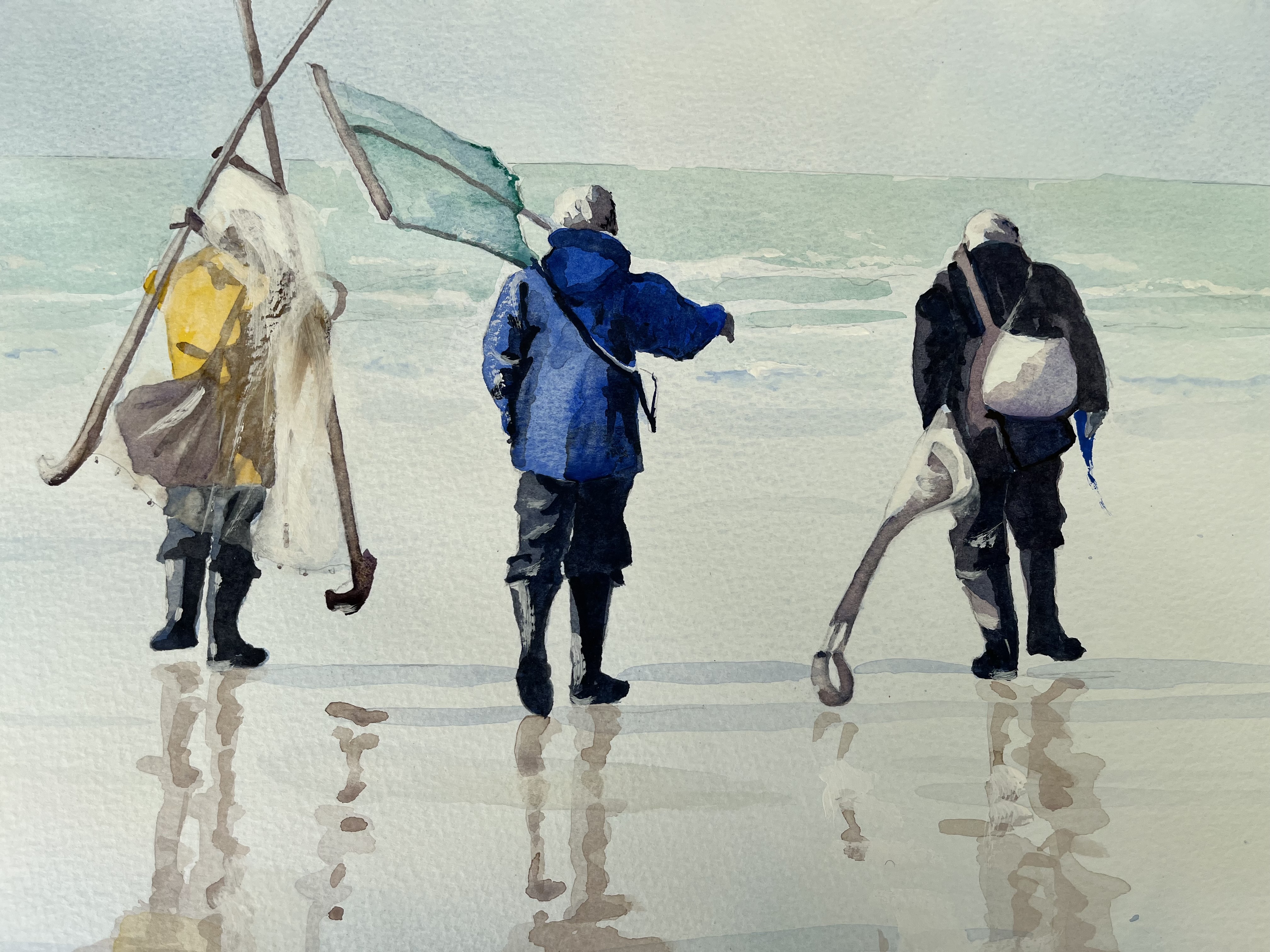
I wasn’t sure at first what these guys were setting out to catch. It’s shrimps I am told, and of course the green net seems obvious when you know. The other two with the white nets were less obvious but presumably they are for pushing along on the curved ends shovelling up shrimps.
Anyway they made an interesting group and I enjoyed painting them. The wet sand worked well I was told and certainly I was pleased with it.
More about the image than anything else. I hope you enjoy looking at it.
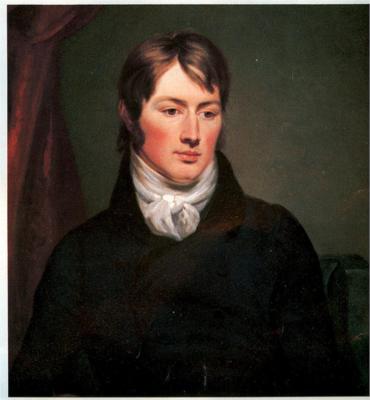
Something I didn’t know until I started reading about him with a view to preparing a talk later this year entitled Turner and Constable. In 1821 when he showed at the Royal Academy and showed The haywain in fact, he was wildly embraced by the French art market, not quite literally although he might have been. he was totally unprepared for all this enthusiasm which he certainly wasn’t used to at home
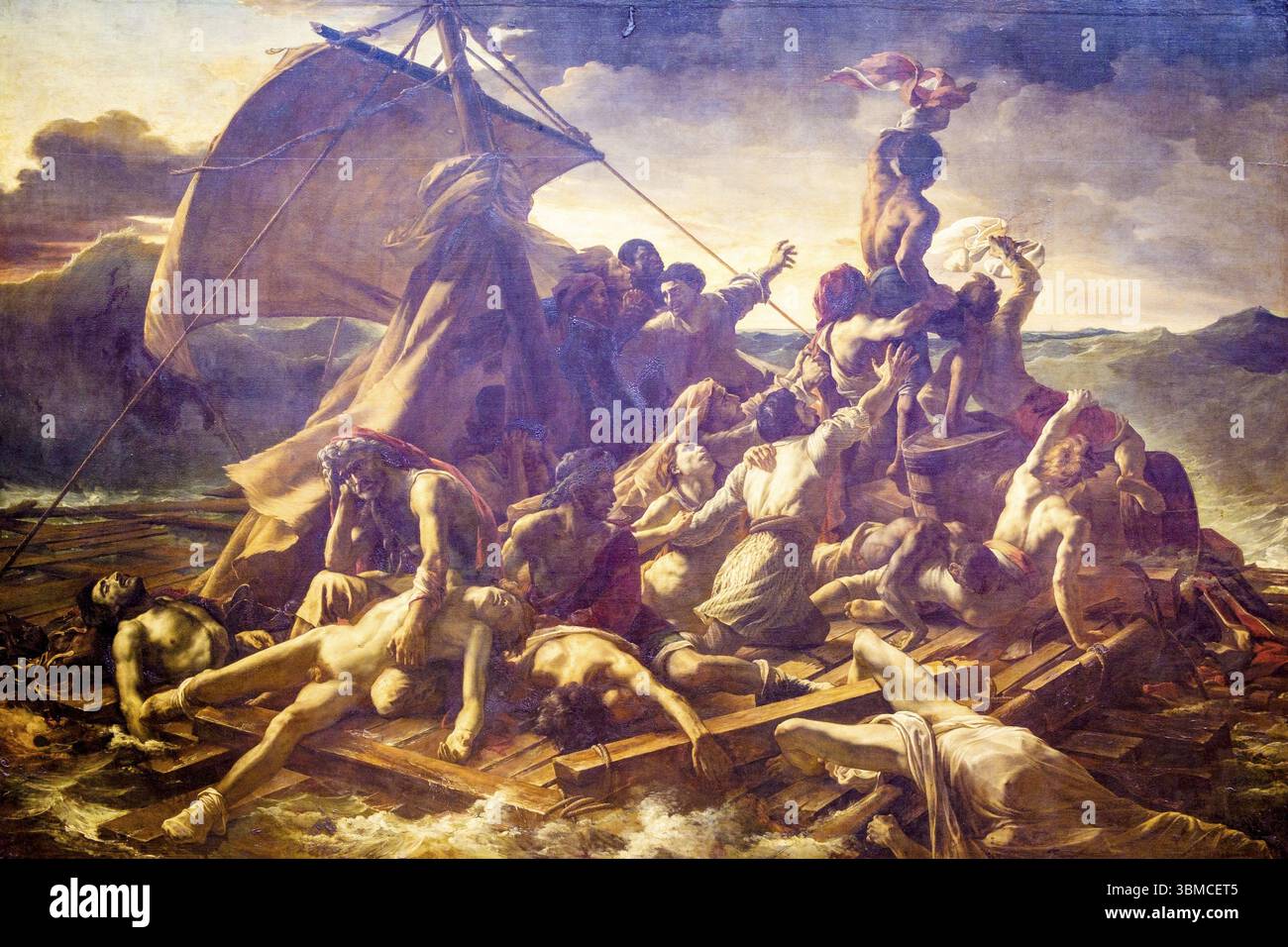
One of the first to discover him was the French Romanticist Theodor Gericault. He is probably best known for his famous painting The Raft of the Medusa, which he had brought to London, and which we are told thrilled 70,000 Londoners
And this is Gericault’s famous painting, which I will just talk about before talking about Gericault’s reaction to Constable’s work
This painting was based on a real incident which shocked the French nation. The French naval frigate ran aground off the coast of Mauretania on 2 July 1816. At least 150 people were set adrift on a hurriedly constructed raft. Only 15 survived and were picked up. The event fascinated Gericault and he could be said to have hooked into national grief. He undertook extensive research including visiting morgues for the skin colour of the dying and the dead. The painting was shown in the Salon of 1819 and received national approbation. He brought it to London where it thrilled Londoners including one Turner who went back to his studio and reworked his own great work The Shipwreck
Whilst in London Gericault visited the Academy exhibition and there discovered Constable. He thought that The Haywain was the best in the exhibition. Other French visitors thought the same and waxed lyrical.
Much to Constable’s surprise the interest quickly snowballed. A Parisian art dealer called Arrowsmith, French despite his name, offered to buy The Hay Wain and offered a derisory sum. The negotiations broke down but two years later, when Constable was short of money, he agreed to sell the painting to Arrowsmith for £250, as well as other pieces. The paintings caused a stir when they arrived in Paris.
The arrival of the Hay wain in 1824 was like a pebble dropping in a Parisian mill pond. The effect was immediate. At the epi-centre of the quake was another influential figure, Eugene Delacroix, who was so influened by the Hay Wain that he went back to his studio and repainted background on his great work The Massacre at Chios. He was blown away by Constable’s greens and tried to copy them. Critics viewing this picture at the time couldn’t find much evidence of green being used, but there we are.
If Delacroix was talking about the Hay Wain, then others were bound to be listening. A few weeks later it was these two paintings which received the greatest share of the attention at the Academie des Beaux-Arts, known as the Salon. The Salon dominated taste and opinion in France to an even greater extent than the Academy in Britain
Constable was embraced at the Salon in a way that had never happened to him at home. His large paintings were removed to positions of prominence, and Monsieur Constable, Peintre de Paysage was awarded a gold medal of excellence. His friend John Fisher couldn’t resist commenting that plain old Constable, who didn’t speak a word of French, was the talk and admiration of the French. His name entered the language. Landscapes were described as a la Constable!. More French exhibitions followed in Lille including another gold medal, Douai and the Salon again in1827, where there were plenty of landscapes a la Constable, with rustic cottages, wagons in ponds and open fields and skies.
Constable nevertheless refused to visit France, his attitude seemingly bloody-minded bordering on rude.
This is probably a good place to take a break. We are about half way, so a lot of writing and a lot of reading for you guys. It will take another post to complete the subject which I will do soonest
This is a photograph I took myself trying to catch the little ferry crossing from Twickenham over to Ham on the other side. I just missed the ferry but my reason for keeping this picture, is that this must be one of the nearest points on the river from Turner’s house in Twickenham. I dealt with his house a few blogs ago so I won’t repeat that. Turner loved boats, he loved fishing, he loved the river, and he loved picnics with his friends. Was this the sort of spot he came to? We don’t know for sure about him fishing here, but he would have known this location.
I took this picture from the riverside of the grounds of Orleans House Gallery, where we go from time to time. The gallery is what remains of the original Palladian mansion built in the c18. Louis Philippe duc d’Orleans lived here in exile from 1813-1819. Turner met him and they became lifetime friends. Later in 1830 he became king of France, until he was toppled by another revolution, and went into exile in England once more. He died at Claremont in 1850. Turner went to see him in France near the end of his own life in 1845, one of his last visits to Europe, and they talked into the night about ‘Dear Old Twick’
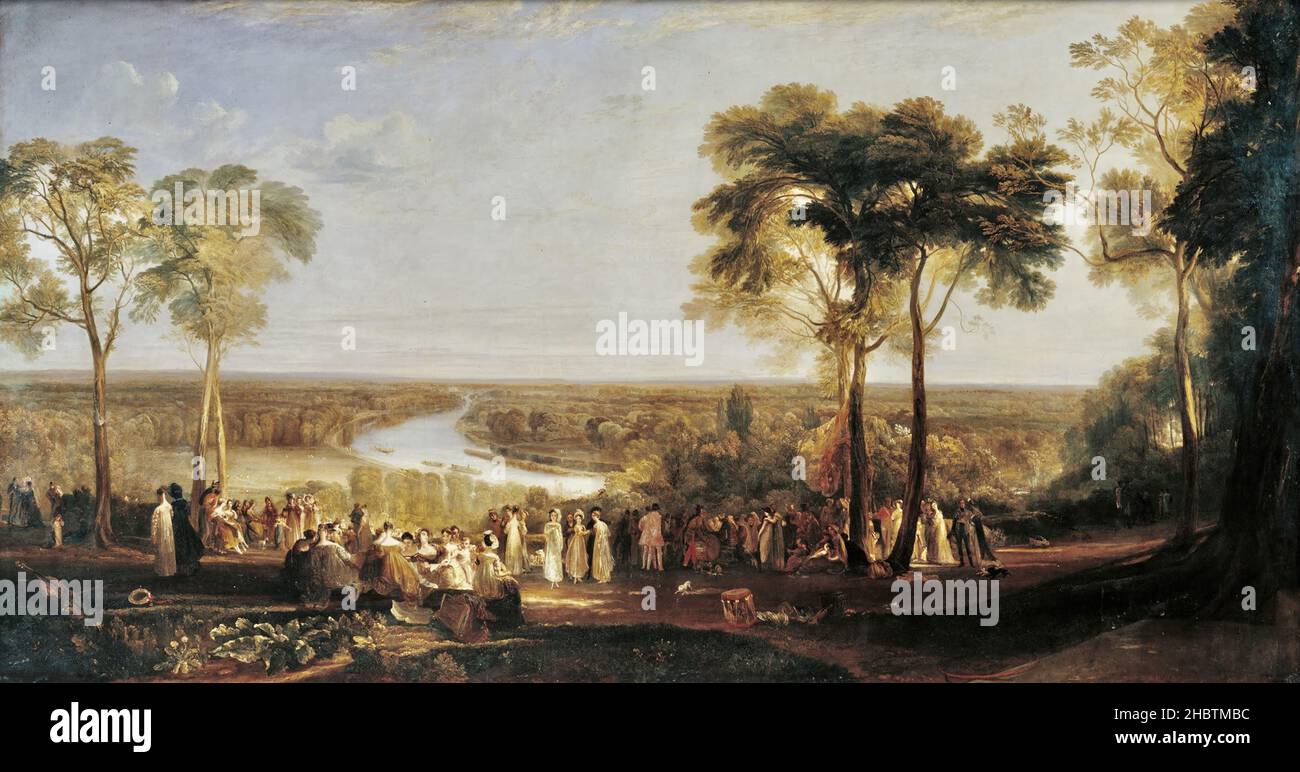
In the background on the hill is the Star and Garter, what used to be a retirement home for disabled service men, and more recently converted into apartments. Nonetheless a powerful landmark, and showing us where Richmond Hill starts. Turner painted the view from there, and I would like to look at one particular painting dated 1819, painted in honour of the Prince Regents birthday
I think that this was an unashamed bid for royal patronage, which was unsuccessful as I believe but nevertheless an interesting painting, which of course looked down on an area which he grew to love. Actually as King George 1V he was able to bestow a seascape on Turner in 1823, but to return to Richmond Hill
I will, if I may quote from Anthony Bailey’s biography, which talks about this painting in some depth. Travel and the proprietorship of Sandycombe Lodge, his country house in Twickenham, had occupied much of his time. His painting output had dropped, and he had no new commissions, so he needed new patronage, or may have felt so. In 1819 he had exhibited this great canvas, kingsize, measuring about six feet by eleven. This was England: Richmond Hill on the Prince Regent’s Birthday. It showed the winding Thames at Twickenham, and Sandycombe hidden in the trees, and on the further bank a game of cricket going on whilst in the foreground a group of partying people which could have been borrowed en masse from Watteau
There were mixed views. Some thought the painting to be unEnglish despite its title. There is a quotation from Bell’s Weekly Messenger (16 May 1819) where the writer admired the painting but qualified his praise.’ The distance, the foreground,the trees,and the figures are all Italian. On Richmond Hill, and on such a day, John Bull with his dame, with the rustic lads and lasses of the village, sporting under the sturdy oak, would have been more characteristic of England’ But this was to request a different nostalgia. Turner had not yet been to Italy and was perhaps looking forward to that country to paint
That is probably enough for writer and reader for now. I am getting some material together for his excursions down the River Wey taking him deeper into Surrey, so we can look at that another time
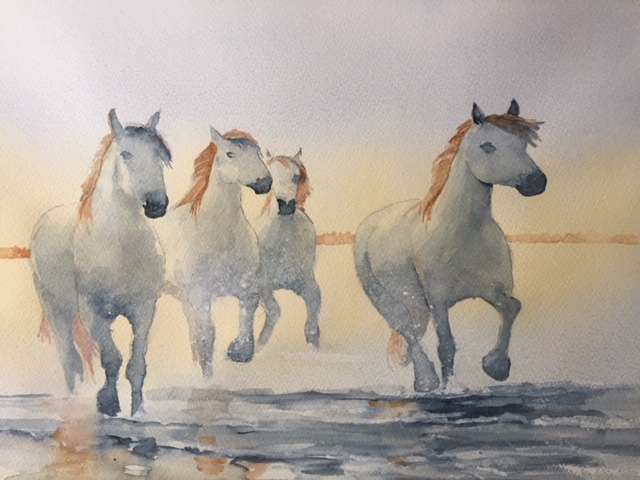
White horses galloping along the shore are always a stirring sight
I am getting paintings together for a new exhibition in March at Denbies Wine Estate near Dorking, and needed some new work. This one I am pleased with and will be putting it forward. This is the latest in my series of Camargue horses. I like this one more than previous horse pictures. perhaps I am getting better!
Recently I was given a commission to paint a horse with its owner. This will be given as a present so a special responsibility. I will let you know how I get on
I never tire of looking back to our visit to the Camargue, where tributaries of the Rhone flow into the Mediterranean sea. This wetland area is famous for its wildlife, flamingos which breed here in possibly their only breeding ground in Europe, bulls which are bred for fighting, and, of course, the famous white horses which run wild throughout the area. They are magnificent to watch
I have painted them before. Always a delight. I hope you enjoy looking at this painting. As far as I remember I have only used two watercolours, Cobalt Blue and Vermillion which work well together as a sunset effect.
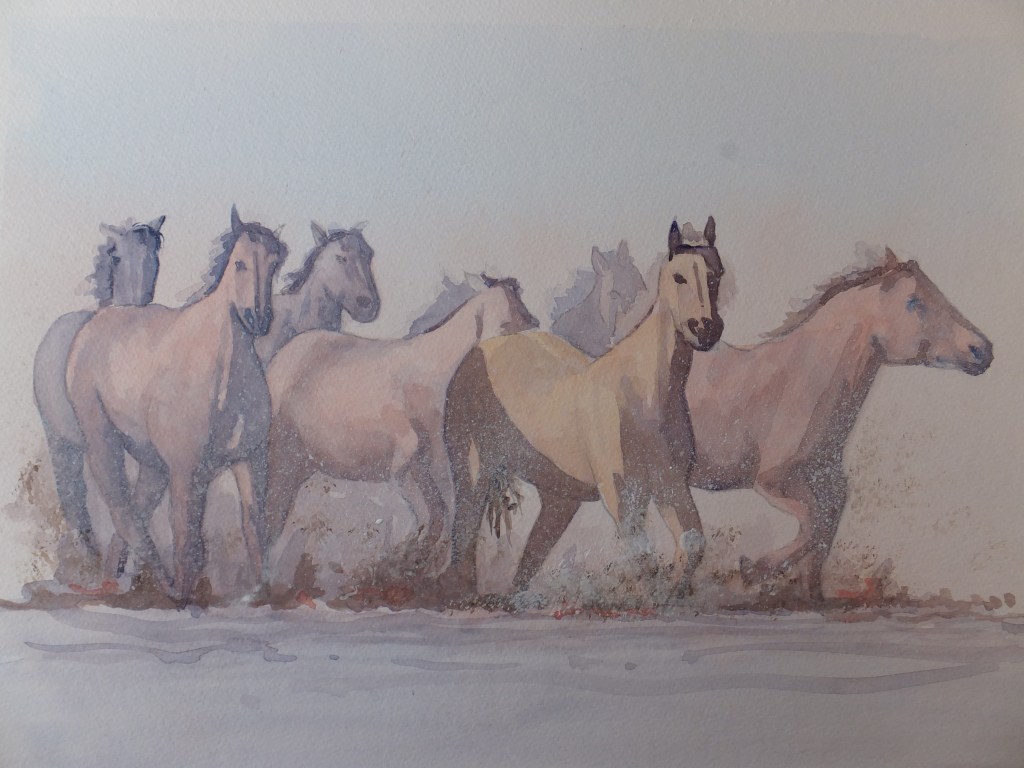
I changed some of the colouring on some of the horses as I wasn’t pleased with the way that they were turning out.I used some very dilute rose in a glaze over some as well as a very dilute gold over the lead horse, just to see what that did for the effect
I found I quite liked it. That is why I have changed the name to Horses in the Wetlands as they don’t look like Camargue horses any more, although arguably the rose colour could come from a low sun. Anyway, I am quite pleased with the overall effect
I am not going to feature this one on the internet just yet as I am starting to build up a collection for my show in December, and this one I think will work well. Strange to think my first bricks and mortar exhibition of 2020 will be in December, unless cancelled of course. Life is getting restricted again
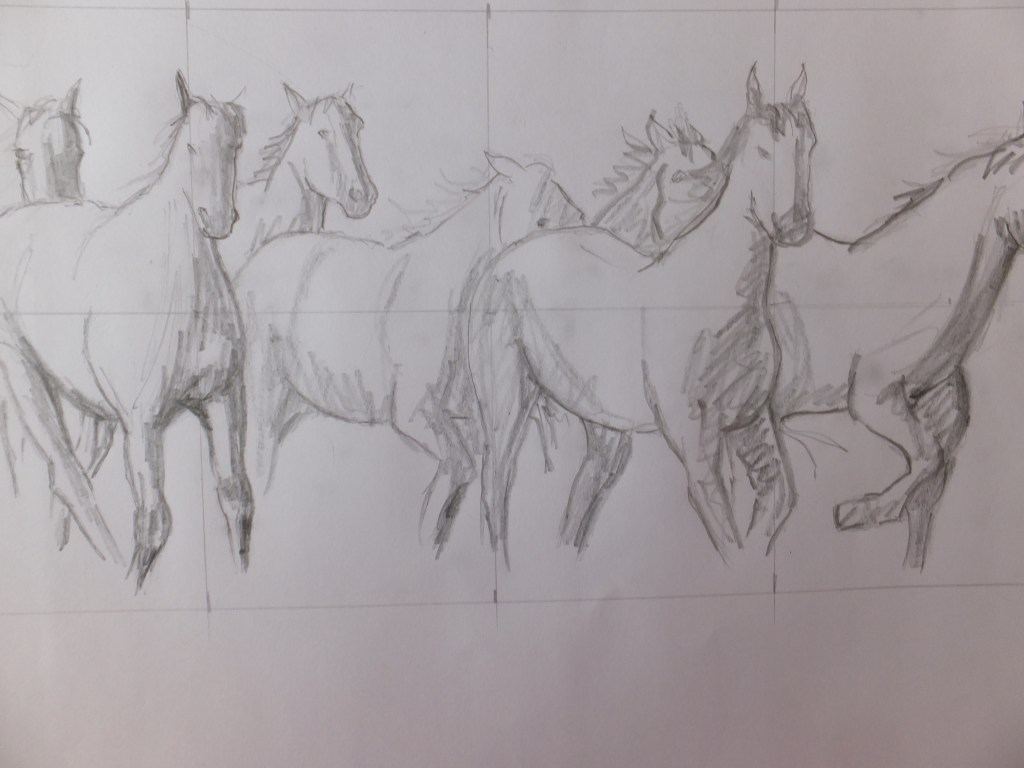
As I said in my last post, I am looking for another horse painting, ideally of horses on the move, to replace Horses in the Snow which sold last week
This one should work hopefully. You can’t tell from this sketch but horses are cantering through water, so a lot of splashing going on which will give the idea of movement hopefully to the picture. A good excuse to do a lot of flicking and splashing during the painting as well. One of those defining moments when you throw paint at the picture or spray with an old toothbrush and hope it lands in the right places
I have painted Camargue horses before. We were there a few years ago, and they are magnificent to watch. I don’t trouble much with background for these shots, just paint the horses and sky the same blue/pink/grey combination, and then build up the horses with dark shadow
It worked last time, which is no guarantee of future success of course
Horses in the Snow, you may remember was the subject of a recent post. It sold extremely quickly from my Artfinder site, which is most gratifying. In fact I don’t remember a painting selling so fast. It is on its way now to its new owner, who I hope will get years of pleasure from it
It leaves me with a happy problem, but a problem no less, of a gap in my collection that I am putting together for my first and only bricks and mortar exhibition this year, which will take place through the Christmas break. This will be at Denbies the winery near Dorking, which has an art gallery, which is let out to groups throughout the year. This will be the first time that I have shown there, and I am very much looking forward to it
Horses on the move are a popular subject, and are fun to do, so I shall be looking through my photo stock for inspiration. There are several to choose from as kind persons have been sending ideas through to me. Mostly excellent screen shots of wild horses galloping through water which do look dramatic, but for the moment I am going for an image I brought back from my visit to the Camargue three years ago, and which I attach
I like the way that the lead horse looks at the camera
I quite like doing these narrative paintings from time to time. This one I have done in a vignette style, again something I do for a change. In some ways this style takes less time, as I don’t have to tape up, and without big expanse of sky or sea, there are no big washes to worry about.
This was not done from one of my reference photos, and my thanks and acknowledgements go to an unknown photographer whom I could not find. This painting is not a copy of but was inspired by a photograph.
This is pure nostalgia in one sense. I don’t know of a visitor to France who didn’t enjoy that early morning trip to the boulangerie for the fresh bread.
In England we don’t have that culture. Our bread is homogenised and comes plastic wrapped, although some of our supermarkets are now baking on site, and producing something worth eating. But we still don’t go for it early morning when it is fresh and still warm
This is Paris obviously. The location was not marked, but looks like Montmartre, with those steep steps. Again a place much visited and much painted.
I changed the background considerably. I have lengthened the perspective so that the Eiffel Tower looks much further away. The buildings are deliberately out of focus, so that we concentrate on the lady in the foreground. We look at her with great compassion as she struggles homeward up that steep slope, heavily laden. I see her almost pushing that basket with her knee, to take some of that strain off her arm.
This painting is smaller than my usual, this time about 30×25 centimetres. I found it a pleasant change to do. At the moment,thanks to lockdown I am sorting and consolidating my reference photographs, so who knows may find more of this type
The painting is now finished, in that I have started to fiddle, which is a good time to stop
Getting the sand/mud to look waterlogged has been a problem, and I have settled for what I’ve got, rather than end up with a surface which looks dark and unconvincing. I did mask out some tyre tracks which had filled with water, and then touched them in afterwards. They seemed to work well enough.
I have taken the mask off the lighthouse, and painted that in, with its red domed top, that attracts the eye. Two tricolor flags on the boats give another opportunity for small dabs of red too. I tend to use vermilion now rather than cadmium red, which seems to work.
Some of the figures and dinghies have bled into the wet, which I have allowed, as I think that gives a hint of reflection.
I think I have taken it as far as I dare without spoiling, so will leave it now as complete.
I have a new commission arrived, a house portrait, which is highly convenient so will start on that soon