Reworking Langstone Mill Painting

Langstone Harbour & Mill

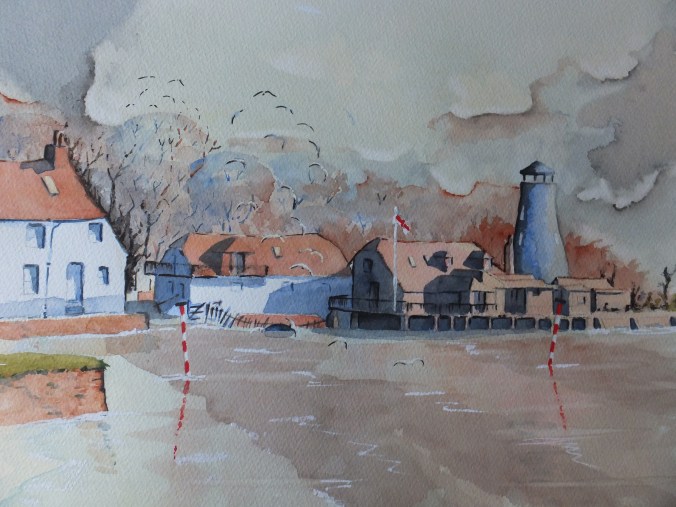
Just to put the picture up again. The more I looked at this painting, the more dissatisfied I became

I think that I said before that the camera has leeched colour from the image, and that is true. Nevertheless, I feel that the painting looks anaemic ( I checked the spelling and I am correct, even though the spellcheck doesn’t agree). This was supposed to look dramatic with the wild sky etc, but just doesn’t work in my opinion

I consulted my mentor at the art club, and she has given me a list of suggestions, so I shall be working on this next, hopefully not too long, trying to get some feeling into the picture

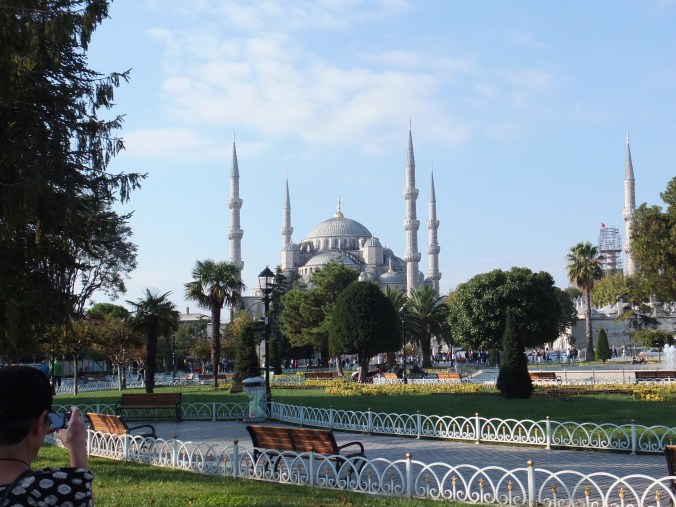
After that, I want to get back to Istanbul. I need a smaller painting, and I think the Blue Mosque will lend itself to that, as this image

DSCF2491

I may have to remove a tree or perhaps not. This will make a nice little study. So plenty to get on with!

Snow Painting Completed

St.Nicholas Church, Pyrford, Surrey

St.Nicholas Church, Pyrford, in Surrey

This is the finished painting of the church to start with, and I will put up one of the stage paintings next, which deals with the masking out and the sky. The sky is probably the trickiest part of the operation as this is done wet-on-wet, and needs some handling, and I will talk about that with the next image

For the trees and bushes I used a fan brush loaded with two  colours at once, ultramarine blue and burnt sienna. These mixed on the paper giving a nice brown/grey or didn’t mix and gave the two colours in the tree which is fine too. Just needed to add some branches with a detail brush

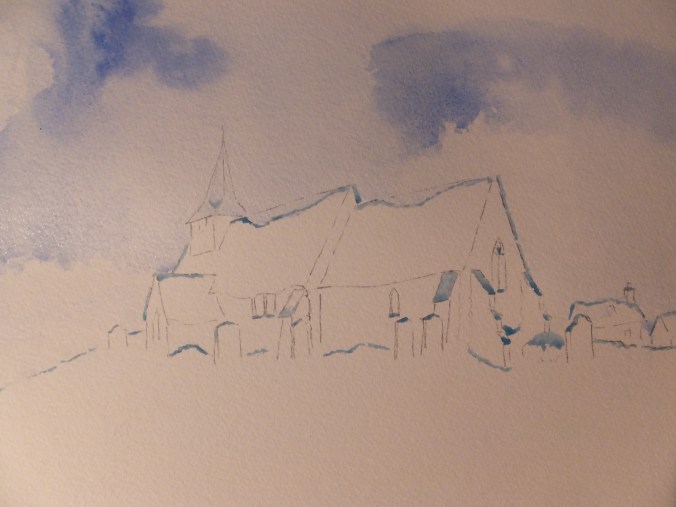
Masking and sky

Masking and sky

I was asked where I would put the masking fluid in this picture. Well, along the snow line on the church roof, as when I come to put the sky in next, there will be quite a lot of water sloshing about, and it will be difficult to keep the blue colour off the virgin snow. Having said that, I have drawn the snow line down the roof line, as though it is thawing slowly, and that is just me, as I think it looks more interesting like that.

Also on the roofs of the house in the background, plus window ledges, grave stones and buttresses. Anywhere you think snow will cling

The sky is a subject in itself. I wanted to have a sky with movement in, and to look cold even though the sun was shining. That was the intention. I have a method which I have evolved and which I prefer, although obviously there are different ways of tackling this

Firstly I wet the area thoroughly with a large brush with clean water, so the paint can move around quickly. Next I brush on cobalt blue mid strength, and then pat out some cloud shapes with paper towel. Whilst the paper is still glistening, and that is very important otherwise the paint will not move, pump in ultramarine blue pigment, where you think you will want to see blue sky. I suggest not too much

I should have said at the beginning, make sure that your board is loose from the easel, as you are now going to pick it up and you won’t have a lot of time. Hold the board vertically and watch the ultramarine blue bleed downwards, and then turn the board on 90 degrees and watch the pigment bleed again this time across the sky, if that makes sense. You will have to decide when you think you have the right effect, and of course the colour will dry lighter than it is now

Put the board back on the easel. Phew!

Let this dry rock hard. I leave it overnight usually. What you should end up with is a swirling sky because with all this water swirling around that is the effect you should get. The cobalt blue will become dark cloud, and where you have blotted out will be the white tops of the clouds. The ultramarine will be the sky showing through

Obviously, when you are doing this, water will run down onto your snow. Just be ready with paper towel to mop that quickly and you should be ok

Apart from the sky, these are simple little paintings to do, yet effective in their simplicity. Hope you liked this

My Workspace

My Workspace

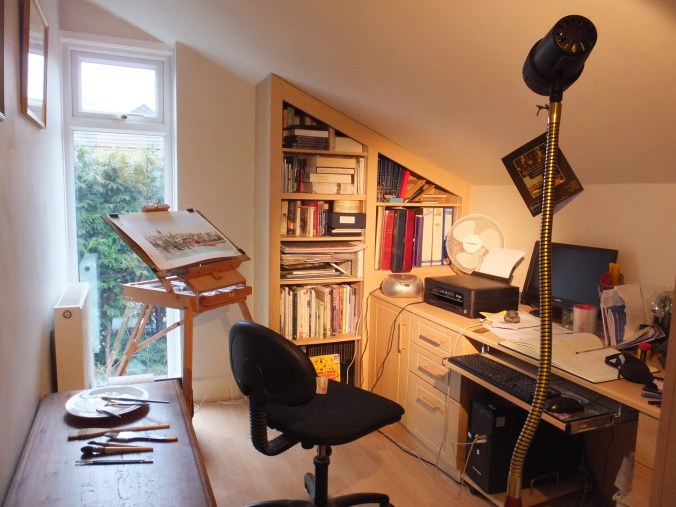
I have been asked on a couple of occasions to show my work space. As I am still working on the snow scene, this seems like a good opportunity.

As you can see, it is rather cramped. We live in a Victorian cottage, built 1889, which is charming but not intended for 21st century living. There is an extension on the back, built around 1980, but that extended the ground floor only, so the kitchen is a good size which is the main thing, but sometimes could do with more space upstairs. But it is enough

This is really the third bedroom which we don’t need so converted to an office. Computer, books and files are all here, and  I also paint here. I recommend an easel with a drawer, so that you can get the colours you need, ready to use. Nothing worse than rummaging through boxes looking for a colour with the paint drying on the paper.

I am rather particular when it comes to lighting too. I buy from a company called Serious Readers who specialise in lighting for people who do close work, and also for people with less than perfect sight. Some of their lights emulate daylight. The light that I use is brilliant but warm, which I prefer to daylight. As you can see, my window space is small and faces north. My neighbour’s hedge does not help!! The bulbs are low-energy despite their brilliance, and long-lasting, 25,000 hours as I remember. Mine is floor-standing but they do table models. Their web site http://www.seriousreaders.com will tell you anything you need to know

You can just about make out where I have laid out my favourite brushes on the side, and also my old white dinner plate which I use for mixing and which I prefer to a pallette. Brushes that I use all the time are the large hake for overall washes,and  a range of squirrel brushes which are a joy to use, as they hold so much water that you can paint on and on. Also they will come to a point despite their size, so you can use them for detailing too. I do also have a couple of detail brushes as well, and a square edged brush for straight lines

I don’t tend to go in for very fine detailing even with architecture, probably because I can’t but do admire people who can. My excuse is, that I have a tremor in my hands which is not to worry about, just a nuisance. I think it must be genetic, as my father who is close to 100 years old, writes like a lie detector, so that will be me trying to paint one day, I guess. Perhaps I will do Jackson Pollock look-a-likes insteadSome of my reference books
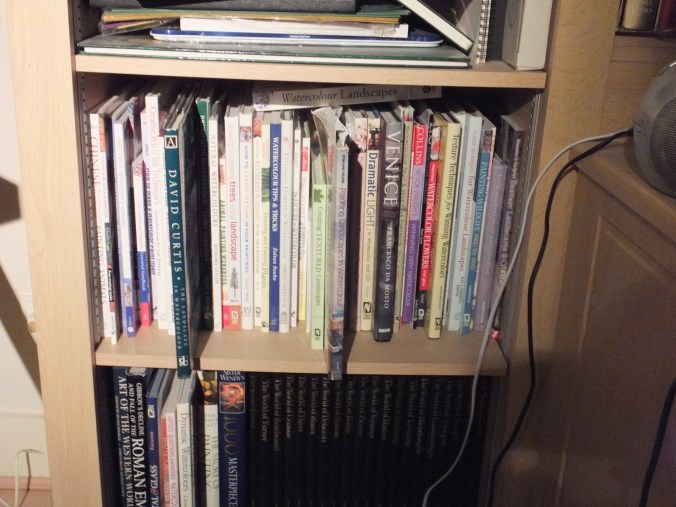
Just some of my reference books.

These books are like recipe books for artists, and just as well thumbed. Many of them are American, really excellent, from whom I have learned a lot, and maybe I will do a post on one or two in the future. Some of their methods are really interesting, especially when portraying texture in watercolour. Next are my favourite two authors, both British, coming up.Two favourite authors

David Curtis produces mouth-watering watercolours in gentle, gentle colours that somehow lift off the page. I can never get anywhere near his work. The other painter, whose work I often refer back too is, Rowland Hilder, now sadly deceased. He is known for winter landscape, especially in his native Kent, in south-east England. The landscape is fairly flat there, so big threatening skies are a speciality of his, some of which I have attempted, sometimes successfully I am pleased to say. He also did a lot of seascape especially around the Thames estuary, as he was also a sailor, and spent a lot of time in and around east-coast harbours

That pretty well completes my article on my work space. If anything I suppose, it does show that you can work in a confined space with just the basic tools. If you need to know anything else about equipment, if I can help then I will
Snow Painting: the Working Sketch

Snow Painting Sketch

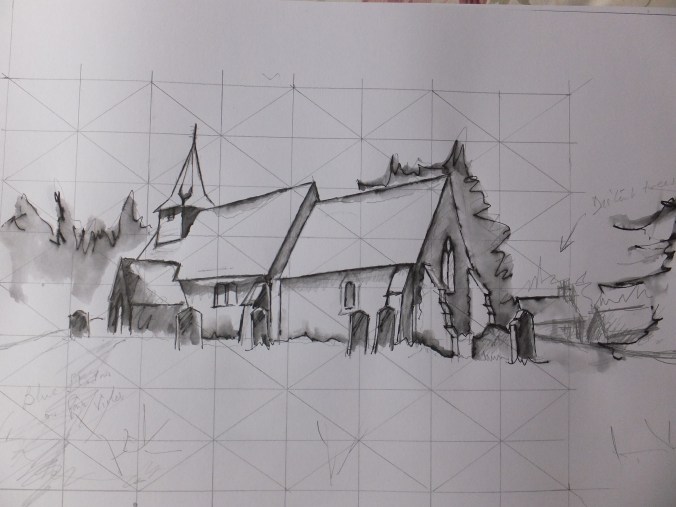
This is my sketch, done fairly quickly, which, I think will give me some sense of direction. I need to use the photograph less now and my sketch more

The snow will be denoted by the paper that I shall leave white. There will be some masking out to be done, and as I don’t have a photographic reference for the snow, I shall have to be thorough in planning where the snow would lie. One thing that masking fluid is good for, is making a blobby line which does give the appearance of snow

I must remember to put snow on both sides of the roof. This is easily forgotten. I have certainly forgotten to show this on the drawing. Some will gather in the trough of the broach spire. Window ledges, tops of grave stones, buttresses, snow will cling to horizontal surfaces of these. The ground level must look uneven as snow piles up the wall of the church

I usually like to paint snow-covered buildings as though some slight thaw has taken place, so that the ridge-tiles and part of the roof show through. This makes a bit more interest and relief from all that white.

The church stands on high ground. I have exaggerated the gradient in the drawing, slightly, to increase the interest. Shadows, when I put them in, will tell the eye where the ground lies, and pick out the ups and downs. Also I have put a couple of houses in the background, which are dropped down behind the slope.

I usually put in some frozen looking bushes and dead-looking grasses, strategically, so that hopefully they will indicate that the ground slopes down towards us

So, plenty to do. Best get on.

Snow Painting

Pyrford Parish Church

Using the charming little church of St.Nicholas at Pyrford, one of the Woking villages. To give an idea of the sort of effect I want to achieve, the following painting of Wanborough Barn near Farnham, was done from a photograph without snow, just adding snow from imagination. We don’t get enough snow, I am afraid, to get good snow scene shots to work from, so we will just have to adapt what we haveWanborough Barn near Farnham

Wanborough Barn near Farnham, with added snow

So that is the task to be tackled next. I need a snow scene for my next exhibition, as usually they sell quite well.

Just a word about St.Nicholas Church. It is an unspoiled but humble village church of the 12th century, retaining many of its original Norman features. Unexceptional apart from having a porch on both sides, which is unusual. It is built from local materials, naturally, using pudding stone and clunch, which is the hard form of the local chalk, used quite a lot for building materials in the area. In some parts of the church, not on the shot I have shown, the walls have been stuccoed over, which was done to give the appearance of stone

That should keep me busy for a little while. I will publish the working sketch just out of interest, just to see which way we go with this

Different people have asked to see photographs of my workspace. I have been taking some pictures and will run a post on that. Not very impressive as we live in a 19th century cottage, and space is at a premium, but it is always surprising how well you can operate from a little corner. Good lighting is essential, and the rather expensive lighting I use, I actually prefer to daylight

I will go into detail on that at a later date

Istanbul: Bosphorus Waterfront: the finished painting

Istanbul Bosphorus Waterfront

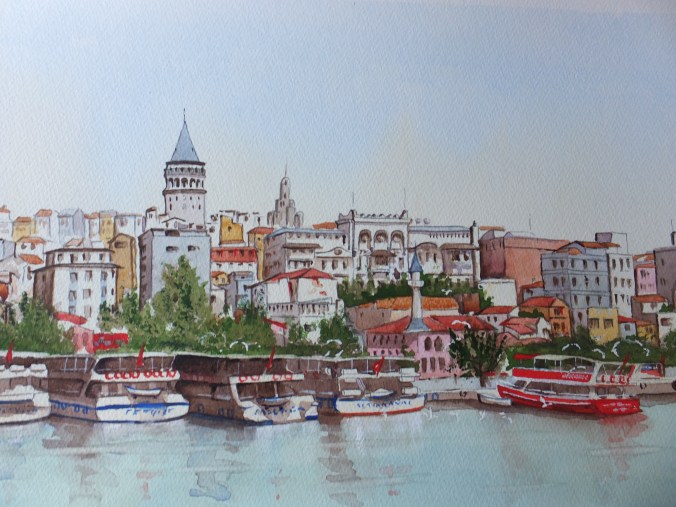
The finished painting!

I read somewhere that you have six seconds to catch a reader’s eye before they move on, so I thought I would put the picture first and talk about it afterwards

Once again the photograph has leeched out some of the colour. The painting itself is brighter and fresher than the jpeg, but for the moment is the best I can do

Quite a time consuming painting to do, but rewarding watching the finished view come towards you.

The palette was much as I foretold in one of my previous posts:

Phthalo Blue/ Cobalt Blue mix for the sky and water, with extra phthalo blue on the water

Raw Sienna/Naples Yellow as a base coat for all the buildings etc

Sap Green/raw sienna mix for trees

Transparent Brown/Ultramarine Violet for all shadows

Burnt Sienna for brickwork

Cadmium Red

I did use a little Permanent Rose as a glaze over the brickwork to give it a little zing. The burnt sienna first coat has to be rock hard for this. The result should look as though the sun is catching the building

For the white reflections from the boats, I lifted out the blue back to white paper, and then touched in some White Gouache or body paint, whichever you call it. Still watercolour but opaque

Fun to do, but nice to finish. This painting will go towards my exhibition at the Guildford Institute in May, which seems a long way off but really isn’t as I have much to do. I still need a snow scene for the exhibition and will be working on that next. As we so rarely have snow these days, I shall have to work from a photograph without snow, and put snow in. This is quite a test for the imagination, but it will be interesting to talk about, perhaps in the next post.

The web site has been busy over the last three months, which is nice. The only problem is I am selling paintings which were going in to the exhibition. Can only sell a painting once though, so best get working.

Istanbul:our condolences

DSCF2491

Our deepest sympathies to the people of Istanbul, for yet another terrorist outrage in your country today

We were there on this spot in October, so makes it feel closer. Crazy misguided people who can’t be reasoned with are a threat to us all. Somehow they must not win

Such a lovely city, Istanbul. People should keep visiting

Istanbul: Finished Drawing transferred to Watercolour Paper

Not very often that I am moved to include a quotation, but this one in last week’s Painter magazine, seemed very appropriate for artists, no matter what standard they have reached.

” Don’t think about making art, just get it done. Let everyone else decide if it’s good or bad, whether they love it or hate it. While they are deciding, make even more art”       Andy Warhol

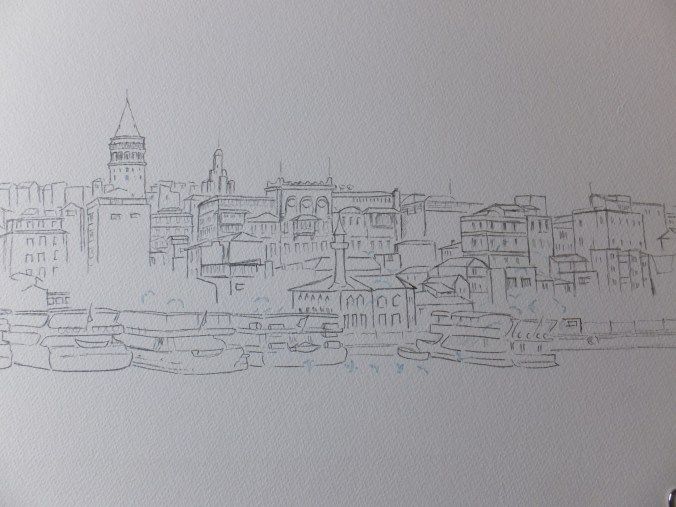
The drawing has now been transferred onto watercolour paper, seemingly without mishap

DSCF2792

I have left the shading out, and just left the line work for guidance. The image has unfortunately cropped some of the drawing out to the left and right hand sides. I did actually achieve the length of 43 centimetres that I wanted.

I didn’t do very much masking out, just a few gulls hovering over the surface and two tiny windows on the Galata Tower which appear to be reflecting sunlight. The boats, I know are brilliant white, but I have chosen to go with the old adage” the darker the darks, the brighter the lights”. In other words if I can make the shaded sides of the boats dark enough, then the rest will appear white. That is the theory. I have done it before, but watch this one go wrong.

I have chosen the following palette, which if I include the mixes as one colour, then I will have a palette of six, which would be quite effective if I can stick to it

Base colour: Raw Sienna/ Naples Yellow blend which is my favourite hot colour for buildings

Shadows : Ultramarine Violet/ Transparent Brown blend

Burnt Sienna

French Ultramarine

Sap Green/Raw Sienna blend for trees

Cadmium Red for those foreground red spots like flags, life belts etc

Not that I am above changing my mind as I go along but that is the palette that I want to stick to. I shall get some detail done before posting again

Just changing the subject, the Frank Auerbach exhibition at Tate Britain finishes the end of this month, so I am hoping to go on Saturday, unless I get an urgent call from someone, wanting me to do something else

I don’t know anything much about him, other than he is Britain’s most celebrated living artist. He appears to paint unrecognisable portraits which seems to be a contradiction in terms. However, I am speaking without firsthand knowledge, so will go with an open mind and reserve judgement until after I have seen the exhibition. I am not very good at appreciating images that are not recognisable, which could be an indictment of me, of course. It will be interesting, whatever happens

Istanbul, Bosphorus: finished preparatory sketch

I said that I would publish the finished preparatory sketch, which will be my tonal guide for the painting stage. That doesn’t mean that I won’t change things as I go along. Not thrilled with the way that boat in the bottom right has turned out, which seems to be lost amongst a clump of trees. Still, that is the benefit of the tonal sketch on cartridge paper, which means that you can make and correct your mistakes, without damaging the surface of the watercolour paper.

Galata Tower finished tonal sketch

Now comes the laborious task of moving the sketch across to the sheet of watercolour paper, which will not make for very interesting reading, so the next post, I think, will deal with starting the painting.

Choice of colours will be interesting. There seem to be plenty of reds and greens which is nice. Definitely my old favourite of raw sienna mixed with Naples yellow across the buildings for some reflected sunshine, and brown shadows to heighten the bright bits

If I get this right, could be a nice painting. We will see

Istanbul, Bosphorus Preparatory Drawing

As today is the first day of the first month, I would like to wish anyone and everyone reading this post, a very happy new year. Perhaps I should wish you a fortunate new year, as inevitably this year will bring the usual mix of joy and sadness that we all share

Meanwhile back to the drawing board, quite literally….

I have made a start on the drawing using the photographs that I featured on the last post. It is not complete yet but is sufficiently in place, so that we can talk about it. This will be a tonal sketch, rather as I did for the Langstone painting, which means that the shadows will have been worked out well in advance of the painting stage.

On this occasion, I have used Derwent sketching pencils which are soluble. I have cross-hatched the dark side of buildings, and then washed over with clean water to give a shaded effect. These are much more convenient to use than ink. I had forgotten that I had them, so that was a nice find.

I will get the image up before we go any further.Galata Tower, Istanbul

The important building in the picture is the Galata Tower, which was a watch tower and which gives a panorama across the city. It was built by the Genoese in 1348, and replaced an earlier tower destroyed by crusaders in 1203. The Genoese were a merchant community in Constantinople at the time, and I guess this was their way of expressing gratitude for the hospitality shown them

I will only be able to use two of the three photographs, as I want to keep the finished painting within 40 centimetres. This is a pity, as I had hoped to include the splendid red Turkish flag shown between two buildings on the third photo. Not to worry, I still have dashes of red in the foreground with the life belts and the small flags on the boats. Maybe I can do a postcard study of the buildings holding this large flag, at a later date

In case you don’t know, and my apologies if you do, using some red in the foreground is a useful device for artists. It is an aid to perspective, as red comes towards you, just as blue recedes. Distant scenery turns blue, as you have probably noticed.

Let me repeat, that this drawing is not yet complete. I will post the completed drawing when I have finished it

I also have photographic references of the Blue Mosque, which should make a lovely study at some time. The last time we were in Istanbul, which was 2001, so a while ago, we went to the Blue Mosque and Hagia Sofia, which I believe is a museum now. We also went to the ancient cisterns of Constantinople, that masterpiece of Roman engineering, where the city’s water supply was stored. I try not to use the word “awesome” too lightly but that really was.

This time we went to the Topkapi Palace and of course cruised along the Bosphorus. Istanbul is still one of those places I would like to return to.

If you are following this demo, then thank you. I will complete the finished painting in stages and post as I go