Venice Painting: Halfway Through

Venice Painting Halfway

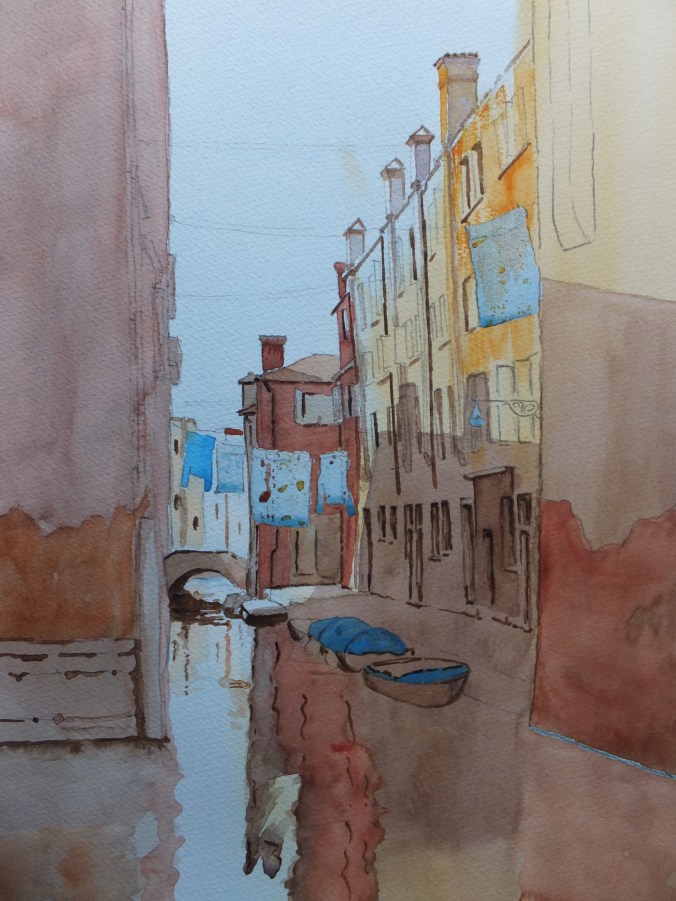
About halfway through the painting, and if I were smart I would wait for the painting to be finished completely, before showing it. However there are things to be talked about before they are covered by further work.

We left the picture as a drawing with some items masked out, namely the washing on the line. The sky in my usual mix of phthalo blue and cobalt blue, I washed down through the bridge and used for the water. I scrubbed out the distant buildings and painted them in with their reflections.  The tricky bit was the shadows which I had worked out with the sketch. I painted them in twice to get some depth whilst still allowing some transparency and continued into the reflections in the water.

In the photograph you may remember the building at the end was red. I have painted that in using Venetian Red appropriately enough, and have taken that through the reflections.

Venetian Red goes back to the days of the Renaissance. It is a warm red earth colour derived from Ferric Oxide, which always sounds like rust to me. It was used by Renaissance painters mixed with white to make skin tones. It was also called Sinopia, because the best quality pigment came from Sinop in Northern Turkey

It was expensive. If your house was painted in this colour, then you were a man of some means.

Francesco da Mosta in his lovely book, Francesco’s Venice tells us that the art of mixing pigments in Venice was something akin to alchemy. The secrets were closely guarded. Venice was a city of painters, who demanded the best

Still some shadow to be deepened, as well as detailing to be done. I need to work out a green for the shutters, which should also work with the red buildings. So more to do!

Someone phoned with a commission today which is always welcome. Someone who has bought my paintings before wants me to paint somewhere memorable, so something to look forward to.

Langstone: Underpaintings

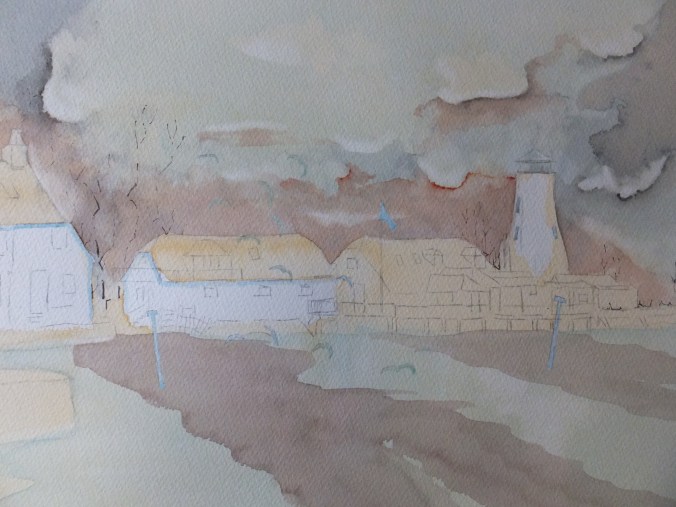
I mentioned in the last post that I would give the painting a coat of burnt sienna. In fact, I changed my mind and used raw sienna with Naples yellow mixed to give some brightness against the darks that would come.

I did mask out the white-walled buildings, as well as two metal posts jutting out of the water, and for good measure masked out some gulls to give the scene a sign of life.

I also put in some tree shapes as guidelines in sepia ink

DSCF2766

Rather a pale wash, so a pale photograph I am afraid. I think you can see where I have masked out in blue, the white buildings, the posts and also the flag as well as the windows on the old mill tower. The tree shapes I put in after this picture was taken but you will see them on the next image.

I gave this coat 24 hours to dry hard. Had I been in a hurry, I could have used a hair dryer, but I prefer natural drying, as then the paper returns to its flat condition. I find if you rush the drying, then the paper retains any cockling that may have taken place whilst wet.

I then mixed a dilute solution of Phthalo blue and Cobalt blue and washed this over the sky and sea. I blotted out some clouds. This coat also had 24 hours to dry.

The next step was to mix up a solution of French Ultramarine blue and Light Red. The trick is to get it not too strong yet not too wishy-washy. That is not easy. I worked this in from left to right, simulating, I hoped, gathering storm clouds. The colour varies depending on the mix from blue-black to deep red. In some places I put pure pigment along the top of a cloud edge to give the impression of strong light behind. To accentuate this, I scrubbed with a bristle brush and clean water, the area the other side of this pigment line. In other words, I scrubbed off the blue to reveal the sienna / yellow. I worked on the clouds adding some colour here and removing some there. I will show the image next

DSCF2774

Sadly the camera has taken some of the strength out of the colours, no matter how many times I took this shot, which spoils the light against dark effect

Always an act of faith to go on, at this stage, as mid-painting always looks a bit of a mess, which is why it is essential to finish

Next to put in the trees behind the roof-tops and the shadows on the buildings which will give them their form. I still have to do that, so will post again

Corfu: Shopping Lanes in Kerkyra,continued

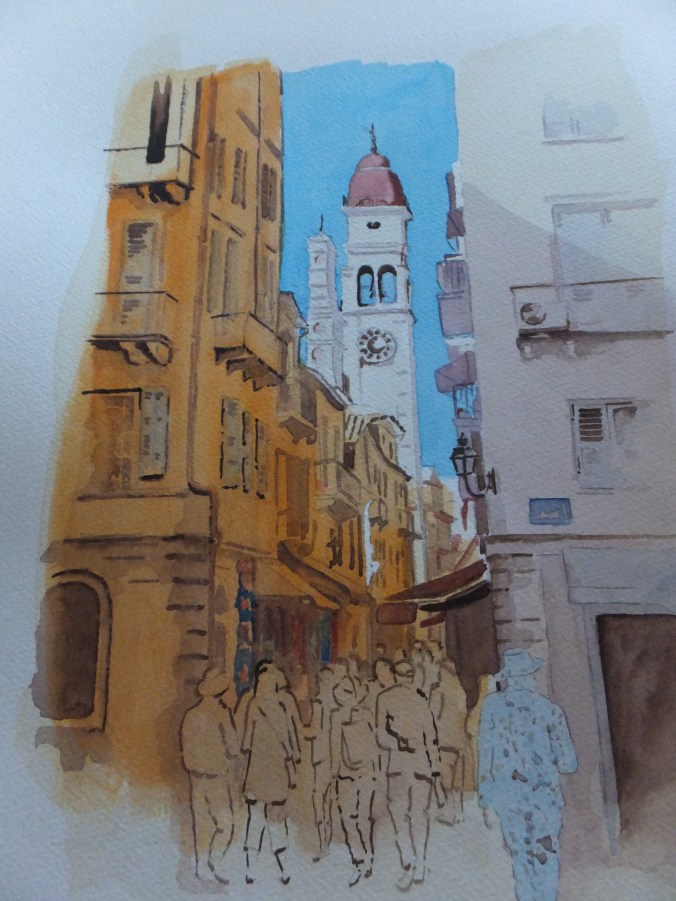
From where we finished on the last post, I used Indian Red to paint the dome on the bell tower. The blue sky dropped back, as I had hoped it would. Indian Red is a good hot weather colour, and I echoed its use on things down the lane, like awnings and shop blinds. On the left-hand side is a shop selling garments, and I used some dabs of red to denote red dresses hanging on display.

I finished the detailing on the bell tower so as to give me something sharp to focus on, when working out the detail on other parts of the painting.

I used my favourite warm weather shadow, ultramarine violet mixed with Sennelier Transparent Brown, and put in the shadow on the buildings

I left this to dry overnight, and this is what it looked like the next day

almost there

It was starting to look the part. I drew the figures in again with the brush, as I was starting to lose them

I still wanted some deep darks further down the lane, where the light didn’t reach. I still wanted to try Alvaro Castagnet’s mix of Brown Madder, Cobalt Brown and Raw Umber. I mixed up the first two, and then added Transparent Brown instead, which certainly produced a very dark shadow colour, with which I started to work

Corfu  Shopping Lanes in Kerkyra

This is the painting virtually complete. The dark mix has been used on the deep shadow areas. The figures have been finished, although the foreground figure looks a bit ghostly, and will need some colour after all. Some white gouache has been used to give the allusion of white paintwork on the balconies.

Was I successful in producing something in the style of Alvaro Castagnet? No, absolutely not, but nonetheless I have enjoyed working on this painting, and like the result

Possible framed version

This is what it could look like framed. Some extra colour went into the figures, otherwise the painting is finished

I hope you found this helpful, and by the same token, if you have suggestions for me, I am always pleased to hear