As before I am grateful to Narbe Photographie of Joulouville-les -Pins in Normandy for the use of their image
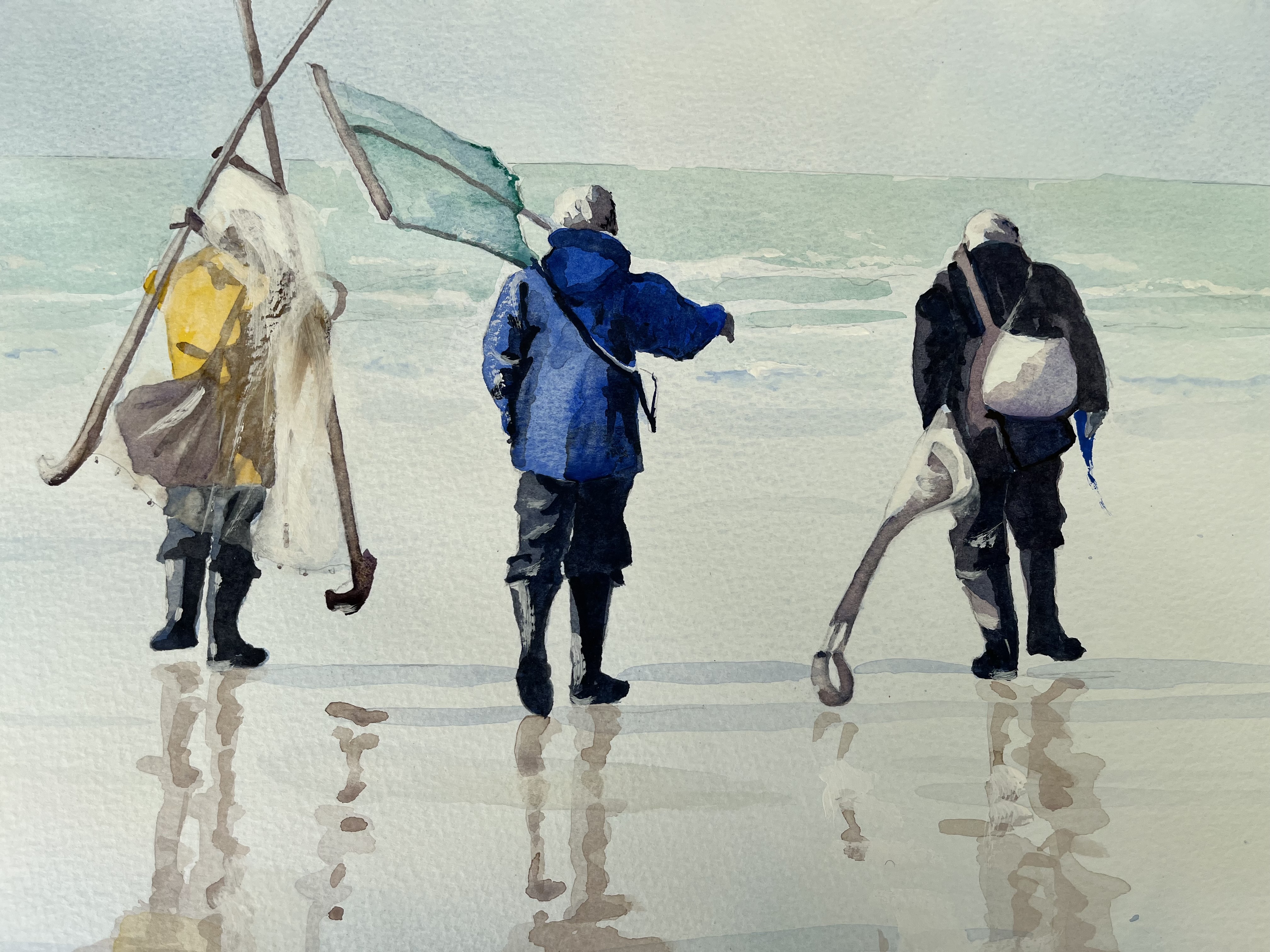
I wasn’t sure at first what these guys were setting out to catch. It’s shrimps I am told, and of course the green net seems obvious when you know. The other two with the white nets were less obvious but presumably they are for pushing along on the curved ends shovelling up shrimps.
Anyway they made an interesting group and I enjoyed painting them. The wet sand worked well I was told and certainly I was pleased with it.
More about the image than anything else. I hope you enjoy looking at it.
This is the painting that we always think of and this was shown for the first time in Paris in 1824
This became the style that the French referred to as a la Constable, rustic cottages,wagons in ponds and open fields and skies.
In the light of his French success, Constable’s continues determination not to travel abroad seems nothing short of bloody-mindedness if not pure rudeness. In spite of all inducements from Arrowsmith, from his friend Fisher, and even despite his gold medal was about to be presented by King Charles X himself he was adamant about refusing to go to France.He was thrilled with the medal which was later presented to him in London by the French ambassador. But he was resolved not to go to France
“I hope not to go to Paris as long as I live” he said. ” I would rather be a poor man here than a rich man abroad”. Well, be careful what you wish for. All of a sudden, as quickly as it came,Constable’s moment of French fame passed. By the end of 1825 he had fallen out with Arrowsmith. When the French market crashed like the British one during the mid-1820s, Arrowmith and another of Constable’s dealers Claude Scroth, went out of business. Constable’s commercial conduit dried up. He had sold more landscapes in a short space of time than had been bought by British buyers in years, but now the HayWain came back and The Cornfield was sent back from the Louvre in 1827 unsold
And there it is. It is in the National Gallery now
Constable hadn’t been the only successful british Painter at the 1824 salon. In fact so many British painters were showing , that it was known as the Salon des Anglais, which was quite a coup for the national contingent. Two others like Constable were awarded medals, and another made a Chevalier of the Legion d’Honneur. There seemed to be widespread approval of the so-called “British style” in landscape painting. If only Constable had been more amenable to travel and doing some networking he might well have prolonged his popularity. Delacroix for one was anxious to meet him, but although Delacroix came to London in 1825, and met other painters, there is no record of him meeting with Constable. You can’t imagine Turner squandering an opportunity to make such an important relationship. Quite the contrary, Turner went to a lot of trouble to meet Delacroix in Paris, in either 1829 or 1832. The urbane Frenchman was underimpressed with Turner’s appearance. Constable he described as ‘an admirable man…one of the glories of England’. He recorded Turner as looking’like an English farmerwith his rough black coat and heavy boots, and his cold, hard expression’. Later on though we was to concede that both Turner and Constable were the ‘true reformers’ of landscape painting
So on that note, let’s bring Turner bck into the story. Did Turner also fly the flag for the British School in Paris. No he didn’t.
He was conspicuous by his absence. Despite his enthusiasm for European landscape and despite his frequent travels, and the way he reinforced the preeminece of European culture, he was never represented at the Salon.
He rarely exhibited outside of his own country, only on two occasions and both times probably wished he hadn’t. The first was a solo exhibition in Rome in 1828 when reaction to his work was vitriolic to say the least. There was a cartoon going round which said ‘O Charlatan excrement is not art’ ! The second occasion was in Munich in 1845. Turner was the only British artist showing at an exhibition called ‘Congress of European Art’ Again his painting horrified the locals. The Germans were appalled by the loose handling and lack of form and regrettably interpreted this as a satire upon their country. To add insult to injury the picture was returned to Turner damaged , with additional carriage costs to pay. He was furious and apparently fussed over it ‘like a hen in a a fury’
An interestin paradox then in Turner’s relationship with Europe. Despite his extensive travels and his European outlook, his paintings had limited appeal abroad during his lifetime. It was Constable who was the more prominent of the two. To this day, it remains one of the more unlikely developments in Western art history.
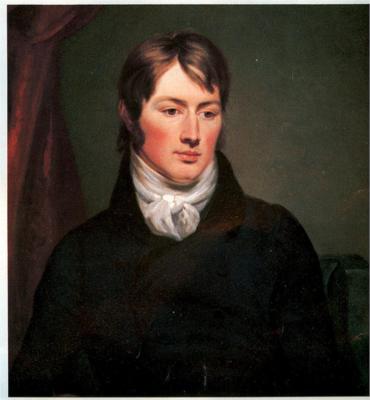
Something I didn’t know until I started reading about him with a view to preparing a talk later this year entitled Turner and Constable. In 1821 when he showed at the Royal Academy and showed The haywain in fact, he was wildly embraced by the French art market, not quite literally although he might have been. he was totally unprepared for all this enthusiasm which he certainly wasn’t used to at home
One of the first to discover him was the French Romanticist Theodor Gericault. He is probably best known for his famous painting The Raft of the Medusa, which he had brought to London, and which we are told thrilled 70,000 Londoners
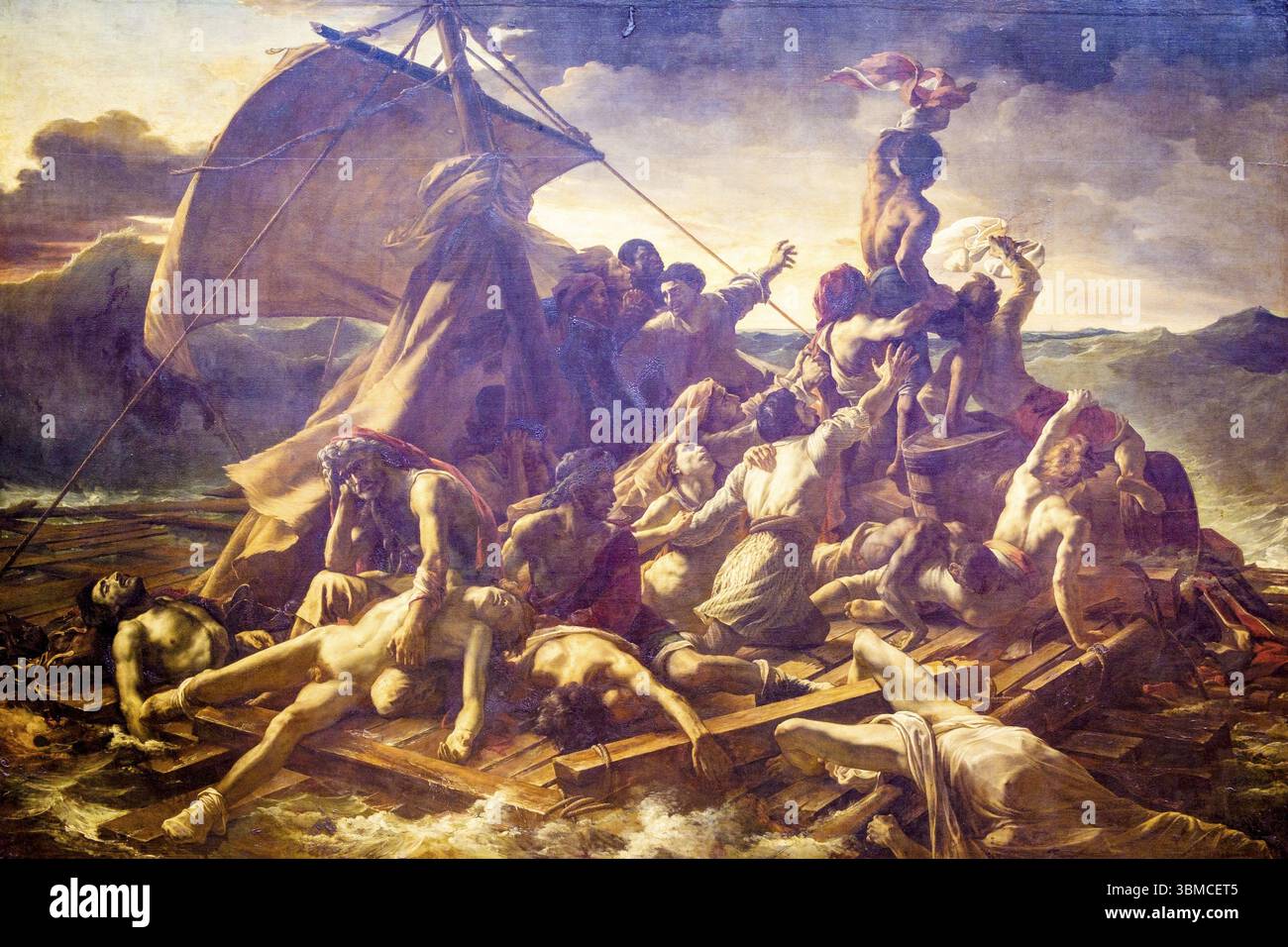
And this is Gericault’s famous painting, which I will just talk about before talking about Gericault’s reaction to Constable’s work
This painting was based on a real incident which shocked the French nation. The French naval frigate ran aground off the coast of Mauretania on 2 July 1816. At least 150 people were set adrift on a hurriedly constructed raft. Only 15 survived and were picked up. The event fascinated Gericault and he could be said to have hooked into national grief. He undertook extensive research including visiting morgues for the skin colour of the dying and the dead. The painting was shown in the Salon of 1819 and received national approbation. He brought it to London where it thrilled Londoners including one Turner who went back to his studio and reworked his own great work The Shipwreck
Whilst in London Gericault visited the Academy exhibition and there discovered Constable. He thought that The Haywain was the best in the exhibition. Other French visitors thought the same and waxed lyrical.
Much to Constable’s surprise the interest quickly snowballed. A Parisian art dealer called Arrowsmith, French despite his name, offered to buy The Hay Wain and offered a derisory sum. The negotiations broke down but two years later, when Constable was short of money, he agreed to sell the painting to Arrowsmith for £250, as well as other pieces. The paintings caused a stir when they arrived in Paris.
The arrival of the Hay wain in 1824 was like a pebble dropping in a Parisian mill pond. The effect was immediate. At the epi-centre of the quake was another influential figure, Eugene Delacroix, who was so influened by the Hay Wain that he went back to his studio and repainted background on his great work The Massacre at Chios. He was blown away by Constable’s greens and tried to copy them. Critics viewing this picture at the time couldn’t find much evidence of green being used, but there we are.
If Delacroix was talking about the Hay Wain, then others were bound to be listening. A few weeks later it was these two paintings which received the greatest share of the attention at the Academie des Beaux-Arts, known as the Salon. The Salon dominated taste and opinion in France to an even greater extent than the Academy in Britain
Constable was embraced at the Salon in a way that had never happened to him at home. His large paintings were removed to positions of prominence, and Monsieur Constable, Peintre de Paysage was awarded a gold medal of excellence. His friend John Fisher couldn’t resist commenting that plain old Constable, who didn’t speak a word of French, was the talk and admiration of the French. His name entered the language. Landscapes were described as a la Constable!. More French exhibitions followed in Lille including another gold medal, Douai and the Salon again in1827, where there were plenty of landscapes a la Constable, with rustic cottages, wagons in ponds and open fields and skies.
Constable nevertheless refused to visit France, his attitude seemingly bloody-minded bordering on rude.
This is probably a good place to take a break. We are about half way, so a lot of writing and a lot of reading for you guys. It will take another post to complete the subject which I will do soonest
I shall publish a recent picture soon of this fascinating house, which Turner had a hand in designing together with his friend and near neighbout John Soane
And this is it in Sandycoombe Road in Twickenham, where we made a visit recently
Turner built this house in the style of a small country villa, in 1813, for himself and his “old dad” William, where they spent much time relaxing away from his London gallery. At the time it was way out in the country. Later on in the latter part of the c19 it was surrounded by suburbia, as it still is today. Quite historic suburbia now of course, but suburbia nonetheless. If I can find it I have somewhere a recreated view from the dining room window at the time that Turner lived there.
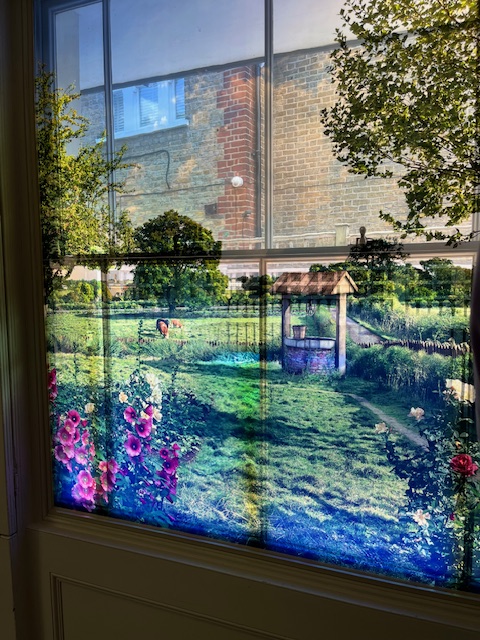
And this is it. Tranquil pastoral countryside image on the window of the dining room. Quite clever. The garden with well,and meadows beyond. Ignore the brickwork showing through the upper part of the window. That is the house next door today in real life, which we can’t block out
How did Turner live at Sandycombe Lodge? Did he paint there? He always went with sketch book in hand, studying the landscape, and its changing moods. It was believed that he used the drawing room as a studio. It had French windows facing north-east from which friends recollect that Turner would refresh his eye.
He used a pony and gig for getting about on sketching trips.The pony was the “old crop-ear” who may have grazed on Turner’s nearby meadow, and whom Turner buried somewhere on his land. No stables are recorded on of the later maps, he must have been stabled elsewhere, perhaps at the nearby Crown Inn.
Fishing was a quiet pleasure shared with friends, many of them fellow artists.The Thames nearby provided an abundant supply.Turner made some beautiful watercolour studies of tench,trout and perch, the catches of some of these expeditions. Often he was accompanied by John Soane, who was also an enthusiastic eel catcher
One of the most prestigious acquaintances Turner made during his time at Twickenham,was the Duc d’Orleans later Louis Philippe, King of France, who lived with his brothers near the Thames at Highshot House in Crown Lane from 1800-1807. Turner met the Duc at a Royal Academy dinner in 1802. Later, between 1815-1817 the Duc was again in exile in “dear quiet Twick”, this time in a house which is still there, named Orleans House which today houses a prestigious art gallery. They must have become firm friends as Louis Philippe gave him a gold snuff box when he came to England for Queen Victoria’s coronation in 1837. Turner took his last continental excursion in 1845, and called on Louis Philippe, who had a chateau on the coast of Picardy, and enjoyed a convivial evening of chat about Twickenham.
The other incumbent of Sandycombe Lodge, was “old Dad”, Turner’s father William, retired barber of Maiden Lane, Covent Garden. He kept house and also opened up the gallery for his son in Queen Anne Street. They both enjoyed frugal living, as William complained about the cost of getting into London, easily affordable by Turner. He was overjoyed to find a market gardener who would take him in on his cart sitting on the vegetables, for the price of a glass of gin!
After 1815, and the Napoleonic Wares drawing to a close, Turner could at last travel on the continent, and we know well, his wonderful paintings of the Alps which he crossed into Italy. Likewise magnificent views of Venice. The Low Countries and Germany were on his list.
He kept Sandycombe on for his father, who enjoyed the life there, but by 1826, William’s health was failing, and indeed by 1829 died. Turner had removed him back to Queen Anne Street before then. Sandycombe had become an irrelevance by then and I believe was sold for a modest £500, ironically less than Turner might expect for a major oil painting. Old William’s death affected Turner greatly. They were very close.
The house enjoyed a long life after Turner, and has now been fully restored , brought back to life by Harold and Ann Livermore, who bought the house in 1947. Ann died in 1997, and Harold established the Sandy Lodge Trust, now Turner’s House Trust, to preserve and maintain the property, which is now open to visitors and certainly worth a visit.
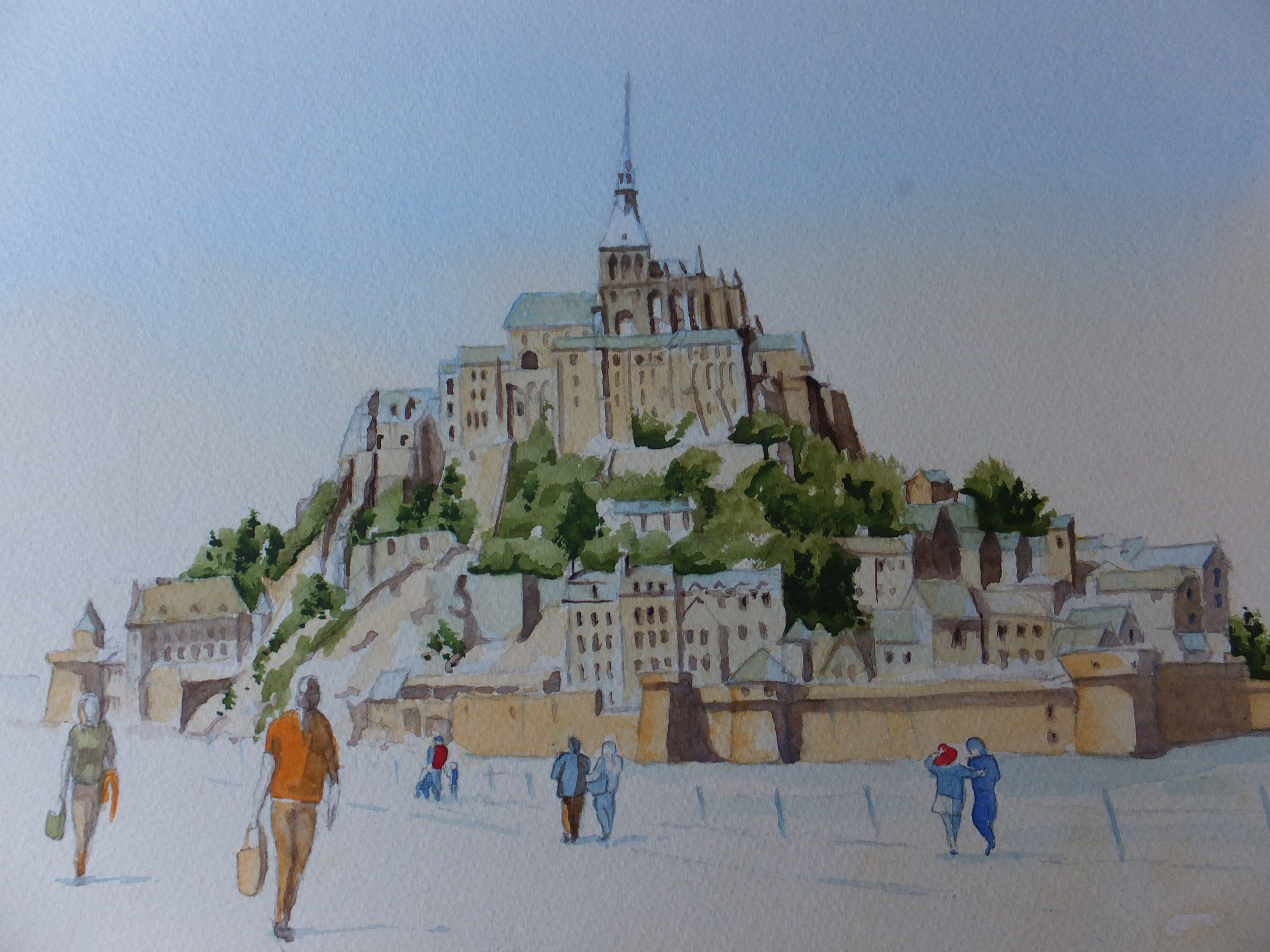
Firstly my thanks to Oska Siobhan photographer in Mont St Michel, for the use of her photograph as reference
We first visited Mont St Michel when our children were small, so nearly fifty years ago, and went back again much later, both times on holiday in Brittany, such a beautiful region of France
Steeped in history, high tide gave protection from would be assailants, whilst at low tide access was allowed to pilgrims to the abbey. The island remained unconquered during the hundred years war despite two sieges by the English. In fact the island’s spirited resistance inspired the French and Joan of Arc.. Louis XI recognised the benefits of the location and turned it into a prison. The abbey was used regularly as a prison during the Ancien Regime
In England we have a look-alike off the coast of Cornwall. In 1067 the Mont gace full support to William the Conqueror’s claim to the English throne. William rewarded this with lands on the other side of the channel, including a small island off the coast of Cornwall, on which the Norman monks built their priory, called St Michael’s Mount of Penzance
Mont St Michel also features on the Bayeux Tapestry. Scenes 16 and 17 show William and Harold there . Harold is rescuing knights from quicksand. This would have been during the period from Harold’s shipwreck on the coast of France, when he was entertained by William
My painting, as usual is in watercolour. Quite a lot of drawing in this one as you might expect
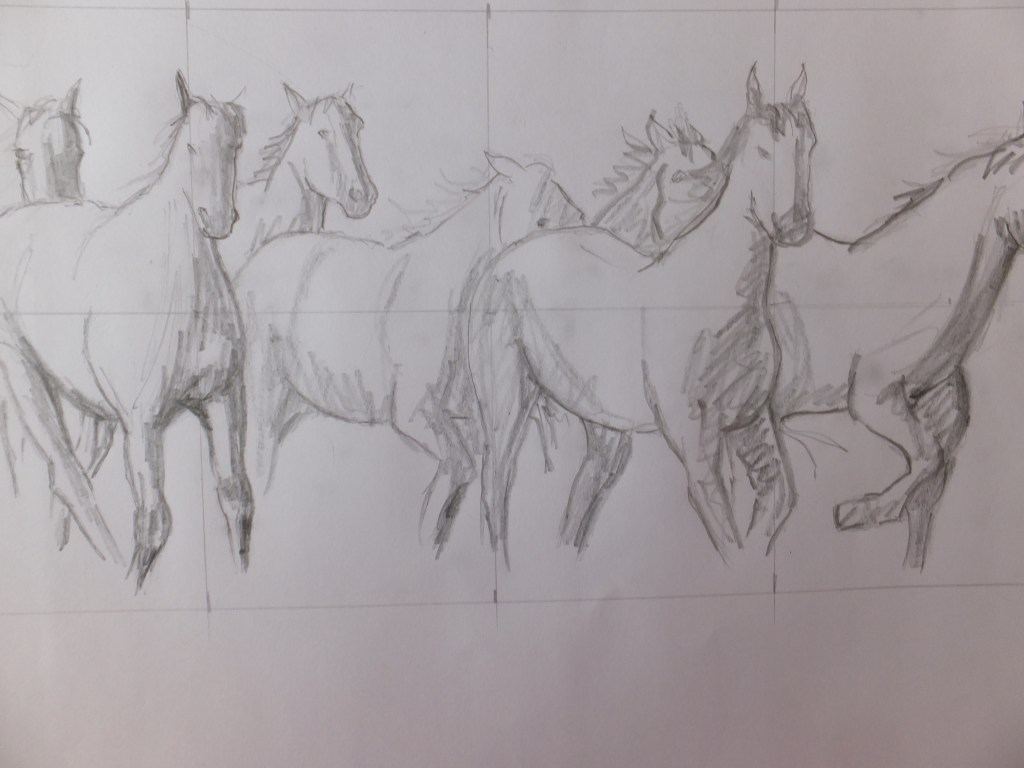
As I said in my last post, I am looking for another horse painting, ideally of horses on the move, to replace Horses in the Snow which sold last week
This one should work hopefully. You can’t tell from this sketch but horses are cantering through water, so a lot of splashing going on which will give the idea of movement hopefully to the picture. A good excuse to do a lot of flicking and splashing during the painting as well. One of those defining moments when you throw paint at the picture or spray with an old toothbrush and hope it lands in the right places
I have painted Camargue horses before. We were there a few years ago, and they are magnificent to watch. I don’t trouble much with background for these shots, just paint the horses and sky the same blue/pink/grey combination, and then build up the horses with dark shadow
It worked last time, which is no guarantee of future success of course
I quite like doing these narrative paintings from time to time. This one I have done in a vignette style, again something I do for a change. In some ways this style takes less time, as I don’t have to tape up, and without big expanse of sky or sea, there are no big washes to worry about.
This was not done from one of my reference photos, and my thanks and acknowledgements go to an unknown photographer whom I could not find. This painting is not a copy of but was inspired by a photograph.
This is pure nostalgia in one sense. I don’t know of a visitor to France who didn’t enjoy that early morning trip to the boulangerie for the fresh bread.
In England we don’t have that culture. Our bread is homogenised and comes plastic wrapped, although some of our supermarkets are now baking on site, and producing something worth eating. But we still don’t go for it early morning when it is fresh and still warm
This is Paris obviously. The location was not marked, but looks like Montmartre, with those steep steps. Again a place much visited and much painted.
I changed the background considerably. I have lengthened the perspective so that the Eiffel Tower looks much further away. The buildings are deliberately out of focus, so that we concentrate on the lady in the foreground. We look at her with great compassion as she struggles homeward up that steep slope, heavily laden. I see her almost pushing that basket with her knee, to take some of that strain off her arm.
This painting is smaller than my usual, this time about 30×25 centimetres. I found it a pleasant change to do. At the moment,thanks to lockdown I am sorting and consolidating my reference photographs, so who knows may find more of this type
The painting is now finished, in that I have started to fiddle, which is a good time to stop
Getting the sand/mud to look waterlogged has been a problem, and I have settled for what I’ve got, rather than end up with a surface which looks dark and unconvincing. I did mask out some tyre tracks which had filled with water, and then touched them in afterwards. They seemed to work well enough.
I have taken the mask off the lighthouse, and painted that in, with its red domed top, that attracts the eye. Two tricolor flags on the boats give another opportunity for small dabs of red too. I tend to use vermilion now rather than cadmium red, which seems to work.
Some of the figures and dinghies have bled into the wet, which I have allowed, as I think that gives a hint of reflection.
I think I have taken it as far as I dare without spoiling, so will leave it now as complete.
I have a new commission arrived, a house portrait, which is highly convenient so will start on that soon
I have done some drawing and also started to paint as you can see. Nothing startling, just the background. The lighthouse has been masked out, so it can stand out stark white with red at the very end
I have also masked out some of the tyre marks in the sand which are full of water, hopefully to recreate that image. The composition itself I have altered slightly, but only slightly, as really not much improvement is necessary. The fishing boats have been beached at low tide, which immediately offers an interesting picture for watercolour. There is light coming from the left, offering shadows as well as possible reflections.Some boats were left out, and one different one added. Otherwise the scene is much the same as it was in 1972
I needed some human activity so added the two figures in the foreground. They are actually copied from the figure in the distance. I had to guess the perspective, so I hope it looks convincing. Both figures are bent over as though hauling on some imaginary chain, so a little bit of narrative
I have added shadow to the boats just to give them form, and to guide me when I go to paint them in. One or two extra dinghies as well. I may well have to add somehting small in the centre, but I am not sure yet.
That is as far as I have got. So far so good I think
This was really something of a diversion, while I considered where my priorities lay, for the next painting.
This exercise is really part of a competition, which appealed to me. I don’t usually enter competitions as I never get anywhere, but what intrigued me with this one, was, that it was using ball-point pen with watercolour. Something I had thought of doing but for some reason, not got round to .
This took me back to the days before I retired. I worked for a company that made specialist furniture and fittings for the hotel and restaurant industry. I designed things to customer specification, which is a grand term for drawing out from people what they wanted, and then sketching them during the conversation, until we arrived at a solution. This is very good drawing practice and I can recommend it.
Ball point works well on a hot pressed surface, the motion is fluid and the image is instant. You can’t rub out of course which can be a problem. It doesn’t work very well on cold-pressed watercolour paper which is what I use. The ball clogs and pulls at the paper
Nonetheless it was a useful exercise and interesting to see how it ended up. I sent my entry in after all, very much tongue in cheek. If I never mention it again, you will know that it bombed