JMW Turner’s House in Twickenham

I shall publish a recent picture soon of this fascinating house, which Turner had a hand in designing together with his friend and near neighbout John Soane

And this is it in Sandycoombe Road in Twickenham, where we made a visit recently

Turner built this house in the style of a small country villa, in 1813, for himself and his “old dad” William, where they spent much time relaxing away from his London gallery. At the time it was way out in the country. Later on in the latter part of the c19 it was surrounded by suburbia, as it still is today. Quite historic suburbia now of course, but suburbia nonetheless. If I can find it I have somewhere a recreated view from the dining room window at the time that Turner lived there.
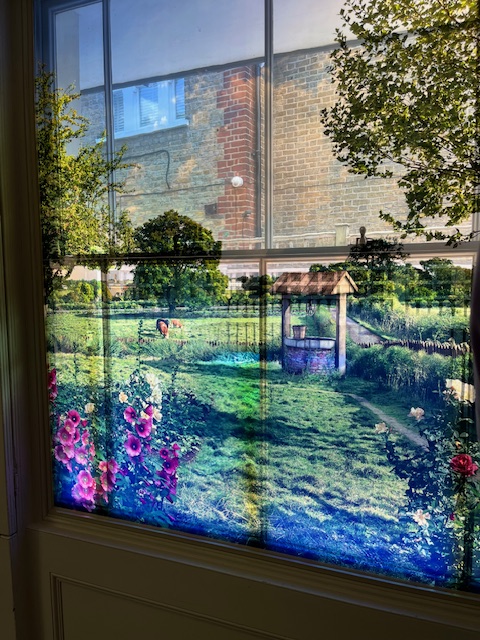
And this is it. Tranquil pastoral countryside image on the window of the dining room. Quite clever. The garden with well,and meadows beyond. Ignore the brickwork showing through the upper part of the window. That is the house next door today in real life, which we can’t block out

How did Turner live at Sandycombe Lodge? Did he paint there? He always went with sketch book in hand, studying the landscape, and its changing moods. It was believed that he used the drawing room as a studio. It had French windows facing north-east from which friends recollect that Turner would refresh his eye.

He used a pony and gig for getting about on sketching trips.The pony was the “old crop-ear” who may have grazed on Turner’s nearby meadow, and whom Turner buried somewhere on his land. No stables are recorded on of the later maps, he must have been stabled elsewhere, perhaps at the nearby Crown Inn.

Fishing was a quiet pleasure shared with friends, many of them fellow artists.The Thames nearby provided an abundant supply.Turner made some beautiful watercolour studies of tench,trout and perch, the catches of some of these expeditions. Often he was accompanied by John Soane, who was also an enthusiastic eel catcher

One of the most prestigious acquaintances Turner made during his time at Twickenham,was the Duc d’Orleans later Louis Philippe, King of France, who lived with his brothers near the Thames at Highshot House in Crown Lane from 1800-1807. Turner met the Duc at a Royal Academy dinner in 1802. Later, between 1815-1817 the Duc was again in exile in “dear quiet Twick”, this time in a house which is still there, named Orleans House which today houses a prestigious art gallery. They must have become firm friends as Louis Philippe gave him a gold snuff box when he came to England for Queen Victoria’s coronation in 1837. Turner took his last continental excursion in 1845, and called on Louis Philippe, who had a chateau on the coast of Picardy, and enjoyed a convivial evening of chat about Twickenham.

The other incumbent of Sandycombe Lodge, was “old Dad”, Turner’s father William, retired barber of Maiden Lane, Covent Garden. He kept house and also opened up the gallery for his son in Queen Anne Street. They both enjoyed frugal living, as William complained about the cost of getting into London, easily affordable by Turner. He was overjoyed to find a market gardener who would take him in on his cart sitting on the vegetables, for the price of a glass of gin!

After 1815, and the Napoleonic Wares drawing to a close, Turner could at last travel on the continent, and we know well, his wonderful paintings of the Alps which he crossed into Italy. Likewise magnificent views of Venice. The Low Countries and Germany were on his list.

He kept Sandycombe on for his father, who enjoyed the life there, but by 1826, William’s health was failing, and indeed by 1829 died. Turner had removed him back to Queen Anne Street before then. Sandycombe had become an irrelevance by then and I believe was sold for a modest £500, ironically less than Turner might expect for a major oil painting. Old William’s death affected Turner greatly. They were very close.

The house enjoyed a long life after Turner, and has now been fully restored , brought back to life by Harold and Ann Livermore, who bought the house in 1947. Ann died in 1997, and Harold established the Sandy Lodge Trust, now Turner’s House Trust, to preserve and maintain the property, which is now open to visitors and certainly worth a visit.
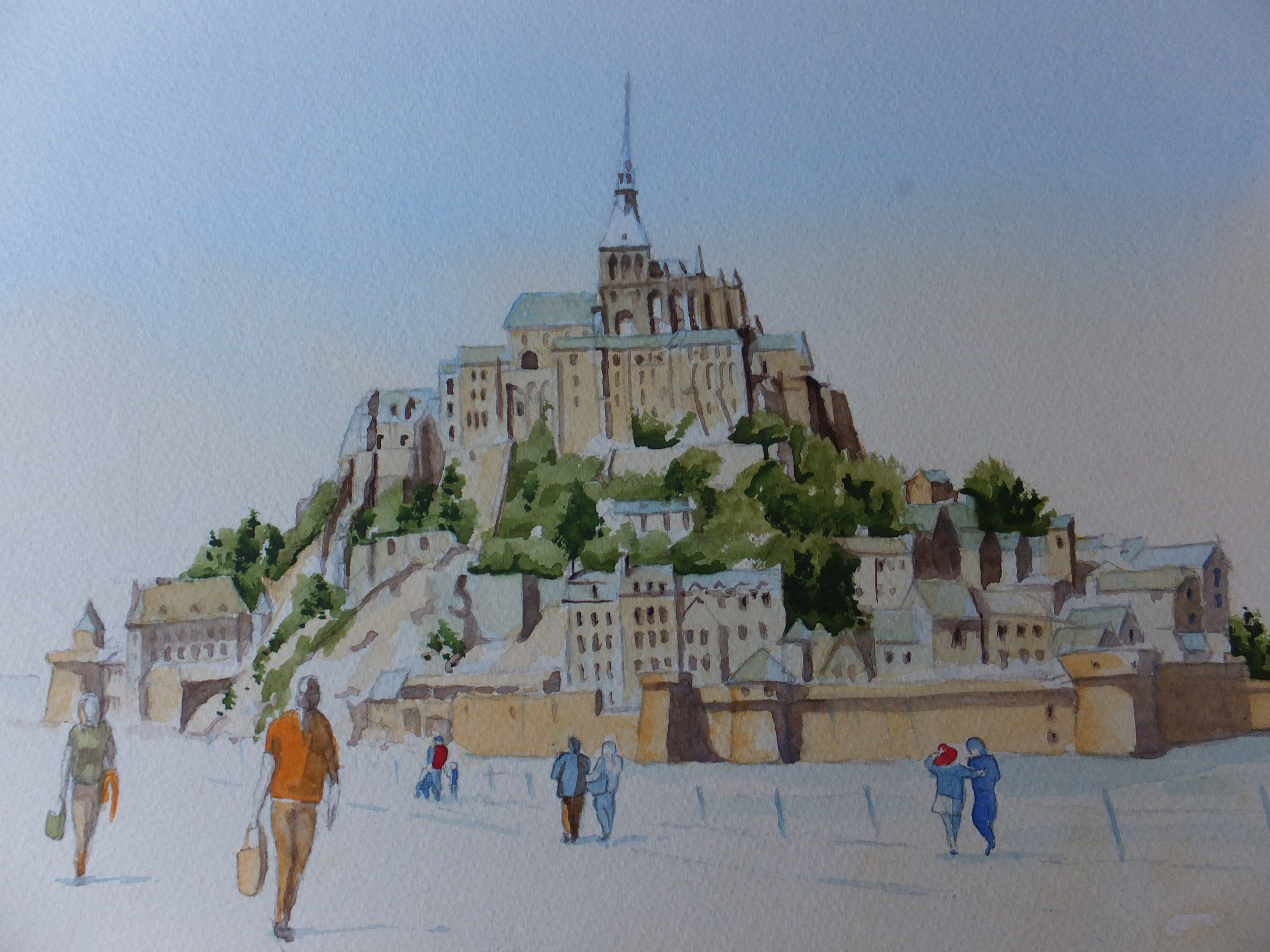
Mont St Michel, Normandy

The island fortress of Mont St Michel

Firstly my thanks to Oska Siobhan photographer in Mont St Michel, for the use of her photograph as reference

We first visited Mont St Michel when our children were small, so nearly fifty years ago, and went back again much later, both times on holiday in Brittany, such a beautiful region of France

Steeped in history, high tide gave protection from would be assailants, whilst at low tide access was allowed to pilgrims to the abbey. The island remained unconquered during the hundred years war despite two sieges by the English. In fact the island’s spirited resistance inspired the French and Joan of Arc.. Louis XI recognised the benefits of the location and turned it into a prison. The abbey was used regularly as a prison during the Ancien Regime

In England we have a look-alike off the coast of Cornwall. In 1067 the Mont gace full support to William the Conqueror’s claim to the English throne. William rewarded this with lands on the other side of the channel, including a small island off the coast of Cornwall, on which the Norman monks built their priory, called St Michael’s Mount of Penzance

Mont St Michel also features on the Bayeux Tapestry. Scenes 16 and 17 show William and Harold there . Harold is rescuing knights from quicksand. This would have been during the period from Harold’s shipwreck on the coast of France, when he was entertained by William

My painting, as usual is in watercolour. Quite a lot of drawing in this one as you might expect

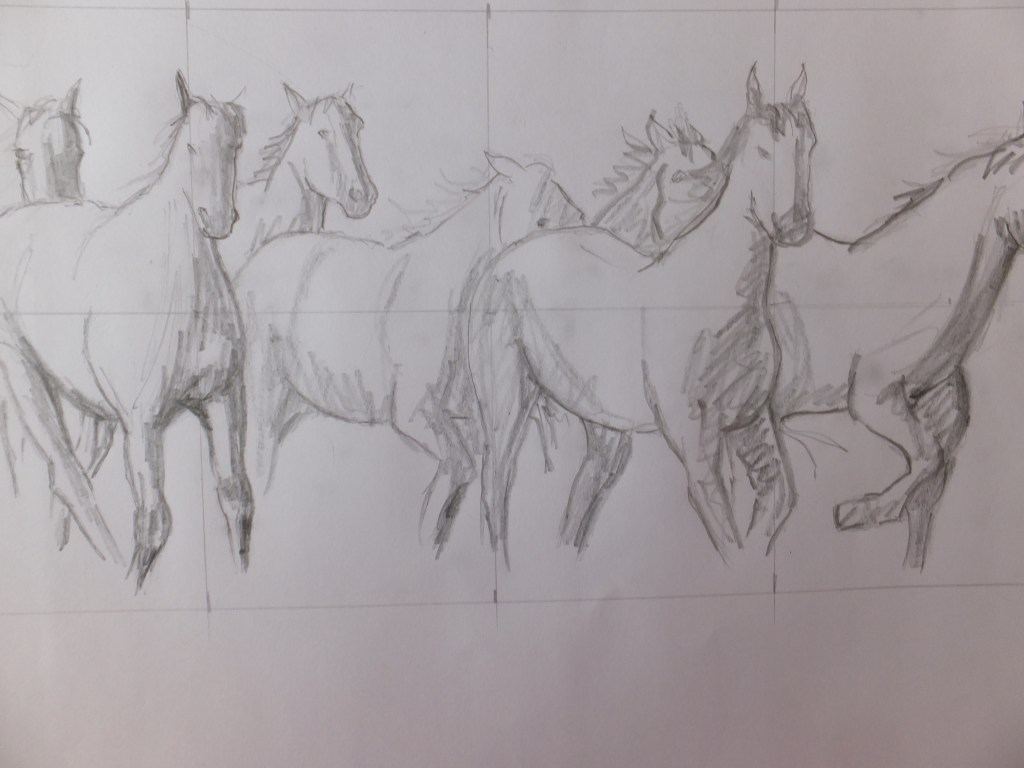
Camargue Horses: the Sketch

Horses in the Camargue

As I said in my last post, I am looking for another horse painting, ideally of horses on the move, to replace Horses in the Snow which sold last week

This one should work hopefully. You can’t tell from this sketch but horses are cantering through water, so a lot of splashing going on which will give the idea of movement hopefully to the picture. A good excuse to do a lot of flicking and splashing during the painting as well. One of those defining moments when you throw paint at the picture or spray with an old toothbrush and hope it lands in the right places

I have painted Camargue horses before. We were there a few years ago, and they are magnificent to watch. I don’t trouble much with background for these shots, just paint the horses and sky the same blue/pink/grey combination, and then build up the horses with dark shadow

It worked last time, which is no guarantee of future success of course

Baguettes

Baguettes

I quite like doing these narrative paintings from time to time. This one I have done in a vignette style, again something I do for a change. In some ways this style takes less time, as I don’t have to tape up, and without big expanse of sky or sea, there are no big washes to worry about.

This was not done from one of my reference photos, and my thanks and acknowledgements go to an unknown photographer whom I could not find. This painting is not a copy of but was inspired by a photograph.

This is pure nostalgia in one sense. I don’t know of a visitor to France who didn’t enjoy that early morning trip to the boulangerie for the fresh bread.

In England we don’t have that culture. Our bread is homogenised and comes plastic wrapped, although some of our supermarkets are now baking on site, and producing something worth eating. But we still don’t go for it early morning when it is fresh and still warm

This is Paris obviously. The location was not marked, but looks like Montmartre, with those steep steps. Again a place much visited and much painted.

I changed the background considerably. I have lengthened the perspective so that the Eiffel Tower looks much further away. The buildings are deliberately out of focus, so that we concentrate on the lady in the foreground. We look at her with great compassion as she struggles homeward up that steep slope, heavily laden. I see her almost pushing that basket with her knee, to take some of that strain off her arm.

This painting is smaller than my usual, this time about 30×25 centimetres. I found it a pleasant change to do. At the moment,thanks to lockdown I am sorting and consolidating my reference photographs, so who knows may find more of this type

Erquy in Brittany: the Finished Painting

Erquy in Brittany

The painting is now finished, in that I have started to fiddle, which is a good time to stop

Getting the sand/mud to look waterlogged has been a problem, and I have settled for what I’ve got, rather than end up with a surface which looks dark and unconvincing. I did mask out some tyre tracks which had filled with water, and then touched them in afterwards. They seemed to work well enough.

I have taken the mask off the lighthouse, and painted that in, with its red domed top, that attracts the eye. Two tricolor flags on the boats give another opportunity for small dabs of red too. I tend to use vermilion now rather than cadmium red, which seems to work.

Some of the figures and dinghies have bled into the wet, which I have allowed, as I think that gives a hint of reflection.

I think I have taken it as far as I dare without spoiling, so will leave it now as complete.

I have a new commission arrived, a house portrait, which is highly convenient so will start on that soon

Erquy: the Drawing

Erquy in Brittany

I have done some drawing and also started to paint as you can see. Nothing startling, just the background. The lighthouse has been masked out, so it can stand out stark white with red at the very end

I have also masked out some of the tyre marks in the sand which are full of water, hopefully to recreate that image. The composition itself I have altered slightly, but only slightly, as really not much improvement is necessary. The fishing boats have been beached at low tide, which immediately offers an interesting picture for watercolour. There is light coming from the left, offering shadows as well as possible reflections.Some boats were left out, and one different one added. Otherwise the scene is much the same as it was in 1972

I needed some human activity so added the two figures in the foreground. They are actually copied from the figure in the distance. I had to guess the perspective, so I hope it looks convincing. Both figures are bent over as though hauling on some imaginary chain, so a little bit of narrative

I have added shadow to the boats just to give them form, and to guide me when I go to paint them in. One or two extra dinghies as well. I may well have to add somehting small in the centre, but I am not sure yet.

That is as far as I have got. So far so good I think

Painting Someone Else’s Photo

With their permission of course

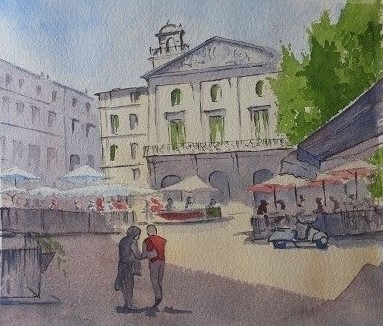
A typical square in the south of France

This was really something of a diversion, while I considered where my priorities lay, for the next painting.

This exercise is really part of a competition, which appealed to me. I don’t usually enter competitions as I never get anywhere, but what intrigued me with this one, was, that it was using ball-point pen with watercolour. Something I had thought of doing but for some reason, not got round to .

This took me back to the days before I retired. I worked for a company that made specialist furniture and fittings for the hotel and restaurant industry. I designed things to customer specification, which is a grand term for drawing out from people what they wanted, and then sketching them during the conversation, until we arrived at a solution. This is very good drawing practice and I can recommend it.

Ball point works well on a hot pressed surface, the motion is fluid and the image is instant. You can’t rub out of course which can be a problem. It doesn’t work very well on cold-pressed watercolour paper which is what I use. The ball clogs and pulls at the paper

Nonetheless it was a useful exercise and interesting to see how it ended up. I sent my entry in after all, very much tongue in cheek. If I never mention it again, you will know that it bombed

The Original before cutting down

The Original Sea Gazers

The comment was made, quite fairly, that I didn’t include the original painting, before it was reduced.

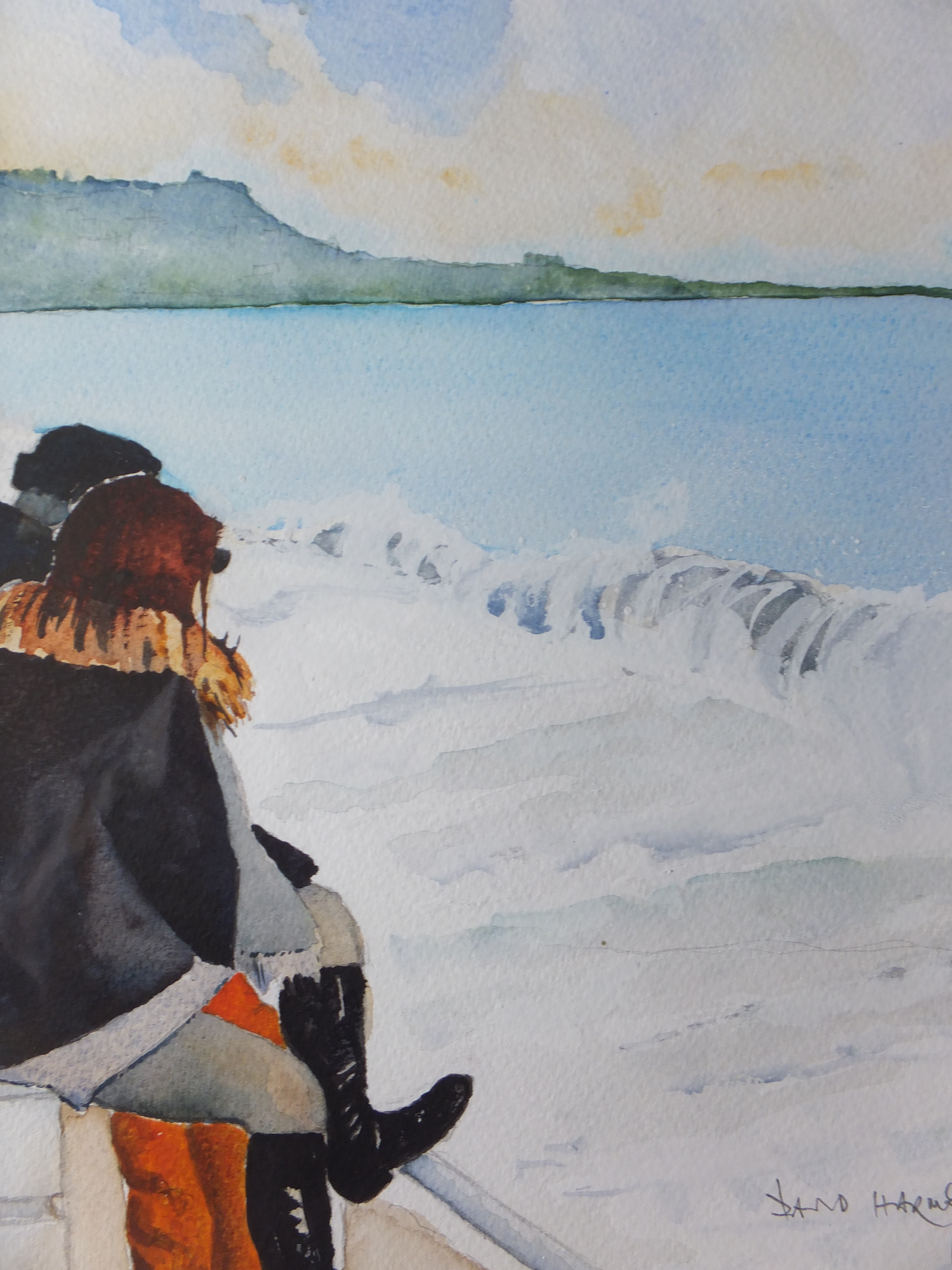
This is it. As I said, I felt the eye ran off the page to the right, and was possibly rather boring anyway. By removing the right hand side, I effectively made more of a central group with the figures and the distant headland.

I found the breakers rather strange here, as they rolled in, roughly the same size each time, so rather monotonous, really

Please feel free to comment, should you want to. Your opinions are important to me

Cutting Down an Old Painting

Sea Gazers in Nice

Sometimes a painting creates no interest whatsoever, even though I might have been pleased with it at the time. Occasionally, and only when I think appropriate, I remove a section of the painting, which perhaps detracts from the overall composition, and reduce the image to a smaller painting. Hopefully an improvement.

So it was with this picture, Sea Gazers in Nice. We were in Nice for New Year, a few years ago. The weather was mild compared with the rest of Europe, which was deep-frozen. We walked along the famous Promenade des Anglais, and watched the sea and watched people watching the sea. This couple were alone with their thoughts and almost mesmerised by the breakers rolling in.

They kindly kept motionless, unaware of me sketching them and taking photographs. Not often that sitters are so obliging. I did the painting some years later, but then I included a long expanse of sea and breakers to the right of the couple. It was a mistake, looking back, as the eye of the viewer went right off the page.

I showed the painting a few times, but it impressed no-one. I prefer this version, so will see if others do

I have used this method only a few times. Occasionally only a central detail from a larger painting, seems to work. The last time I rescued a painting in that way, was to cut a small scene about the size of a postcard, and this worked on its own. The rest wasn’t worth keeping. The reduced painting, of the London Embankment, with a small section of London Eye, I sold, so that was worth doing.

We’ll see what happens to Sea Gazers!

Sacre-Coeur de Montmartre: the finished painting

DSCF3669

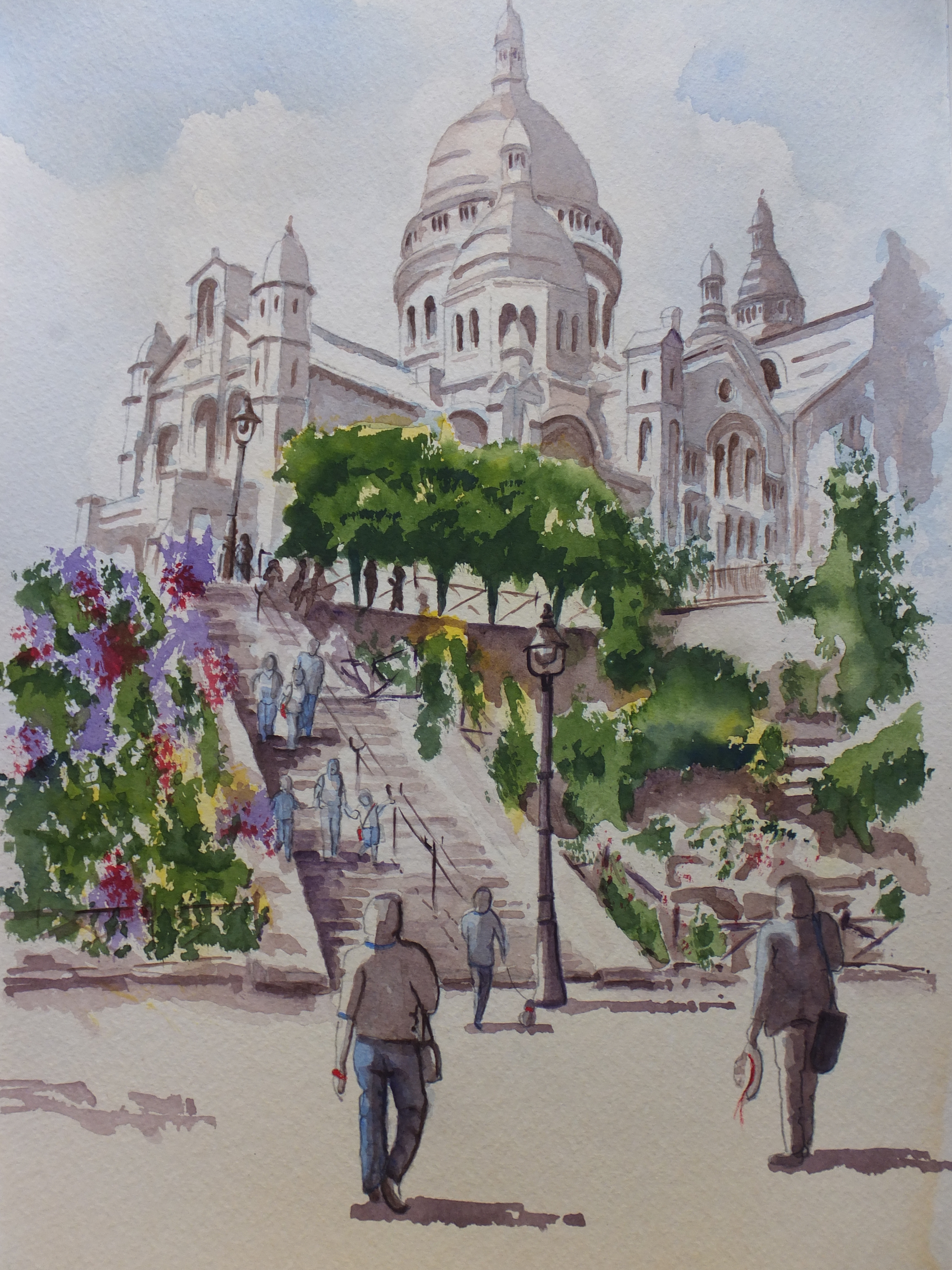
The finished version of Sacre-Coeur de Montmartre

There are still things I look at and feel like going back and fiddling with, but I have learned to resist that, and have finally decided that the painting is finished

Since posting the underpainting, I have been back in with stronger versions of the Transparent Brown and Violet mix, bringing, I hope,  the image closer to the eye, as the detailing becomes sharper

I have had to resist making the detail of the basilica too sharp in order to give the impression of distance. The shadows in the garden and on the steps I have deepened. Likewise the foreground figures, with the obligatory spots of red in the foreground, which are discreet, but they are there.

If I can find a suitable frame, I should be able to include this one in my July exhibition at the Royal Surrey Hospital in Guildford

I bought recently an interesting frame in a driftwood texture, which is comparatively long with the mount divided into four spaces. They are usually used for photographs. I bought it at a craft fair recently. At the same fair, a watercolour artist was showing , and had included one of these frames with four individual pictures making up a wide scene, which looked very effective. I thought I might try something similar. Not the same picture, I hasten to add, but a retake on something I have done before of a long line of beached fishing boats in Devon

I have finally launched my Artfinder shop. The application form was a bit of a marathon, but the support staff were very helpful indeed. I know they are supposed to be, but sometimes they aren’t. The young woman at Artfinder who I think, took pity on me and patiently answered my questions, helping me over the hurdles, was truly excellent.

I have only listed six paintings so far, as the uploading can take a time, if like me you don’t get the sizing right always, but there will be more as time goes by. We’ll see how it goes