Line Drawing Preliminary Study for Boats on Beach at Beer, Devon

Boats at Beer Drawing

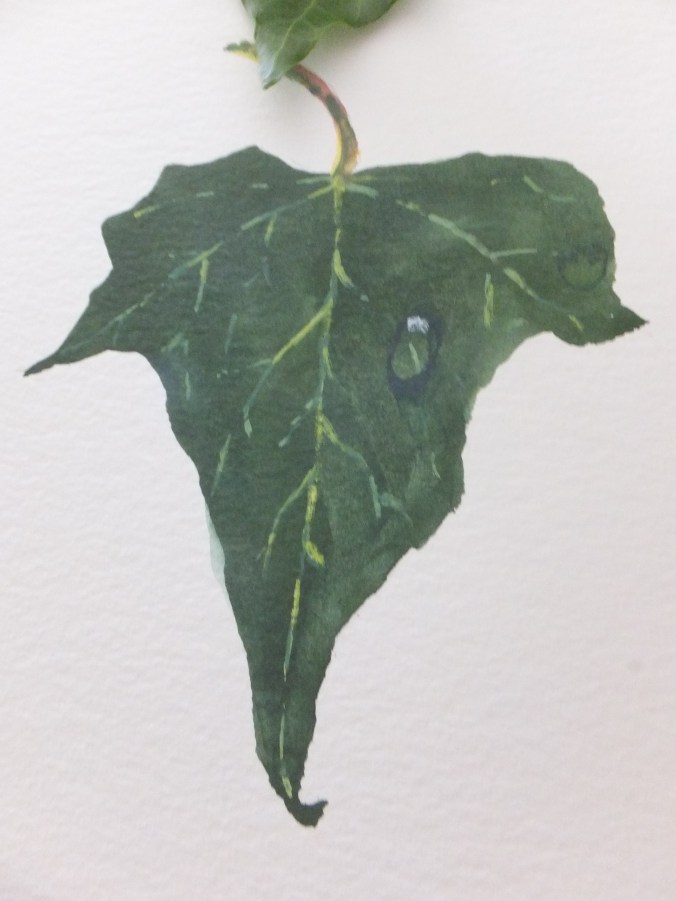
Rather a faint study from the collage of photographs that I posted a few weeks ago, but sufficient, I think to form the basis for a painting. I have done this study before only differently, so this painting will be the usual journey of discovery that they all are, that fine line between success and failure

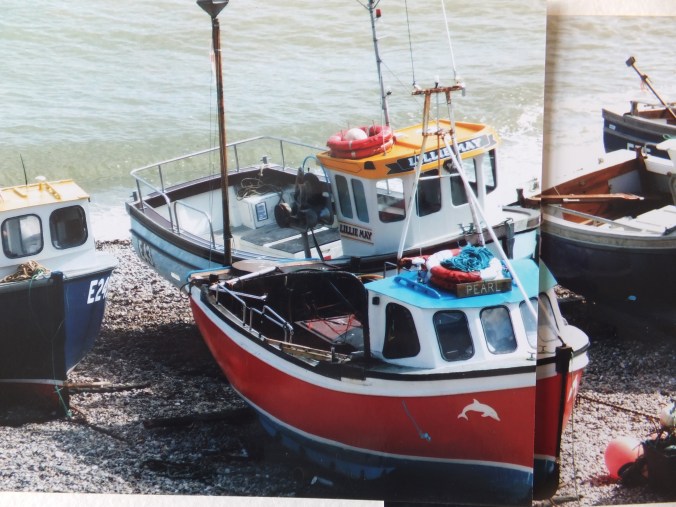
I mentioned before, I think, that this shot is from a visit some years ago now to the fishing village of Beer, on the south Devon coast. The fishing boats are dragged up on the beach, and make a colourful line-up, a mixture of bright reds and blues

This is the first time that I will have done this painting as a long horizontal shot. It should work, he says, hopefully. I will have to cut a different mount, though. The original one with the four slots just is not going to suit

So for now, it just remains to titivate these drawings and check that I have everything, including all those small props like chains, anchors etc. Then I can start mixing the underpainting

We will see how we get on

Fishing Boats at Beer in Devon

Fishing boats

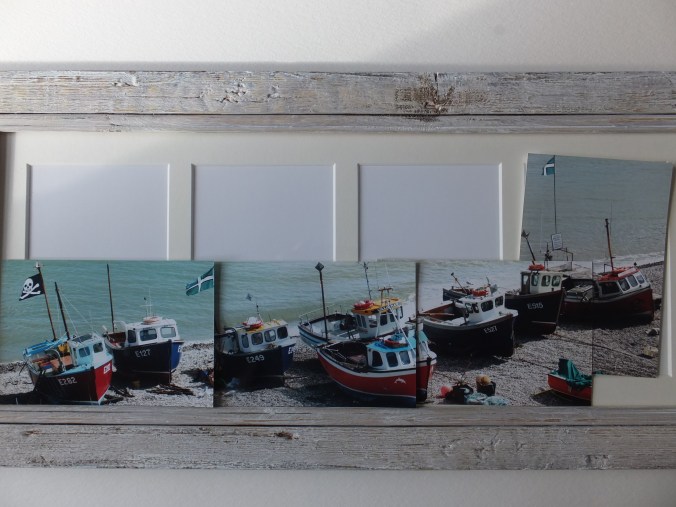
Years ago we went to the delightful little fishing village of Beer on the south Devon coast. These colourful boats were drawn up in a line on the beach, and I photographed them in several frames, as I have shown here

I painted them once and showed them. That painting sold. A year or two later, someone picked the painting out from the web site, and commissioned something like, so I painted something similar but not the same

At a craft fair recently I bought the frame in the photograph. The beading is Italian, heavily distressed and in a driftwood finish. The mount is split into four spaces, and is obviously intended for photographs.

It reminded me of something I had seen not long ago at an exhibition. An artist had used a frame like this using a long painting, which looked very effective, I thought. It obviously needs a long horizontal subject, which reminded me of the line of boats at Beer, so I am going to try it out. It may not work, as the spacing of the boats may be wrong, but I will try it anyway

If it turns out well, this could be my twelfth and last painting for the July exhibition, so we shall see

Zoom in

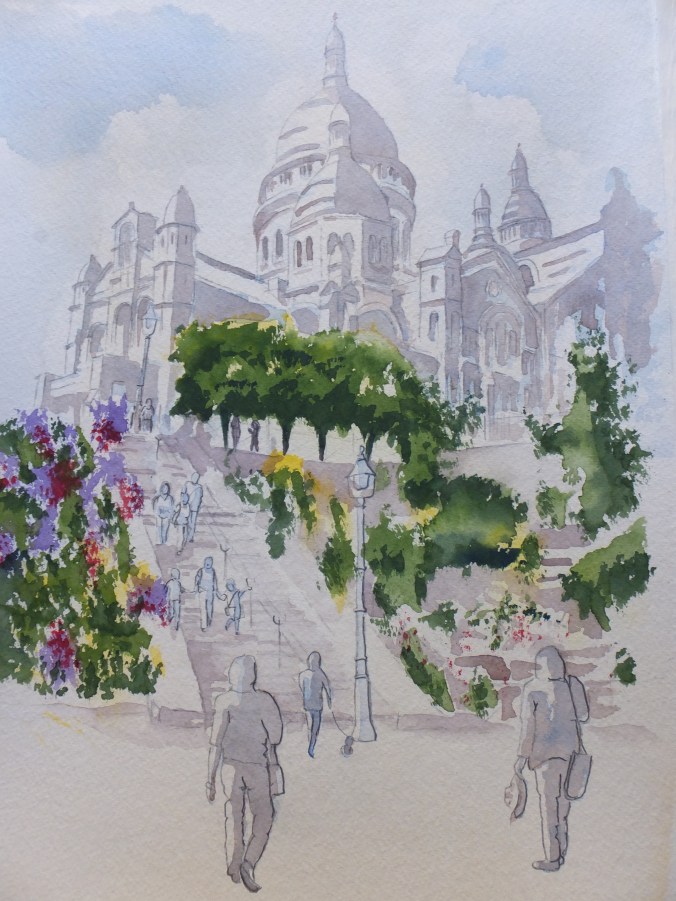
Sacre-Coeur de Montmartre: the finished painting

DSCF3669

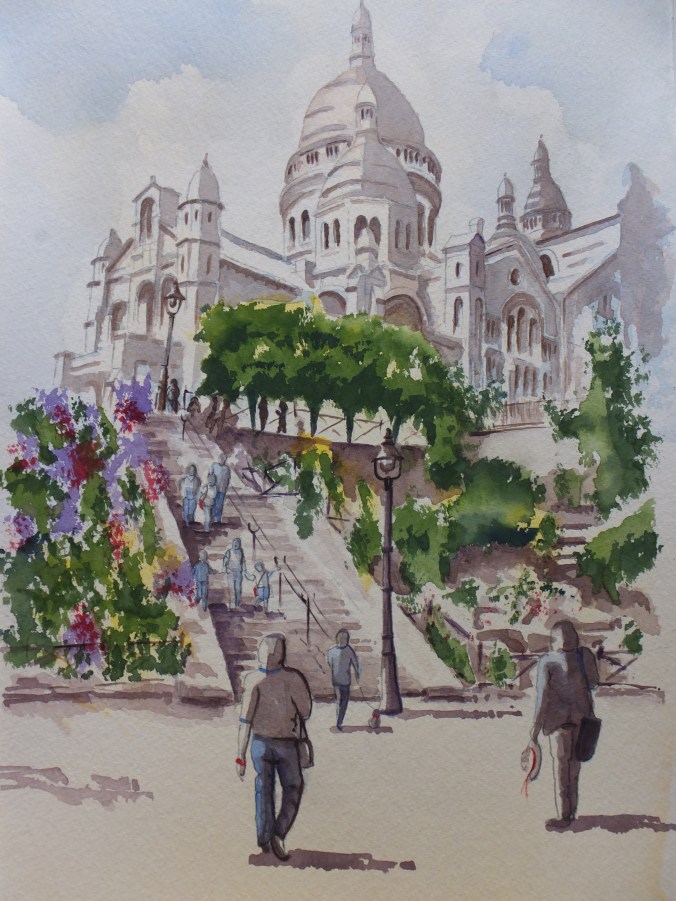
The finished version of Sacre-Coeur de Montmartre

There are still things I look at and feel like going back and fiddling with, but I have learned to resist that, and have finally decided that the painting is finished

Since posting the underpainting, I have been back in with stronger versions of the Transparent Brown and Violet mix, bringing, I hope,  the image closer to the eye, as the detailing becomes sharper

I have had to resist making the detail of the basilica too sharp in order to give the impression of distance. The shadows in the garden and on the steps I have deepened. Likewise the foreground figures, with the obligatory spots of red in the foreground, which are discreet, but they are there.

If I can find a suitable frame, I should be able to include this one in my July exhibition at the Royal Surrey Hospital in Guildford

I bought recently an interesting frame in a driftwood texture, which is comparatively long with the mount divided into four spaces. They are usually used for photographs. I bought it at a craft fair recently. At the same fair, a watercolour artist was showing , and had included one of these frames with four individual pictures making up a wide scene, which looked very effective. I thought I might try something similar. Not the same picture, I hasten to add, but a retake on something I have done before of a long line of beached fishing boats in Devon

I have finally launched my Artfinder shop. The application form was a bit of a marathon, but the support staff were very helpful indeed. I know they are supposed to be, but sometimes they aren’t. The young woman at Artfinder who I think, took pity on me and patiently answered my questions, helping me over the hurdles, was truly excellent.

I have only listed six paintings so far, as the uploading can take a time, if like me you don’t get the sizing right always, but there will be more as time goes by. We’ll see how it goes

Sacre-Coeur de Montmartre: Underpainting

Sacre-Coeur Underpainting

From the drawing I have got as far as providing a base coat for the painting. As you can see, I have added some foreground figures from my archive, just to deepen the composition

Basically I have put in the shadows, which in effect gives the subject its form. For the church and figures I have used a mix of transparent brown and violet, which has gone a bit too grey for my liking, so colder than I wanted. I had run out of Ultramarine Violet which I normally use, so used Windsor Violet instead which is more blue than I expected. I will run a wash of transparent brown over the shadow, when bone dry, just to warm them up, and then work in the detail.

I sometimes prefer this stage to the finished painting, when the buildings seem to loom out of the mist.

For reasons best known to myself, I have finished the trees and shrubs first. I don’t usually do that, and have probably made it hard for myself to strike the right tonal balance. Oh well, let’s hope it works out

I am also in the middle of trying to set up an online shop with Artfinder, who come recommended. Nothing like the sales that I enjoyed last year, either locally or from my own website. Maybe it is the Brexit effect slowing down our economy. Anyway I have to try something different, so I will doubtless post when I have done it successfully, and also on social media

Sacre-Coeur de Montmartre, Paris

DSCF3643

The Basilica of the Sacred Heart, Montmartre , Paris


This has always been a favourite area of Paris. I have wandered around many times taking pictures, and have used them for paintings afterwards. The artist’s quarter, the steps, the views over the roof tops and the Consulat have all featured in my paintings and have been popular at exhibitions, but for some reason, I have never painted the basilica itself

The basilica was planned or started about 1870, and was part of a Catholic revival in France. It was said to be partly a penance following defeat by the Prussians in the Franco-Prussian war, and partly to expiate the sins of the Communards during the Commune which followed the exile of Napoleon 111.

Napoleon III was captured by the Prussians after the battle of Sedan. His son, the Prince Imperial Louis Napoleon, a boy of fourteen, present at the battle, was spirited away to Ostende and thence to England by boat. His mother the Empress Eugenie, dropped everything and fled to England to join her son. In fairness, all was up with the imperial rule. her husband Napoleon III  was released by the Prussians and allowed to travel to England. Already a sick man, he died in exile in 1873.

The Commune , following the fall of Paris, saw much anti-church rhetoric and atrocities. The building of the Sacre-Coeur on the hill of Montmartre, a scene of much insurrection, was intended to heal the divisions in France, and create a church come-back. Certainly this was  a significant building

Using various photographs, I have made this pencil sketch on which to base a painting. I just haven’t worked out colours yet, although something sunlit I suspect. No doubt my favourite warm shadows using Sennelier Transparent Brown mixed with Violet will be present.

I have the task now of moving the sketch in very basic terms onto watercolour paper and then finishing a drawing ready for painting. So, as always we shall see.

Venice Painting Completed

Venice Painting Completed

The finished painting with San Giorgio Maggiore in the background, which I enjoyed doing, although trying to hit the right colours was testing to say the least

I have already mentioned the mooring posts. In the photograph they looked red in the evening light. This turned into a glazing exercise, wet on dry, although nothing like as tricky as the hull of the gondola which I will come to in a minute

For the posts I started with a Burnt Sienna wash which is pretty safe. When the paint had dried, the pigment had disappeared. I applied another coat of the same colour, followed by a coat of Permanent Rose which should have given these posts a nice evening red glow, but still pasty. I had been waiting to use quinacridone red, of which I have a fairly limited experience, so perhaps risky. The colour worked well, I thought, giving me what I wanted. I used Indigo for the strips of bark hanging onto the wood. Indigo makes an alternative to black which I avoid if I can

Now the real challenge, to use that overworked word, was how to treat the hull of the gondola. I may have said before that gondolas are black by regulation. The finish is of a very high gloss, the sort one sometimes gets on pianos, in fact it used to be called piano finish. I think polyurethane was involved which may have been universally banned by now because of health risks.

Black gloss in certain lights obviously won’t look black, because of the other bright colours it picks up in this mirror like shine. If you remember the original photograph that I worked from, the vessel looked a sort of bright copper colour.

Again this was a long and drawn out glazing exercise. At least five coats as I remember and twenty four hours natural drying in between each coat. I used Quinacradone Gold, Burnt Sienna, Van Dyke Brown, Transparent Brown and Permanent Rose

I looked at it in the morning from a distance. I think it worked but I will have to put it away and get it out again another time, before I can make an objective view

As always comments are welcome

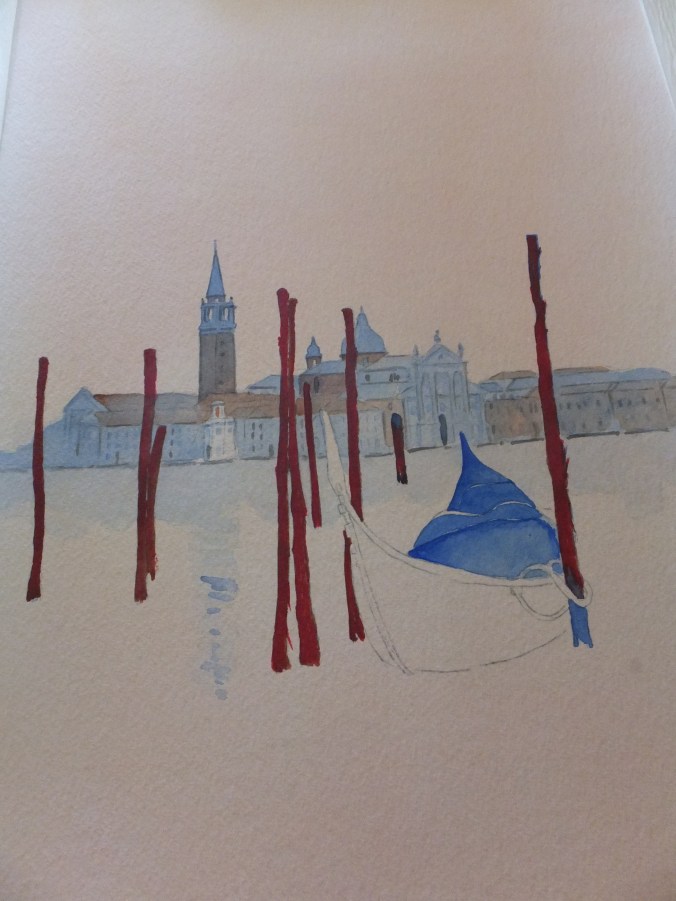
Venice Painting so far

Venice painting to date


Not the best of photographs I am afraid

The sky is much pinker than the picture shows but try as I might, I can’t stop the camera leeching out the background colour. Also too much camera distortion making the posts lean inwards which I will try to correct on the finished version

What I did to colour match the original photograph, in which the sky and most of the water is a deep salmon pink, was to brush all over first with a red-orange mix, which did dry quite pale. I then built up with dilute coats of alizarin crimson until I reached the depths of colour that I wanted.

When that was hard-dried, I started on the background buildings, the church of San Giorgio Maggiore, always a favourite. Being in deep shadow I gave all the buildings a wash of French Ultramarine, and then another one. When that was really dry, I painted the rooftops and brickwork in Burnt Sienna.

The mooring posts I started with Burnt Sienna, but I wanted them to be more red than that. I glazed them with Permanent Rose. They were still too brown, so went over them again with quinacrodone red ( it doesn’t matter which way I spell that word, it always seems to be wrong). This was getting nearer the shade

I now had the colour relationship between the foreground posts and the background church. I felt the church could go darker still, with another coat of Ultramarine, and this time bring the wash down a little way over the water, to cast a shadow. There is one small building in front of the church, which I think is the customs house, which in reality stands well out on a promontory coming towards us. I missed this out with the last coat so that it didn’t disappear altogether

That is as far as I have gone as yet. I still have to darken the posts and finish the gondola, probably with some indigo on the seating. How I tackle the hull, I still have to work out, so we shall see.

Venice Tonal Sketch

Venice Tonal Sketch

The exhibition at the Guildford Institute has been running for a working week now. There have been a crop of complimentary comments, otherwise fairly quiet. Not unexpected ,as although the Institute is a delightful venue, it is not a very busy place, and I tend to get more publicity than sales there. Having said that, I usually sell something even if it is after the show

Now is the time I have to think about my next solo show which will be at the Royal Surrey Hospital in July.  This is held in the Peter Thompson Gallery, which is quite a busy place. Taking the worst case scenario and assuming I sold no paintings whatsoever at the Institute, I still wouldn’t take the same collection to the hospital. I will take some but also freshen the gallery with some new stuff which I will work on between now and July. This sounds a long way off but there are holidays in between, so I cannot slacken the pace

I need a couple of Venice pictures which are always popular, so I am working on the view above.  The lovely church of San Giorgio Maggiore near the mouth of the Grand Canal is always a favourite, and I have painted it several times before, but not this particular shot. It always sold in the past, which I know is no guarantee for the future.  Everyone wants the same view so the test is to provide the same image, yet giving it some twist that stretches the artist at the same time.

I am going to give this painting some different colours which will make me think. This will be an evening scene, so a reddish sky which will reflect on the water. The church will fade into the background, and the foreground will be taken up with this solitary gondola. Gondolas are traditionally black. I think there is a regulation which says that they have to be. But it won’t have to look black. The high gloss finish will reflect the colour of the water and the shadows on the water, and also include the dancing highlights

This will certainly test me, and I am not at all sure that I can pull this one off. However it will be interesting to say the very least, and an experience I shall learn something from

As always I will post my progress stage by stage


.

Sidney Sime Memorial Gallery in Worplesdon, Surrey, UK

A Wild Creature Stalking the Woods by Sidney Simes

A Wild Creature Stalking The Woods by Sidney Sime

This gem of a gallery existed on my doorstep without my ever hearing about, or seeing it even, despite being just off a busy main road that I use often. The gallery has been there since 1956, opened with proceeds from the sale of Simes’ home in Worplesdon on the death of his widow in 1949. There are approximately 500 catalogued pictures of which 86 are hung and on permanent display. The rest are in cabinets and folders.

We went there recently with a group from Guildford Museum, which was, I have to say, a most enlightening visit.

To say something about the man. Sidney Sime was born in Manchester in 1867. As soon as he was old enough he went to work in the pits and for five years pushed “scoops” of coal along rails through tunnels about 75 centimetres high.

He used to scratch little drawings on the walls even then and find odd moments for making sketches

After a succession of jobs including sign-writing which he became successful at, he eventually joined the Liverpool School of Art, part of a network of art colleges stretching down to South Kensington.

His studies complete , he contributed drawings to many well-known magazines, eventually purchasing and editing a magazine himself. Called the Idler, there are copies in the gallery.

He married in 1898. Following a bequest from an uncle in Scotland, the couple settled in Perthshire, where he painted many Scottish landscapes. They felt isolated in Scotland and moved to Worplesdon in Surrey which was accessible to his London studio.

He began to specialise in caricature, drawing local characters in the pub, viewing them in the mirror behind the bar. Many of his most enthusiastic supporters were among the wealthy, and they gave him the stimulus to produce some of his finest pictures. In 1896 he gained membership of the Royal Society of British Artists.

After the Great War, came a prolific period, when he produced much of his visionary work, especially from the Book of Revelation. He staged a well-received exhibition at St.George’s gallery in London in 1924, and another less so in 1927.

Later he was to drift into obscurity, painting for his own pleasure until his death in 1941.

There will be a major exhibition of his work in Woking’s  Lightbox Gallery from 15th April to 28th May 2017


David Hockney at Tate Britain

Pool with Two Figures 1972 detail by Hockney

Pool with Two Figures 1972 detail

David Hockney is probably one of the most popular and widely recognised living artists of our time. His work spans the last 50 years from his student days, continually reinventing himself

We went there today. We like Tate Britain on a Saturday morning. Thanks to the kindness of the Borough of Kensington and Chelsea you can still park free on a meter on a Saturday. Also no congestion surcharge on a weekend. Anticipating correctly a heavy attendance for this exhibition, Tate Britain has been opening the doors two hours earlier than usual. We were early but not that early. The queues as we drew up looked daunting. This is where the member’s card comes into its own. We swept in effortlessly

Like most people, we have followed Hockney throughout each of his stages. Some of them leave me cold. In his student days he was influenced by Picasso. Everybody copies Picasso at some stage. It is very easy to tire of Picasso

One of my favourite Hockney periods is when he veered towards naturalism. I just like recognisable paintings. He was in Los Angeles for this time in his life, and so lots of swimming pool pictures of athletic young men. I particularly like his double portraits which explores the relationship between the two. Mr and Mrs Clark and Percy 1970 is a favourite. Especially touching is the affectionate portrait of his parents, especially the way they are posed

I remember his work with the Polaroid camera in the 1980s, producing myriads of small images to make up into a collage of quite a large picture. He was dissatisfied with the white border around each small image. I rather like that. The whole composition looked like a ceramic mural.

After many years in America, he moved back to his native Yorkshire, and produced some marvelous work. Massive tableaux of the Yorkshire Wolds. The colours are breathtaking. He moved from paint to video to produce a colossal work entitled The Four Seasons which as the name tells us, was of a single stretch of road in Spring, Summer, Autumn and Winter. Incredibly technical work

I am sorry I have no images. Vigilant attendants quite rightly moved in on me every time I tried to take a photograph discreetly with my phone. His charcoal drawings……….one can go on and on, my eyes ached after two hours. I shall go again

Paintings to Google are My Parents 1977, Mr and Mrs Clarke and Percy 1970,the Road to Thwing 2006, A Closer Winter Tunnel February-March 2006 and of course so many more

See it if you are in London. On until 29th May