Impressionists in London Exhibition at Tate Britain

Charing Cross Bridge by Pissarro

Charing Cross Bridge by Camille Pissarro

I took my grandson to see this fascinating exhibition at Tate Britain, a week or so ago, as he is studying Pointillism as part of his Art GCSE syllabus. The work of Camille Pissarro was much in evidence, so a lot for him to have a look at. This was his first visit to a major gallery, so significant, and as he pointed out, we were looking at originals, so the actual canvases that these painters worked on. I sometimes lose sight of that fact myself.

The exhibition was centred around the work of French painters who fled to Britain in the 1870s to escape the horrors of the Franco-Prussian War. Napoleon III had been captured after the Battle of Sedan, and on his release went into exile with his wife, Eugenie, and their son the Crown Prince, in England, living in Chislehurst. All three are entombed in Farnborough, in the abbey founded by Eugenie. After the fall of the Second Empire the fight went on, culminating in the horrific Siege of Paris in 1871. Civil war followed after a popular uprising by the Paris Commune. Thousands died. Many of the Communards were amongst those who fled to Britain, and who were received without question or restriction.

Many well-known painters arrived and stayed in London. Claude Monet had a suite of rooms in the Savoy Hotel, and painted the Thames and Houses of Parliament in all its moods. He loved the London fog, as did Whistler, credited by Oscar Wilde with the “invention of the fog”

Camille Pissarro, whose house in Louceviennes was commandeered by the Prussians, fled to south London with his mother and other relatives, ruined by the conflict. He lived at Kew, and paintings of his, of the Gardens and Kew Green are on display. He was another fascinated by the Thames and painted similar views to Monet, of the Houses of Parliament through the mist, as well as Charing Cross Bridge in the picture shown.

Not all the arrivals were Impressionists. James Tissot having been introduced by his friend Thomas Bowles, made a name for himself as a painter of High Society. With a great eye for colour and fashion, his paintings of ball gowns and uniforms are magnificent.

Many well-known dealers also followed the painters, and there are many more names that one could mention, but in the final room, is displayed the work of Andre Derain, who was inspired by the London paintings of Monet. He was sent to London in 1906 by the dealer Vollard, and produced thirty canvases from this trip. These were in homage to Monet and covered the same subjects , Charing Cross Bridge, the Thames and the Houses of Parliament. Not to my taste, I think he belonged to a group called the Fauvistes, which believed in the arbitrary use of colour. However, his work is successful, and rounds off this exhibiton nicely

Paintings are on loan from galleries across the world, so a one-off opportunity for most of us to see them. Worth going to, more than once if you can


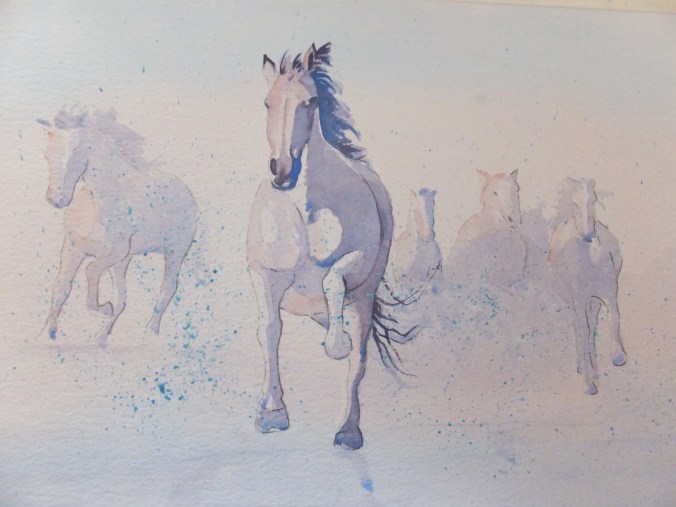
Wild Horse Painting

Wild Horses

Now that my exhibition entry is complete, I can start to look at painting something for pure pleasure, whilst at the same time, having something very different in my portfolio, knowing that local exhibitions will be cropping up during the summer.

Horses are something of a favourite. I rode for many years. Nothing very serious, just hacking out but still exhilarating. Christmas rides over the Downs were the best, with a couple of long gallops thrown in. Some parts of the ride were on sandstone, so sandy tracks to gallop along which just went on and on.

My son and I used to go to the north-east several years running, and go post-trail riding spread over the week. Quite hairy galloping across the moors, but the horses were like goats, so you just let them take you

So after a while, you form an affection for horses, whether they are ponies or drays. In fact I loved watching the big dray horses delivering beer in certain parts of London, especially Wandsworth, home of Youngs Brewery which had a team of drays up to the time they closed down not that long ago. Now I just enjoy looking at them and taking photographs, hopefully to get some shots good enough to paint.

I am getting one or two different sketches together, hopefully to create something dramatic, perhaps even wild-looking. I haven’t finished my deliberations yet, but for the moment will just show the sketches which I’ve prepared so far, which might change as I go along

Galloping Horse

Finished Bosham Panorama Painting

Finished Bosham Panorama

and there it is waiting to go into its long frame

That will then complete a collection of twelve paintings for the coming exhibition at the Guildford Institute from 19th of this month

Since the last post, really the work was purely detailing, using dark brown, white and cadmium red. I have drawn in some buoys and odd details like that

I bought a new detail brush the other day, designed by Matthew Palmer. It has a large bole which holds a good supply of water, but the tip comes to a very fine point, which produces a line rather like you’d expect from a pen. I think it was designed for painting very thin branches and twigs. It also works well for fine rope work, and window frames

Huge sigh of relief now that the exhibition collection is finished, all but framing the last one

I can now look at catching up with a few paintings for pleasure. I love doing horses and have made some initial sketches, from which I think I can put an interesting composition together. I have gone back to drawing by eye instead of using a grid, which not only saves time, but also is comforting to know I can still do it ( or think I can)

I will publish the horse drawings at another time

Bosham Panorama for the Long Frame

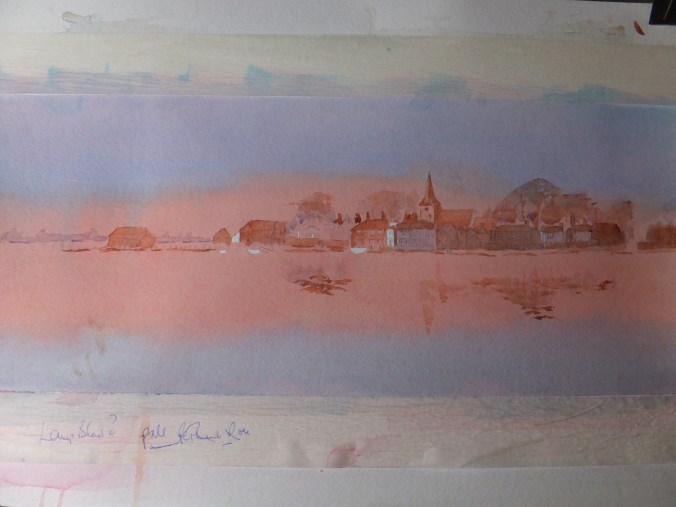
Bosham Panorama Starting to emerge

Emerging from the sea mist almost

This is the start of the panoramic painting for the long frame which I mentioned recently, which I am hopeful for, but we shall see

For sky and sea I used a mix of phthalo blue and cobalt. For the sunset sky and reflection in the water, I have used a mix of Cadmium Orange and Permanent Rose. I was not pleased with the initial result, as the sky came up very orange indeed. I applied coat after coat of Permanent Rose, wet on dry, which when dry, appeared to have made very little impact. Eventually the sunset turned pinky red, and I quite liked the effect of the pink over the blue. Where the blue had gone on sparsely, the pink soaked in, and started to look like pink clouds on the blue sky. I am not sure whether this shows in the photograph.

In order to get the effect of the low sun on the rooftops, I will need to glaze the buildings with something like Light Red and if that goes too brown, then a thin wash of Cadmium Red. Sparingly, of course, as that is powerful stuff.

There is masking fluid to come off, where white buildings have caught the strong light. I should have mirrored that in the sea, but forgot, but I think I can rescue that with White Gouache.

Dark shadows to go in with dark Brown which will accentuate the light, I hope. Also some small boats for which I will use the same blue mix, and white masts, should add to the effect

I am hoping so, as exhibition time draws near

Schooldays in the 1950s: Part Two

One of the most important aspects of grammar school life was sport and sporting achievement. Sporting heroes were venerated, whilst scholars were not. I haven’t given this piece a title, quite deliberately, but if I did it could be Sport and Entertainment, which sounds like a quiz round. We had a lot of sport, but very little entertainment. Our antidote to work was sport. There was no place for the frivolous

I have not named my old school yet, I don’t know why, there is no need for me to be coy about it. The college was founded in the c18, by an East India merchant named Richard Churcher, to train boys in mathematics and navigation, before entering the service of the East India Company. The school is Churcher’s College, still very much there, but independent since the introduction of the comprehensive system. It stands alongside the old Portsmouth Road, built of local sandstone, it boasts clocktower, quadrangle,refectory and all those other ingredients of a traditional boy’s college from a distant past. It could be Greyfriar’s or Hogwarts

Sport was very well catered for. Rugby in the autumn term, cross-country running in the spring term and cricket in the summer, were obligatory, and enjoyed by many. I hated all three. My extreme odium was reserved for cross-country running, always on a Tuesday afternoon for juniors, straight after a lunch of corned beef, lumpy mash potato and some mixed salad leaves, with a boiled suet pudding to follow. Running three miles over rough farmland straight after that, was not good for the digestion. Several boys lost their lunch on the way.

I said this took place in the spring term. This ran from early January to Easter more or less so took in the worst two months of the year. Today,  thanks to global warming, we have comparatively mild winters, and rarely have snow in the south. In the 1950s snow was more or less guaranteed straight after Christmas, and would hang around for weeks

We changed in the pavilion, which doubled as a gym. One afternoon sticks in my mind, as our games master opened the doors to start us off. The sky was black, and large flakes of snow fell in blizzard conditions. Surely the run would be cancelled, and we could spend the afternoon in the library.  Dream on.  Smiling, if not laughing, our games master dressed in duffle coat, scarf and gloves waved us on our way. We had rugger shirts and shorts and Plimsoll shoes to protect us against the elements. Today, I think, people would be horrified to run in those conditions. Most runners in the winter seem to wear leggings, hood and anorak today, something about keeping muscles warm.

Across the playing fields and out into Love Lane, we ran en masse. Gradually the good runners pulled ahead, with the boys not built for speed lagging further and further behind. I was usually somewhere in the middle , I have to say

After a mile or so of road running, we approached that terrible first obstacle, the “muddy bridge” which really did sort out the good from the awful. This was an old railway bridge, one of many, which carried the Petersfield to Midhurst railway. The railway was in use then, but later would be axed by Doctor Beeching.  Beneath the bridge never saw the light of day, was very deep mud. It never dried out, not even in good weather. The local farmer drove his cattle through it. The cattle sank above their knees in this ooze, creating holes that filled with water with a crust of ice on top. We forged through this lot, likewise well over our knees, so that it took a very great effort to extricate our feet from this sticky morass of mud and excrement. Plimsolls were lost,  sometimes for ever.

After this we were on to open farmland, which we took in our stride, quite literally. It was expected, and we had to do it, so we did. No one was in touch with their feminine side in those days, if we had one to be in touch with. We were told it was good for us, as we arrived back at the pavilion, our characters built, glad to be alive, glad the ordeal was over for yet another week but yet strangely satisfied as we took our hot shower, forged anew by this arduous test. I felt sorry for the tail-enders, as they trickled in, sometimes in the dark, suffering derisive comments from the games master. I don’t remember any concern being shown for boys late back, only irritation. They could have been face down in a ditch for all that anyone knew.

Reading this back, it looks as though I had a miserable time at school, but not so.  I enjoyed my studies, and also enjoyed my time in the CCF or Combined Cadet Force, which once must have been an Officers Training Corps. You could join either of the three services. I chose the army. Everything was still WW2 issue,  uniform, weapons etc. Give a boy of 14 a .303 rifle and a magazine of blanks, and have him charging round the countryside shooting at the”enemy”, this had to be enjoyable. Health and Safety today would be horrified. This deserves, one day, a chapter of its own, so I will talk about what served as our only light relief in those days.

We read a great deal, it is fair to say. We read the classics without being told to. I read H.Rider Haggard, Robert Louis Stephenson, Herman Melville, Joseph Conrad, and H.G.Wells. These authors wrote wonderful adventure stories which appealed to boys, then. Stories of exploration and of empire, which remember we were only just leaving behind us. The humiliation of the Suez Crisis in 1956 taught us that our days as a world power had come to an end, and that America was taking over.

In our wonderful library, we had, amongst many other things, leather-bound copies of Strand Magazine, a Victorian publication which serialised stories that we know well today. Conan Doyle published his adventures of Sherlock Holmes in this magazine in serialised form, and I remember especially reading Hound of the Baskervilles. I can say truthfully that I read it in the original.

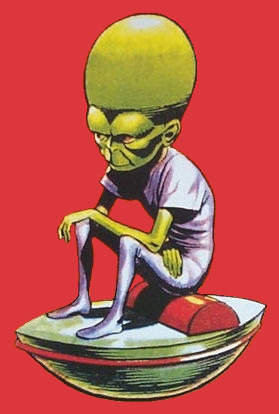
We had comics. I bought the Eagle from W.H.Smith on Havant Station. One of the first comics to run stories of space travel, it was a runaway success. Dan Dare was the great hero with his sidekick Digby from Wigan. Together they thwarted the plans of the Mekon and his reptilian band of Treens

Recently I researched and gave a talk on H.G.Wells and his time in Woking, his most prolific time, from 1895-6, where he wrote works that made him famous like War of the Worlds. He also wrote something called The Man from the Year Million, where humans had developed massive brains with massive heads to match, and atrophied bodies and limbs which had shrunk because they were no longer being used. Interestingly, the illustrators of the Dan Dare stories borrowed from Wells when they created the Mekon character, and somewhere I have a picture.
Mekon_Big

and there is the rascal himself

Dan Dare stories were also broadcast on Radio Luxembourg , which I was not allowed to listen to, in our authoritarian household.

There was very little in the way of titillation. Censorship was strong and minors had to be protected. Nevertheless we sometimes bought a paper called Reveille, which might contain a picture of Diana Dors in a one piece bathing costume! She was Britain’s answer to Marilyn Monroe, a blond bombshell and a very popular model. She died quite young in 1982, married to a gangster as I remember, and living an orgiastic lifestyle. On a more serious note, she was also RADA trained and a very competent straight actress. I can remember seeing her in character parts in TV dramatisations of different works by DIckens, in which she was excellent.

I became very interested in photography in my mid teens, an interest way out of my meagre budget. I did buy each week, the Amateur Photographer magazine, which cost me 1/6d in old money, out of my pocket money of 3/6d, which left me strapped for the rest of the week. My father liked to read it too, but never thought to cough up a bit more money to cover the outlay. Maybe this propagated in me a latent interest in art, who knows

Bits and pieces come back as I write. I started learning German when I was 14. You were only allowed to do this, if you were already proficient in French. We were encouraged to have pen friends in Germany, and I started to write to Brigitte who lived in Wilhelmshaven, a naval port on the Baltic coast, a place better known for U-boat pens than anything else, but enough of that. We were the same age. She wrote in English and I wrote in German. Her stuff was very girly, as one might expect, and I wasn’t mature enough to say anything interesting either, so the arrangement foundered fairly quickly. She was very good-looking though.  Who knows what became of her.

I think I will stop
Turner in Surrey Exhibition at Lightbox in Woking

Turner's Newark Priory

I can highly recommend this exhibition at the Woking Lightbox. Their exhibitions just get better. I had no idea that Turner did so much work in Surrey, especially around Guildford in or around 1805

He painted Newark Priory Church plein air long before the Impressionists, and you may be able to tell from my bad photograph that his style then was getting towards an impressionist one. His later paintings like Rain, Steam and Speed were all about colour and not form, very much like the Impressionists. The ruined priory church is all that remains of a once complete Augustinian foundation, coming under Chertsey as I remember. It stands on private land so it cannot be visited only viewed from the towpath on the Wey Navigation, or from the road, and I rather think Turner made his study from the road. There was probably less traffic on the road than on the canal towpath in those days

He also stayed at the White Lion Inn in Guildford High Street, one of the many old coaching inns in the town. Demolished despite local protest to make way for Woolworths store, the white lion model inn sign was kept, and brought forward again, when Woolworths itself was demolished to make way for the White Lion Walk shopping centre in the 1980s

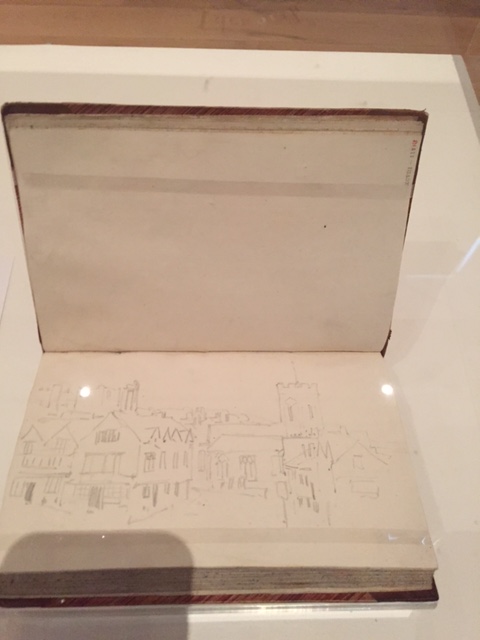
From his room in the hotel, Turner sketched Quarry Street opposite. The scene is much the same as today, with the historic Star Inn on the right-hand corner and St.Mary’s, the Saxon church behind that. You can see the castle too. The building on the left, which is now Thomas Cook, has changed. I tried to photograph the sketch, but not too successfully

Turner's Sketch Book

I have painted this view myself, so slightly eerie

He also painted and etched a very fine view of St.Catherine’s Chapel which stands just outside of the town on the Portsmouth Road. Ruined 13c, it stands roughly on the old pilgrim’s way, near where pilgrims would have been ferried across the river. No connection with pilgrims though, as it was built as a chapel of ease for the parishioners of Artington, to save them the long journey to St.Nicholas’ Church

There is more and I shall go back


The Finished House Portrait

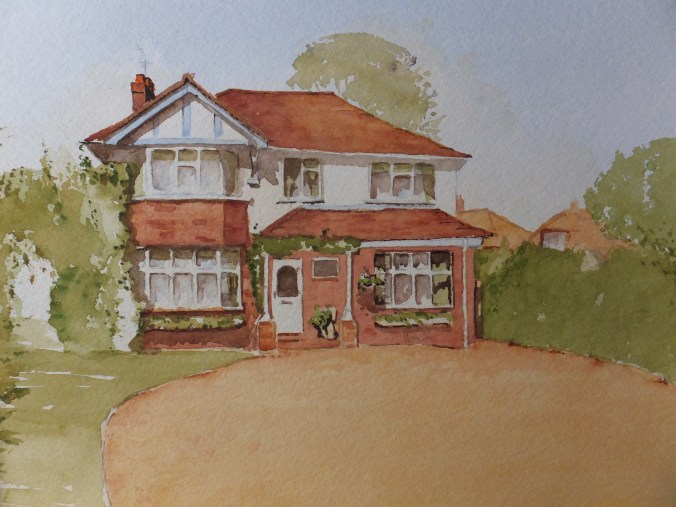
Finished House Portrait

Well, the portrait is finished and shown to the client who is delighted. I don’t usually allow myself satisfaction, but even I think that this one turned out well. It just has to be mounted, which I shall do in the new year. It isn’t required until the middle of January so that should work out nicely

Basically, all that I needed to do since the last post, was to put in the shadows. Half the gravel drive was covered by shade from a large tree just off-stage, which also darkened the hedge. Some intricate shadow underneath the porch gave shape to the covered interior, and even the cartwheel stands out more now from the wall

Some dark detailing was added to the shrubs on the left. Somewhere in the deep tunnel made by those shrubs is a white garden gate, which I have shaded. Most of this I had to guess, with the help of some alternative references

I enjoy house portraits. I’m not sure why. This one will go on my website one day

But for now to resume my exhibition work, as time does not stand still

At this time of year, may I wish all who read my blog,warmest greetings and good fortune in the coming year

House Portrait: Part Finished

DSCF3964

Getting there but not quite. Still some detailing to be done

Apart from changing some of the trees on the right-hand side, I have kept as faithfully as possible to the subject. I have left out some of the dark coniferous foliage that was intruding in the right-hand corner. I didn’t like it, and it was very much “in your face”, and so detracted from the house, which should remain the star of the show. I hope the client agrees with me, but I could always put some in, if she insists.

I put a distant tree in behind the ridge of the roof, just to alleviate that line. The sky itself is bland, as I wanted the building to come forward. For the roof colour I glazed burnt sienna over raw sienna, and then when bone dry, glazed light red over the burnt sienna. I did the same for the brickwork, hopefully to give an impression of bricks being sunlit.

I have just started to put in some of the shadow, but have by no means completed. As soon as you do that, the building takes on a third dimension, and I love watching the house come towards me. Once the shading on the house is complete, I shall put some dark shadow on the hedge to the right. As well as that, dark shadow on the gravel, about halfway, which will help to make the rest of the drive, look bright. That is the plan

On the left-hand side I see from other pictures, that there is a white gate deep amongst the bushes which is just visible, so I will need to include that, as well as some extra dark in the shrubs, as well as shadows from them.

Still some way to go, but being a mad time of the year, I am reduced to little and often, which I don’t mind, as I can judge each stage as it dries out. As we all know, the difference between the wet pigment and the dried-out colour is quite significant.

Every so often, I take pains to point out, that I am not formally qualified to teach painting, but if you like watching me work, and if you find what I do to be helpful, then I am very pleased to welcome you to my blog. Especially welcome are more recent followers, whom perhaps I haven’t addressed before

House Portrait

DSCF3956

I have interrupted the study of the bridge over the Basingstoke canal, as I have been lucky enough to be given a commission for a house portrait. This is the first this year and it is only December. Last year I was doing something from the web site every other month.

This will be a gift for a couple moving after 40 years in this lovely house, and a painting will make a lovely memento. I do always feel privileged to be entrusted with this sort of task, and naturally will give the job my very best attention

This will be presented by another family member, and will be a surprise for the couple concerned. My job will be to make it a pleasant one

Crazy time of the year, of course and many things happening, year end, which I am involved in, so I am working on the project during spare moments. Luckily I am not under much pressure to complete to a deadline

So far I have prepared a working sketch with tonal work, which will help me place the details in my head and also let me know where the shadows are. I will flash the sketch up next, so you can see where I have got to. Next, the tedious bit, moving the drawing onto watercolour paper, but it has to be done

By way of a PS, we had our annual art exhibition at the week-end. By we I mean the Pirbright Art Club, and I am pleased to say that I sold “Salt Mills at Trapani, Sicily”. The painting is somewhere in the archives if you wanted to check it out. So, after a very slow start, sales have not been too bad during the second half of the year

Working Sketch

Again, because of the importance of the task, I have used a grid to get architectural details in the right place, I hope

I love house portraits, and am looking forward to getting back to this one

Basingstoke Canal Bridge

Basingstoke Canal Bridge

Continuing my theme of Waterways in Watercolour which is my next solo exhibition in February, and for which I am worryingly behind schedule, I am going to look again at the Basingstoke Canal which runs near where I live

This is a typical Sunday morning walk to exercise the dog and buy a newspaper in the village shop. The tow path is often quite busy with walkers and annoyingly sometimes, bicycles who use their weight to make people jump out of the way. Most are courteous but just a few are inconsiderate

The bridge in the picture is one of the original ones from the c18, brick built with bricks which would have been made in St.Johns nearby, most likely. It is a typical canal bridge, with shaped  walls that curve out on to the tow path. This enabled the bargee to bring the horse over from one side to the other without snagging the rope

I have painted this stretch of the canal many times, and it remains a favourite at exhibitions. My personal favourite which is in the gallery, is of one of the lock gates and which is into the light, contre-jour I think it is called. That sold at one of my exhibitions to a couple who were going back to New Zealand, and I helped them with the packing. I sometimes think of these paintings and where they are, rather like worrying about the children. How stupid can you get!

There is a flight of seven locks along this stretch of the canal, all fairly close to one another. An enormous amount of work for the barge people, getting out and opening the gates, and then closing gates behind the barge when in the lock. Fun to watch though

So far, I have just started to make some sketches, and there are some details I want to change, so nothing to show at the moment

For the future, I came across a lovely photograph which I took along the Amazon, a couple of years ago, of local boys with their pet alligators, small ones obviously, which they had on leads like dogs. This would make a lovely painting if I could bring it off, but might upset some people, so would have to give that one some thought