Salt Mills of Trapani: the finished painting

dscf3567

The painting finished, and that now completes my quota for the exhibition coming up at the Guildford Institute on the 13th. Something of a relief that I am in time, and only have some framing left to do.

For the conical roofs on the mills, I used a different red. Quinacridone Red which I haven’t used before, makes a nice deep pinky red and was virtually an exact colour match to the photograph. Indian Red is not dissimilar but I remembered buying the quinacridone some while ago for some purpose or other, so thought I would trial it. I quite like it by way of a change

I then went on to run a dilute shade of the same colour down the sides of the mills themselves which again brought the masonry colour closer to the original in the photograph.

The stones along the walkway between the salt pans, were quite bright in the sunlight, so I used quinacridone gold instead of raw sienna

There was little else to do. I deepened the blue in the foreground. Sadly little or nothing to put there, so I have made the reflections more pronounced in order to break up the expanse of blue water  I could use red for my signature. I will think about that

But life does not stop here. I have another exhibition coming up in July at the Royal Surrey Hospital, which is another favourite venue. This time I shall be sharing the space with my colleague, Elaine. She does more abstract and adventurous stuff than me, so our paintings seem to compliment one another

Taking a pessimistic view, with no sales at the Institute, I shall just move these paintings to the next exhibition. However there would be one or two changes that I would like to make anyway, and I would like to include some more paintings of Venice which are always popular. I have come across a very good source of photographs that I can work from and leave the next one with you

venice-san-giorgio-maggiore

San Giorgio Maggiore, an old favourite which I have painted before but the light and colours on this shot are delightful

We will see what I make of it. Suggestions by the way, are always welcome

Salt Mills at Trapani: the part finished painting

salt-mills-part-finished

Well, I am moving along slowly, which is the best I can say

There have been quite a few problems over the last couple of weeks, which have demanded my attention. Sadly things that I enjoy, like painting, have had to take second place. Still, every now and then, I creep back to my easel and manage an hour or so. I treat painting as r&r at the moment, and there is no doubt that it soothes the troubled spirit.

I have called this the part finished stage. perhaps more accurate would be to call it the part unfinished stage.

I have put in a Mediterranean sky and water. Phthalo Blue and Cobalt blended seem to work quite well for this. Again I have worked up the distant background in the same colour only deeper, which I think gives it a more faraway look

I have been putting detail into the three mills and adjacent buildings. I have been trying to gradate the tone from one to the other to create the feeling of distance. The nearest will require more work, as this one will have to look really sharp. Detailing the sails will be testing, knowing how much to put in and how much to leave out. I want them to look accurate without looking like a photograph. Oh well, if it were easy it wouldn’t be fun, I suppose

Ironically, the furthest mill presented the least difficulties when it came to painting the sails. Just a flick of a wet brush and that was it. I still have to think about the middle one which will be difficult to get just right. The three bears had the same problem!

I have had to rearrange those low walls to help the composition and to get some reflections in, otherwise there will be nothing in the foreground. No boats here.

Some interesting problems to tackle!

Salt Mills at Trapani, Sicily

70489254

When I last posted about the painting that I finished of Marzamemi in the south eastern corner of Sicily, I referred to the salt pans and the salt mills of Trapani near Marsala in the north western end of the Sicilian island

The mills aren’t used any more I am told, but stand as monuments to an industrial past. They are striking, as windmills always are. Something about them standing against the skyline, which makes you want to paint them, and these are no exception.

The design is somewhat different to the ones you see in Northern Europe. Six sails instead of the four we are used to. The sails themselves seem less sturdy too. Maybe that is why there are so many ropes strung from one sail to the next. I don’t know, and I could not find anyone to tell me either. The conical roof can be rotated manually with a lever behind, to turn the sails into the prevailing wind. English mills have something similar although not the same.

But whatever, they are impressive and very paintable although what surrounds them is not inspiring, so will have to be sorted somehow

The actual salt extraction continues as of old. The sea water floods the pans and is allowed to evaporate in the hot sun. The salt as it is exposed is turned by hand until it dries, and then piled on the dockside awaiting removal by truck and further processing later

I have got as far as making  a perspective drawing and transferring it onto watercolour paper, and I will include a shot of the drawing at the end. I have masked the edges of the mills and other buildings, to allow me to sweep across with my usual Mediterranean sky mix of phthalo and cobalt blue. You will see from the drawing that I have added one more mill to deepen the perspective. I have actually just added the blue and will let it harden for 24 hours before removing the mask

I would love to think that this will make a pair with the last Sicilian painting of Marzamemi. Probably too much to hope for, but we will remain optimistic

dscf3562

As clear as I can get it for the moment, so hope that makes sense

Henry Moore Exhibition at The Lightbox in Woking

henry-moore-reclining-figure-in-elmwood

The centrepiece of the current Henry Moore exhibition which we went to see recently.

The Reclining Figure in Elmwood.

If you have worked in elmwood, you will know it is notoriously  difficult to get a smooth finish. The grain is very knobbly for want of a better word, and resists efforts to sand it to a smooth finish. This piece is like satin and invites you to touch, which you mustn’t do, of course

Moore sculpts for the landscape with his monumental works, and developed in his pieces the “far-seeing gaze”, so that they could look out over long distances. With the space restriction at the Lightbox , this exhibition quite rightly concentrates on Moore’s drawings and smaller pieces, which sometimes don’t get the exposure that they deserve. Here we see the natural shapes and found objects that influenced the sculptor throughout his career, which in turn influenced his finished sculptures

The holes and negative spaces were intended to stimulate rhythm, tension, force and vitality. He was driven by this idea of the outer layer giving protection to the inner shape within.  His interest extended to helmets, armour and shells which also protect the interior.

A frequent theme is the mother and child image, which explores this idea. The big protecting the small. His Madonna and Child sculptures reflect Moore’s fascination with the interdependence felt between mother and child.  He was drawn to how things naturally fit together within the balance of nature, and of course he was not the first to notice that.

He was also influenced by the solidity of  ancient Greek statues which he sketched in the British Museum. He sought to reflect the weight of the stone through the strength of his mother figures.

The exhibition lasts until 7th May. Although not a large space, nevertheless because of the accent on his drawings and maquettes, there is much to study. Too much, perhaps, for my level of concentration, I intend to go at least one more time before the closing date to carry on where I left off.mother-and-child

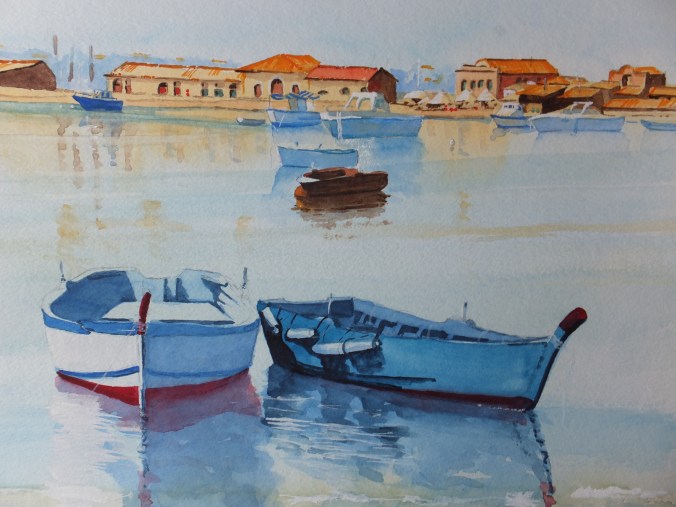
Marzamemi in Sicily: the finished painting

marzameni-finished-painting

Marzamemi, the fishing village near Syracuse in Sicily, almost a study in blue. The painting itself is more striking, but the photograph is as good as I can get it.

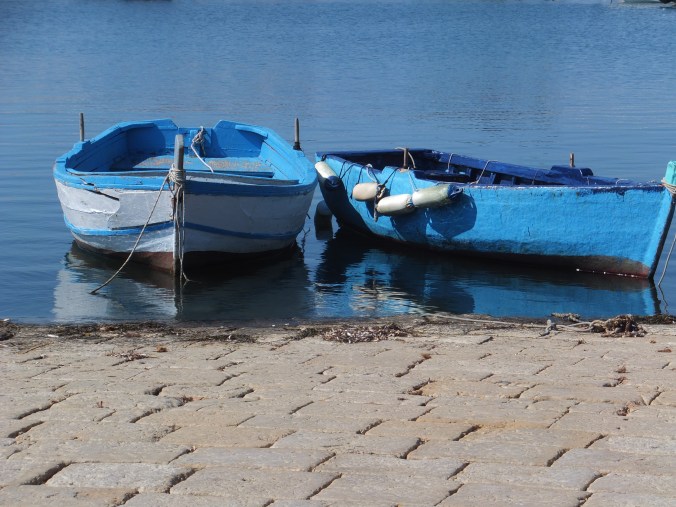
There is very little that I can add from the last post. I have detailed the boats in the foreground and you can check back against the original photograph. The only difference , I think, is that I have added a brighter red to the hull along the waterline.

I like it and it will be going into my exhibition in March

Next, well, there is one more painting of Sicily that I would like to try, and that is of the salt mills at Trapani. Salt is still extracted from the sea, by evaporation in salt pans. The majestic windmills that stand there still against the skyline no longer work, but they look marvelous. You couldn’t imagine the horizon without them

We will see how they come up in a painting

Marzamemi, Sicily: the story so far

marzamemei-part-way

The painting of Marzamemi, the fishing village in Sicily, which I have started and which is in its early stages.

Not much sky in this paicture which is useful, as I wanted the roof tops of the buildings to remain sharp if possible against the skyline. I used my old friend, the Mediterranean mix of Phthalo Blue and Cobalt for the sky, not wetting the paper beforehand, so that the colour didn’t run all over the place

I have tidied up the buildings to a certain extent and let the colour of the buildings bleed down into the sea. The sea colour is the same as the sky. I let that dry hard before going any further.

After a day or so, I picked up the painting again, and put some more colour into the sea. I avoided going over the reflections of the buildings, but just went over the rest with sweeps of sea colour, to give the effect of breeze ripples, I hope

I went right across the boats, risky I know but I think all the colours to be used on the boats will cover what I have done

Since taking this photograph I have introduced indigo into the foreground boats, for the detailing and deep shadow. I really want these two boats to come out at the viewer and command most of the attention.

Toying now which colours to use to be faithful to the original whilst at the same time, I want the combination to work as a painting. Winsor Blue perhaps which I haven’t used for some time, red along the waterline and white gouache. There will be some trial and error I think, so we shall see.

Every now and then I repeat that I am not an art teacher and have no qualification other than experience. I am very happy for people to watch, and if  what I do is helpful, then great. By the same token, I like to learn so alternative suggestions are always welcome

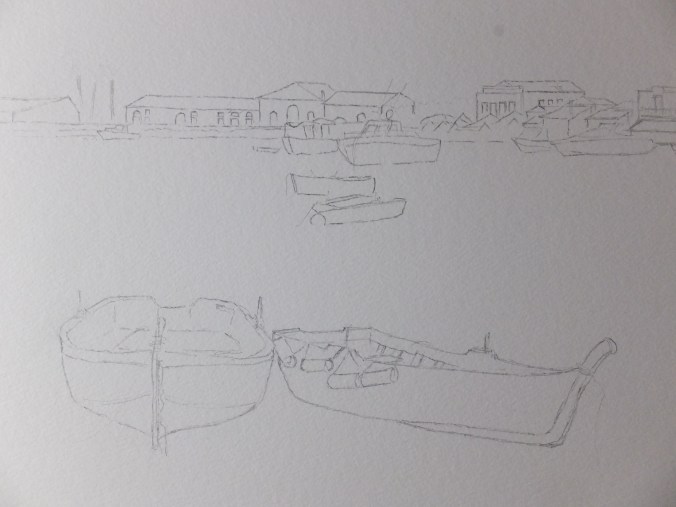
Marzamemi, Sicily : Composed Drawing

marzamemei-composition

Using the boat photograph and various other photographs which I took at the time, I have put together quite a simple composition, which I hope nonetheless will be effective

As a drawing, it is none too exciting, but when painted up, I am hoping that these bright, Mediterranean colours will provide the stimulus

With the exception of buildings on the far shore, nearly everything is blue or white. Different shades of blue, too, which will be challenging ( please excuse that overworked word) to do successfully as a watercolour

Textures will be interesting too. The boats in the foreground look as though their hulls have been reinforced with fibre glass, not too professionally, so that consequently the surface of them is quite rough. How to achieve that with a watercolour painting, I am not sure, probably with gouache applied thickly to give an impasto finish. Anyway we can play around with that.

We only had a short stop off here. Just enough time for a coffee, in one of the lovely little cafes in the main square, which was charming, and a walk round the harbour, which is a mix of boat repair workshops, restaurants and boutiques. That may sound an unlikely mix but seemed to work well.

Marzamemi is fairly close to Syracuse, the history of which is fascinating, and a chapter in itself. Around that eastern part of the island, we had spent quite a lot of time visiting spots used on location filming for the TV cop series Montalbano. If you are not familiar with the series it was broadcast from 1999 until now, something like 11 separate series, so very popular. Marzamemi was not one of those places, so something of a relief in a way. Don’t get me wrong, I have watched the series at home, and it is very good, and we knew what we were going to look at before we joined the tour, but there was a lot of it

As I say, I enjoyed watching Montalbano at home, except I would have preferred subtitles to a dubbed voice. Dubbing never works for me, always slightly out of sync, and you don’t have to be a lipreader to see the face doesn’t match the dialogue. I much prefer the Scandinavian crime dramas like “The Bridge” which we get which are subtitled.

But I am going off the point. Enough to say that Marzamemi was delightful and I look forward to doing this painting.

Paintings of Sicily

dscf3326

I really need two more paintings for my exhibition in March. I love painting Italy, and am going to pick two locations from our trip to Sicily last year. One lovely little spot was the fishing village of Marzamemi, which is on the southern side of the island, not far from Syracuse. Actually it is more for the tourists than anything else now, but there are some nice little boats tied up in the harbour, obviously old but cared for. They are not pristine, but I don’t want that anyway. What I prefer are something like the boats in my photograph, painted by hand in these bright Mediterranean colours. How to get that bright blue will be challenging in itself and whether I can capture that thick hand-painted effect will be another matter

I took several pictures, and I will have to cull bits and pieces for the far distance, which is the far side of the harbour. I can generate something from these for the composition. There are buildings like cafes on the shore as well as other craft both on and out of the water

It could be an interesting task putting these together, but as I say, making something out of all that bright blue will be fun

dscf3411

On the north west side of the island near the town of Marsala, is a quiet area where salt is evaporated from the sea-water in large pans. We watched the salt being piled high, and then being taken away for processing , with a constant shuttle of trucks. The mills are picturesque. I don’t think any of them work now, but they are still part of the scene

I thought I could make a painting from the pictures I took. I hope so, I will have juggle them about and see

I also bought two nice frames at a fair recently in a distressed finish, which look very Italian, so I hope that works out. I just have to get down to it

I received the brochure from the Tate the other day, and a new David Hockney exhibition starts next month, with special viewing times for members, which is me, which is a very welcome innovation. To be looked forward to

Notre Dame de Paris finished

notre-dame-finished

The finished painting which has had enough description already probably. An improvement on the first one so I am glad that I did it.

The little girl in the picture, modeled by my granddaughter, Lola,  although she didn’t know it, is struggling to put her hood up, so that she can continue chasing the poor pigeons. She loved to watch them take off as a flock, and then shortly afterwards settle back in more or less the same place again

The rest of my gallant family had gone into the cathedral, as the other grandchildren wanted to climb the tower. Lola didn’t want to, and frankly nor did I, so we stayed below on terra firma. My wife, who hates flying but doesn’t mind tall buildings, went with the others. I don’t mind flying but don’t like going up tall buildings. Curious really.

I prefer looking at cathedrals, studying the architecture, and trying to imagine the history surrounding the building. My first thought was of the wonderful story written by Victor Hugo, “The Hunchback of Notre Dame”, and visually for me, going to see that wonderful film in 1956 of the same name, starring Anthony Quinn and Gina Lollobrigida. Quinn played Quasimodo the hunchbacked bellringer, and as a schoolboy then, I was very impressed as Quasimodo sat astride each bell in turn, urging them on like horses. An exciting story, which has been remade subsequently.

On 18 March 1314, Jacques de Molay, with others was burned at the stake in front of this cathedral. He was the last Grand Master of the Order of Knights Templars, an organisation of warrior monks, formed originally to protect pilgrims visiting the shrine of the Holy Sepulchre in Jerusalem.

Pilgrims no doubt rewarded them, as they became rich, as religious orders so often do. They were astute money managers and became in effect, international bankers, lending enormous sums to crowned heads of Europe.

They became super rich and powerful, and thus attracted enemies, including the then Pope Clement V. It was alleged that the Templars had started to identify with their Moslem counterparts, and accusations of heresy were made. Without doubt Templars learned much from their eastern contacts, especially in the field of architecture. What they learned was kept a secret, always suspect, and laid the foundations to the Masonic Order.

Philip IV of France, taking his cue from the Pope started to arrest Templars. Also please note that he owed fortunes to the Templars who were pressing for payment. Templars were tortured horribly to obtain confessions of heresy. De Molay himself confessed to stop the pain and retracted afterwards. He was ordered to be burned at the stake, and it was so arranged that he was consumed very slowly by the fire. Most died within minutes

De Molay at the stake, cursed those who had colluded in his murder, that they should die within the year, and their descendants meet a violent end likewise. Clement V died the following month, and Philip IV had a stroke whilst hunting shortly afterwards. Philip’s descendants did meet premature deaths, so much so that the Capetian line died out

I snap out of my reverie, Lola is still chasing pigeons, and everything seems normal again


Notre Dame de Paris :Halfway

notre-dame-halfway

After another false start which I won’t go into, I decided to paint this subject in a vignette style, which I quite enjoy for a change. When there is a lot of peripheral detail which you just don’t need, this is a good way of getting rid of it and just focusing on the main subject.

I also happen to think they look attractive when they are finished, and certainly they seem popular with everyone

Talking of detail, I had to simplify the facade of the cathedral quite a lot, as even with a small detail brush, there is a limit to what you can include, bearing in mind the perspective.

I have chosen to depict the scene in soft winter sunlight, which is possibly my personal favourite. This is the sort of day that gently warms the stonework, and when the sun leaves long shadows on the ground and along the sides of buildings.

For the base colour of the stonework and of the square in front of the cathedral, I have used my typical mix of raw sienna and Naples yellow. For the shadows on the buildings I used violet ultramarine, and as they became deeper like some of the recesses on the cathedral, I toned the violet down with some Transparent Brown. For really dark corners I went over this again with pure violet straight from the tube.

Blue with a dash of brown to provide the grey slate roofs, and some cadmium red pale for the awnings of the restaurant next to the cathedral, finishes what I have done so far. I will echo the red amongst the figures in the foreground, either bags or jackets, so that the eye gets led into the centre of the picture.

Putting the shadows into the figures will be next. Detailing some of the foreground figures will be a long job, and how I’m looking forward to those pigeons, not. Still every painting is a lesson, so we shall see what I get out of this one