Istanbul along the Bosphorus Waterfront

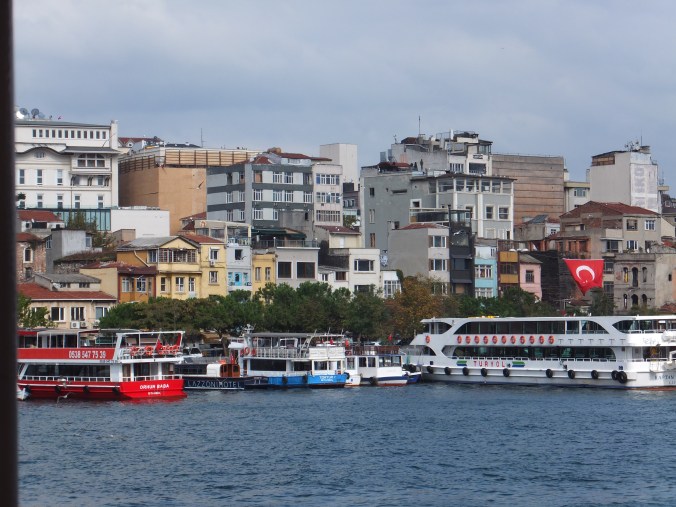
We were here in October, and cruised in a small boat gently along the Bosphorus Strait for about an hour. There were any number of picture opportunities and ideas which I have brought back.

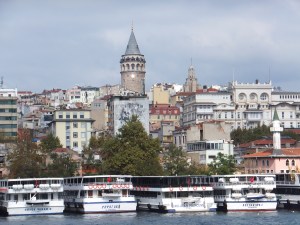
I have picked for now, three shots of the waterfront with its variety of buildings. These are consecutive frames which I hope to piece together to make an interesting composition, and finally a painting

Istanbul Bosphorus 1


Istanbul Bosphorus 2

Istanbul Bosphorus 3

Just not clever enough to get them in a line but the idea is there. I need to get a painting measuring about 45×30 centimetres out of these three frames, so will be fun sorting out the drawing in the New Year

Old Albury Church in Surrey

This is a post that I had wanted to do earlier, but never found time for, so I’m catching up before the year end

Not far from where we live, in Surrey, flows the Tillingbourne river which is idyllic now, but in the 18th century was an industrial river, punctuated with mills producing everything from flour to gunpowder

One of the many villages along its length is Albury, and we went one day in late summer, with a friend who was staying with us to look at Albury Old Church. This is one of those mentioned by Simon Jenkins in his wonderful reference book “England’s 1000 best churches”

It is one of those places that has an interesting story. The church stands next to the old manor house, and until 1782 acted as the parish church for the village. The new incumbent of Albury House, one Captain William Finch RN decided to enclose the village green, annexe a large section of the churchyard, and then set about harassing the villagers, until they moved about a mile to the west. Where they settled became the village of Albury today.

In 1839 the then owner of Albury House,  Henry Drummond, the banker, built a new parish church for the villagers and Albury Old Church was closed . Today it is maintained by the Churches Conservation Trust, and is a redundant church

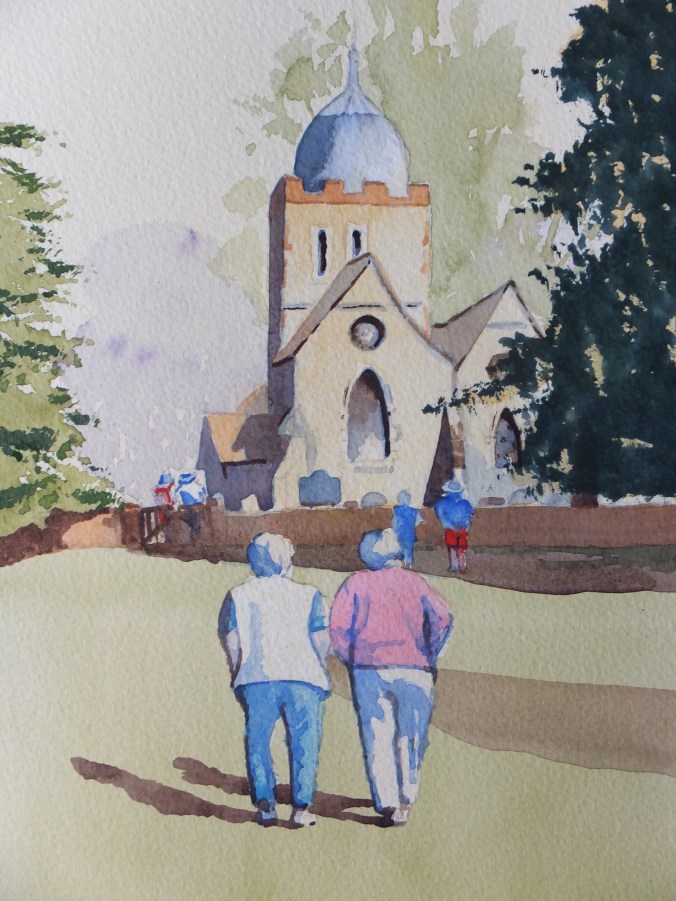
Before I talk about the church, let us have a look at an image, which is my painting done shortly after our visit.

Old Albury Church

The nave is Saxon and the tower is Norman. The dome was a later addition from the c18

A lot of interesting things associated with this church! One rector of Albury, William Oughtred, was also a famous mathematician. He invented the slide rule in 1622 and is also credited with the introduction of the x symbol in multiplication. He was also the tutor to the young Christopher Wren, who was later a mathematician and astronomer before becoming known as an architect.

Henry Drummond engaged Augustus Pugin in the 1840’s to build his mortuary chapel within the 13 th century walls of the existing transept. This is regarded as a remarkable example of the work of Pugin, perhaps better known for his collaboration with Sir Charles Barry on the then new Houses of Parliament.

The entrance is on the north side which is unusual. On the south wall interior is an amazingly well-preserved Medieval wall painting showing St.Christopher. It was customary during the Middle Ages for people to look in the main door at the saint, who was believed to give them good luck on their journey.

I took a picture of the wall painting, which I will show.St Christopher Wall Painting at Albury

Most of these paintings were washed over in the Reformation, but this one survived somehow

As regards the little painting I showed earlier, there is not too much to say about it. I would just mention, as you can probably see, that I have used brown for the shadows. This is my “hot-weather shadow” reflecting the temperature of the day. I quite like doing a painting as a reminder of a day’s excursion as sometimes it captures the mood better than a photograph. That doesn’t stop me sending it to exhibition and selling it if someone wants it, though

To anyone reading this post, thank you, and have a very good Christmas and a lucky new year

Langstone Harbour: The Finished Painting

When I finished the last post, I was about to put in the background trees and then the shadows on the buildings themselves

The trees I painted with a fan brush with crinkly bristles. Wide brushes like these are useful, as they can be used to pick up two colours at once, in this case French Ultramarine and Light Red. I used Sepia as well, where I needed to create definition, along the side of white buildings for example.

Imagining a low, bright light coming from the right-hand side, I used a blue – grey wash to put in shadow on every left-hand surface of each building including shadows that would have been cast on the ground. On the mill tower, which is round obviously, and which in real life is black, I again wanted to create the effect of bright light striking the round surface.  To get this effect. I painted blue-black down the left side whilst down the right half I brushed clean water. Then I let them meet. They did the job for me, and obligingly dried as I wanted. Along the left-hand perimeter, I brushed a thin line of neat Indigo, which gave the look of deep shadow on the far left.

Probably best to look at the image at this stage.

Langstone Harbour & Mill

Sadly, the camera leeches out some of the colour no matter how many different lights I use for the photography. The colours are subtle, anyway, so notices on the jpeg, whereas the painting itself works perfectly.

As I said, when I started out, I was going to attempt the style of Rowland Hilder, the famous watercolourist. I have used his colours, but I think my own style has crept through. Nevertheless, I am still happy enough with the finished painting

So let’s talk through the detailing

On the left-hand building, I have defined the window recesses with Indigo, as well as the guttering and down-pipe, and the roof line with Sepia

On the centre building, again I defined the roof-line and painted a rickety fence in front of the sluice gate. I may have mentioned earlier, that this was a tide mill as well as a windmill, so seawater flowing through this tunnel would have powered grinding machinery somewhere. I can’t tell you more than that, I’m afraid, as these buildings were derelict when I was a boy in the 1950’s, and had been for many years, so nobody knew their history. Thankfully, they were restored for residential use.

The right-hand building took more work, as the space underneath where the house is standing on brick stilts, is very dark, and took various coats, even using some black eventually. Window recesses were defined as was the balcony.

It just left the masking fluid to be removed, and to paint in the posts and flag, which was a splendid opportunity to use Cadmium Red, nice and bright to guide the eye into the picture. The gulls were tinged with grey under the wings and black at the tips. We were done!

I hope that you enjoyed this long journey. Thank you once again,  for reading my blog
Pirbright, a paintable village, conclusion

I had to finish yesterday’s post rather abruptly, as time was against me. Sorry about that

Every year the village holds its annual Scarecrow Festival. Villagers compete in producing scarecrows, sometimes commemorating a tableau of some event or perhaps depicting a well-known person.

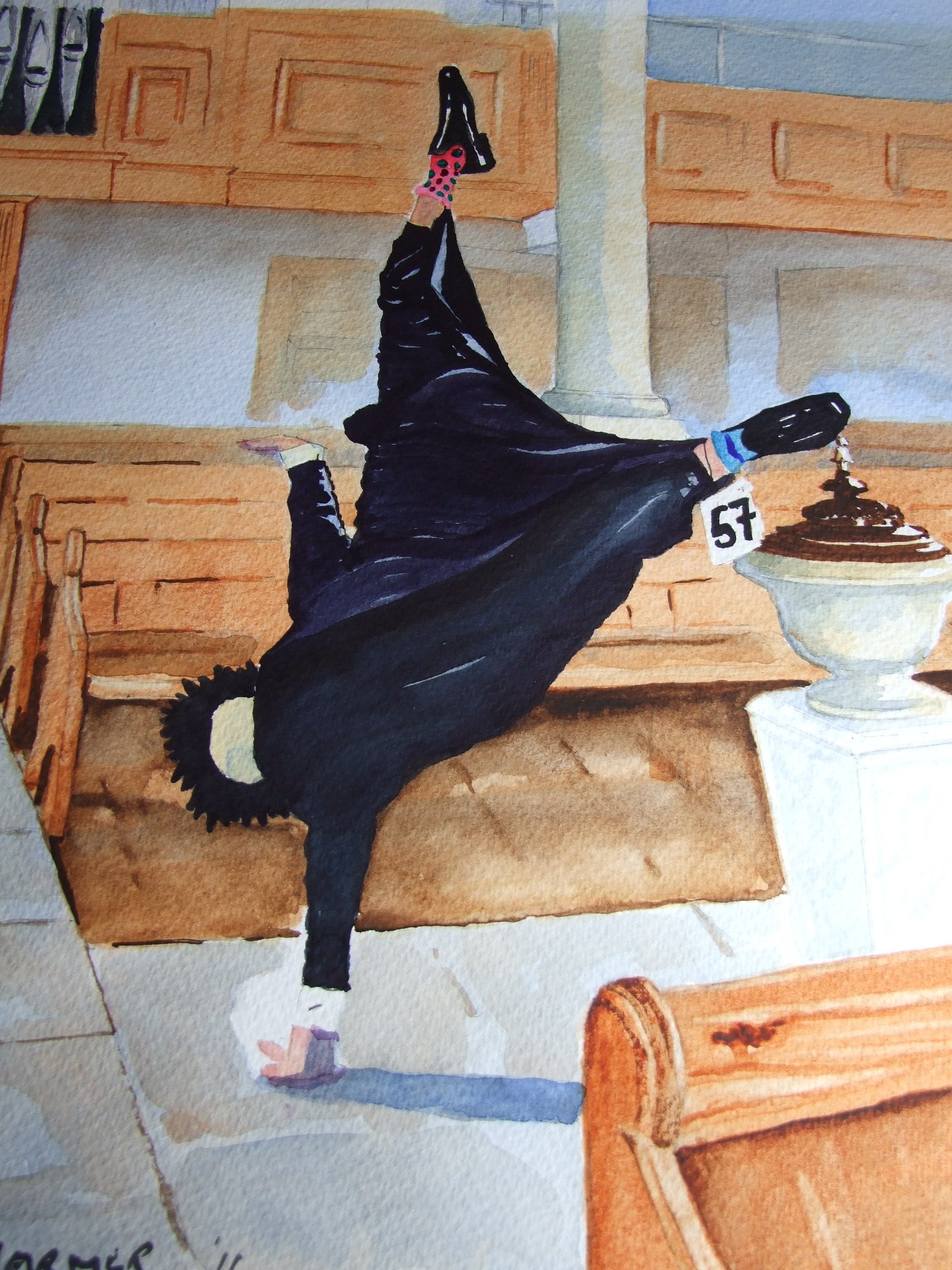
In the year of William’s marriage to Kate, a tableau of the wedding was made in the parish church. Also, you may remember, if you watched the wedding on TV, that after the ceremony, as people were filing out of the abbey, the Dean did a cartwheel for joy along the centre aisle. He was also immortalised as a scarecrow and so too was the bellringer. Pictures follow hopefully

Paintings various 025Paintings various 027Paintings various 030

They were all good but I was particularly taken with the Cartwheeling Dean, and decided to use him as a model for a painting. If I can upload successfully, I will show you the finished article.

Cartwheeling_Dean

I was pretty pleased with the result. I fully expected to sell him at a local exhibition. Not a bit of it. Serves me right for being overconfident. No interest whatsoever locally, and in my reckoning, outside of the Pirbright area, who would want him?

I decided to cut my losses and put him up for auction online, where he sold for little money. A gentleman in the north-east of England bought him, which I found surprising. He wrote to me afterwards, and said that every morning he would look at this painting, and it would cheer him up for the day.

Accolades like that are sometimes worth more than the money (but only sometimes)

I am not long back from cruising around Turkey and Greece, and have brought back some good reference material for future paintings. One of the loveliest places we went to was the island of Corfu, and I have just started sketching out a drawing of a lovely little shopping lane in Kerkyra, the island capital

One of my favourite watercolour artists is Alvaro Castagnet, who depicts Mediterranean street scenes so brilliantly with his skill with lights and darks. I am going to try and emulate him, if I can, although I doubt if I will be successful. What I am going to borrow are some of his colours for mixing his “rich darks”, so a different pallette to what I am used to, which will be interesting if perhaps risky.

That will be something that I will share in my next post, probably nearer the end of the month. Until then………..

Pirbright, a paintable village in Surrey

I mentioned in my last post, that I paint regularly with the Pirbright Art Club, and that their next exhibition is on December 5th and 6th

In itself the village is interesting, and has all the ingredients that painters love, a church, a village green with pond, some interesting houses and of course, good pubs

I have painted most of these and they have generally sold well at exhibition. The church is favourite, and my third version was shown in the last post, which will go to exhibition in December. It will probably nose-dive because I said that!

In the churchyard lies the grave of Henry Morton Stanley, the British American explorer who found Dr.Livingstone in 1871 on the shores of Lake Tanganyika, as it was called then. His grave is marked with a massive monolith, with the inscription, amongst other things, Bula Matari or Breaker of Rocks in Congolese. Apparently this referred to his ability to crack problems, no matter how insuperable they appeared

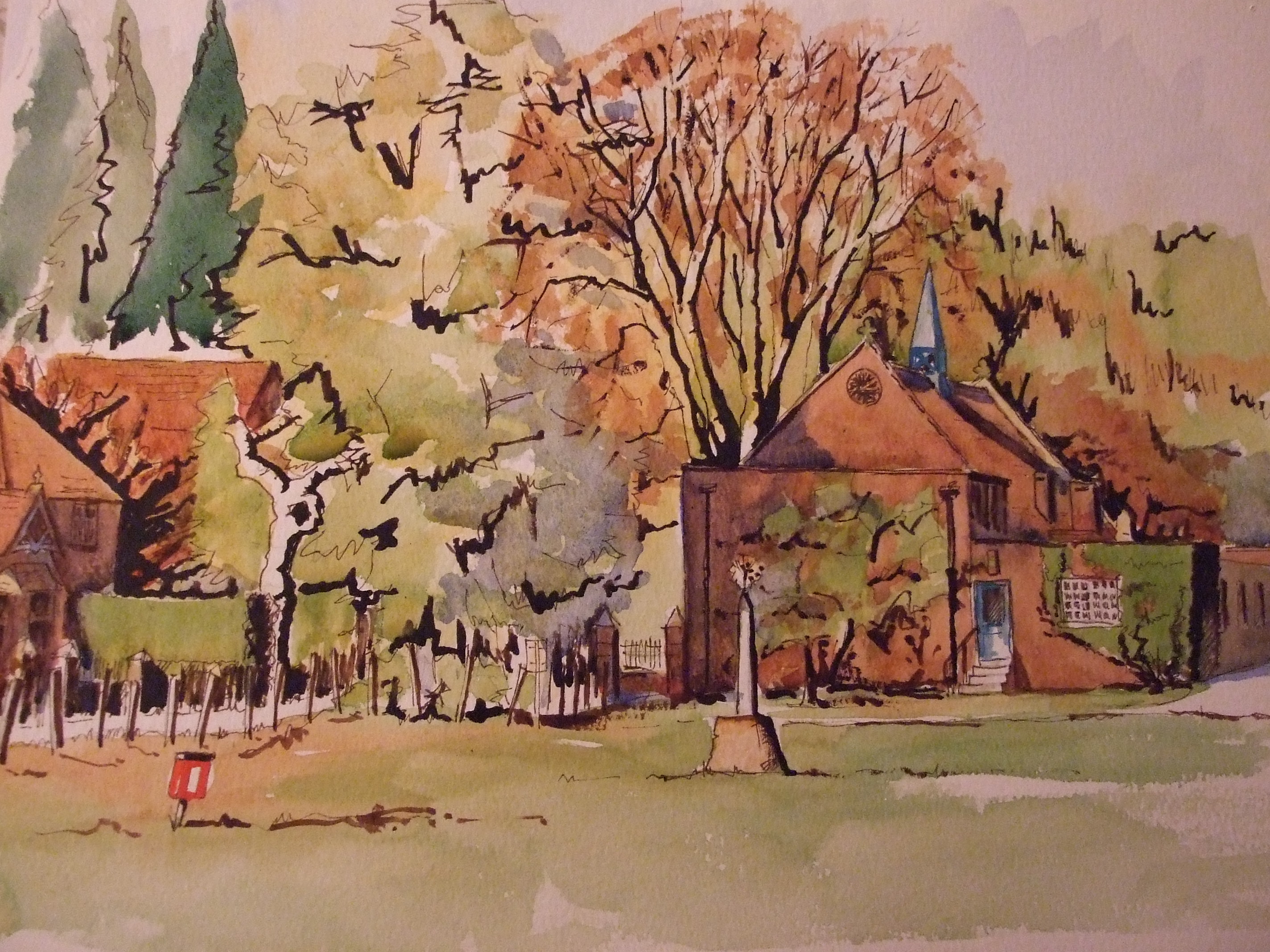
Lord Pirbright's Hall

The painting shown above was of the village hall in Pirbright, which I did in ink as well as watercolour. Ink is a lot of fun, and this reminds me that I haven’t done any for ages, so must give it another go

The other painting is of the church, on one of those rare occasions when we have snow. I sold this last exhibition. I can’t be lucky again

I shall have to cut this post short, as I have to pick up my grand-daughter. I had wanted to talk about the annual scarecrow festival which is impressive, and led to paintings, but will have to keep for next time

Pirbright Church in Winter