Spinnaker Tower painting drawing stage

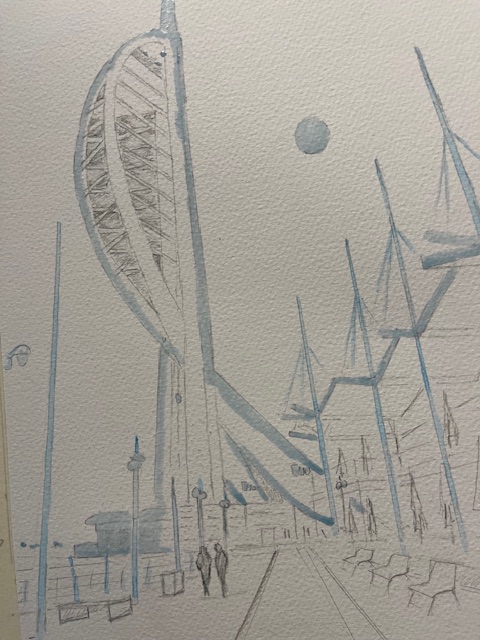
This is the drawing so far and even this took some working out. There was an awful lot of masking out to do. The tower itself has had to be protected as the night sky will be darker than the colour chosen for the tower itself.

Likewise the gables on the rooves over the shops on the right hand side have had to be protected. I don’t usually like a lot of sharp edges in a painting, preferring to let colours blend, but in this case it has been unavoidable. Plastic or metal edges really have to be shrp otherwise just look wrong imho.

I am apprehensive about starting the painting on this one, especially the sky. If that doesn’t work, and I have to start again, then I will have wasted a lot of time. Let’s not go there. I have retrieved worse situations

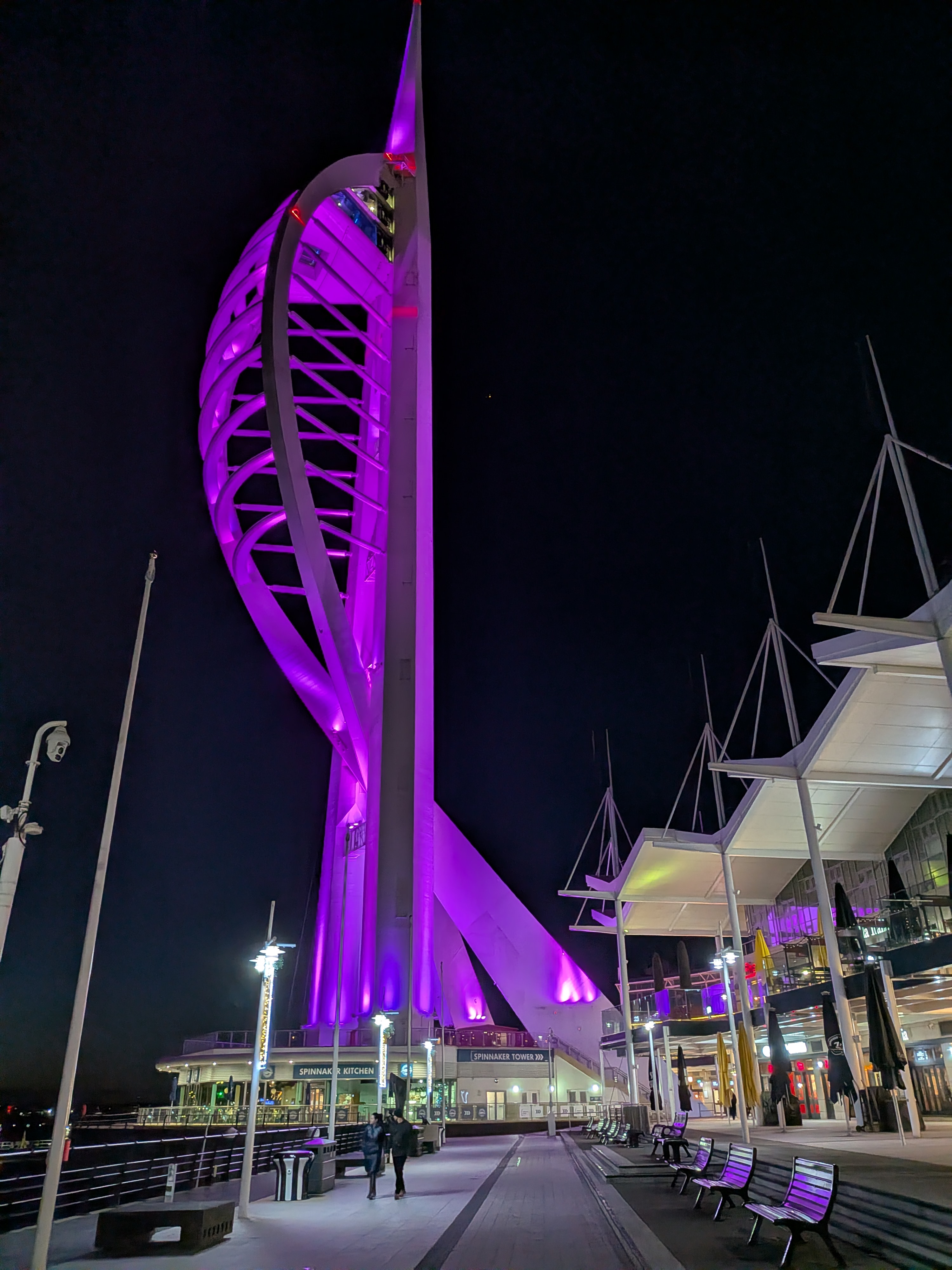
Spinnaker Tower Portsmouth at Night

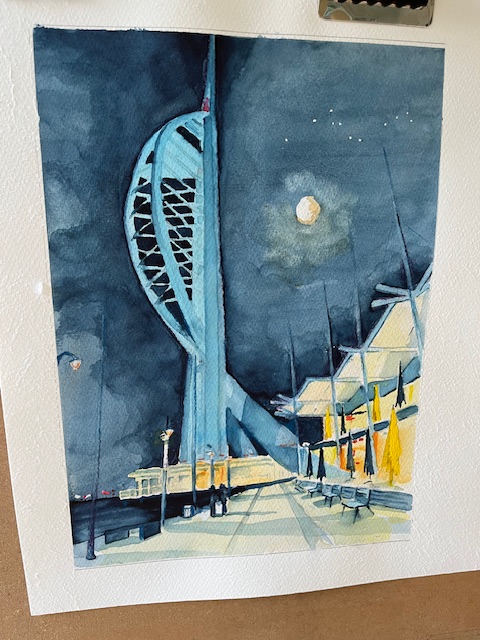
This must be one of the trickiest commissions that I have ever accepted, and one which questions my wisdom. Firstly working out a colour for night black, and it won’t be black ,has not been easy. Black in large quantities I find tends to flatten the painting, unless it is a raven glossy black which works for many things but not sky imho. Then what colour to use for the illuminated tower itself, and there we have a certain choice of watercolours that have a luminous quality, but which one to use against which night sky that is the question.

This is the client’s photograph btw and is a very good one in terms of composition. So many aren’t and refreshingly I have little or nothing to change other than possibly including the moon, which i have agreed with the client. Perspective is intriguing which I like. All those lines going towards the vanishing point will be fun to work with

I have done various trials and have shared these with the client. For the night sky I looked first at a midnight blue colour, definitely steering away from black per se. To mix a midnight blue I am using indigo with a touch of Payne’s Grey, which is a blue black colour, and is useful. A lot of artists avoid Payne’s Grey but I find it useful at times. in fact that was the other contender for the night sky, as it is not quite black, as I say more of a blue black colour. So that was my submission for the sky. Now for the illuminated tower. The colour needs to be luminous which is not that easy with watercolour. I chose in the end pthalo blue and as an alternative, permanent rose both of which would work. I also glazed pthalo blue over rose just to see what would happen and again the result was workable

The client came back quite quickly. She preferred the indigo version of midnight blue and also the pthalo blue for the tower. I was relieved about that, as both were my preferred option, and in neither case did I lead her in anyway

So I know which direction I am going in, and will proceed with the painting. I will come back about that although probably not too soon

Painting of my home village

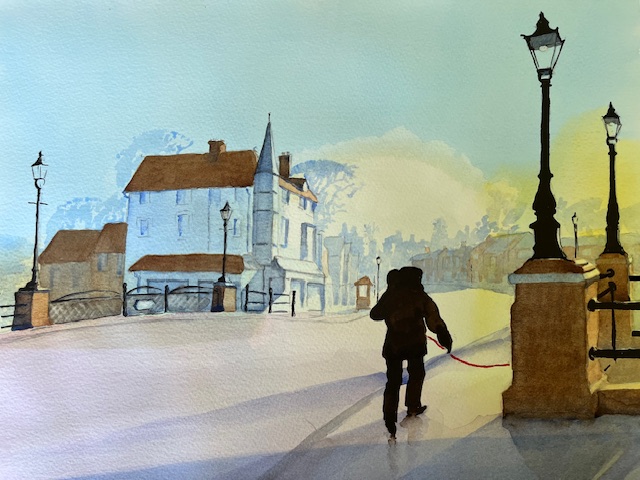
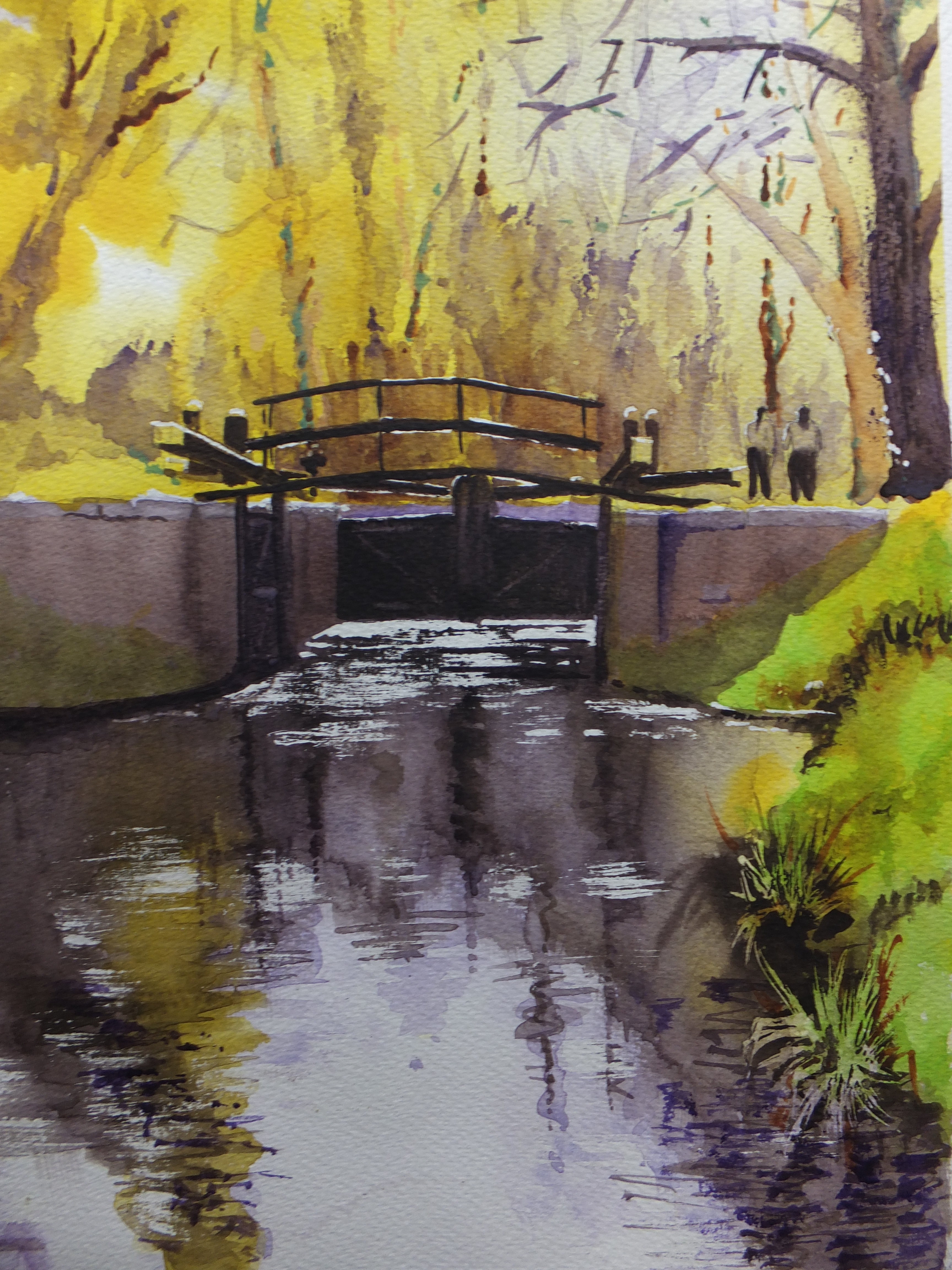
This is the centre of my local village, St John’s near Woking. The name St John’s was taken from the local church, built in the c19 by the then rector of Old Woking, as a chapel of ease for the village inhabitants. Quite a long walk to church otherwise in a century when no one had transport.

The village is mostly Victorian, and although surrounded by suburbia, does still retain its village atmosphere and integrity. Life started here in the late c18 when the canal was cut through open heathland. In the distance in my picture, the road makes a hump, as it crosses the canal. This is Kiln Bridge, where as the name suggests bricks were made from local clay, and these were used in the building of the canal. The canal was intended to link London with Southampton, but only reached Basingstoke before the railways were built and superseded canals. This was still a time when war with France was a possibility, and inland links with major south coast ports were desirable.

Today the Basingstoke Canal is maintained by Surrey and Hampshire County Councils. There is some leisure boating but not much. Wild life proliferates and the towpath is used for cycling and walking.

This is the very first time that I have painted my own village. I don’t know why. I put this painting on a local website and had more than 240 hits. All complimentary, I am pleased to say. No offers to buy though.

In the middle of the picture is our comparatively recent coffee shop, which has become the hub of village activity. Walkers and shoppers meet there to relax and catch up. We never had that before and it is a very welcome addition. We do have a pub but located going out of the village, so not so convenient. We have most shops so a useful selection.

At the bottom of my lane, we are blessed with a green open space, called St John’s Lye. Lye, lea or leigh means a green space. It is common land and so protected although we did have to physically resist Woking Borough Council who wanted to build a village hall on the Lye to replace the one that was starting to fall down. Eventually common sense prevailed and the new hall was built on the site of the old one. The Lye is available to all age groups for spontaneous activity including dog walking.

And so you have it. Not a place that many know, but loved by its local population

Southsea Pier Sunrise in Watercolour

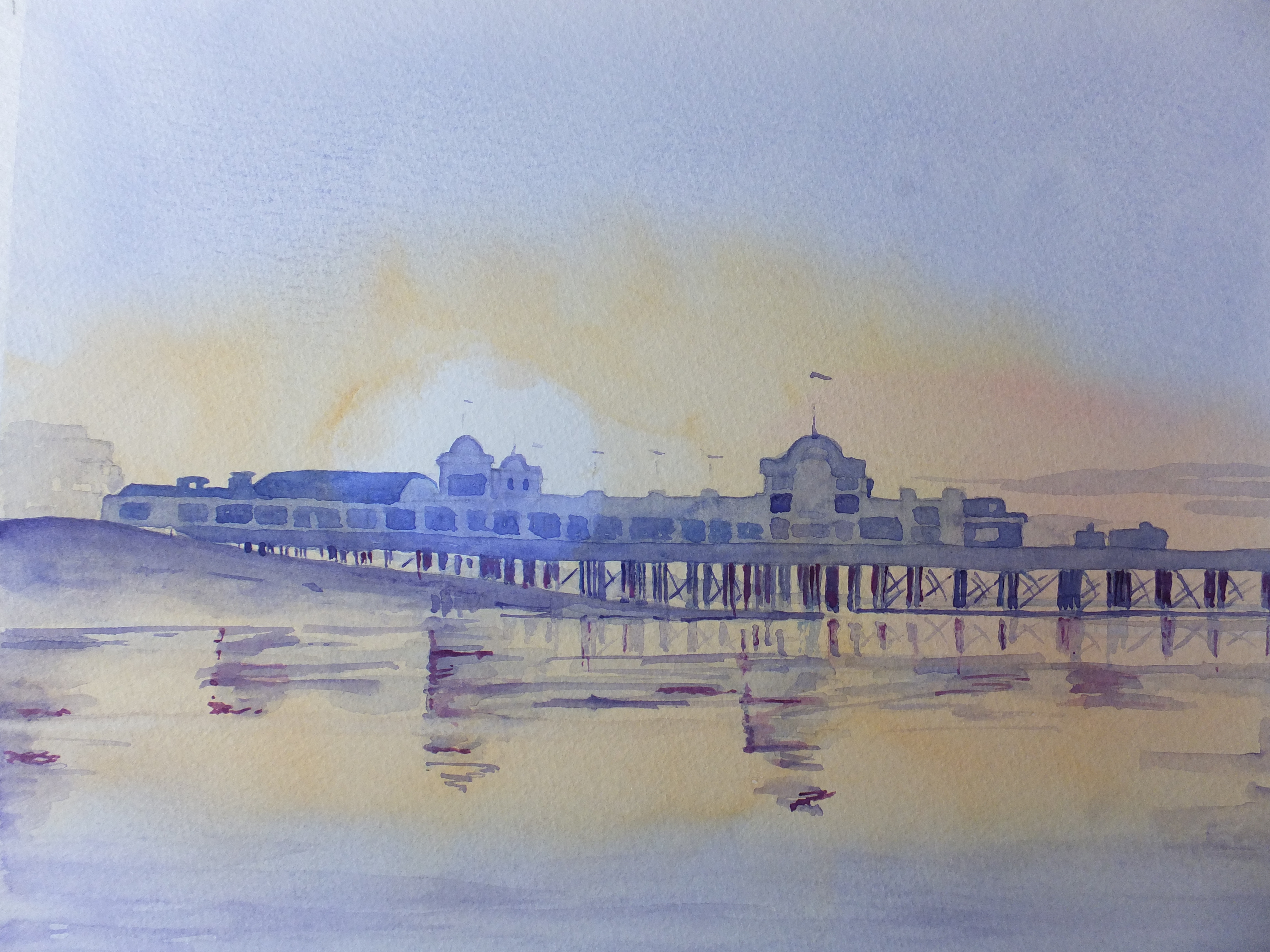
Sunrise over South Parade Pier in Southsea

A favourite place from my childhood. We were taken there and allowed to play on the gaming machines, which were not very sophisticated in those days. I remember putting in one old penny which was the pre-decimal currency, so value today, one half of a new penny. The aim was to flick a ball bearing round at speed and see where it landed, hopefully in a slot which gave you a payback. As I say, extremely unsophisticated

This painting relates to the reference photograph which I posted last time, which I was kindly allowed to use by Vicky Stovell of Smiley Sunshine Photography.

I used few colours. Cadmium Orange, Ultramarine Violet, Dark Mauve and Cobalt Blue. I combined the blue and the violet for the sky as well as the wet sand at the bottom of the picture. The uprights for the pier were in deep, deep shadow so i used the dark mauve, instead of black which I avoid where possible.

In order to get the bright sun image, I held a tissue in place with one finger, and then applied the first wash. There are probably better ways of getting that result, but that was the best I could think pf at the time

This painting will be going in my September exhibition at Denbies Wine Estate, so hopefully will freshen up the collection

I have another Istanbul painting in preparation so will post that at a later date

Langstone Mill in Evening Glow

A favourite place and a favourite subject. My boyhood was spent in the area, and Langstone was a favourite haunt. There was and is, a lot for boys to do here, bathing and canoeing, digging for shellfish and running from aggressive swans when we interrupted them on the nest. It is an historic place. It was the ancient port serving nearby Havant, the main town about a mile inland. I say ancient. Coal was still coming in here from the north, in the early part of the twentieth century. Today it is just a delightful creek, used by sailors and photographers, and of course painters.

The tower is what is left of the c18 windmill. The sails were removed in the c19, and the building left to rot. The building to the left of the tower was the original grain store, and the one to the far left was the tide mill. In the 1930s the mill was rescued by the famous artist Dame Flora Twort and restored for residential use. The architect was Ernst Freud, well-known for his work in Germany and later in London.

Langstone Mill has a connection with Neville Shute, the novelist, who lived here during the last war, and did some of his writing here. Shute was an aeronautical engineer, and was a director of a company making aircraft in nearby Portsmouth

I have painted this subject many times. On this occasion I tried something slightly different, and used Quinacradone Gold which puts a glow in the sky, which you get with early evening. Then I added the long shadows which hopefully finish the effect

Canals of Venice

Venice Drawing

Today my colleague in paint, Elaine and I set up our joint exhibition at the Royal Surrey Hospital in Guildford. I have to say that it did look good. It will be on for four weeks, and now one has to forget about it, which is never easy, as it is so tempting to check one’s emails

Having said that my exhibition work is over for a while, I am reminded that on the 29th July, our local club, the Pirbright Art Club are holding their summer exhibition. We call it the “Railings” as we hang our paintings from the iron railings around the old village hall. It does look quite effective

However all my best stuff is at the hospital and will be until mid August, so a bit of a problem

There was a Venice picture which I wanted to do, and I have attached the photograph as well as my line drawing version of it. I am going to try and complete this by the 25th when we have our “auditions” for this exhibition, so at least it will look as though I am trying to support our local show.

The photograph, I found startling, with the brightness of the colours and the deep shadows, both complimentary and both fascinating to attempt. Some lovely deep oranges and some texture work with these bright colours, should be very satisfying to do. There are too some really good architectural shapes, such as the Gothic window which I hope to give more prominence. I have omitted the window next to it, shown in the photograph. The architectural iron work of he balconies is a study in itself

Anyway that is my next task, which promises to be fun

Dewdrop on Leaf Exercise

Dewdrop on Ivy Leaf

Now that my exhibition work is finished pro tem and before I go away for a while, I thought I would look at some exercises that I have been meaning to do, yet never found the time

This one I owe thanks to Susan Neale who did this demonstration in the Paint magazine some while ago.

She mixed the leaf colour with indigo and lemon watercolour. I have to say, one of the most accurate dark leaf greens I have seen and I have included a real leaf in my picture to compare

Using her own words, more or less:

  1. Using the dark green mix, paint the leaf shape with a no 7 brush. Add the veins using a mix of white gouache mixed with the lemon yellow ( I did add a little of the pale green too)
  2. When dry, draw the dewdrop shape. Now with dark green colour add the shadow area at the top of the dewdrop. Soften the shape with clean water and allow to dry
  3. Paint the cast shadow at the base of the dewdrop, using a darker shade of green
  4. To finish, using the white gouache, apply a rounded dot to the top of the bubble and a highlight to the bottom end


As for my attempt, well, could improve with practice perhaps

A useful little detail if you can master it

Close up of dewdrop

I won’t be posting anything for a while so don’t get upset if I don’t respond

Fishing Boats at Beer in Devon

Fishing boats

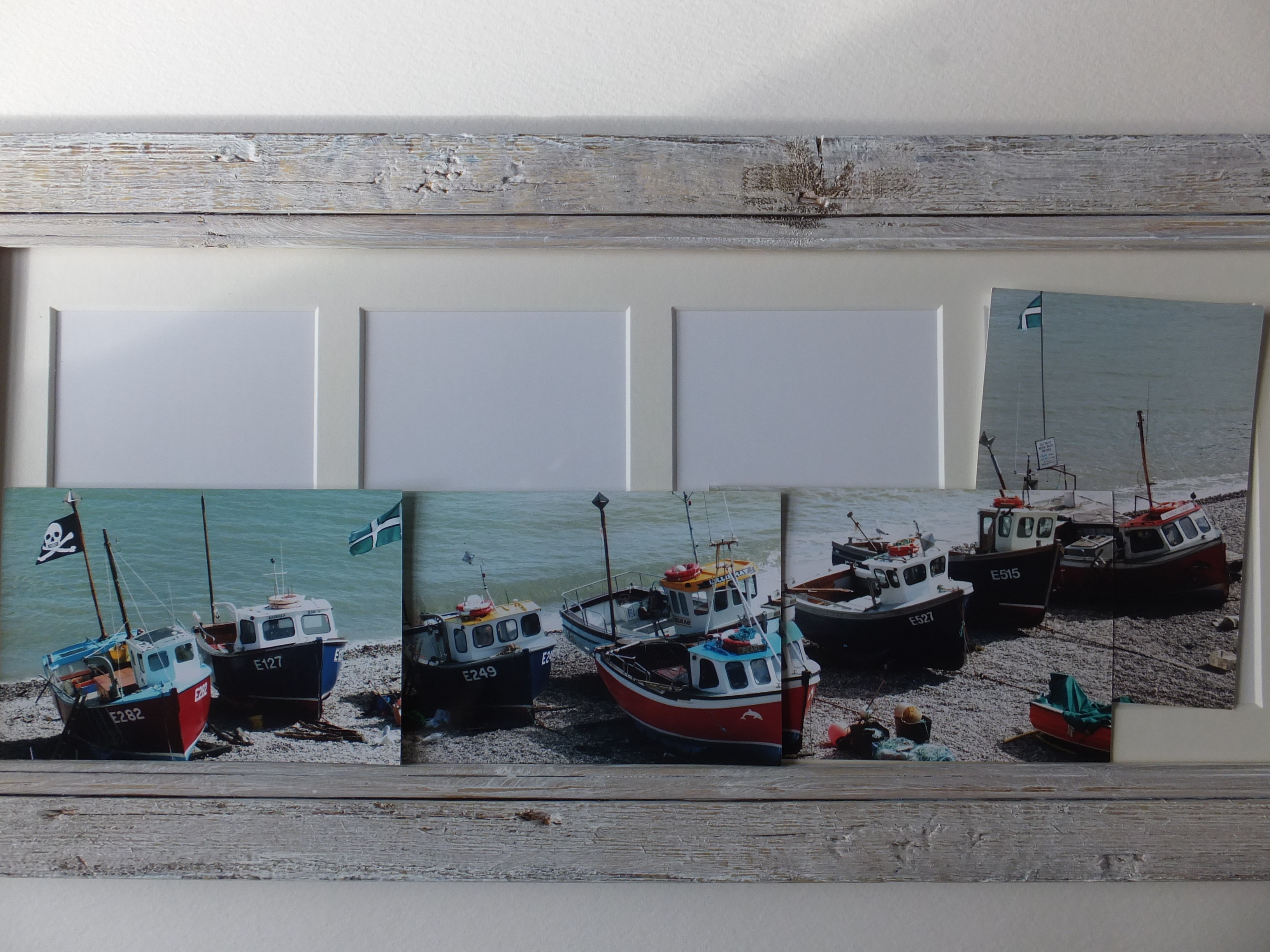
Years ago we went to the delightful little fishing village of Beer on the south Devon coast. These colourful boats were drawn up in a line on the beach, and I photographed them in several frames, as I have shown here

I painted them once and showed them. That painting sold. A year or two later, someone picked the painting out from the web site, and commissioned something like, so I painted something similar but not the same

At a craft fair recently I bought the frame in the photograph. The beading is Italian, heavily distressed and in a driftwood finish. The mount is split into four spaces, and is obviously intended for photographs.

It reminded me of something I had seen not long ago at an exhibition. An artist had used a frame like this using a long painting, which looked very effective, I thought. It obviously needs a long horizontal subject, which reminded me of the line of boats at Beer, so I am going to try it out. It may not work, as the spacing of the boats may be wrong, but I will try it anyway

If it turns out well, this could be my twelfth and last painting for the July exhibition, so we shall see

Zoom in

Venice Painting Completed

Venice Painting Completed

The finished painting with San Giorgio Maggiore in the background, which I enjoyed doing, although trying to hit the right colours was testing to say the least

I have already mentioned the mooring posts. In the photograph they looked red in the evening light. This turned into a glazing exercise, wet on dry, although nothing like as tricky as the hull of the gondola which I will come to in a minute

For the posts I started with a Burnt Sienna wash which is pretty safe. When the paint had dried, the pigment had disappeared. I applied another coat of the same colour, followed by a coat of Permanent Rose which should have given these posts a nice evening red glow, but still pasty. I had been waiting to use quinacridone red, of which I have a fairly limited experience, so perhaps risky. The colour worked well, I thought, giving me what I wanted. I used Indigo for the strips of bark hanging onto the wood. Indigo makes an alternative to black which I avoid if I can

Now the real challenge, to use that overworked word, was how to treat the hull of the gondola. I may have said before that gondolas are black by regulation. The finish is of a very high gloss, the sort one sometimes gets on pianos, in fact it used to be called piano finish. I think polyurethane was involved which may have been universally banned by now because of health risks.

Black gloss in certain lights obviously won’t look black, because of the other bright colours it picks up in this mirror like shine. If you remember the original photograph that I worked from, the vessel looked a sort of bright copper colour.

Again this was a long and drawn out glazing exercise. At least five coats as I remember and twenty four hours natural drying in between each coat. I used Quinacradone Gold, Burnt Sienna, Van Dyke Brown, Transparent Brown and Permanent Rose

I looked at it in the morning from a distance. I think it worked but I will have to put it away and get it out again another time, before I can make an objective view

As always comments are welcome

Venice Painting so far

Venice painting to date


Not the best of photographs I am afraid

The sky is much pinker than the picture shows but try as I might, I can’t stop the camera leeching out the background colour. Also too much camera distortion making the posts lean inwards which I will try to correct on the finished version

What I did to colour match the original photograph, in which the sky and most of the water is a deep salmon pink, was to brush all over first with a red-orange mix, which did dry quite pale. I then built up with dilute coats of alizarin crimson until I reached the depths of colour that I wanted.

When that was hard-dried, I started on the background buildings, the church of San Giorgio Maggiore, always a favourite. Being in deep shadow I gave all the buildings a wash of French Ultramarine, and then another one. When that was really dry, I painted the rooftops and brickwork in Burnt Sienna.

The mooring posts I started with Burnt Sienna, but I wanted them to be more red than that. I glazed them with Permanent Rose. They were still too brown, so went over them again with quinacrodone red ( it doesn’t matter which way I spell that word, it always seems to be wrong). This was getting nearer the shade

I now had the colour relationship between the foreground posts and the background church. I felt the church could go darker still, with another coat of Ultramarine, and this time bring the wash down a little way over the water, to cast a shadow. There is one small building in front of the church, which I think is the customs house, which in reality stands well out on a promontory coming towards us. I missed this out with the last coat so that it didn’t disappear altogether

That is as far as I have gone as yet. I still have to darken the posts and finish the gondola, probably with some indigo on the seating. How I tackle the hull, I still have to work out, so we shall see.