Exhibition at Royal Surrey County Hospital

Brewery Dray

Brewery Dray in Guildford

When we were breaking down the exhibition on Friday morning, I sold this painting at the last minute. A young woman arrived breathless with the money and bought it. I was very pleased with this as it raised my score for the whole exhibition to four paintings sold. Not the best that I have ever done but not the worst either, and certainly quite respectable.

The other three were Strolling through Montmartre, Grand Canal Venice and Painshill Park

Paris and Venice are always popular, especially the well-known landmarks. I have almost lost count of how many of each that I have sold. Painshill Park is a new subject for me and I was heartened to sell this picture, as I now feel encouraged to paint some other views, of which there are many to choose from

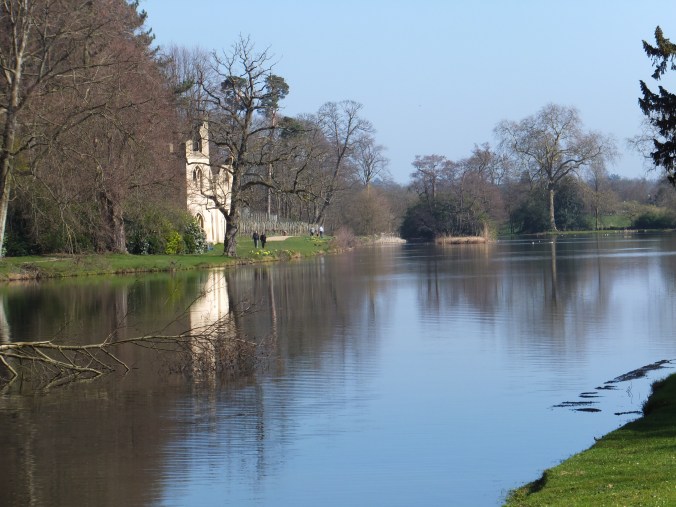
Painshill is a local estate near Cobham in Surrey. It was laid out in the c18 by a man called Charles Hamilton. It was in the style of a natural landscape made popular at the time by garden architects like Capability Brown and Humphrey Repton. The views were sculpted, whole forests were planted, fake ruins were built and rivers were dammed to form lakes.

Hamilton worked a lot with American species of trees. It was interesting to note that you could import a “box” of plants from American nurserymen, suitably packed to withstand the rough and long sea voyage. Many did survive and are still flourishing in the park today.

Over the years, the place deteriorated and became overgrown. In the 1950s it was rediscovered and lovingly brought back to life. Every year there is a new project. Recently the old boat house was rebuilt using old photographs. The previous year one of the bridges was replaced using an old painting as a reference. I attach my painting

PainshilL Park, Surrey

This was an unwary group of people feeding the Canada Geese by the lake at Painshill. There are literally flocks of geese of different species, as well as ducks and swans. Always a lot of activity on the water. In the background is one of the strategically placed follies, which I think is the Gothic Chapel

I am starting to whet my own appetite for painting here again!

DSCF0985

A different view of the lake with a different ruin which could make a good subject. Wants something in the foreground though. I have umpteen swan pictures from which to choose.

I have a commission to do and then I might tackle this one

Thames Estuary Sea Forts: Finished Painting

Sea Forts Thames Estuary

This is the finished painting

I had intended to post another work in progress shot, but as I got into the rhythm of the painting, it was as easy to finish, and more interesting to look at anyway

I had one false start, which normally I wouldn’t admit to. I decided the sea looked too pale and insipid, so I scrubbed back the bottom half of the platform legs, so that I could paint over the sea again and deepen the colour. Especially the area around the platforms needed to be darker even though it wasn’t in the photograph. I used Viridian mixed with a little Lamp Black for the sea colour, which works well I always think, with a nod of thanks to Rowland Hilder.

This alteration did leave me with two hard lines which normally I would have been able to blend. I have disguised them a bit with white caps, so not too bad

As for the structures themselves, I used Burnt Sienna with a little Crimson to get close to the colour of rust, and drybrushed as much as possible to look like rusty paintwork. The very deep shadows on the platforms I did with Ultramarine Violet, neat straight out of the tube with as little water as possible and straight over the rust colour. The barnacles at the bottom were painted with Olive Green, but still not dark enough, so I overlaid with the Violet.

There were some red marks where brackets had been fitted, which was probably red oxide base coat in its day. Again some Crimson, with a little free expression, seemed to get that effect.

This turned out better than expected, I am pleased to say. I have learned from it, and it was a welcome change from the usual scenes. Not a painting anyone is likely to buy, so pure self-indulgence really.

Sea Forts Work in Progress

DSCF2988

So far, I have put down a base coat of Cobalt Blue/Phthalo Blue mix right across. I fixed the horizon with a vague idea of coastline. One or two small details were masked out. There is a small buoy next to one leg of the first fort, which will be white eventually. One or two girders or rails facing the light will be pale blue when the mask is removed.

It may not appear so in the photograph but I have washed over the sea, with a dilute Cobalt green, and then rubbed in Raw Sienna at the base of the towers, as the sandbank is visible through the water

With the shadows on the metalwork, I have allowed myself to experiment and used a mix of Cerulean Blue and Ultramarine Violet, a combination I have not used before, but only read about. This makes a pleasant shadow colour, although whether it suits old ironwork is another matter. Some people put shadows in afterwards, and it is a personal choice. I find putting in shadows first gives me a dimensional image to start with, which I find helpful

I couldn’t get near the pale green colour of the paintwork on the towers. I used the Cobalt Green over the original blue wash, and will hope for the best. Time now to work on those delicious rust shades, which I hope will bring a touch of reality

I have absolutely no idea how this painting will end up

Thames Estuary Sea Forts

Pirbright 098

I have just finished the work for my second exhibition which I set up tomorrow in the Royal Surrey Hospital in Guildford, for anyone living close enough to go, this will be on for a month. All new work, so hopefully enjoyable

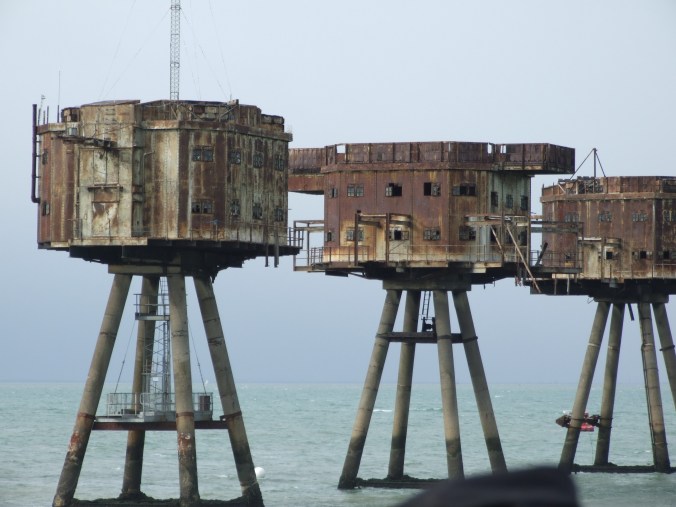
With that said and with a couple of weeks spare before I start my next commission, I am going to indulge myself and tackle something totally different, namely the Maunsell Sea Forts in the picture above. These are in the North Sea about nine miles out from the Thames Estuary, and loom like ghosts in the mist as you approach them

They were designed by a civil engineer called Guy Maunsell, and had a short but intense life during WW2. Built in 1942, they were erected on sandbanks, and commanded the estuary of the Thames, so they protected London and the Kent coastline from low-flying attacks by the Luftwaffe.

After a spell as a pirate radio station in the 1960s, they relapsed into disuse and as far as I know nothing is being done with them, probably because they are out of sight and so out of mind. There were seven of them, but one was hit by a Norwegian vessel and had to be taken down

We went to see them some years ago on a one-off trip organised out of London. This was on a paddle steamer called the Waverley, which originated from the Clyde as I remember, but would sail round the British coast and would organise excursions from various ports. This one was from London. We started in the Pool of London, sailed through Tower Bridge which was novel at the time, although I think cruise ships do this quite often now, and then chugged down the Thames, stopping only at the end of Southend Pier to pick up some more passengers. The voyage continued out into the North Sea , passing a surprising number of ferry boats at anchor, mothballed until they were needed. The forts slowly came into view through the sea mist. Very atmospheric indeed

I thought I would paint them one day, and have finally got round to it. Not something that is commercial, although I may get a surprise, but that doesn’t matter. This will be an interesting project in itself, tackling all those rusty surfaces, and hopefully capturing something of the mood which the photograph has missed somehowPirbright 091


Finished Painting entitled Christmas Shopping:Guildford High Street

Signed revised Christmas Shopping Guildford High Street

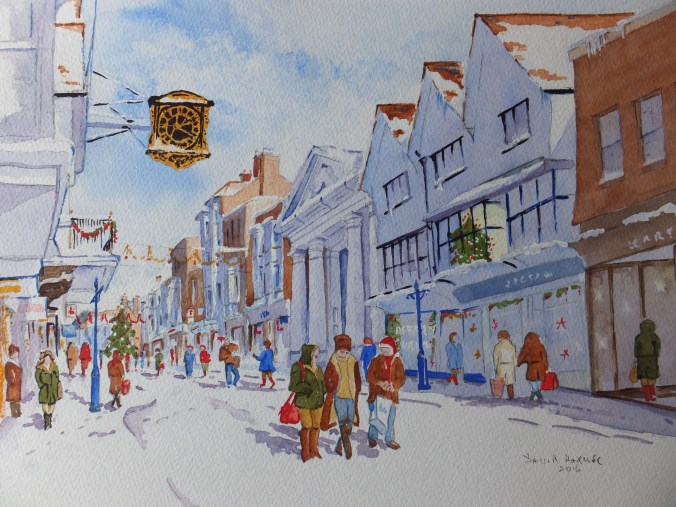
Christmas Shopping: Guildford High Street

The historic High Street of Guildford is always a joy to paint. This street is actually Saxon in origin, although nothing that early remains above ground. The plan of the street though goes back that far, and the dimensions of the actual plots are still the same

There are still buildings from the c13. The iconic clock which I have mentioned before is dated 1683, when the facade of the old Guildhall was restored. A relative newcomer, the classical arch in the centre was built in 1819, and was the last corn market in the town. Known as the Tunsgate Arch this was built on the site of the old Tun Inn, one of the many coaching inns in the town. The Tun Inn went bankrupt and was demolished in 1818. The columns used to be equidistant until the middle two were moved to accommodate motor traffic in the 1930’s. In the 1990’s the arch was closed to motor traffic, and paved over. To celebrate the twinning of Guildford with Freiburg in Germany at the time, the coats of arms of both towns were let into the floor in mosaic.

This painting was commissioned by a charity called Cards for Good Causes, and I am pleased to say has been approved, and will go forward for reproduction as a Christmas card.  They will be on sale in pop-up shops in every town in the UK from 18th October onwards.  Details on their web site. The proceeds are distributed amongst 25 well-known charities and should you wish to support, thank you.

An extremely detailed painting which has taken me some time to complete, but enjoyable nonetheless. The framed original will also go on sale in support of the above


Winter Street Scene Current Progress

Winter Street Scene Interim

Well, I have made a start with the painting, after staring at the drawing for ages.

The blue sky is in. As a bright winter sky, I am happy with that. There will be shadows, quite long ones for that time of the year. The shady side of the street has had one wash of blue but is still quite pallid. Those shadows will have to be deepened considerably, if we are to get the effect of bright sunshine over the rooftops. I think I will put a little red in with the blue next time, which I prefer as a shadow colour, when I glaze over the existing

The large white space in the sky is, of course, the large clock. This I will have to redraw and paint as accurately as I can. I have done the clock a few times now. I tend to do it freehand, and I have always been lucky. Watch it go wrong this time, as I have a lot riding on it.

This clock, if I haven’t mentioned it before, has become the iconic image of Guildford. It dates from 1683, and was the gift from a London clockmaker called Thomas Aylward, who wanted to set up in Guildford, so presented this as a gift to the town to accompany his application. Today we would call it a bribe. It hangs from the old Guildhall, just off the picture to the left, a building which served amongst other things as the town law courts until well into the twentieth century. The clock works perfectly today, and is lovingly maintained.

Back to the picture, quite a lot of laborious masking out, to preserve the snow on window sills etc.That took a lot of time with little to show, but happily we are on with the actual painting now, so starting to see something taking shape.

Quite a lot of detail in this picture, and I am taking my time, just doing a little, letting it dry, so that I get the true colour, and then going on from there. It is hard to say when I will finish, but I have promised it for the end of the month, which once looked a long way off, but now doesn’t. Oh well, crack on.

Winter Street Scene Initial Sketch

High Street Winter

This is by no means the finished drawing, but is plenty for me to transfer onto watercolour paper. I like to leave some freehand drawing still to do on the final sketch before painting. It seems to preserve the spontaneity somehow.

I have dressed the figures suitably for the winter, thanks to online catalogues. There are Christmas references and of course there will be snow which won’t show properly until the colour goes in

A lot more detail to go in, as I say. Some buildings are still to be completed, and there will be more figures further down the High Street. Not too many so that the composition looks cluttered, but hopefully enough to make the street look busy

Not only do I have the tedious job of moving the sketch onto watercolour paper, but I must soon start thinking about colours.

The sky will be a wintry cloudy blue. The time will be early afternoon, so still some watery winter sunshine with long shadows. The painting will not be grey. Colours are visible. Shadows should be blue especially on the snow. I need some oranges and reds. Brickwork and roof tiles will help. Some of the snow will be sliding off the rooftops, as a very gradual thaw has set in

Clothing? Some olive greens perhaps and some browns. One or two red anoraks dotted up the High Street. Also one or two red Christmas hats and some red spots on Christmas trees and in shop windows

Let us hope that all goes to plan

Watts Chapel and Gallery, Compton

Watts Chapel,Compton

Watts Cemetery Chapel, Compton, Surrey designed by Mary Watts

The winter street scene of Guildford is going to take me some time. Not only do I have to use my imagination, which is not my strong point, I also have to do a fair bit of research and also calculation, which I have to take my time over.

This does give me an opportunity to post something local which we visited not that long ago, which is Watts Cemetery Chapel or sometimes known as the Watts Mortuary Chapel.This is in the village of Compton, near Guildford in Surrey. I painted the above after our visit. Financed by the famous Victorian painter, George Frederick Watts, through his paintings,he donated it to the village of Compton.The Watts Gallery is also nearby. Recently restored after years of dilapidation, it houses a wonderful collection of his paintings and sculpture. The chapel was designed by his wife Mary Watts who also oversaw the building

In 1895 Mary started giving evening classes to the villagers at their home Limnerslease, teaching them how to model the local clay, and producing decorative tiles in terra cotta. They modelled the symbolic and beautiful patterns that she had designed, which would be used in the interior decoration of the chapel. The chapel she designed is in the Arts and crafts Style, the nearest we get in England to Art Nouveau, although I maintain many of the interior details are really Art Nouveau

In England, we never really had an architect who epitomised Art Nouveau, as they did in Scotland with Rennie Mackintosh. I sometimes think Mary Watts was our Art Nouveau heroine.

Close by, her husband’s gallery. A very famous Victorian painter, G.F.Watts, known for allegorical and symbolic works. His paintings hang all over the world, yet many are here at Compton, and this gallery is so worth a visit.

If I were to be asked to pick a favourite painting, it would be that very famous one “Hope”. There are many to choose from, but this female allegorical figure, clutching a wooden lyre with only one string left, is very poignant.

There were two versions painted and when we were last there, the version from the Tate was on loan to Compton.

This painting has been an influence on many great names. On Picasso during his Blue Period for his hunched figure The Old Guitarist, is one example. Martin Luther King referenced it in his collection of sermons. Nelson Mandela allegedly had a copy on the wall of his cell in prison on Robben Island.

Later in the 1980s the painting was the subject of a lecture by one Dr.Frederick Sampson in Richmond, Virginia who described it as a study of contradictions. One Jeremiah Wright apparently attended the lecture and in his sermon in 1990 on Hope, coined the phrase “audacity of Hope”. Having attended the sermon, Barack Obama adopted the phrase later as the title for his 2004 Democratic National Convention keynote address, and more well-known to most of us, as the title of his second book.

I think the quote runs something like : to have one string left and to have the audacity to hope that you can still make music

How some things echo down the ages!800px-Assistants_and_George_Frederic_Watts_-_Hope_-_Google_Art_Project

Hope

Critics of the day called it Despair but obviously missed the point

Preparing the Winter Street Scene

Guildford High Street

This is the photograph that I am going to use as a reference for my winter street scene. I may have already mentioned that I have been asked to do this by a national charity, to be used as a Christmas card for fund-raising, so rather thrilled to be involved.

I have already used this photograph to produce a hot weather painting, similar to what is already depicted. That worked well and sold recently from my web site. You can see it if you want in my gallery. I now have to transform it completely, and all I can use is imagination, which for me, is never easy.

I have to add snow. Well, that is ok. I have done that many times, and that is fun, so I will enjoy doing that. I now have to imagine everyone in warm weather gear. The weather here is warming up slowly, and people are starting to walk around in light clothing. Already I cannot remember what people look like in heavy coats and hats, so I have been looking at web sites of winter overcoats for women and men, as well as hats and boots

I did some sketches straight off the screen. They are very rough so I will have to ask you not to be too judgmental as they are just to use as a guide when I put figures into the painting. I may even change some of the figures altogether, although I think the three in the front centre work quite well

I am attaching, I hope, my squiggles on winter overcoat designs and winter hat styles.

This is as far as I have got at the moment, so will come back when I have something more to say, which will hopefully  be a first draft tonal sketch of the whole scene

DSCF2951

Sketches of Winter Coats for Women and Hats for men and Women

DSCF2950

The Finished Venice Painting

Peaceful Reflections of Venice

This is the completed version. I call it Peaceful Reflections of Venice, because that is what these quiet corners of Venice are, very peaceful. The city can be busy, but then turn off into one of the side canals, and you are alone with your thoughts.

This should give me enough now for both exhibitions, I hope. The first I may have mentioned already starts on May 3rd, so some framing and stuff to do now, and then hopefully I should be ready. Guildford Institute is a lovely, friendly venue to show at and always attracts good publicity. Sales are never high there but as I say, the coverage is good, so I still like to do it

Following on, on 27th May I am at the Royal Surrey Hospital in Guildford, in the Peter Thompson gallery. Sales are usually good there as the place is so busy. Having built up this stock, I am looking for sales now of framed pictures, just to give myself space to carry on painting.

Quite a few lovely people from around the world have written in to say how much they enjoy watching the painting come together in stages, starting with the drawing and ending with the finished picture. Thank you for that feedback. That is so helpful. Sometimes I think I sound like a teacher, which I am not.  I have no teaching qualifications, but I am happy for anyone to watch me paint, and if that helps, that is fine.

Some useful reaction to the website over the last few months. Three sales and two very interesting commissions. The most recent which I shall start first because of the deadline, is from a national charity, for a painting of a local high street in snow, to be, hopefully used as a Christmas card. I shall donate the work, of course, but nevertheless, the publicity will be valuable

This will take me a little while to work out but I will post in stages as time goes by.