Paul Nash and the Turner Prize Finalists

Hoping to go to the Tate Britain Art gallery tomorrow, weather and circumstances permitting to see amongst other things , the Paul Nash exhibition

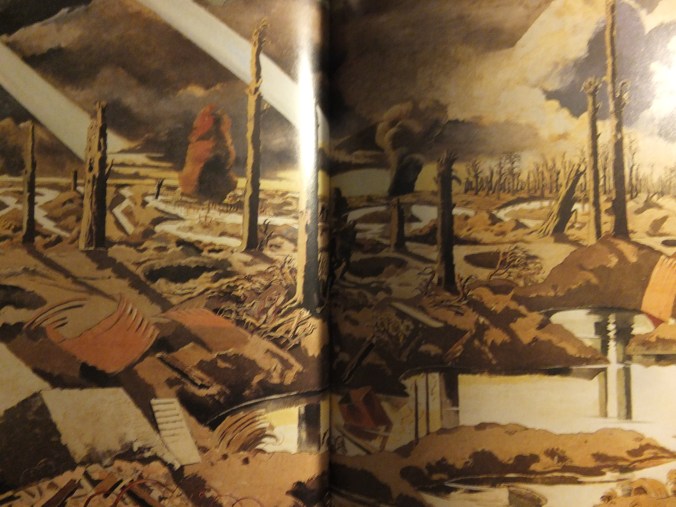
Paul Nash, known as a war artist covering both world wars, not as a documentary reporter, but with his own surrealist style, was also a superb landscape artist in his own right

In fact an artist of many facets

I shall look forward to writing about him and his work when i have learned more myself

Bosham Harbour: Second Version, Preparatory Drawing

bosham-preparatory-drawing

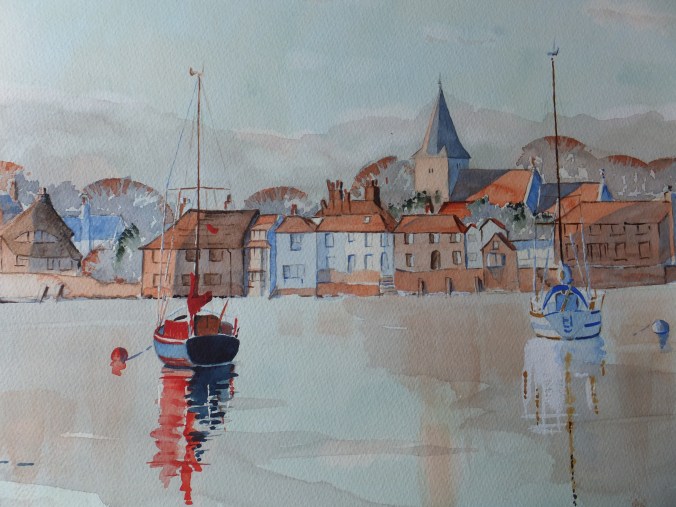
I painted Bosham Harbour in West Sussex as a commission a few weeks ago. I painted it in evening light which I hadn’t done before, and was very pleased with the way it turned out, and relieved too seeing as it was a commission. The colours worked exceptionally well, and I was left wishing that I had something like it, to include in next year’s crop of exhibitions.

Using a number of different photographs, some of my own and some from different sources, especially the boats, I compiled the composition which I have drawn above. The church and houses I have thrown back into the distance, and extended out at the left past the boat house. The boats themselves are entirely different to my previous painting, so everything will be new, which I prefer.

One day I will be stumped as to how to paint Bosham Harbour without referring to something I have painted previously. There are other views, but this is the one people always want, with the church in the background and boats in the foreground. Move along the coast, I suppose, but there is something about Bosham which is hard to find elsewhere. Perhaps it is the historical associations with Saxon kings like Cnut and Harold, with the symbolic Saxon church as a reminder, or maybe just the sheer charm of the place, that makes it difficult to replicate

Anyway, I am going to attempt this composition as a watercolour painting and see what happens. I shall use my previous painting as a colour guide but may still experiment along the way, but still the objective will be to create a painting in evening light

We shall see how we get on

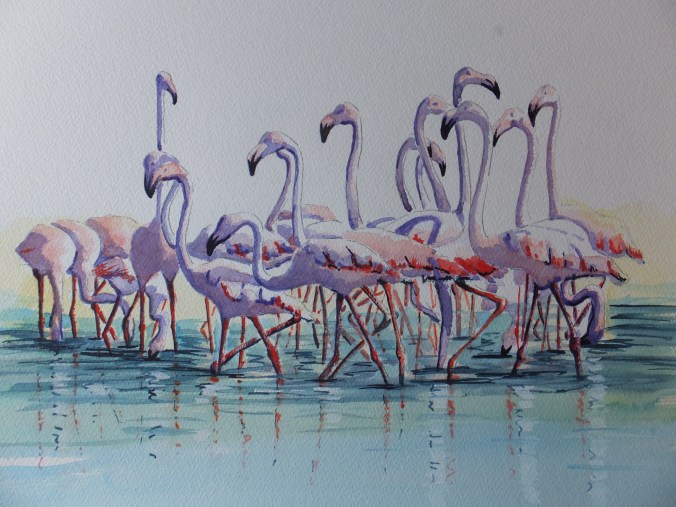
Flamingos in the Camargue: Finished Painting

flamingos-in-the-camargue

This follows on from the last post on flamingos which just showed the preparatory drawing. I think this is one occasion where I prefer the coloured version to the black and white. The colours are really vivid

We were in the Camargue region in the Rhone estuary watching the white horses which I have already painted, and also the flamingos which breed there. This is apparently the only place in Europe that flamingos breed, although I have subsequently seen them in Sicily. Matbe they were just stopping over.

Curiously these flamingos were more white than pink, which is the image we tend to have of these birds. I have probably used more pink wash than necessary in order to get some definition between the birds. In actual fact their heads were pale pink, whilst under their wings they were bright red/orange. I used cadmium red for these markings and that was spot-on accurate

The legs again were a very deep and bright pink. I read somewhere of someone using permanent rose with some cadmium orange to get a good flamingo colour. I tried that and got cadmium red !  Oh well, two routes to the same destination, which is not necessarily such a bad thing.

I started with a light pencil drawing taken from the original sketch. I used violet to put in the shadows on the birds and on the water, which gave me the form to base the painting on. Underneath the birds, and running down the paper, I laid a very dilute wash of Windsor Yellow, as an  experiment really, which I was glad of later, and I will explain why when I get there.

I then started to put in the red markings, and the birds started to take shape. I put in reflections of the legs in the water. I left this for 24 hours to harden off, and then laid a dilute wash of phthalo blue and cobalt mix, for the water. Over the yellow, this glaze turned a soft green, and I think, made a better water colour The red reflections showed through and looked convincing. So far so good

The shadows on the water made by the birds, I deepened with Indigo. Likewise some of the deep shadows on the birds and especially on the legs, I put in with Indigo. The same colour worked well for the tips of the beaks

So there we have the finished painting. I keep looking at it and thinking it looks bright but then again it was a bright subject

Always pleased to hear from anyone else who has experience of painting these colourful birds

Exhibition in Woking Lightbox: The Camden Town Group

dscf3467

This painting is by Robert Bevan 1865-1925, one of the the Camden Art School, painting as the name suggests in North London during the Edwardian period

This painting is entitled Dunns Cottage and was painted in Devon, although Bevan was just as at home painting in London, usually horse fairs and horse drawn vehicles. Bevan studied in Brittany in Pont Aven painting alongside Gauguin, and the influence on this painting is plain to see, large blocks of flat colour and unrealistic shades

Other artists represented at this exhibition are Walter Sickert, sometimes known as the father of them all, Spencer Gore and Ginner

Rather like the French Impressionists a few decades before, the Camden group painted contemporary scenes of city life, the streets, theatres, places of entertainment like pubs and circuses. Sickert portrayed young women in the nude at their toilette rather in the style of Degas, who was a great influence. Non erotic portraits of women in dingy surroundings were something he often came back to, as though the flatness of their life was something which fascinated him.

Preparatory drawings of the figures for his famous painting Ennui are also there, a study of tedium and of people trapped in their lives

dscf3470

The Balcony, Mornington Crescent  by Spencer Gore (1878-1914)

dscf3475

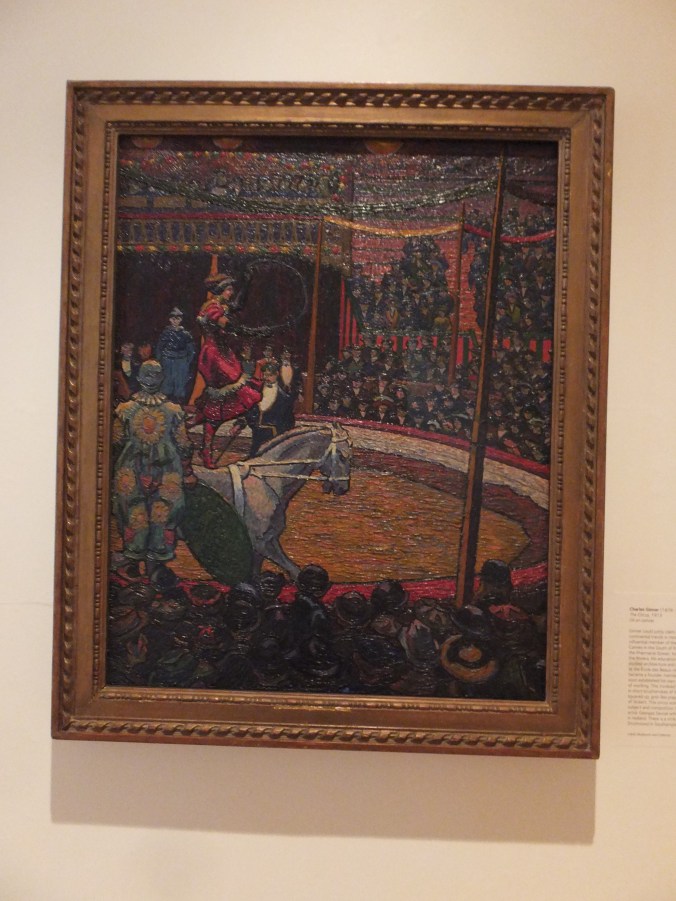
The Circus by Charles Ginner (1878-1952)

Ginner was born in Cannes of a British father who established the Pharmacie Ginner. His brother was a doctor on the Riviera . Ginner himself studied art at the Ecole des Beaux-Arts and was influenced by the French art of the day. The circus was a favourite subject, and this picture can be compared by one of Seurat, which is in the Kroller Muller Museum in Holland

Ginner moved to London and became an influential member of the Camden group

The quality of exhibitions at the Lightbox continues to improve, and well worth a visit if you are in striking distance. The other exhibition one floor below, on the History of the Comic, extremely informative and comprehensive for those interested in graphic art

Flamingos in the Camargue: first sketch drawing

flamingos-in-the-camargue

I took a number of photographs of the flamingos when I was in the Camargue. None of them were usable, so I took this group from someone else’s picture as the birds had formed a natural composition which, I thought, would make an interesting painting.

This is just the sketch done in my favourite Payne’s Grey. What is it about black and white, that I often prefer the sketch to the finished painting

They breed here apparently, the only place in Europe where they do that. I have seen them in Sicily as well, but perhaps they don’t have a breeding ground there

These birds are white, with bright pink flashes under the wings. Legs are a very bright deep pink. Always interesting trying to paint a white bird on white paper. I don’t really want any background against those long white necks, as I want them to stand out sharply. I will have to give that some thought

There will need to be colour around the undercarriages as reflections will be important and part of the composition, probably a blue of some sort. Phthalo with some Cobalt mixed in is a good Mediterranean colour, and could work with the deep pink legs. The pink will probably be Permanent Rose with a little Cadmium Orange.

Whether I shall have this finished for the Pirbright Art Club December exhibition remains to be seen. Let’s see how it turns out first!

The Contented Donkey: finished painting

the-contented-donkey

This is the finished donkey painting supplied to Egypt Equine Aid for their next auction which is early next month. Full details on their Facebook page, as well as news of the wonderful work that they do

I don’t think I deserved the build up they gave me. I didn’t really recognise myself. I was just happy enough to do something to help.

Let’s hope it sells after all that. Embarrassing otherwise

Flinging myself now into exhibition work for pre Christmas and into the new year, as am rather behind. Just starting a drawing of flamingos, as seen on our recent holiday in the south of France. Not drawn these birds before. I have to say that they are rather a strange shape

Just a short post this time, but wanted to mention the finished donkey painting


Bosham Harbour in West Sussex

bosham-harbour-and-church

Bosham Harbour and Church

I was commissioned to paint this view of Bosham Harbour. This is a favourite spot for sailors and visitors generally, as well as being beloved by photographers and artists alike.I was given the Contented Donkey commission at the same time, so have been working on them both from time to time. Bosham has been finished first, so will write about that now.

Bosham harbour is used by people who sail now, but historically this was a port for cross-channel traffic. It was used by the Saxons. The church is Saxon, and has a connection with King Cnut. His daughter is buried in the church. If you have heard the apocryphal story of Cnut trying to hold back the waves, because his courtiers had told him that he was that powerful, that was supposed to have happened at Bosham.

Cnut was a Dane, a Viking who was King of England, Denmark and Norway from 1018 to 1035. An important man and a great king, who returned England to prosperity following the Viking raids, his reign is largely obscured by the events of 1066

The power struggle for the throne just before 1066, involved Bosham. Harold Godwinson (and I expect I have spelled that wrongly,) sailed from Bosham to discuss the succession with Duke William of Normandy, and as we know was shipwrecked on the French coast. He was delivered to William as a prisoner, albeit treated as a guest, and during his stay was tricked into swearing on holy relics, that he would support William’s claim to the throne of England.

This gave William’s claim legality. He invaded England and landed at Pevensey, and met Harold in battle on Senlac Hill. The rest as they say, is history

Why was it called the Battle of Hastings when it was nowhere near there?  I’ve never been given a satisfactory answer to that question

The donkey painting will be next on the easel


The Contented Donkey

contented-donkey

I was pleased to be asked to provide a painting for auction for a well-known charity involved in the rescue of horses and donkeys in Egypt

Many years ago I painted from the charming photograph inset, a watercolour study. I sold it subsequently and then forgot about it. Trying to remember what horse or donkey study I could paint, I remembered this one and finally found the photograph

We were coming back from the Cotswolds, and pulled off the highway at Minster Lovell in Oxfordshire A beautiful village in that lovely honey-coloured Cotswold stone which was the home of Francis Lovell, close confidante to Richard III, who limped home to Minster Lovel Hall to lick his wounds after the Battle of Bosworth in 1485. He continued to resist the Tudors and was killed at Stoke in 1487. The whole setting is delightful and the old dovecote is still there to see. The donkeys were part of the setting and I photographed one or two including the one inset. They are fun to draw but remember the long ears otherwise they will become a horse

The pencil study I did just now, and will transfer onto  watercolour paper. I actually have a commission on the easel at the moment which is a view of Bosham in Sussex, with a lovely sweep of the harbour with the Saxon Church in the background. Bosham Harbour is a delight to paint and I have done many times. When the painting is more complete, I will blog about it, as the history is fascinating.

For now, we are talking about the donkey. I am painting this alongside Bosham and also working up a picture of flamingos brought back from the Camargue. Very rarely do I do three easels at once, so let’s hope I don’t come unstuck

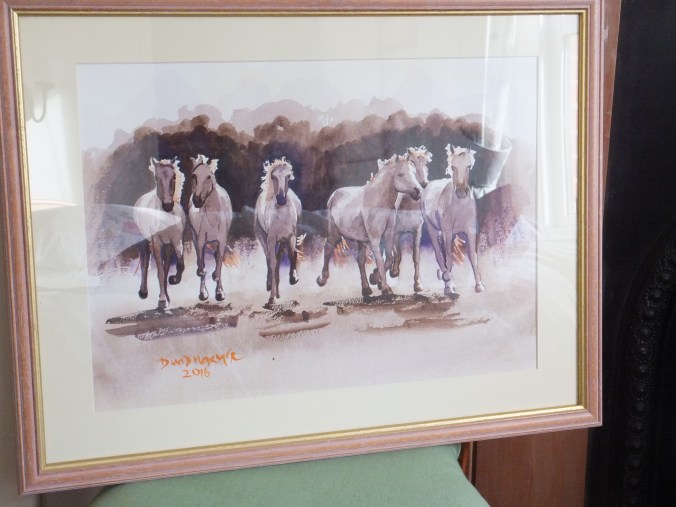
I attach a picture of the painting of Christmas Shopping in Guildford , now framed,which goes on sale at the end of this month for charity in St. Nicholas Church, Guildford with all the Christmas cards, one of which, of course, is from this painting.   I am attaching also the framed picture of the Wild Horses in the Camargue, which is now ready for the next exhibition

christmas-shopping-in-guildford-high-street-framed

The framed version of Christmas Shopping in Guildford High Street, which has been donated to Cards for Good Causes. Sorry about the reflections

wild-horses-of-the-camargue-framed

Wild Horses of the Camargue framed ready for exhibition. Again the reflections are annoying but I couldn’t get rid of them

Quite a bit to do, so hope to have something to show you next time

Exhibition at Royal Surrey County Hospital

Brewery Dray

Brewery Dray in Guildford

When we were breaking down the exhibition on Friday morning, I sold this painting at the last minute. A young woman arrived breathless with the money and bought it. I was very pleased with this as it raised my score for the whole exhibition to four paintings sold. Not the best that I have ever done but not the worst either, and certainly quite respectable.

The other three were Strolling through Montmartre, Grand Canal Venice and Painshill Park

Paris and Venice are always popular, especially the well-known landmarks. I have almost lost count of how many of each that I have sold. Painshill Park is a new subject for me and I was heartened to sell this picture, as I now feel encouraged to paint some other views, of which there are many to choose from

Painshill is a local estate near Cobham in Surrey. It was laid out in the c18 by a man called Charles Hamilton. It was in the style of a natural landscape made popular at the time by garden architects like Capability Brown and Humphrey Repton. The views were sculpted, whole forests were planted, fake ruins were built and rivers were dammed to form lakes.

Hamilton worked a lot with American species of trees. It was interesting to note that you could import a “box” of plants from American nurserymen, suitably packed to withstand the rough and long sea voyage. Many did survive and are still flourishing in the park today.

Over the years, the place deteriorated and became overgrown. In the 1950s it was rediscovered and lovingly brought back to life. Every year there is a new project. Recently the old boat house was rebuilt using old photographs. The previous year one of the bridges was replaced using an old painting as a reference. I attach my painting

PainshilL Park, Surrey

This was an unwary group of people feeding the Canada Geese by the lake at Painshill. There are literally flocks of geese of different species, as well as ducks and swans. Always a lot of activity on the water. In the background is one of the strategically placed follies, which I think is the Gothic Chapel

I am starting to whet my own appetite for painting here again!

DSCF0985

A different view of the lake with a different ruin which could make a good subject. Wants something in the foreground though. I have umpteen swan pictures from which to choose.

I have a commission to do and then I might tackle this one