The Basilica of la Sagrada Familia

DSCF3619DSCF3610

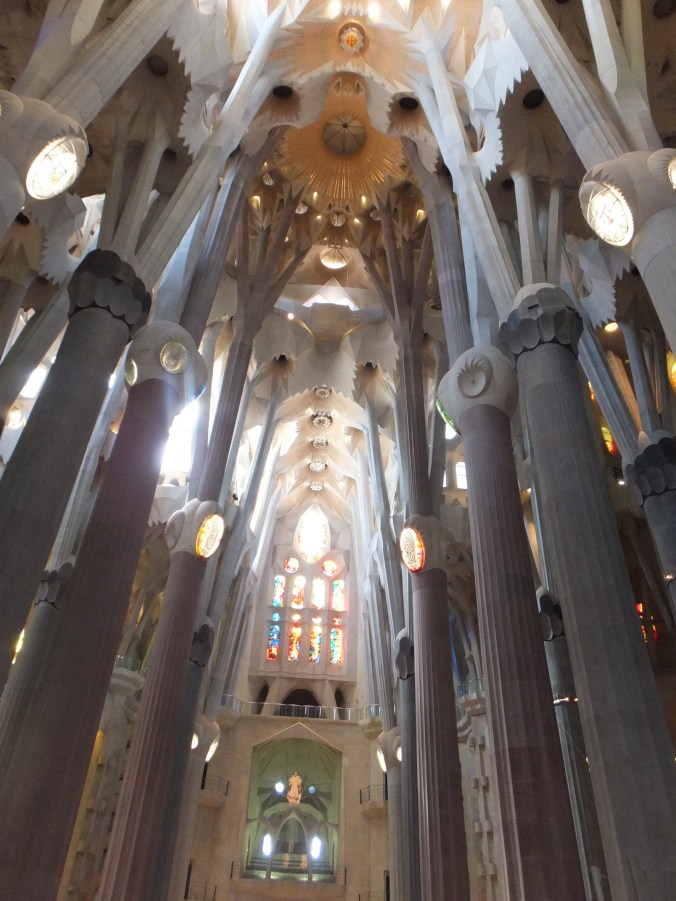
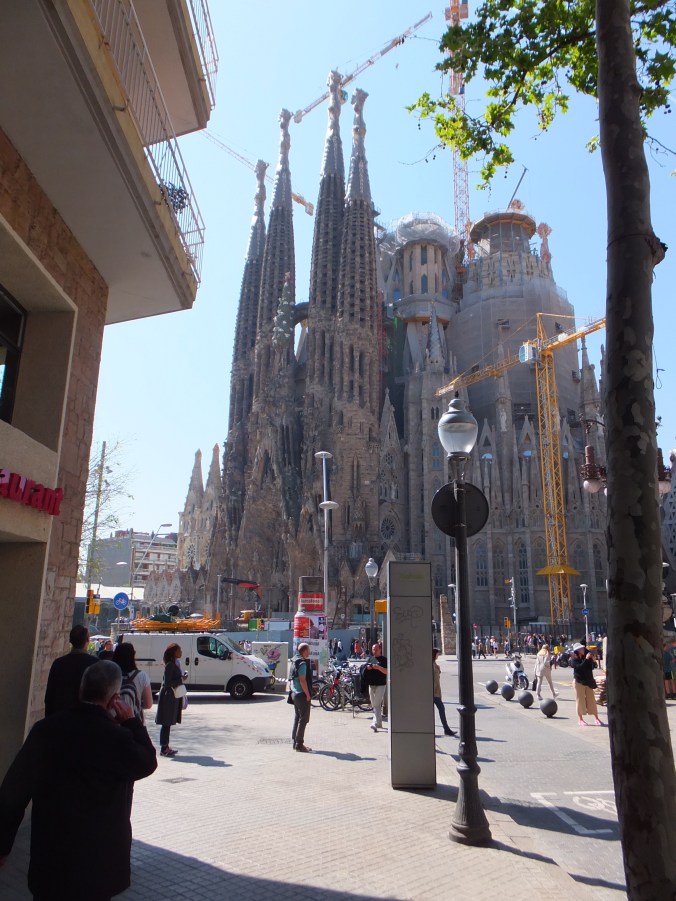
The Basilica of La Sagrada Familia in Barcelona. An amazing structure, quite, or perhaps almost, unique

We have been staying in Sitges for the last five days, enjoying the sun and the warmth, although as our perverse climate would have it, the temperature in southern England shot up to 25c, whilst in Spain only 20c but nevertheless very agreeable.

We took the train into Barcelona, which proved very straightforward, not to mention cheap in comparison to the steep fares charged around the London area. The journey took about forty minutes. I had already bought timed tickets for the Sagrada Familia on line before I left home. What a boon that proved to be as the crowds queuing for tickets when we arrived were formidable

We were, of course, very early, so time for a coffee, and a stroll round the outside of the building, taking in the details. We were last here twenty years ago, and the place, even inside, was a construction site. High up in the heavens magnificent cranes are working with the sensitivity and lightness of touch that you might expect from an artist.

After lunch and another stroll, our tickets allowed us to enter and we went inside. I don’t often use the word “breath taking” but we were looking at a masterpiece.

We associate this building, sometimes called the third cathedral, with Antoni Gaudi, the incredible architect in the Art Nouveau style, who adapted Gothic architecture to produce this wonderful building. He took over the project in 1883, and stayed with it until his untimely death in 1926. During all this time he is also completing other large projects for the Guell family and also for the Church.

So much has been achieved since our last visit. The nave with its paraboloid arches which seem to reach up into the heavens, will be my enduring memory. Colour is everywhere, as the light streams through stained glass. Detail is everywhere, small animals, leaves, vegetation as well as so many human figures representing the Nativity and other stories. Gaudi was devoted to nature. He was also extremely devout, and his interpretations of the liturgy, I found moving. So much detail, too much to record here.

In the cloister which surrounds the building, is situated the museum, now open, which records the timeline of the whole construction period. Gaudi’s models are on show and his drawings, which enabled successive craftsmen to carry on his work. Still much to do, with a projected finish date of 2026. I wonder if I will get back to see that. Could do, I certainly hope so

Venice Painting Completed

Venice Painting Completed

The finished painting with San Giorgio Maggiore in the background, which I enjoyed doing, although trying to hit the right colours was testing to say the least

I have already mentioned the mooring posts. In the photograph they looked red in the evening light. This turned into a glazing exercise, wet on dry, although nothing like as tricky as the hull of the gondola which I will come to in a minute

For the posts I started with a Burnt Sienna wash which is pretty safe. When the paint had dried, the pigment had disappeared. I applied another coat of the same colour, followed by a coat of Permanent Rose which should have given these posts a nice evening red glow, but still pasty. I had been waiting to use quinacridone red, of which I have a fairly limited experience, so perhaps risky. The colour worked well, I thought, giving me what I wanted. I used Indigo for the strips of bark hanging onto the wood. Indigo makes an alternative to black which I avoid if I can

Now the real challenge, to use that overworked word, was how to treat the hull of the gondola. I may have said before that gondolas are black by regulation. The finish is of a very high gloss, the sort one sometimes gets on pianos, in fact it used to be called piano finish. I think polyurethane was involved which may have been universally banned by now because of health risks.

Black gloss in certain lights obviously won’t look black, because of the other bright colours it picks up in this mirror like shine. If you remember the original photograph that I worked from, the vessel looked a sort of bright copper colour.

Again this was a long and drawn out glazing exercise. At least five coats as I remember and twenty four hours natural drying in between each coat. I used Quinacradone Gold, Burnt Sienna, Van Dyke Brown, Transparent Brown and Permanent Rose

I looked at it in the morning from a distance. I think it worked but I will have to put it away and get it out again another time, before I can make an objective view

As always comments are welcome

Notre Dame de Paris finished

notre-dame-finished

The finished painting which has had enough description already probably. An improvement on the first one so I am glad that I did it.

The little girl in the picture, modeled by my granddaughter, Lola,  although she didn’t know it, is struggling to put her hood up, so that she can continue chasing the poor pigeons. She loved to watch them take off as a flock, and then shortly afterwards settle back in more or less the same place again

The rest of my gallant family had gone into the cathedral, as the other grandchildren wanted to climb the tower. Lola didn’t want to, and frankly nor did I, so we stayed below on terra firma. My wife, who hates flying but doesn’t mind tall buildings, went with the others. I don’t mind flying but don’t like going up tall buildings. Curious really.

I prefer looking at cathedrals, studying the architecture, and trying to imagine the history surrounding the building. My first thought was of the wonderful story written by Victor Hugo, “The Hunchback of Notre Dame”, and visually for me, going to see that wonderful film in 1956 of the same name, starring Anthony Quinn and Gina Lollobrigida. Quinn played Quasimodo the hunchbacked bellringer, and as a schoolboy then, I was very impressed as Quasimodo sat astride each bell in turn, urging them on like horses. An exciting story, which has been remade subsequently.

On 18 March 1314, Jacques de Molay, with others was burned at the stake in front of this cathedral. He was the last Grand Master of the Order of Knights Templars, an organisation of warrior monks, formed originally to protect pilgrims visiting the shrine of the Holy Sepulchre in Jerusalem.

Pilgrims no doubt rewarded them, as they became rich, as religious orders so often do. They were astute money managers and became in effect, international bankers, lending enormous sums to crowned heads of Europe.

They became super rich and powerful, and thus attracted enemies, including the then Pope Clement V. It was alleged that the Templars had started to identify with their Moslem counterparts, and accusations of heresy were made. Without doubt Templars learned much from their eastern contacts, especially in the field of architecture. What they learned was kept a secret, always suspect, and laid the foundations to the Masonic Order.

Philip IV of France, taking his cue from the Pope started to arrest Templars. Also please note that he owed fortunes to the Templars who were pressing for payment. Templars were tortured horribly to obtain confessions of heresy. De Molay himself confessed to stop the pain and retracted afterwards. He was ordered to be burned at the stake, and it was so arranged that he was consumed very slowly by the fire. Most died within minutes

De Molay at the stake, cursed those who had colluded in his murder, that they should die within the year, and their descendants meet a violent end likewise. Clement V died the following month, and Philip IV had a stroke whilst hunting shortly afterwards. Philip’s descendants did meet premature deaths, so much so that the Capetian line died out

I snap out of my reverie, Lola is still chasing pigeons, and everything seems normal again


Notre Dame de Paris :Halfway

notre-dame-halfway

After another false start which I won’t go into, I decided to paint this subject in a vignette style, which I quite enjoy for a change. When there is a lot of peripheral detail which you just don’t need, this is a good way of getting rid of it and just focusing on the main subject.

I also happen to think they look attractive when they are finished, and certainly they seem popular with everyone

Talking of detail, I had to simplify the facade of the cathedral quite a lot, as even with a small detail brush, there is a limit to what you can include, bearing in mind the perspective.

I have chosen to depict the scene in soft winter sunlight, which is possibly my personal favourite. This is the sort of day that gently warms the stonework, and when the sun leaves long shadows on the ground and along the sides of buildings.

For the base colour of the stonework and of the square in front of the cathedral, I have used my typical mix of raw sienna and Naples yellow. For the shadows on the buildings I used violet ultramarine, and as they became deeper like some of the recesses on the cathedral, I toned the violet down with some Transparent Brown. For really dark corners I went over this again with pure violet straight from the tube.

Blue with a dash of brown to provide the grey slate roofs, and some cadmium red pale for the awnings of the restaurant next to the cathedral, finishes what I have done so far. I will echo the red amongst the figures in the foreground, either bags or jackets, so that the eye gets led into the centre of the picture.

Putting the shadows into the figures will be next. Detailing some of the foreground figures will be a long job, and how I’m looking forward to those pigeons, not. Still every painting is a lesson, so we shall see what I get out of this one

Notre Dame de Paris: back to the drawing board

notre-dame-de-paris-mk2

It is now nearly a month since I last did any painting, and I have missed it. Either because of festivities or through illness, I have not been able to get to my easel. Even last week, I had a relapse and have been given a second course of antibiotics which I have to say, have made me feel much better.

The next item on my to-do list, was to rework the painting that I did last year of Notre Dame de Paris in the Rain, except leave out the rain and inject some sunshine. I showed this painting a couple of times last year, without any interest being shown. Although to paint a scene in rain is skilled in its way, nevertheless the subject matter in itself is quite depressing . The colours become muted and everything looks dark. Would you want to buy a painting that lowered your mood? Probably not, so I am going to try to paint the same subject on a bright day, with colours more vibrant. Still could be autumn or winter time, but one of those bright days with long shadows.

What I have done more or less immediately, is to remove that unsightly marquee from the left of the picture. You may remember it, or you can scroll back in the gallery and find the original. I managed to find on the net, the buildings to the left of the cathedral, distant apartments and shops possibly, and these have been substituted

I have also rearranged the figures in front of the cathedral. By removing some, I have taken out the queue that was filing towards the entrance to get in. Looking back on this, it seemed quite mournful, like figures queuing for the dole. I have given the crowd, I hope, a more random look, so that hopefully they do now look like tourists, and consequently looking more interesting.

To the right of the cathedral, and out of sight, is the wonderful statue of Charlemagne. I considered moving it into the picture, but decided not too. Too much of a statement, which would have competed for attention with the cathedral itself

So, a start has been made which is always the hard part. I’ll get on with some painting and come back when I have something more to say

Chichester and Pallant House Art Gallery

chichester-market-cross-and-cathedral

Chichester Market Cross and Cathedral

We were here on the 31st. A lovely cathedral town with its c14 market cross, and one I remember from my youth. Pedestrianised many years ago and rightly so, I remember when traffic drove round the cross, and double decker buses clipped bits off it. Now it is safe from that sort of damage. There are still a few of these market/preaching crosses about, Winchester has a good one for example, and they need to be cherished

The city is Roman originally. Noviomagus, the new market, I believe. There was a straight road to London built by the Romans, called Stane Street. It is still there, but now called A24 and A29. It has one or two kinks in it, as it had to get through the gap in the Downs for example, but basically is straight as a die from Chichester to London Bridge.

The cathedral needs a separate chapter, and is one of the finest in England, but our main reason for going there was to visit our old favourite , the Pallant House Art Gallery, which houses a wonderful collection of modern art.. The collection includes names like Hepworth, Moore, Piper and Sutherland. Incidentally in the cathedral, there is a magnificent tapestry backdrop to the altar, designed by Sutherland. There is also a wonderful window by Marc Chagall, not always remembered for stained glass, although he did many. But I digress from the art gallery

Founded on the collection made by Dean Hussey of Chichester Cathedral , it was bequeathed to the city in 1977, on condition that it was housed in Pallant House, a Grade 1 listed Queen Anne townhouse built in 1712, for a wine merchant called Peckham and his wife Elizabeth.

The collection was added to by further donations over the years, and the impressive collection of artists represented, includes now Cezanne, Leger,Sickert,Lucien Freud, Richard Hamilton and Eduardo Paolozzi

As well as paintings, there is an excellent collection of c18 Bow porcelain

The new wing, a superb example of a modern building blending well with a Queen Anne townhouse, won the 2007 Gulbenkian Prize and was also listed for a RIBA award the same year

I try to stop after 300 words but have rattled on

Thanks for your comments on Bosham Harbour, now framed up and in store ready for the March exhibition. Thank you to those of you who enquired about this exhibition. The details are:

Guildford Institute, Ward Street, Guildford, Surrey, UK in the Assembly Rooms

Dates from 13th to 31st March this year

Thanks again


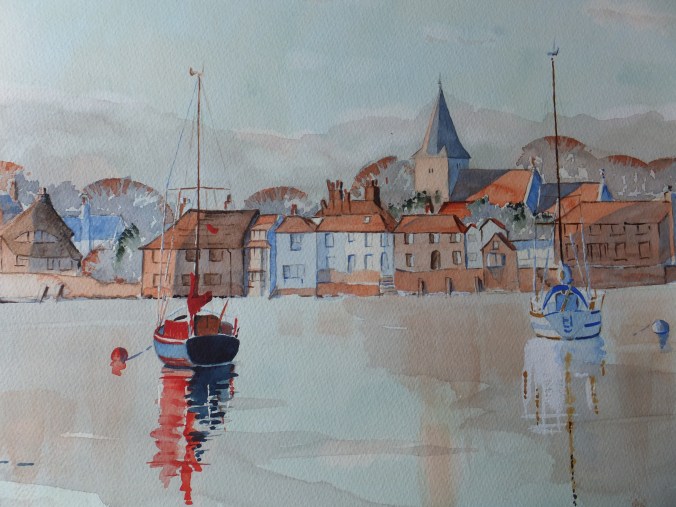
Bosham Harbour in West Sussex

bosham-harbour-and-church

Bosham Harbour and Church

I was commissioned to paint this view of Bosham Harbour. This is a favourite spot for sailors and visitors generally, as well as being beloved by photographers and artists alike.I was given the Contented Donkey commission at the same time, so have been working on them both from time to time. Bosham has been finished first, so will write about that now.

Bosham harbour is used by people who sail now, but historically this was a port for cross-channel traffic. It was used by the Saxons. The church is Saxon, and has a connection with King Cnut. His daughter is buried in the church. If you have heard the apocryphal story of Cnut trying to hold back the waves, because his courtiers had told him that he was that powerful, that was supposed to have happened at Bosham.

Cnut was a Dane, a Viking who was King of England, Denmark and Norway from 1018 to 1035. An important man and a great king, who returned England to prosperity following the Viking raids, his reign is largely obscured by the events of 1066

The power struggle for the throne just before 1066, involved Bosham. Harold Godwinson (and I expect I have spelled that wrongly,) sailed from Bosham to discuss the succession with Duke William of Normandy, and as we know was shipwrecked on the French coast. He was delivered to William as a prisoner, albeit treated as a guest, and during his stay was tricked into swearing on holy relics, that he would support William’s claim to the throne of England.

This gave William’s claim legality. He invaded England and landed at Pevensey, and met Harold in battle on Senlac Hill. The rest as they say, is history

Why was it called the Battle of Hastings when it was nowhere near there?  I’ve never been given a satisfactory answer to that question

The donkey painting will be next on the easel


Sitges: the Transferred Drawing plus Preparation for Next Exhibition

Transferred Drawing of Sitges

This is the drawing now transferred onto watercolour paper. I hope you can make it out. Obviously only lightly pencilled in as I want it to be covered by the painting.

One or two areas are covered by the blue masking fluid, especially the building on the far left which is sparkling in the sunlight. I want a hard edge there, and likewise in one or two other places which are caught by the sun. I have denoted white foam in the sea where I might otherwise lose it, although I shall have to enhance later with white gouache.

I have kept the foreground figures to two plus dog. Hopefully I should get some pleasing reflections on the wet sand from the buildings which will need some space in the foreground

Spaces have been left amongst the buildings too, for large areas of shade and for trees. Soon I shall have to pick up a paint brush and start. I still get apprehensive until I get underway

As well as this I have been trying to finalise my entries for my next forthcoming solo exhibition, which will be in Guildford, a town near me, in one of the town’s best known venues, the Guildford Institute. Always an enjoyable place to show, albeit not especially busy, but nevertheless because of the prestige of the place, I am able to get good coverage in local papers, which is so very useful

I have been trying to get my framing up-to-date and these are two of the latest

Brewery Dray Framed

Brewery Dray on Guildford Bridge

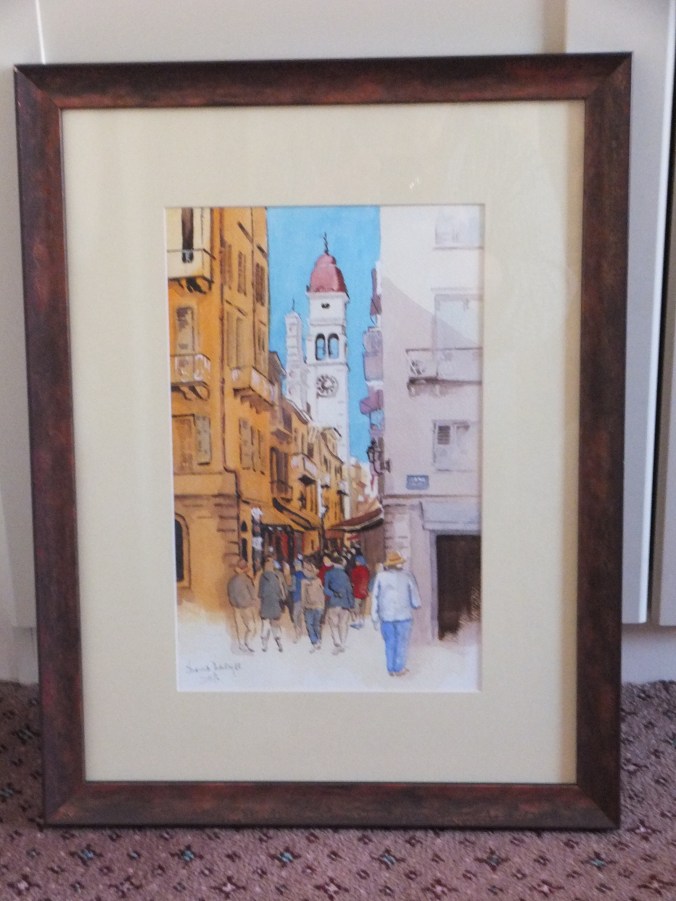
Corfu Shopping Lanes Framed

Corfu Shopping Lanes in Kerkyra

You may well have seen these in earlier posts, but it is nice to see them framed, and ready to be exposed to an unsuspecting public. I am aiming to show between 12-14 pictures in total. I am almost there.Still time to make some revisions, and certainly if the Sitges painting turns out well, I shall want to include that too. The exhibition, if I haven’t said before has a theme entitled “Watercolour Wanderings”, so every picture will be of a place I have visited. Not just faraway places that I have been to on my travels but also local scenes as well, which are just as relevant. The name is a little bit corny, I know, but you are expected to give your exhibition a name, which I admit does give the show some sort of structure, rather than a motley collection of miscellaneous paintings.

The exhibition runs from 3rd to 20th May, so just under three weeks. We shall hope for a successful show. I shall be following up with another exhibition at the Royal Surrey Hospital starting on the 27th May and running for one month, so two bites at the cherry

Just while it goes through my mind, I get many “visits” to this art blog from all corners of the globe, and I am very grateful for your interest. It is so nice to feel that you are talking to someone. Comment if you want to. Thanks