The Contented Donkey: finished painting

the-contented-donkey

This is the finished donkey painting supplied to Egypt Equine Aid for their next auction which is early next month. Full details on their Facebook page, as well as news of the wonderful work that they do

I don’t think I deserved the build up they gave me. I didn’t really recognise myself. I was just happy enough to do something to help.

Let’s hope it sells after all that. Embarrassing otherwise

Flinging myself now into exhibition work for pre Christmas and into the new year, as am rather behind. Just starting a drawing of flamingos, as seen on our recent holiday in the south of France. Not drawn these birds before. I have to say that they are rather a strange shape

Just a short post this time, but wanted to mention the finished donkey painting


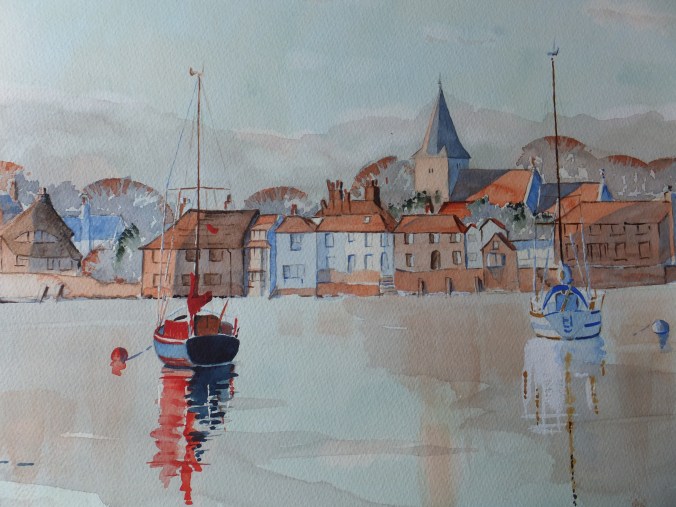
Bosham Harbour in West Sussex

bosham-harbour-and-church

Bosham Harbour and Church

I was commissioned to paint this view of Bosham Harbour. This is a favourite spot for sailors and visitors generally, as well as being beloved by photographers and artists alike.I was given the Contented Donkey commission at the same time, so have been working on them both from time to time. Bosham has been finished first, so will write about that now.

Bosham harbour is used by people who sail now, but historically this was a port for cross-channel traffic. It was used by the Saxons. The church is Saxon, and has a connection with King Cnut. His daughter is buried in the church. If you have heard the apocryphal story of Cnut trying to hold back the waves, because his courtiers had told him that he was that powerful, that was supposed to have happened at Bosham.

Cnut was a Dane, a Viking who was King of England, Denmark and Norway from 1018 to 1035. An important man and a great king, who returned England to prosperity following the Viking raids, his reign is largely obscured by the events of 1066

The power struggle for the throne just before 1066, involved Bosham. Harold Godwinson (and I expect I have spelled that wrongly,) sailed from Bosham to discuss the succession with Duke William of Normandy, and as we know was shipwrecked on the French coast. He was delivered to William as a prisoner, albeit treated as a guest, and during his stay was tricked into swearing on holy relics, that he would support William’s claim to the throne of England.

This gave William’s claim legality. He invaded England and landed at Pevensey, and met Harold in battle on Senlac Hill. The rest as they say, is history

Why was it called the Battle of Hastings when it was nowhere near there?  I’ve never been given a satisfactory answer to that question

The donkey painting will be next on the easel


The Contented Donkey

contented-donkey

I was pleased to be asked to provide a painting for auction for a well-known charity involved in the rescue of horses and donkeys in Egypt

Many years ago I painted from the charming photograph inset, a watercolour study. I sold it subsequently and then forgot about it. Trying to remember what horse or donkey study I could paint, I remembered this one and finally found the photograph

We were coming back from the Cotswolds, and pulled off the highway at Minster Lovell in Oxfordshire A beautiful village in that lovely honey-coloured Cotswold stone which was the home of Francis Lovell, close confidante to Richard III, who limped home to Minster Lovel Hall to lick his wounds after the Battle of Bosworth in 1485. He continued to resist the Tudors and was killed at Stoke in 1487. The whole setting is delightful and the old dovecote is still there to see. The donkeys were part of the setting and I photographed one or two including the one inset. They are fun to draw but remember the long ears otherwise they will become a horse

The pencil study I did just now, and will transfer onto  watercolour paper. I actually have a commission on the easel at the moment which is a view of Bosham in Sussex, with a lovely sweep of the harbour with the Saxon Church in the background. Bosham Harbour is a delight to paint and I have done many times. When the painting is more complete, I will blog about it, as the history is fascinating.

For now, we are talking about the donkey. I am painting this alongside Bosham and also working up a picture of flamingos brought back from the Camargue. Very rarely do I do three easels at once, so let’s hope I don’t come unstuck

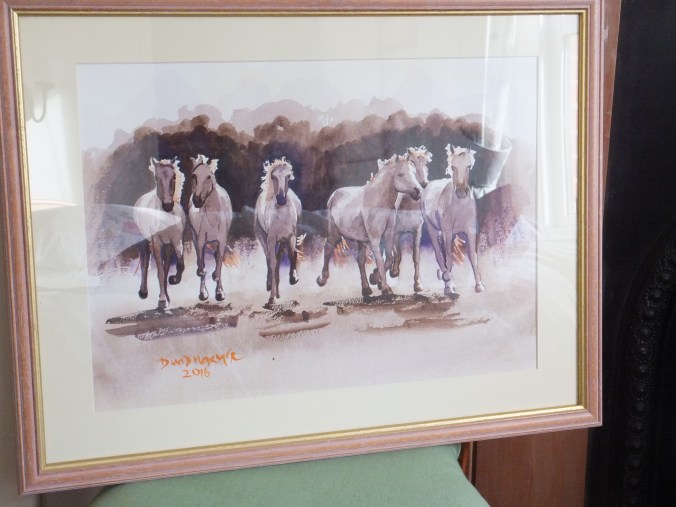
I attach a picture of the painting of Christmas Shopping in Guildford , now framed,which goes on sale at the end of this month for charity in St. Nicholas Church, Guildford with all the Christmas cards, one of which, of course, is from this painting.   I am attaching also the framed picture of the Wild Horses in the Camargue, which is now ready for the next exhibition

christmas-shopping-in-guildford-high-street-framed

The framed version of Christmas Shopping in Guildford High Street, which has been donated to Cards for Good Causes. Sorry about the reflections

wild-horses-of-the-camargue-framed

Wild Horses of the Camargue framed ready for exhibition. Again the reflections are annoying but I couldn’t get rid of them

Quite a bit to do, so hope to have something to show you next time

Wild Horses of the Camargue: the finished painting

wild-horses-of-the-camargue-finished-painting

Well, this is the finished painting

Quite a lot of work building up the shadows on the horses. They have so much muscle which has to be shaded correctly. in order to look right. Having stared at this painting for so long, I just can’t tell any longer if it looks right or not

As well as showing horses, I also wanted to show speed and independence of spirit which these animals possess in the wild.

I wanted to paint the flamingos from the Camargue as well but commissions are backing up which is a happy problem, so sadly flamingos may have to wait for a while

I have been asked to paint something for Egypt Equine Aid which I am pleased to do, which may well be one of my donkey paintings which I have not done for years, so that should be interesting. They have a Christmas auction but paintings have to be in in November so not that much time

Wild Horses in the Camargue: Continued

dscf3434

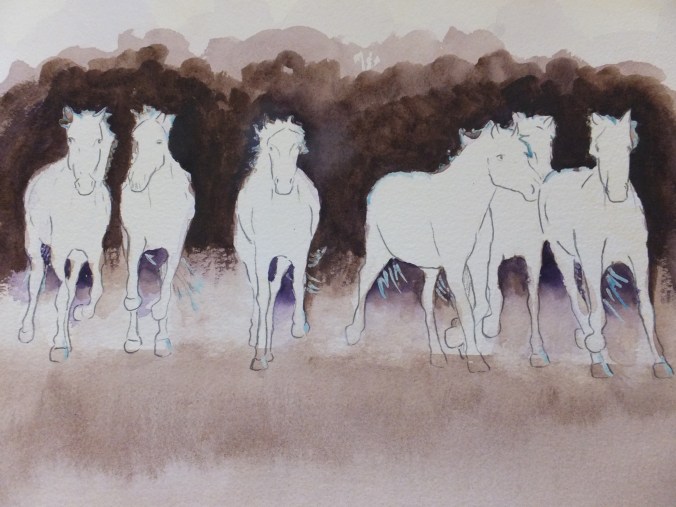
I have started back on the Camargue Horses painting. Bit of a mess at the moment. This is the point where it is easy to lose heart and abandon the whole the thing. However I have always told myself to finish the painting. come what may, and so that is what I shall do.

So far I have masked the edges of manes and tails, as I would like them to appear white and flowing against the dark background. I have gradually built up the dark background using violet and transparent brown, sometimes mixed and sometimes alternately

Soon I shall have to take the masking off, and tidy up those rough edges where I have overlapped with paint, despite all my best efforts. The forms of the white horses will need to be built up carefully, light against the dark and dark against the light

I am hoping too that the light strip around the horses’ legs will look like dust thrown up by the hooves. Hoping is the word. That needs to look convincing.

I received another commission this morning, which is good. It means that I need to clear my easel soon, as there is a deadline. Still, what one might call a happy problem!

A Week in Sicily

dscf3364

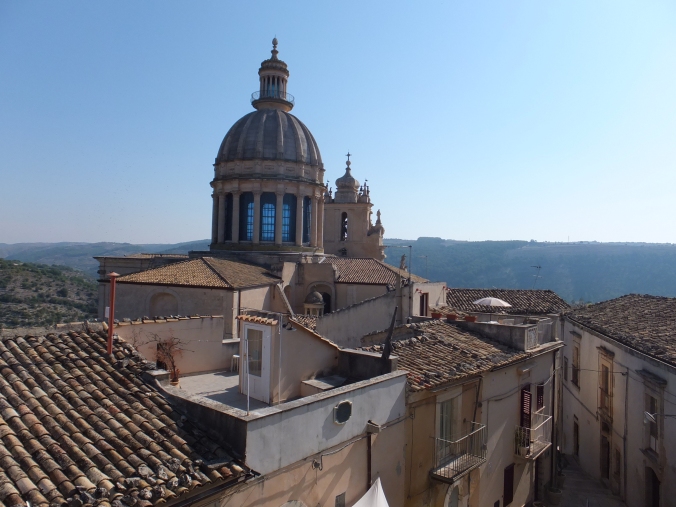
The Rooftops of Ragusa

We have just returned from a wonderful week in Sicily. I am exhausted as we packed a lot in, and did more walking than I am used to. The city of Ragusa is beautiful built on the sides of gorges, so dramatic in themselves. However everything is steep, and the climb we did to get this picture was no exception. I am not sure how many steps as I lost count at 150.

We were about ten minutes too early for the lovely baroque church in the background, so our guide took us to the top for the view, one picture and straight back down. Bit of a killer in the hot sun

dscf3366

This is the way down, only more of it, as the steps wind on round the houses.

Sicily has been hit by several earthquakes in its history, but the big one in the c17 destroyed nearly everything. Consequently all the churches seem to be in the Baroque style following a massive rebuilding programme, in whichever town you visit.

Syracuse was fascinating with its wonderful archaeological park. Sicily was Greek from 750BC, and the park shows where slaves quarried massive stone blocks from the hillside for their building programme. Greek theatres followed by Roman amphitheatres abound. The Romans took Syracuse from Greek hands in the early third century, and also drove out the last of the Carthaginians

Sicily changed hands so many times throughout its long history. Goths and Vandals after the Romans, Arabs and then the Norman Conquest in the c11, creating the Kingdom of Sicily, curiously matching England which became Norman in 1066 just before Sicily

You often see images of St Thomas a Becket in churches in Sicily. Henry II of England’s daughter, Joan married King William II of Sicily. You may remember that Henry had Becket murdered in Canterbury Cathedral, an act that horrified the rest of Europe. William venerated Becket in Sicily in order to distance himself from Henry’s crime, which later Henry was to do penance for

Of more recent interest, were the location shots for the Montalbano  detective series shown on TV. These were in Raguso, Scipli and Punta Secca. Lost on me as I never watched the series however

Some superb shots for paintings, including the roof top view which I have shown, and also the beautiful Medieval windmills on the west side of the island. Still, for now, I shall be getting back to the drawing of the Camargue horses which I left before I went away

A nice message waiting for me when I got back. Someone is buying the painting of Langstone Harbour, which is shown in the archive of this blog somewhere

dscf3421

The Medieval windmills and saltpans near Trapani

Horses of the Camargue: Preparing to Paint

Line Drawing on Watercolour Paper

The Line Drawing on watercolour paper

I have transferred the sketch just as a line drawing onto the watercolour paper. The size of the image is roughly what I want, about 30×40 centimetres

The painting will be interesting to say the least. The horses should be lighter than the background, and as you know, you can only go from light to dark with watercolour and not vice versa. The manes and tails in the photographs seem to glow as though they have light behind them. I think they will have to be masked out for that to happen. I may have to put background in first, which will be amusing

I won’t have a lot of time this week as we are going away soon to Sicily, another wonderful source of material. I think before I go, I will hopefully have time to give the painting an all-over wash of Naples yellow and Raw Sienna, which should give the glow of low sunshine that I want. Fingers crossed on that one

So, it may be nearer the end of the month before I can finish the painting completely. This won’t be an easy painting to do for the reasons stated. We shall just have to see how it turns out


White Horses of the Camargue

Camargue Horses

White Horses of the Camargue

When we were in the south of France a few weeks ago, we finished our voyage down the River Rhone at Arles. I have already mentioned my walking tour of the city in the footsteps of van Gogh, as well as the magnificent Roman amphitheatre

Just south of the city, and in the salt marshes of the Rhone estuary, is the Camargue region, famous for its semi-wild horses, its black bulls bred for fighting and also flamingos, which breed there, the only breeding ground of that species in Europe.

I say the horses are semi-wild. They roam the region more or less at will until round up time, but also they are used for riding, and the tamer ones used by riding schools and trekking stations. They are, I believe one of the oldest breeds in Europe, and because of the remoteness of the area, the bloodstock remains undiluted

I wanted to paint them. I do paint horses occasionally, usually heavy draft horses as I find them intriguing, but the Camargue horses are something of a challenge, because of their colour as much as anything. You can always find one white horse or two perhaps in a herd, but a complete herd all the same colour is unusual, and would make a striking painting.

I took some pictures of my own, which were shot from the hip very often as an opportunity presented itself, and were ok but not the best. I bought a photograph from a local, which was much more impressive, and am using this to compose something which I hope will make an interesting painting

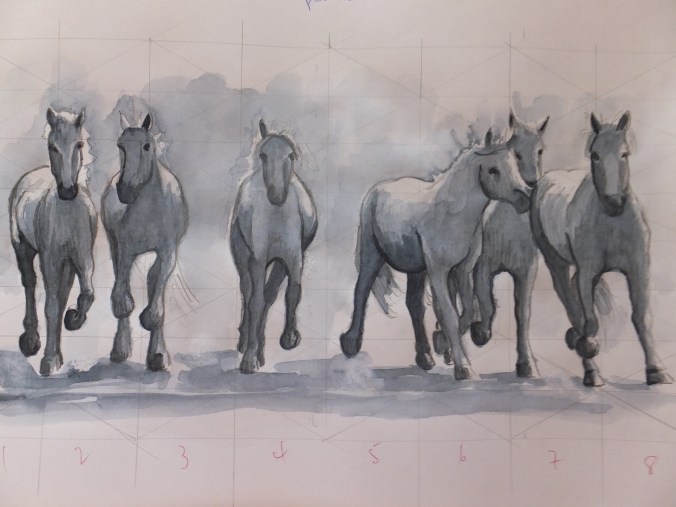
I have sketched something out as above, using Paynes Grey watercolour which I now prefer to ink, which I think will work. Quite a lot of shadow of course on white and how to make it stand out against white paper will be interesting too. I shall transfer this sketch onto watercolour paper and see how we get on

From Sketch to Finished Painting

Lavant Cottage

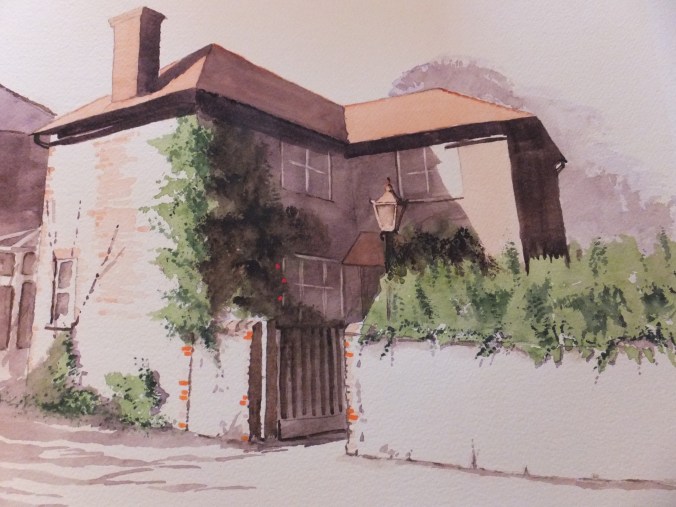
The finished house portrait

Just a pity that the camera leeches out some of the colour, try as I might to avoid it happening. The original has a much softer tone

This was an interesting commission, and of course follows on from the last post about the value of the preliminary sketch. The lights and darks from the tonal sketch were invaluable as a reference. What was so delightful about this subject was the strong light coming from the left and low at that.

After transferring the drawing onto watercolour paper, I bathed the whole thing in a mix of Naples Yellow and Raw Sienna. There was very little sky in the frame, so I saw little point in trying to introduce a sky colour. I have used this neutral sky on several occasions before and it works well, when you need to soften the subject, and also focus on a subject, so pertinent  when you are doing a house portrait.

I usually paint roof tops with Burnt Sienna over the Raw Sienna. This time, as it was a commission, and therefore being more careful, I did some research. Some people use Light Red and some too use Indian Red, I was told. After a couple of trials, I elected to use Light Red, which I found rather pleasing and closer to the reference photograph.

The dark shadow was a mix of Violet and Transparent Brown, always successful. Some orange brickwork and one or two red roses to lead the eye

I was pleased with the result. A nice soft portrait of a period house, which was not unlike a sepia photograph, evocative of the period and somehow timeless.

From here, I can rest from commissions. I love doing them as they challenge me with something new, but I have exhibition commitments from March, which seems a long way off but not really. I have stock enough to do an exhibition now, but most have been seen this year, those that I have left unsold that is.

That means a new collection, so best get started

Sketch Painting

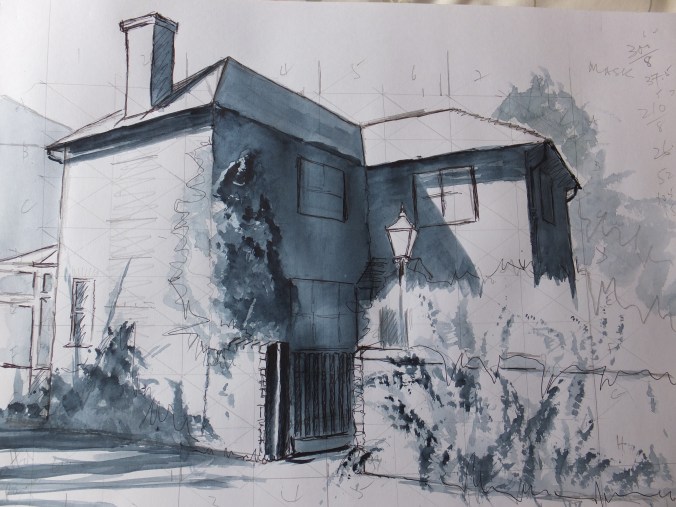
Lavant Tonal Sketch

This is a house portrait that I am working on at the moment, which just serves to illustrate the value of the preliminary sketch. The drawing is very loose, which I often think adds to the effect. Unnecessary detail has been removed. The power is in the tone. The dimensions are to scale. All I that I need is there for producing the final painting. Any changes that I want to make or mistakes that I want to correct, I can do now so that hopefully I won’t be rubbing out on sensitive watercolour paper.

What is it about black and white that captures atmosphere so well, perhaps better than colour?  Something in the drama of light and dark perhaps. In this sketch, I haven’t used black, which tends to flatten a painting as it drains all the light. Ink is even worse in my opinion, and although I like black ink for line drawing, I use watercolour for large blocks of dark. Instead of black, I have used Payne’s Grey, which is grossly undervalued in my opinion. It produces a beautiful blue/grey and the end result is a painting in its own right.

Purists tell us that we should mix our own greys, depending on the grey we want for a particular purpose. I agree and I do that too, but Payne’s Grey has its place. It makes superb skies giving pale greys through to black clouds, and I believe was the reason for William Payne inventing it. It also works superbly well as an alternative to ink for sketching.

William Payne, 1760-1830, Devonshire born, lived in Plymouth, until moving to London in 1790. He was a watercolourist and etcher, and above all, an innovator. His style, we are told, could be easily learnt and he became the most fashionable drawing master in London. His innovations include” splitting the brush to give forms of foliage, dragging the tints to give texture to his foreground, and taking out forms of light by wetting the surface and rubbing with rag and bread”

And of course Payne’s Grey.

Later in life he was surpassed by other artists, and sadly forgotten before his death in 1830