Bosham Harbour: Second Version, Preparatory Drawing

bosham-preparatory-drawing

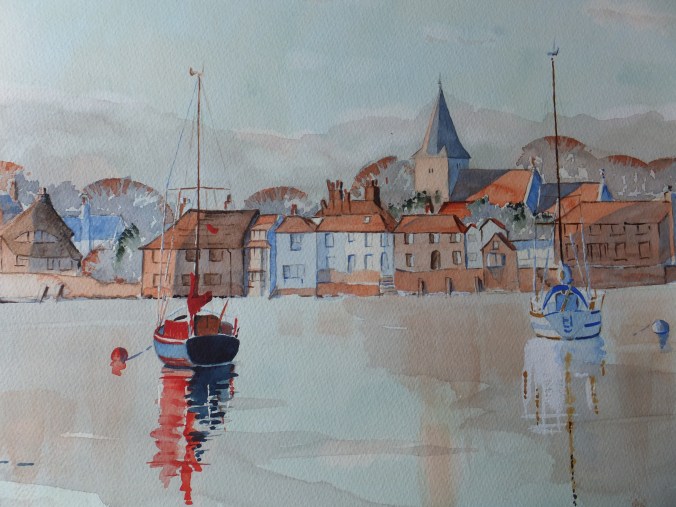
I painted Bosham Harbour in West Sussex as a commission a few weeks ago. I painted it in evening light which I hadn’t done before, and was very pleased with the way it turned out, and relieved too seeing as it was a commission. The colours worked exceptionally well, and I was left wishing that I had something like it, to include in next year’s crop of exhibitions.

Using a number of different photographs, some of my own and some from different sources, especially the boats, I compiled the composition which I have drawn above. The church and houses I have thrown back into the distance, and extended out at the left past the boat house. The boats themselves are entirely different to my previous painting, so everything will be new, which I prefer.

One day I will be stumped as to how to paint Bosham Harbour without referring to something I have painted previously. There are other views, but this is the one people always want, with the church in the background and boats in the foreground. Move along the coast, I suppose, but there is something about Bosham which is hard to find elsewhere. Perhaps it is the historical associations with Saxon kings like Cnut and Harold, with the symbolic Saxon church as a reminder, or maybe just the sheer charm of the place, that makes it difficult to replicate

Anyway, I am going to attempt this composition as a watercolour painting and see what happens. I shall use my previous painting as a colour guide but may still experiment along the way, but still the objective will be to create a painting in evening light

We shall see how we get on

Flamingos in the Camargue: Finished Painting

flamingos-in-the-camargue

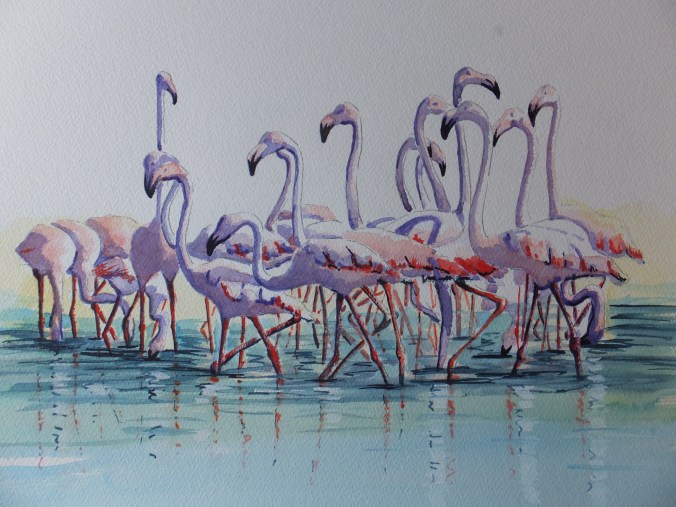
This follows on from the last post on flamingos which just showed the preparatory drawing. I think this is one occasion where I prefer the coloured version to the black and white. The colours are really vivid

We were in the Camargue region in the Rhone estuary watching the white horses which I have already painted, and also the flamingos which breed there. This is apparently the only place in Europe that flamingos breed, although I have subsequently seen them in Sicily. Matbe they were just stopping over.

Curiously these flamingos were more white than pink, which is the image we tend to have of these birds. I have probably used more pink wash than necessary in order to get some definition between the birds. In actual fact their heads were pale pink, whilst under their wings they were bright red/orange. I used cadmium red for these markings and that was spot-on accurate

The legs again were a very deep and bright pink. I read somewhere of someone using permanent rose with some cadmium orange to get a good flamingo colour. I tried that and got cadmium red !  Oh well, two routes to the same destination, which is not necessarily such a bad thing.

I started with a light pencil drawing taken from the original sketch. I used violet to put in the shadows on the birds and on the water, which gave me the form to base the painting on. Underneath the birds, and running down the paper, I laid a very dilute wash of Windsor Yellow, as an  experiment really, which I was glad of later, and I will explain why when I get there.

I then started to put in the red markings, and the birds started to take shape. I put in reflections of the legs in the water. I left this for 24 hours to harden off, and then laid a dilute wash of phthalo blue and cobalt mix, for the water. Over the yellow, this glaze turned a soft green, and I think, made a better water colour The red reflections showed through and looked convincing. So far so good

The shadows on the water made by the birds, I deepened with Indigo. Likewise some of the deep shadows on the birds and especially on the legs, I put in with Indigo. The same colour worked well for the tips of the beaks

So there we have the finished painting. I keep looking at it and thinking it looks bright but then again it was a bright subject

Always pleased to hear from anyone else who has experience of painting these colourful birds

Flamingos in the Camargue: first sketch drawing

flamingos-in-the-camargue

I took a number of photographs of the flamingos when I was in the Camargue. None of them were usable, so I took this group from someone else’s picture as the birds had formed a natural composition which, I thought, would make an interesting painting.

This is just the sketch done in my favourite Payne’s Grey. What is it about black and white, that I often prefer the sketch to the finished painting

They breed here apparently, the only place in Europe where they do that. I have seen them in Sicily as well, but perhaps they don’t have a breeding ground there

These birds are white, with bright pink flashes under the wings. Legs are a very bright deep pink. Always interesting trying to paint a white bird on white paper. I don’t really want any background against those long white necks, as I want them to stand out sharply. I will have to give that some thought

There will need to be colour around the undercarriages as reflections will be important and part of the composition, probably a blue of some sort. Phthalo with some Cobalt mixed in is a good Mediterranean colour, and could work with the deep pink legs. The pink will probably be Permanent Rose with a little Cadmium Orange.

Whether I shall have this finished for the Pirbright Art Club December exhibition remains to be seen. Let’s see how it turns out first!

Bosham Harbour in West Sussex

bosham-harbour-and-church

Bosham Harbour and Church

I was commissioned to paint this view of Bosham Harbour. This is a favourite spot for sailors and visitors generally, as well as being beloved by photographers and artists alike.I was given the Contented Donkey commission at the same time, so have been working on them both from time to time. Bosham has been finished first, so will write about that now.

Bosham harbour is used by people who sail now, but historically this was a port for cross-channel traffic. It was used by the Saxons. The church is Saxon, and has a connection with King Cnut. His daughter is buried in the church. If you have heard the apocryphal story of Cnut trying to hold back the waves, because his courtiers had told him that he was that powerful, that was supposed to have happened at Bosham.

Cnut was a Dane, a Viking who was King of England, Denmark and Norway from 1018 to 1035. An important man and a great king, who returned England to prosperity following the Viking raids, his reign is largely obscured by the events of 1066

The power struggle for the throne just before 1066, involved Bosham. Harold Godwinson (and I expect I have spelled that wrongly,) sailed from Bosham to discuss the succession with Duke William of Normandy, and as we know was shipwrecked on the French coast. He was delivered to William as a prisoner, albeit treated as a guest, and during his stay was tricked into swearing on holy relics, that he would support William’s claim to the throne of England.

This gave William’s claim legality. He invaded England and landed at Pevensey, and met Harold in battle on Senlac Hill. The rest as they say, is history

Why was it called the Battle of Hastings when it was nowhere near there?  I’ve never been given a satisfactory answer to that question

The donkey painting will be next on the easel


Exhibition at Royal Surrey County Hospital

Brewery Dray

Brewery Dray in Guildford

When we were breaking down the exhibition on Friday morning, I sold this painting at the last minute. A young woman arrived breathless with the money and bought it. I was very pleased with this as it raised my score for the whole exhibition to four paintings sold. Not the best that I have ever done but not the worst either, and certainly quite respectable.

The other three were Strolling through Montmartre, Grand Canal Venice and Painshill Park

Paris and Venice are always popular, especially the well-known landmarks. I have almost lost count of how many of each that I have sold. Painshill Park is a new subject for me and I was heartened to sell this picture, as I now feel encouraged to paint some other views, of which there are many to choose from

Painshill is a local estate near Cobham in Surrey. It was laid out in the c18 by a man called Charles Hamilton. It was in the style of a natural landscape made popular at the time by garden architects like Capability Brown and Humphrey Repton. The views were sculpted, whole forests were planted, fake ruins were built and rivers were dammed to form lakes.

Hamilton worked a lot with American species of trees. It was interesting to note that you could import a “box” of plants from American nurserymen, suitably packed to withstand the rough and long sea voyage. Many did survive and are still flourishing in the park today.

Over the years, the place deteriorated and became overgrown. In the 1950s it was rediscovered and lovingly brought back to life. Every year there is a new project. Recently the old boat house was rebuilt using old photographs. The previous year one of the bridges was replaced using an old painting as a reference. I attach my painting

PainshilL Park, Surrey

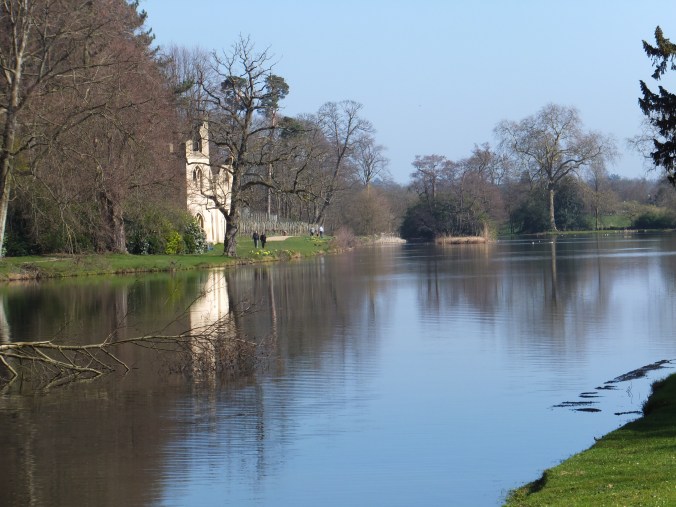
This was an unwary group of people feeding the Canada Geese by the lake at Painshill. There are literally flocks of geese of different species, as well as ducks and swans. Always a lot of activity on the water. In the background is one of the strategically placed follies, which I think is the Gothic Chapel

I am starting to whet my own appetite for painting here again!

DSCF0985

A different view of the lake with a different ruin which could make a good subject. Wants something in the foreground though. I have umpteen swan pictures from which to choose.

I have a commission to do and then I might tackle this one

Thames Estuary Sea Forts: Finished Painting

Sea Forts Thames Estuary

This is the finished painting

I had intended to post another work in progress shot, but as I got into the rhythm of the painting, it was as easy to finish, and more interesting to look at anyway

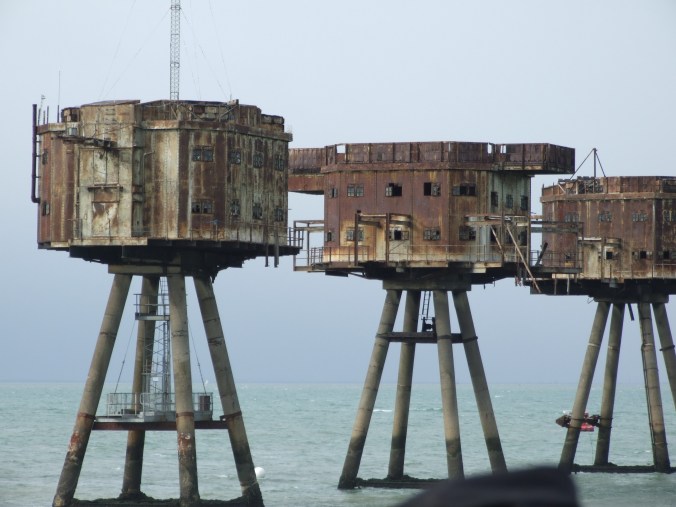
I had one false start, which normally I wouldn’t admit to. I decided the sea looked too pale and insipid, so I scrubbed back the bottom half of the platform legs, so that I could paint over the sea again and deepen the colour. Especially the area around the platforms needed to be darker even though it wasn’t in the photograph. I used Viridian mixed with a little Lamp Black for the sea colour, which works well I always think, with a nod of thanks to Rowland Hilder.

This alteration did leave me with two hard lines which normally I would have been able to blend. I have disguised them a bit with white caps, so not too bad

As for the structures themselves, I used Burnt Sienna with a little Crimson to get close to the colour of rust, and drybrushed as much as possible to look like rusty paintwork. The very deep shadows on the platforms I did with Ultramarine Violet, neat straight out of the tube with as little water as possible and straight over the rust colour. The barnacles at the bottom were painted with Olive Green, but still not dark enough, so I overlaid with the Violet.

There were some red marks where brackets had been fitted, which was probably red oxide base coat in its day. Again some Crimson, with a little free expression, seemed to get that effect.

This turned out better than expected, I am pleased to say. I have learned from it, and it was a welcome change from the usual scenes. Not a painting anyone is likely to buy, so pure self-indulgence really.

Sea Forts Work in Progress

DSCF2988

So far, I have put down a base coat of Cobalt Blue/Phthalo Blue mix right across. I fixed the horizon with a vague idea of coastline. One or two small details were masked out. There is a small buoy next to one leg of the first fort, which will be white eventually. One or two girders or rails facing the light will be pale blue when the mask is removed.

It may not appear so in the photograph but I have washed over the sea, with a dilute Cobalt green, and then rubbed in Raw Sienna at the base of the towers, as the sandbank is visible through the water

With the shadows on the metalwork, I have allowed myself to experiment and used a mix of Cerulean Blue and Ultramarine Violet, a combination I have not used before, but only read about. This makes a pleasant shadow colour, although whether it suits old ironwork is another matter. Some people put shadows in afterwards, and it is a personal choice. I find putting in shadows first gives me a dimensional image to start with, which I find helpful

I couldn’t get near the pale green colour of the paintwork on the towers. I used the Cobalt Green over the original blue wash, and will hope for the best. Time now to work on those delicious rust shades, which I hope will bring a touch of reality

I have absolutely no idea how this painting will end up

Estuary Sea Forts: Sketch

Estuary Sea Forts

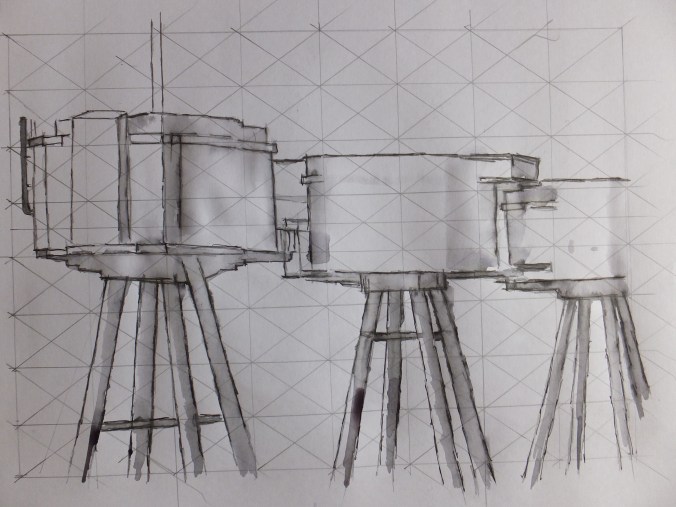
This is the preliminary sketch from the photograph. Very quickly done, as I have dropped behind with this particular picture, probably because there is no deadline on this one. As I said before, I am just painting these forts for my own amusement

There is very little detail drawn in so far. This is just a basic framework put in with the grid ready to transfer onto watercolour paper, which hopefully will ensure that the perspective is correct, and that everything goes into the right place. I quite like finishing the drawing straight onto the surface that is going to be painted. It just feels more immediate that way

I have started to have a few thoughts on colour. I think I will go right across with a mix of cobalt and pthalo blue. Let that dry hard and glaze the sea with another coat of pthalo blue. The horizon line is quite low, so there won’t be too much of that

When that is hard, I could put in the shadows perhaps this time with a mix of cerulean blue and violet, just to show where they are. When that,too, is hard, give the metal work a glaze of pthalo green as a base colour. That should set me up for having a crack at all that rust and dirt and seaweed. The shadows can be deepened up with a dark brown

Once I get those base colours in, then things will get more interesting, I am sure

Thames Estuary Sea Forts

Pirbright 098

I have just finished the work for my second exhibition which I set up tomorrow in the Royal Surrey Hospital in Guildford, for anyone living close enough to go, this will be on for a month. All new work, so hopefully enjoyable

With that said and with a couple of weeks spare before I start my next commission, I am going to indulge myself and tackle something totally different, namely the Maunsell Sea Forts in the picture above. These are in the North Sea about nine miles out from the Thames Estuary, and loom like ghosts in the mist as you approach them

They were designed by a civil engineer called Guy Maunsell, and had a short but intense life during WW2. Built in 1942, they were erected on sandbanks, and commanded the estuary of the Thames, so they protected London and the Kent coastline from low-flying attacks by the Luftwaffe.

After a spell as a pirate radio station in the 1960s, they relapsed into disuse and as far as I know nothing is being done with them, probably because they are out of sight and so out of mind. There were seven of them, but one was hit by a Norwegian vessel and had to be taken down

We went to see them some years ago on a one-off trip organised out of London. This was on a paddle steamer called the Waverley, which originated from the Clyde as I remember, but would sail round the British coast and would organise excursions from various ports. This one was from London. We started in the Pool of London, sailed through Tower Bridge which was novel at the time, although I think cruise ships do this quite often now, and then chugged down the Thames, stopping only at the end of Southend Pier to pick up some more passengers. The voyage continued out into the North Sea , passing a surprising number of ferry boats at anchor, mothballed until they were needed. The forts slowly came into view through the sea mist. Very atmospheric indeed

I thought I would paint them one day, and have finally got round to it. Not something that is commercial, although I may get a surprise, but that doesn’t matter. This will be an interesting project in itself, tackling all those rusty surfaces, and hopefully capturing something of the mood which the photograph has missed somehowPirbright 091


The Finished Venice Painting

Peaceful Reflections of Venice

This is the completed version. I call it Peaceful Reflections of Venice, because that is what these quiet corners of Venice are, very peaceful. The city can be busy, but then turn off into one of the side canals, and you are alone with your thoughts.

This should give me enough now for both exhibitions, I hope. The first I may have mentioned already starts on May 3rd, so some framing and stuff to do now, and then hopefully I should be ready. Guildford Institute is a lovely, friendly venue to show at and always attracts good publicity. Sales are never high there but as I say, the coverage is good, so I still like to do it

Following on, on 27th May I am at the Royal Surrey Hospital in Guildford, in the Peter Thompson gallery. Sales are usually good there as the place is so busy. Having built up this stock, I am looking for sales now of framed pictures, just to give myself space to carry on painting.

Quite a few lovely people from around the world have written in to say how much they enjoy watching the painting come together in stages, starting with the drawing and ending with the finished picture. Thank you for that feedback. That is so helpful. Sometimes I think I sound like a teacher, which I am not.  I have no teaching qualifications, but I am happy for anyone to watch me paint, and if that helps, that is fine.

Some useful reaction to the website over the last few months. Three sales and two very interesting commissions. The most recent which I shall start first because of the deadline, is from a national charity, for a painting of a local high street in snow, to be, hopefully used as a Christmas card. I shall donate the work, of course, but nevertheless, the publicity will be valuable

This will take me a little while to work out but I will post in stages as time goes by.