Reworking Langstone Mill Painting

Langstone Harbour & Mill

Just to put the picture up again. The more I looked at this painting, the more dissatisfied I became

I think that I said before that the camera has leeched colour from the image, and that is true. Nevertheless, I feel that the painting looks anaemic ( I checked the spelling and I am correct, even though the spellcheck doesn’t agree). This was supposed to look dramatic with the wild sky etc, but just doesn’t work in my opinion

I consulted my mentor at the art club, and she has given me a list of suggestions, so I shall be working on this next, hopefully not too long, trying to get some feeling into the picture

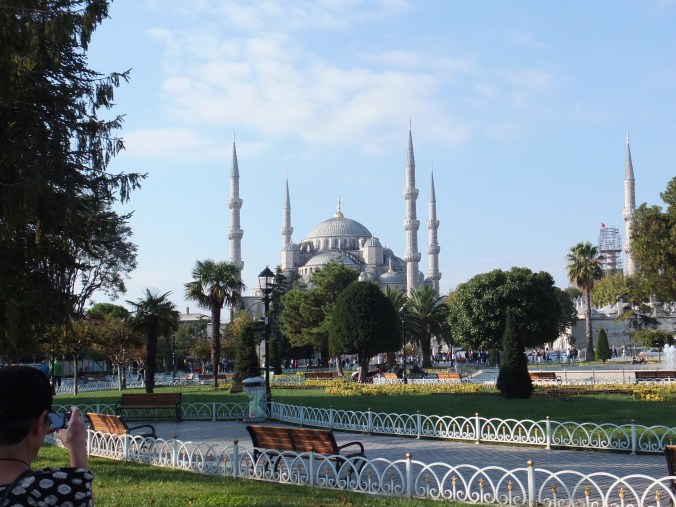
After that, I want to get back to Istanbul. I need a smaller painting, and I think the Blue Mosque will lend itself to that, as this image

DSCF2491

I may have to remove a tree or perhaps not. This will make a nice little study. So plenty to get on with!

Langstone Harbour: The Finished Painting

When I finished the last post, I was about to put in the background trees and then the shadows on the buildings themselves

The trees I painted with a fan brush with crinkly bristles. Wide brushes like these are useful, as they can be used to pick up two colours at once, in this case French Ultramarine and Light Red. I used Sepia as well, where I needed to create definition, along the side of white buildings for example.

Imagining a low, bright light coming from the right-hand side, I used a blue – grey wash to put in shadow on every left-hand surface of each building including shadows that would have been cast on the ground. On the mill tower, which is round obviously, and which in real life is black, I again wanted to create the effect of bright light striking the round surface.  To get this effect. I painted blue-black down the left side whilst down the right half I brushed clean water. Then I let them meet. They did the job for me, and obligingly dried as I wanted. Along the left-hand perimeter, I brushed a thin line of neat Indigo, which gave the look of deep shadow on the far left.

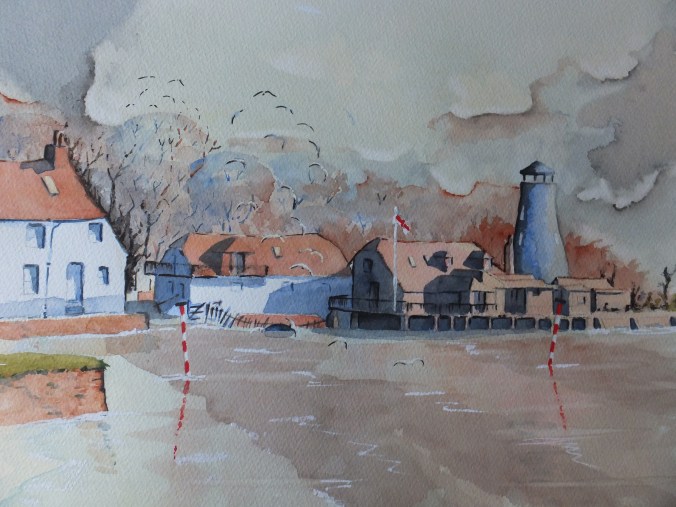
Probably best to look at the image at this stage.

Langstone Harbour & Mill

Sadly, the camera leeches out some of the colour no matter how many different lights I use for the photography. The colours are subtle, anyway, so notices on the jpeg, whereas the painting itself works perfectly.

As I said, when I started out, I was going to attempt the style of Rowland Hilder, the famous watercolourist. I have used his colours, but I think my own style has crept through. Nevertheless, I am still happy enough with the finished painting

So let’s talk through the detailing

On the left-hand building, I have defined the window recesses with Indigo, as well as the guttering and down-pipe, and the roof line with Sepia

On the centre building, again I defined the roof-line and painted a rickety fence in front of the sluice gate. I may have mentioned earlier, that this was a tide mill as well as a windmill, so seawater flowing through this tunnel would have powered grinding machinery somewhere. I can’t tell you more than that, I’m afraid, as these buildings were derelict when I was a boy in the 1950’s, and had been for many years, so nobody knew their history. Thankfully, they were restored for residential use.

The right-hand building took more work, as the space underneath where the house is standing on brick stilts, is very dark, and took various coats, even using some black eventually. Window recesses were defined as was the balcony.

It just left the masking fluid to be removed, and to paint in the posts and flag, which was a splendid opportunity to use Cadmium Red, nice and bright to guide the eye into the picture. The gulls were tinged with grey under the wings and black at the tips. We were done!

I hope that you enjoyed this long journey. Thank you once again,  for reading my blog
Langstone: Underpaintings

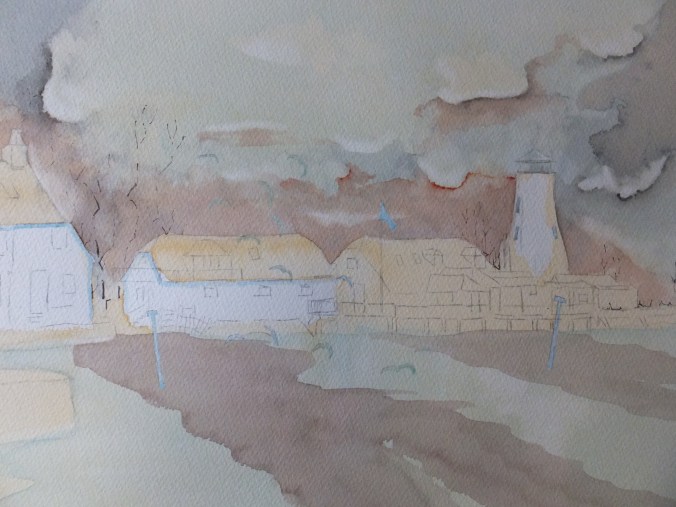
I mentioned in the last post that I would give the painting a coat of burnt sienna. In fact, I changed my mind and used raw sienna with Naples yellow mixed to give some brightness against the darks that would come.

I did mask out the white-walled buildings, as well as two metal posts jutting out of the water, and for good measure masked out some gulls to give the scene a sign of life.

I also put in some tree shapes as guidelines in sepia ink

DSCF2766

Rather a pale wash, so a pale photograph I am afraid. I think you can see where I have masked out in blue, the white buildings, the posts and also the flag as well as the windows on the old mill tower. The tree shapes I put in after this picture was taken but you will see them on the next image.

I gave this coat 24 hours to dry hard. Had I been in a hurry, I could have used a hair dryer, but I prefer natural drying, as then the paper returns to its flat condition. I find if you rush the drying, then the paper retains any cockling that may have taken place whilst wet.

I then mixed a dilute solution of Phthalo blue and Cobalt blue and washed this over the sky and sea. I blotted out some clouds. This coat also had 24 hours to dry.

The next step was to mix up a solution of French Ultramarine blue and Light Red. The trick is to get it not too strong yet not too wishy-washy. That is not easy. I worked this in from left to right, simulating, I hoped, gathering storm clouds. The colour varies depending on the mix from blue-black to deep red. In some places I put pure pigment along the top of a cloud edge to give the impression of strong light behind. To accentuate this, I scrubbed with a bristle brush and clean water, the area the other side of this pigment line. In other words, I scrubbed off the blue to reveal the sienna / yellow. I worked on the clouds adding some colour here and removing some there. I will show the image next

DSCF2774

Sadly the camera has taken some of the strength out of the colours, no matter how many times I took this shot, which spoils the light against dark effect

Always an act of faith to go on, at this stage, as mid-painting always looks a bit of a mess, which is why it is essential to finish

Next to put in the trees behind the roof-tops and the shadows on the buildings which will give them their form. I still have to do that, so will post again

Langstone Harbour in Winter

The last painting was in the warm Adriatic sunshine. Now in the UK, albeit warmer than usual, our days are dark and skies are threatening as our weather comes in from the Atlantic.

For painting, I actually enjoy this time of year. I love winter landscapes, which give us a good opportunity to use those blacks for very deep shadows, as well as bright lighting from the side from the low sun when it does appear.

My mentor, for this type of painting, is a famous watercolourist called Rowland Hilder, who is well-known for this type of landscape. He painted often in his native Kent, and along the east coast generally. He was also a sailor, and produced dramatic seascapes along the south and east coasts, and especially in the Thames Estuary. I am going to try and do the next painting in his style

The subject I have chosen for this style of painting, is Langstone Harbour. Situated between Portsmouth and Chichester on the south coast, and before the bridge to Hayling Island, Langstone used to be the ancient port of Havant, the nearest town. Nothing commercial has happened there for many years, and the place settled down to a quiet pace. The coast is reeded and muddy, so unsuitable for bathing, but beloved by yachtsmen, as are so many inlets along that stretch of coast.

I grew up nearby, and it is a fun place for youngsters who like messing about in boats.

Langstone Mill

This is the old mill at Langstone, which was once a windmill and tide mill. The sails were taken off in the c19, and after a period of dereliction, was refurbished and made residential from about 1950. Dame Flora Twort, the artist lived there and did much of the rescue work. Neville Shute, the novelist was a frequent house guest

This is really the centrepiece of the harbour, and is painted a lot. There are other buildings to the left, like the Royal Oak pub, also lovely. It will just depend on what I can get into the picture

That is what I am going to start on next, as soon as time allows. This is a busy time of the year for everybody, and it could well be next week before I get underway. This week-end is the Pirbright Annual Exhibition, with hanging on Friday evening, which I mentioned in a previous post. Something like 170 paintings are to be exhibited, I am told. I am entering three as I mentioned before, so a lot of competition. I sold one last year, but whether I can do it again, I just don’t know

I shall probably post the drawing, which I may well do in ink, first on its own, as this will be quite a lot of work in itself. I will write again when I have done that. Thank you