Flamingos in the Camargue: first sketch drawing

flamingos-in-the-camargue

I took a number of photographs of the flamingos when I was in the Camargue. None of them were usable, so I took this group from someone else’s picture as the birds had formed a natural composition which, I thought, would make an interesting painting.

This is just the sketch done in my favourite Payne’s Grey. What is it about black and white, that I often prefer the sketch to the finished painting

They breed here apparently, the only place in Europe where they do that. I have seen them in Sicily as well, but perhaps they don’t have a breeding ground there

These birds are white, with bright pink flashes under the wings. Legs are a very bright deep pink. Always interesting trying to paint a white bird on white paper. I don’t really want any background against those long white necks, as I want them to stand out sharply. I will have to give that some thought

There will need to be colour around the undercarriages as reflections will be important and part of the composition, probably a blue of some sort. Phthalo with some Cobalt mixed in is a good Mediterranean colour, and could work with the deep pink legs. The pink will probably be Permanent Rose with a little Cadmium Orange.

Whether I shall have this finished for the Pirbright Art Club December exhibition remains to be seen. Let’s see how it turns out first!

The Contented Donkey: finished painting

the-contented-donkey

This is the finished donkey painting supplied to Egypt Equine Aid for their next auction which is early next month. Full details on their Facebook page, as well as news of the wonderful work that they do

I don’t think I deserved the build up they gave me. I didn’t really recognise myself. I was just happy enough to do something to help.

Let’s hope it sells after all that. Embarrassing otherwise

Flinging myself now into exhibition work for pre Christmas and into the new year, as am rather behind. Just starting a drawing of flamingos, as seen on our recent holiday in the south of France. Not drawn these birds before. I have to say that they are rather a strange shape

Just a short post this time, but wanted to mention the finished donkey painting


The Contented Donkey

contented-donkey

I was pleased to be asked to provide a painting for auction for a well-known charity involved in the rescue of horses and donkeys in Egypt

Many years ago I painted from the charming photograph inset, a watercolour study. I sold it subsequently and then forgot about it. Trying to remember what horse or donkey study I could paint, I remembered this one and finally found the photograph

We were coming back from the Cotswolds, and pulled off the highway at Minster Lovell in Oxfordshire A beautiful village in that lovely honey-coloured Cotswold stone which was the home of Francis Lovell, close confidante to Richard III, who limped home to Minster Lovel Hall to lick his wounds after the Battle of Bosworth in 1485. He continued to resist the Tudors and was killed at Stoke in 1487. The whole setting is delightful and the old dovecote is still there to see. The donkeys were part of the setting and I photographed one or two including the one inset. They are fun to draw but remember the long ears otherwise they will become a horse

The pencil study I did just now, and will transfer onto  watercolour paper. I actually have a commission on the easel at the moment which is a view of Bosham in Sussex, with a lovely sweep of the harbour with the Saxon Church in the background. Bosham Harbour is a delight to paint and I have done many times. When the painting is more complete, I will blog about it, as the history is fascinating.

For now, we are talking about the donkey. I am painting this alongside Bosham and also working up a picture of flamingos brought back from the Camargue. Very rarely do I do three easels at once, so let’s hope I don’t come unstuck

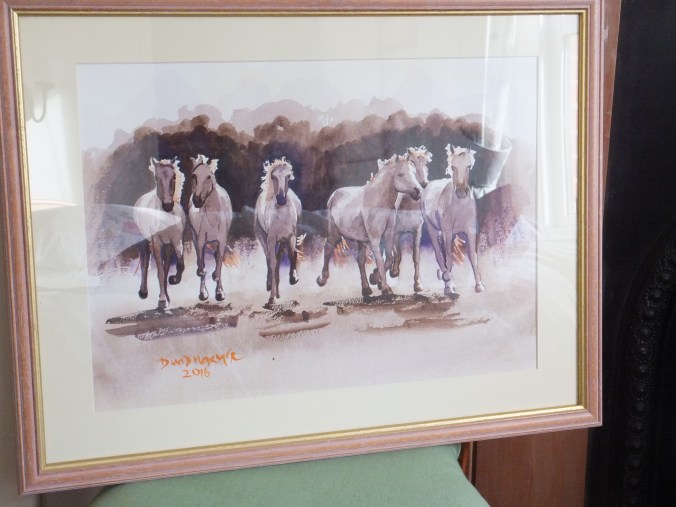
I attach a picture of the painting of Christmas Shopping in Guildford , now framed,which goes on sale at the end of this month for charity in St. Nicholas Church, Guildford with all the Christmas cards, one of which, of course, is from this painting.   I am attaching also the framed picture of the Wild Horses in the Camargue, which is now ready for the next exhibition

christmas-shopping-in-guildford-high-street-framed

The framed version of Christmas Shopping in Guildford High Street, which has been donated to Cards for Good Causes. Sorry about the reflections

wild-horses-of-the-camargue-framed

Wild Horses of the Camargue framed ready for exhibition. Again the reflections are annoying but I couldn’t get rid of them

Quite a bit to do, so hope to have something to show you next time

Wild Horses of the Camargue: the finished painting

wild-horses-of-the-camargue-finished-painting

Well, this is the finished painting

Quite a lot of work building up the shadows on the horses. They have so much muscle which has to be shaded correctly. in order to look right. Having stared at this painting for so long, I just can’t tell any longer if it looks right or not

As well as showing horses, I also wanted to show speed and independence of spirit which these animals possess in the wild.

I wanted to paint the flamingos from the Camargue as well but commissions are backing up which is a happy problem, so sadly flamingos may have to wait for a while

I have been asked to paint something for Egypt Equine Aid which I am pleased to do, which may well be one of my donkey paintings which I have not done for years, so that should be interesting. They have a Christmas auction but paintings have to be in in November so not that much time

Horses of the Camargue: Preparing to Paint

Line Drawing on Watercolour Paper

The Line Drawing on watercolour paper

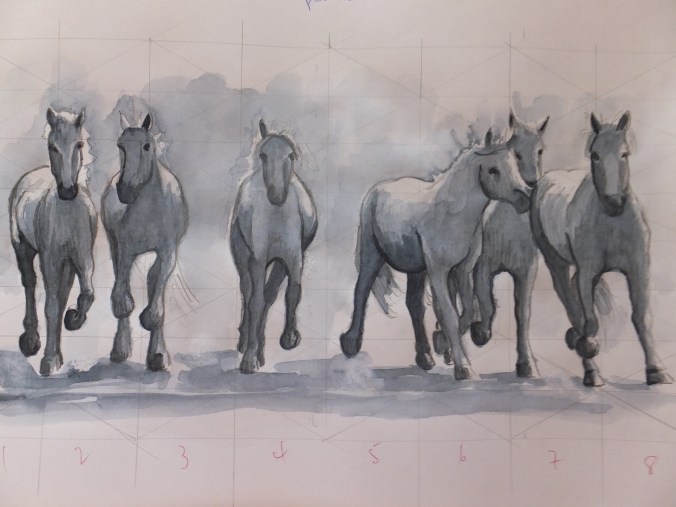
I have transferred the sketch just as a line drawing onto the watercolour paper. The size of the image is roughly what I want, about 30×40 centimetres

The painting will be interesting to say the least. The horses should be lighter than the background, and as you know, you can only go from light to dark with watercolour and not vice versa. The manes and tails in the photographs seem to glow as though they have light behind them. I think they will have to be masked out for that to happen. I may have to put background in first, which will be amusing

I won’t have a lot of time this week as we are going away soon to Sicily, another wonderful source of material. I think before I go, I will hopefully have time to give the painting an all-over wash of Naples yellow and Raw Sienna, which should give the glow of low sunshine that I want. Fingers crossed on that one

So, it may be nearer the end of the month before I can finish the painting completely. This won’t be an easy painting to do for the reasons stated. We shall just have to see how it turns out


White Horses of the Camargue

Camargue Horses

White Horses of the Camargue

When we were in the south of France a few weeks ago, we finished our voyage down the River Rhone at Arles. I have already mentioned my walking tour of the city in the footsteps of van Gogh, as well as the magnificent Roman amphitheatre

Just south of the city, and in the salt marshes of the Rhone estuary, is the Camargue region, famous for its semi-wild horses, its black bulls bred for fighting and also flamingos, which breed there, the only breeding ground of that species in Europe.

I say the horses are semi-wild. They roam the region more or less at will until round up time, but also they are used for riding, and the tamer ones used by riding schools and trekking stations. They are, I believe one of the oldest breeds in Europe, and because of the remoteness of the area, the bloodstock remains undiluted

I wanted to paint them. I do paint horses occasionally, usually heavy draft horses as I find them intriguing, but the Camargue horses are something of a challenge, because of their colour as much as anything. You can always find one white horse or two perhaps in a herd, but a complete herd all the same colour is unusual, and would make a striking painting.

I took some pictures of my own, which were shot from the hip very often as an opportunity presented itself, and were ok but not the best. I bought a photograph from a local, which was much more impressive, and am using this to compose something which I hope will make an interesting painting

I have sketched something out as above, using Paynes Grey watercolour which I now prefer to ink, which I think will work. Quite a lot of shadow of course on white and how to make it stand out against white paper will be interesting too. I shall transfer this sketch onto watercolour paper and see how we get on

Van Gogh and Arles

I have been away for the past week. We cruised down the River Rhone from Lyon to Arles which was lovely, and took three places off my bucket list. One was the Pont du Gard, that amazing section of Roman aqueduct still remaining crossing the River Gard. Very hot that day but still summoned the energy to go down to the water’s edge and look up at this amazing structure whilst envying the people in the water. The second place was the Camargue National Park to see the famous white horses and the black bulls, as well as of course the flamingos who breed there, the only breeding ground of this bird in Europe. Curiously they are not very pink. The third place, as an artist that I wanted to visit was Arles made famous by Van Gogh, and those of us who wanted, were treated to a fascinating walking tour taking in some of the places made famous by the artist.

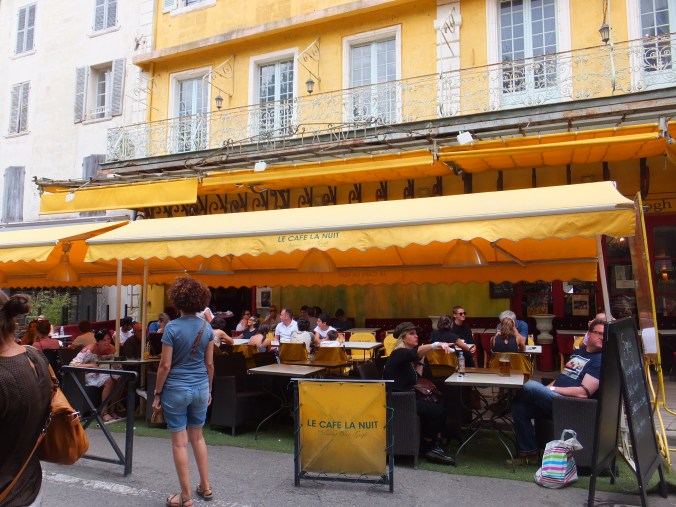
Van Gogh arrived in Arles in 1888, and took a room in a house near the railway station. he called it the Yellow House and it is depicted in one of his paintings. The house isn’t there anymore. It was destroyed by bombing in WW2. The house next door is still there, not yellow but a sort of buttermilk colour, and curiously enough still a cafe.

The light in Arles is extremely attractive for artists. The sun shines and the sky is blue nearly every day. More importantly, the famous wind, the Mistral blows down the Rhone like a corridor and clears the air of water vapour, dust etc, and produces a clarity of colour that would be hard to find elsewhere. The Mistral in summer is like a cooling breeze, like an electric fan in the heat of the city. In winter, I am told, it is something of a tyrant, getting inside your head, making you ill, and in some cases inducing madness. It goes in three-day cycles. If it doesn’t stop after three days, it will go on for another three, and so on

Vincent’s time in Arles was highly productive, producing something like 300 paintings.He was bi polar so was capable of great energy at times.  On our walk we visited some of the sites made famous by van Gogh. One of them was the Night Cafe or Le Cafe la Nuit. The exterior of the cafe is depicted in Cafe Terrace at Night painted in September 1888. My picture follows.
DSCF3231

Another shot with the van Gogh painting as a reference

DSCF3234

He wanted to set up a society of artists in Arles, and to this end, persuaded his brother Theo, who was already financing him, to persuade Gauguin with financial inducements, to come to Arles, which he did. The two of them had a turbulent relationship which turned violent and Gauguin left.

Van Gogh’s despair and self recrimination led to the famous self mutilation incident, when he took a razor to his ear and sliced off a lobe. He wrapped it in newspaper and gave it to a prostitute whom he knew. She reported him to the police, who thought he had killed Gauguin. He was admitted to a hospital in Arles for treatment, where he continued to work, and produced the following painting of the hospital garden

DSCF3230

The garden which he painted is not dissimilar today. Later his condition was to worsen and he was admitted to a nearby asylum in St.Remy.He was estranged from Theo who was about to marry. As we know he was to shoot himself in a nearby field, amidst some controversy. He shot himself in the chest and did not die immediately. People usually shoot themselves in the head and then death is instant. How did he come by a gun. He was unpopular in the town, because of his strange behaviour. Had someone else shot him? All unanswerable questions

I have tried to condense the walk down to as few words as possible. Not easy to convey so much information, but hope you find it interesting nonetheless