Paul Nash and the Turner Prize Finalists

Hoping to go to the Tate Britain Art gallery tomorrow, weather and circumstances permitting to see amongst other things , the Paul Nash exhibition

Paul Nash, known as a war artist covering both world wars, not as a documentary reporter, but with his own surrealist style, was also a superb landscape artist in his own right

In fact an artist of many facets

I shall look forward to writing about him and his work when i have learned more myself

Art and Empire: Following on from my post in February

Moslem Burial Ground

The Muslim Burial Ground near Woking built by the War Office in 1917 and restored beautifully in 2014 in time for the Centenary

If you read my post in February about the exhibition at the Tate Art Gallery, London, entitled Art and Empire, much of which had to do with India including the contribution of the Indian Army during World War 1, then you will remember that I finished with the story of the Muslim Burial Ground where Muslim soldiers who died of wounds in local hospitals, were interred.

There were 28 service personnel buried there from both world wars. Their remains were moved to the Brookwood War Graves in 1968, since when, the area within the walls was left barren. With the restoration, this area has now been turned into a Garden Of Remembrance, and includes a stone tablet with the names of the 28 fallen, inscribed on it.

Finally I have been again to look at it, and have taken some pictures so that I can conclude this post. It really is a very tranquil and, I think, sacred place

DSCF3077

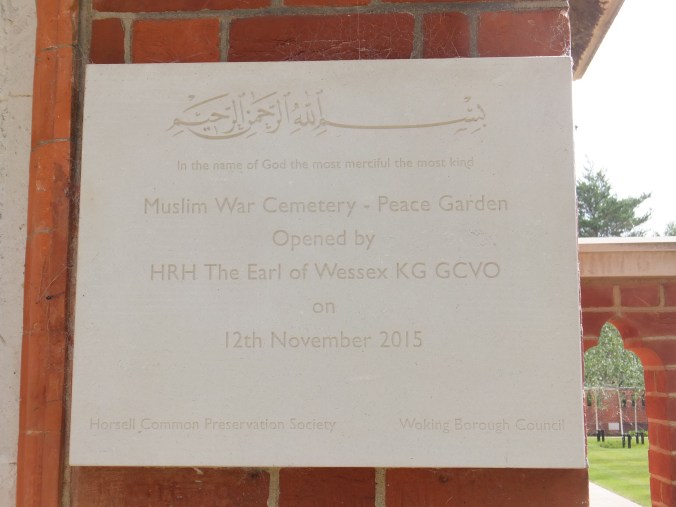
The new plaque by the main entrance of the Muslim War Cemetery-Peace Garden. Let us hope the sentiment comes true

DSCF3082

This is the tablet commemorating the 28 service personnel who lost their lives in both world wars. You will need your zoom to read the names, I am afraid. This was as close as I could get

DSCF3085

Looking back towards the main gate, with the pool, landscaping and new trees. The water is being pumped round continuously, giving that delightful trickling sound. Certainly a place for meditation, and perhaps a prayer for peace. Not easy when there is an atrocity every day

I am still working on the painting of Shere Village and Church, which I would hope to finish within the next week or so

Exhibition at Tate Art Gallery: Painting With Light

We went to see this exhibition recently. Painting with light explored the relationship between painting and photography, and was a thought-provoking exhibition. Purists still tend to be critical of painters who use photographs, and yet at the time, artists saw great merit in the use of the camera

John Ruskin was never easy to please, being most exacting in his standards. He drew meticulous architectural studies which would have taken him hours. I cannot remember the quote verbatim, but words to this effect he said that if he could have been saved many hours of detailed drawing with a device that did the job in half a minute, then there would have been no doubt in his mind as to which he would use.

Photography was invented in 1839, and was to lead to a development in new techniques and materials which were to influence painters

Edinburgh was home to a progressive movement amongst scientist and artists. In 1843 the young Robert Adamson was to establish one of the first photographic studios where he was joined by the painter David Octavius Hill and Jessie Mann. Together they took something like two thousand photographs during their four year partnership

Their photographic portraits were admired during their lifetime and their views of Edinburgh were an influence on Hill’s landscapes. These works came to be recognised as some of the earliest collaborations between photographer and artist

Holman Hunt painting of Nazareth

Holman Hunt’s painting of Nazareth

Photography was a gift to the Pre-Raphaelites  of which Holman Hunt was one of the founder members. They looked for inspiration to the medieval period, and their works are known for sharp detail and vivid colours. This was almost a quasi-religious movement, and partly because of the medieval influence and partly because of his deep Christian conviction, many of Holman Hunt’s pictures are of Biblical or religious subjects.

Together with his friend Thomas Seddon, he stayed in Jerusalem for two years at the home of James Graham, a pioneer photographer. Together they took many landscape photographs. The reference material that photographs gave artists certainly helped painters like Holman Hunt in their chosen philosophy of sharper detailing.

Many photographers had trained as painters, and had set up studios. They used models whose posing time was cut dramatically with the use of the camera, especially when complex or spontaneous poses were called for. Photographs were used for preparatory references, which meant that props, costumes and models could be dispensed with.

Thus began the successful collaboration between photography and painting, the former even becoming an art form in its own right.

For me the camera has become the sketch book, enjoyable as sketching might be. I shall never again feel bad about that

Exhibition at Tate Art Gallery: Art and Empire

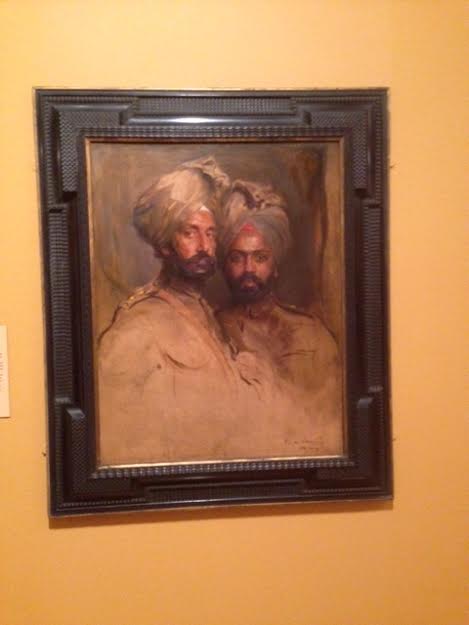
Risaldar Jagat Singh and Risaldar Man Singh by Philip de Laszlo 1916

Risaldar Jagat Singh and Risaldar Man Singh painted by Philip de Laszlo in 1916

We went up to London earlier today, to see this exhibition at the Tate. It was a very big exhibition, drawn from collections from everywhere, which took us about two hours to get round.

There was early stuff, mostly to do with exploration and discovery. The maps reminded me of those in my classroom at primary school, which of course today would be very non-PC

Quite a lot of paintings, as one might expect, were to do with Imperial Heroics or what Victorians considered to be heroics. Not always ending with a British victory, like the battle of Isandlwana (spelling probably wrong) in Zululand, where 1400 infantrymen were slaughtered in a very short space of time. There was an amazing painting of that last stand by an artist named Fripp, who was attached to the newspaper The Graphic. He actually visited the site afterwards to get the atmosphere before embarking on this massive reconstruction. Other memorable pictures were the Death of Wolfe and the Death of General Gordon, all good heroic stuff. The British did quite a lot of bad things around the world, but hopefully left something behind that was worthwhile as well.

If I were to be asked to name the one painting that impressed me the most, I think I would have to choose the double portrait that I have shown. This is an amazingly expressive picture by Philip de Laszlo of two Indian Army officers, named above, painted in a single sitting. What is it about working at speed, that adds so much to a painting?  They were presented to George V at Buckingham Palace, before embarking for France and the Battle of the Somme, where who knows what became of them after that dreadful slaughter. We are told that one in six British soldiers came from the Indian Subcontinent! The contribution from Commonwealth countries was staggering.

Moslem Burial Ground

Moslem Military Burial Ground, Horsell Common

This links into a local monument of which we are justifiably proud, the burial ground pictured above, built by the War Office in 1917, for Moslem soldiers from the Indian Army who died in British hospitals from wounds received in France.

Various hospitals along the south coast housed Indian wounded from the Front. Some tragically did not survive. Sikhs and Hindus were cremated but Moslems were interred, and they were brought here for burial because of the proximity of the mosque at Woking, which is the earliest purpose built mosque in the country.

There were 28 graves in the cemetery which were moved in the 1960’s to the main War Graves Cemetery at nearby Brookwood. Sadly vandalism had been a problem. After a period of neglect, this burial ground was restored in 2014 as part of the centenary remembrance. A Garden of Remembrance has been laid out within the walls, and the names of the 28 soldiers who died are commemorated on a tablet.

Nothing jolly or frivolous to report from this exhibition, I am afraid, all rather heavy, moving stuff. On a lighter note, I am moving along with the Blue Mosque painting. The drawing has been transferred to watercolour paper and various bits masked out where appropriate.