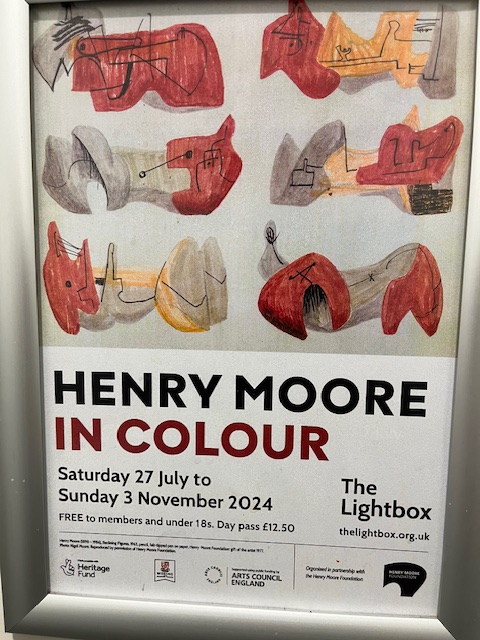
Henry Moore in Colour at the Lightbox

Yet another excellent exhibition at Woking’s Lightbox art gallery. Small, obviously, size dictated by the venue but focused and to the point. We, in Woking, are so pleased as following the bankruptcy of the town brought about by reckless investment, the fate of the Lightbox has been in the balance. Deep cuts are having to be made, and when difficult choices and sacrifices are having to be made, then difficult sometimes to make a case for our wonderful art gallery to be saved. So far it has been managed by the new local government and we are grateful for that. The Lightbox is relatively new, in a town with virtually nothing by the way of heritage or culture, so the rise in prominence of our gallery has been a matter of civic pride. We hope it will continue

Henry Moore is well known, and if like me you tend to remember his wonderful sculptures, then it is useful to be reminded that he painted as well, and some while ago too. When reminded, of course I remember his drawings and paintings of people taking shelter during air raids in London, in the underground railway stations. This exhibition highlights some of these works, known as the Shelter drawings commissioned by the War Artists Advisory Committee during the last war. These Shelter drawings were responsible for achieving widespread recognition for the artist following their display in the National Gallery. When you look at some of these drawings you start to see forming some of his later sculptures and I will show one if I can as an example

Certainly the first one I think I have seen as one of his sculptures!

Many years ago, there was a major exhibition of his sculptures in Kew Gardens, and I painted one of them that was placed in front of the Palm House. By way of light relief, I will end with it here

A figure stretching after a night on a cold platform? Might be

Henry Moore Exhibition at The Lightbox in Woking

henry-moore-reclining-figure-in-elmwood

The centrepiece of the current Henry Moore exhibition which we went to see recently.

The Reclining Figure in Elmwood.

If you have worked in elmwood, you will know it is notoriously  difficult to get a smooth finish. The grain is very knobbly for want of a better word, and resists efforts to sand it to a smooth finish. This piece is like satin and invites you to touch, which you mustn’t do, of course

Moore sculpts for the landscape with his monumental works, and developed in his pieces the “far-seeing gaze”, so that they could look out over long distances. With the space restriction at the Lightbox , this exhibition quite rightly concentrates on Moore’s drawings and smaller pieces, which sometimes don’t get the exposure that they deserve. Here we see the natural shapes and found objects that influenced the sculptor throughout his career, which in turn influenced his finished sculptures

The holes and negative spaces were intended to stimulate rhythm, tension, force and vitality. He was driven by this idea of the outer layer giving protection to the inner shape within.  His interest extended to helmets, armour and shells which also protect the interior.

A frequent theme is the mother and child image, which explores this idea. The big protecting the small. His Madonna and Child sculptures reflect Moore’s fascination with the interdependence felt between mother and child.  He was drawn to how things naturally fit together within the balance of nature, and of course he was not the first to notice that.

He was also influenced by the solidity of  ancient Greek statues which he sketched in the British Museum. He sought to reflect the weight of the stone through the strength of his mother figures.

The exhibition lasts until 7th May. Although not a large space, nevertheless because of the accent on his drawings and maquettes, there is much to study. Too much, perhaps, for my level of concentration, I intend to go at least one more time before the closing date to carry on where I left off.mother-and-child