
Thameside Ferry Crossing
This is a photograph I took myself trying to catch the little ferry crossing from Twickenham over to Ham on the other side. I just missed the ferry but my reason for keeping this picture, is that this must be one of the nearest points on the river from Turner’s house in Twickenham. I dealt with his house a few blogs ago so I won’t repeat that. Turner loved boats, he loved fishing, he loved the river, and he loved picnics with his friends. Was this the sort of spot he came to? We don’t know for sure about him fishing here, but he would have known this location.
I took this picture from the riverside of the grounds of Orleans House Gallery, where we go from time to time. The gallery is what remains of the original Palladian mansion built in the c18. Louis Philippe duc d’Orleans lived here in exile from 1813-1819. Turner met him and they became lifetime friends. Later in 1830 he became king of France, until he was toppled by another revolution, and went into exile in England once more. He died at Claremont in 1850. Turner went to see him in France near the end of his own life in 1845, one of his last visits to Europe, and they talked into the night about ‘Dear Old Twick’
In the background on the hill is the Star and Garter, what used to be a retirement home for disabled service men, and more recently converted into apartments. Nonetheless a powerful landmark, and showing us where Richmond Hill starts. Turner painted the view from there, and I would like to look at one particular painting dated 1819, painted in honour of the Prince Regents birthday
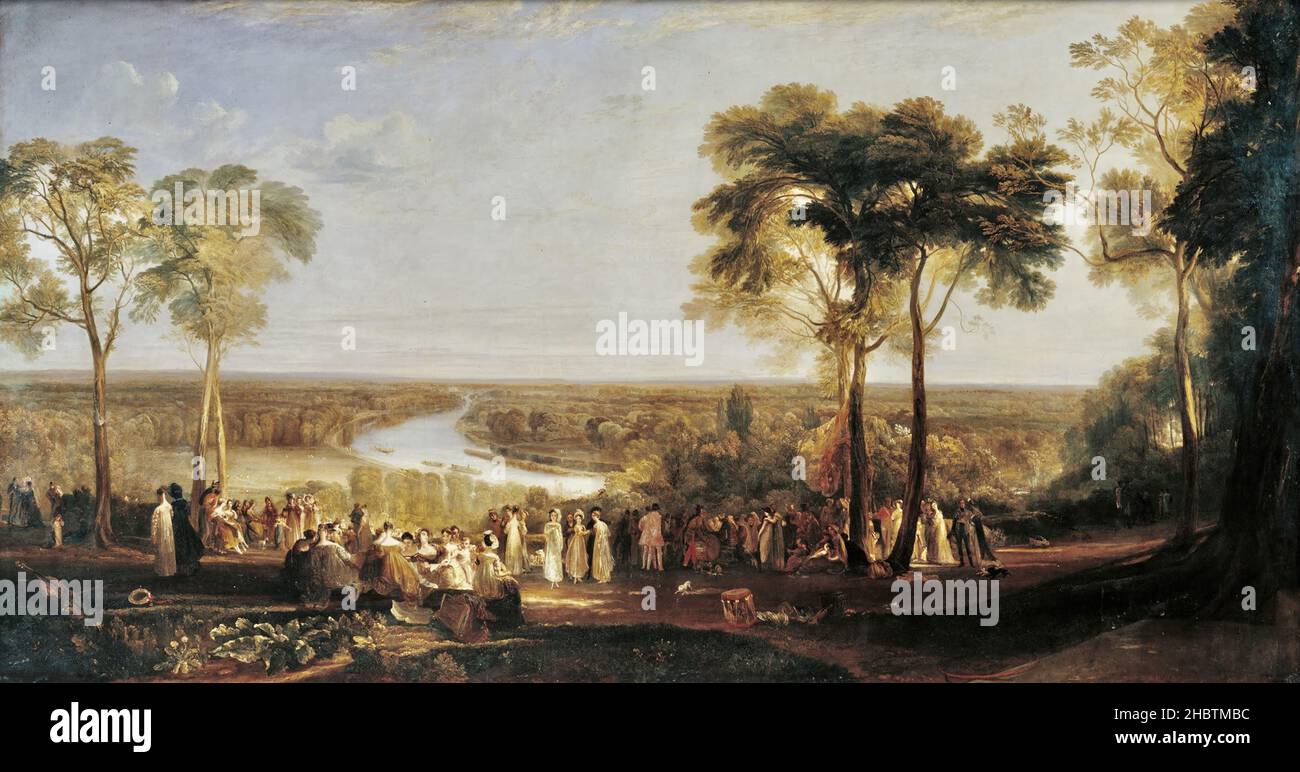
I think that this was an unashamed bid for royal patronage, which was unsuccessful as I believe but nevertheless an interesting painting, which of course looked down on an area which he grew to love. Actually as King George 1V he was able to bestow a seascape on Turner in 1823, but to return to Richmond Hill
I will, if I may quote from Anthony Bailey’s biography, which talks about this painting in some depth. Travel and the proprietorship of Sandycombe Lodge, his country house in Twickenham, had occupied much of his time. His painting output had dropped, and he had no new commissions, so he needed new patronage, or may have felt so. In 1819 he had exhibited this great canvas, kingsize, measuring about six feet by eleven. This was England: Richmond Hill on the Prince Regent’s Birthday. It showed the winding Thames at Twickenham, and Sandycombe hidden in the trees, and on the further bank a game of cricket going on whilst in the foreground a group of partying people which could have been borrowed en masse from Watteau
There were mixed views. Some thought the painting to be unEnglish despite its title. There is a quotation from Bell’s Weekly Messenger (16 May 1819) where the writer admired the painting but qualified his praise.’ The distance, the foreground,the trees,and the figures are all Italian. On Richmond Hill, and on such a day, John Bull with his dame, with the rustic lads and lasses of the village, sporting under the sturdy oak, would have been more characteristic of England’ But this was to request a different nostalgia. Turner had not yet been to Italy and was perhaps looking forward to that country to paint
That is probably enough for writer and reader for now. I am getting some material together for his excursions down the River Wey taking him deeper into Surrey, so we can look at that another time
 offtoafineart