Turner in Surrey: the River Wey

Turner, Joseph Mallord William; Newark Abbey on the Wey; Tate; http://www.artuk.org/artworks/newark-abbey-on-the-wey-202538

Described as Newark Abbey which is in fact Newark Priory, and even Newark Priory Church. The priory was a huge complex, and the ruined church is all that is left after the Dissolution . It looks to me that Turner sketched this from the road. The view is much the same today. The land is privately owned so close inspection is not possible. Cows are in the field much the same as Turner’s sketch. Newark Abbey is near Ripley as a point of reference. This painting is in Tate Britain

After the dissolution it was said that the priory was bombarded by cannon from nearby Pyrford Hill. After that the site must have been robbed for stone, as the ruined church is all that remains, apart from the odd outcrop

Turner would row down the river. We know that he stayed at the White Lion in Guildford, and at another in inn in Walton-on-Thames. He also thought nothing of sleeping on his boat. He was also a prodigious walker, known to cover 25 miles in a day including making sketches on the way. Sometimes he would set out with company and leave them behind if they couldn’t keep up

This is the entrance to Quarry Street in Guildford today. It is not by Turner! This is my painting made about twenty years ago. There is a link with Turner albeit a tenuous one. In order to take the reference photograph for this painting, I had to step back into the White Lion Walk in order to keep the bright sunshine out of my lens. The White Lion Walk is the shopping arcade which now stands on the site of the old White Lion Hotel. Let’s look at the next picture.
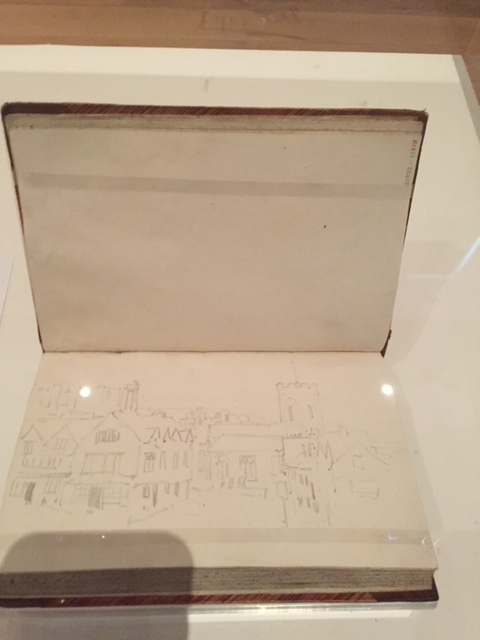
This is by Turner! It is one of his sketch books and shows the same view which I made years later, which still amuses me. I am sorry the image is so pale, but he worked in pencil. You can see the building on the left is much the same and the ancient church of St Mary stands in the background exactly as it does today On the right hand side is an inn much as today. Turner sketched this whilst staying at the White Lion in Guildford. Was he in the lounge relaxing or in his room. We know he didn’t like an audience so maybe the latter

We’ll leave it there for now and continue Turner’s drift down the Wey at some later date
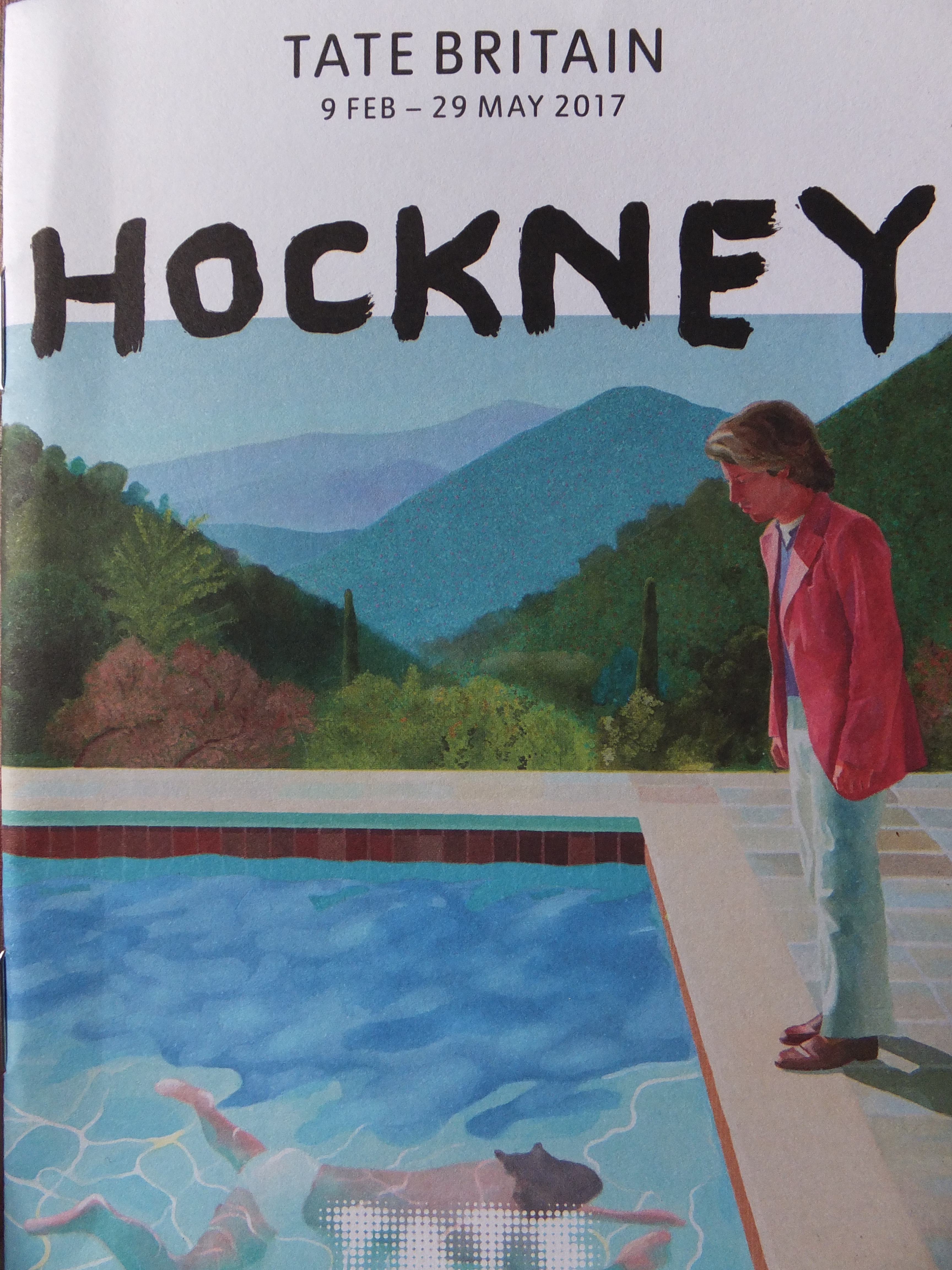
David Hockney at Tate Britain

Pool with Two Figures 1972 detail by Hockney

Pool with Two Figures 1972 detail

David Hockney is probably one of the most popular and widely recognised living artists of our time. His work spans the last 50 years from his student days, continually reinventing himself

We went there today. We like Tate Britain on a Saturday morning. Thanks to the kindness of the Borough of Kensington and Chelsea you can still park free on a meter on a Saturday. Also no congestion surcharge on a weekend. Anticipating correctly a heavy attendance for this exhibition, Tate Britain has been opening the doors two hours earlier than usual. We were early but not that early. The queues as we drew up looked daunting. This is where the member’s card comes into its own. We swept in effortlessly

Like most people, we have followed Hockney throughout each of his stages. Some of them leave me cold. In his student days he was influenced by Picasso. Everybody copies Picasso at some stage. It is very easy to tire of Picasso

One of my favourite Hockney periods is when he veered towards naturalism. I just like recognisable paintings. He was in Los Angeles for this time in his life, and so lots of swimming pool pictures of athletic young men. I particularly like his double portraits which explores the relationship between the two. Mr and Mrs Clark and Percy 1970 is a favourite. Especially touching is the affectionate portrait of his parents, especially the way they are posed

I remember his work with the Polaroid camera in the 1980s, producing myriads of small images to make up into a collage of quite a large picture. He was dissatisfied with the white border around each small image. I rather like that. The whole composition looked like a ceramic mural.

After many years in America, he moved back to his native Yorkshire, and produced some marvelous work. Massive tableaux of the Yorkshire Wolds. The colours are breathtaking. He moved from paint to video to produce a colossal work entitled The Four Seasons which as the name tells us, was of a single stretch of road in Spring, Summer, Autumn and Winter. Incredibly technical work

I am sorry I have no images. Vigilant attendants quite rightly moved in on me every time I tried to take a photograph discreetly with my phone. His charcoal drawings……….one can go on and on, my eyes ached after two hours. I shall go again

Paintings to Google are My Parents 1977, Mr and Mrs Clarke and Percy 1970,the Road to Thwing 2006, A Closer Winter Tunnel February-March 2006 and of course so many more

See it if you are in London. On until 29th May

John Constable Exhibition

Our local and comparatively new art gallery, the Lightbox in Woking is staging an exhibition entitled John Constable:Observing the Weather. No pictures from me, I am afraid so suggest the following link  thelightbox.org.uk. The exhibition opened yesterday and runs until May. We went today and will no doubt go again

Yet another triumph for the Lightbox, a provincial gallery with national recognition. Paintings, prints and watercolour sketches on loan from collections all round the country, tell us of Constable’s fascination with meteorology. Many sketches are from the years 1820-22 when he rented a house on Hampstead Heath to be near his studio in London, and these record cloud formations from different angles. They are really scientific observations which he drew from later when producing his oil paintings, such as Salisbury Cathedral from across the meadows which is the highlight of the show. This is one of nine giant oil sketches that he made which have become famous in their own right

Dismissed by the art world at the time, for not sticking to classical subjects painted in a studio, Constable stuck to painting en plein air, landscapes as he saw them uncontrived and true to nature. He was certainly an influence on the Barbizon School, with painters like Corot and Rousseau, and I always felt too, on the French Impressionists later on

Magnificent prints of Constable’s work by David Lucas are on display, such as The Drinking Boy and The Lock. This was about the time that printmaking moved away from the linear print to a representation that appeared like the painting, even down to brush strokes.

Obviously small by national standards but cleverly put together, and worth a visit, if you are able