Art and Empire: Following on from my post in February

Moslem Burial Ground

The Muslim Burial Ground near Woking built by the War Office in 1917 and restored beautifully in 2014 in time for the Centenary

If you read my post in February about the exhibition at the Tate Art Gallery, London, entitled Art and Empire, much of which had to do with India including the contribution of the Indian Army during World War 1, then you will remember that I finished with the story of the Muslim Burial Ground where Muslim soldiers who died of wounds in local hospitals, were interred.

There were 28 service personnel buried there from both world wars. Their remains were moved to the Brookwood War Graves in 1968, since when, the area within the walls was left barren. With the restoration, this area has now been turned into a Garden Of Remembrance, and includes a stone tablet with the names of the 28 fallen, inscribed on it.

Finally I have been again to look at it, and have taken some pictures so that I can conclude this post. It really is a very tranquil and, I think, sacred place

DSCF3077

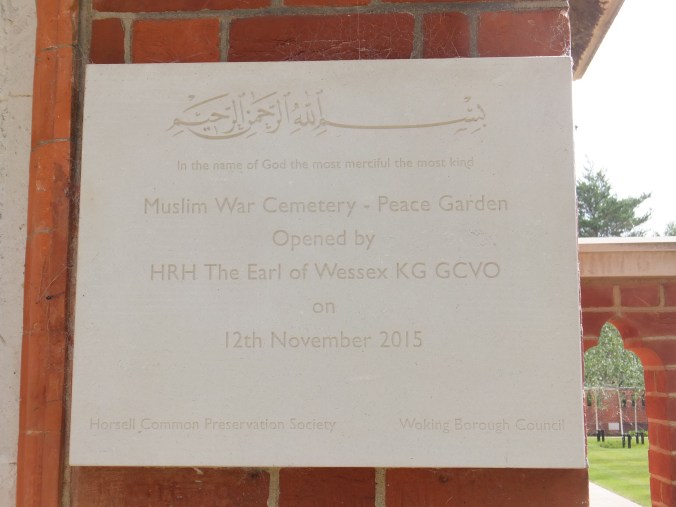
The new plaque by the main entrance of the Muslim War Cemetery-Peace Garden. Let us hope the sentiment comes true

DSCF3082

This is the tablet commemorating the 28 service personnel who lost their lives in both world wars. You will need your zoom to read the names, I am afraid. This was as close as I could get

DSCF3085

Looking back towards the main gate, with the pool, landscaping and new trees. The water is being pumped round continuously, giving that delightful trickling sound. Certainly a place for meditation, and perhaps a prayer for peace. Not easy when there is an atrocity every day

I am still working on the painting of Shere Village and Church, which I would hope to finish within the next week or so

Preparing a Painting of Shere Village in the Surrey Hills

DSCF3003

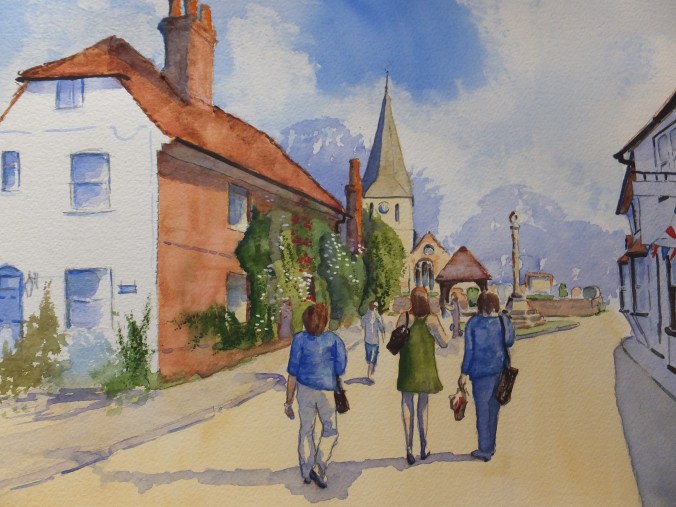
This is a view of Shere Village with its medieval church

Shere stands amongst the Surrey Hills and on the River Tillingbourne. Hard to imagine that in the c13-c15 it was industrial, producing woollen cloth. Today it is idyllic, like a postcard, attracting visitors from far and wide

I have been given an exhibition slot at the Royal Surrey Hospital, for July 2017, which does sound a long way off, but now starts the long slow build-up of exhibits. I need at least twelve that I haven’t shown before, so although I have some, I still want some more in reserve

I haven’t painted Shere for many years and then not from this angle. I think I can make something from this photograph, but for starters all these cars must go. I do sometimes put cars in, but in this case they are just hiding anything attractive. I shall probably broaden the composition by taking in more of the building on the left. I do also want some figures in the foreground looking towards the church, which will be a focal point.

The figures will be from my sketch book. I have drawn them free-hand from the screen, and will transpose them onto the drawing of the village street later. I will leave some pictures of the drawing and will post again when I have done some painting

Sketches of Figures

This is the page from my sketchbook. Figures kindly modelled by members of my family, although they didn’t know it, as we walked up to the old church.  What I do now, is to trace my sketch, and then slide the tracing around the drawing of the street, until the perspective looks right

Figures transposed to Shere Village scene

and so this is the sketch drawing which in turn will be transposed onto watercolour paper, after which it will be enhanced with more freehand drawing. When I have done that I will post the result

Gravetye Manor Hotel: the finished picture

Gravetye Manor Hotel

This is the finished picture of the hotel

The lights and darks helped this painting enormously, which was why I was so grateful for the sun shining just long enough for me to get a shot telling me where they were

The chimneys were hexagonal so each side had a different tonal value. They were fiddly and not sure now whether they were completely accurate, but from the point of view of giving an illusion of their shape, they seemed to work

I used raw sienna mixed with Naples yellow for the sunlit building and also for the path, which is my favourite mix for giving the appearance of sun on stone. The path was a gift for the composition, that bright open gateway surrounded by dark shadow.

Another problem was the plethora of green in the foreground. I used three different mixes which seemed to work, as well as some different plant shapes. The violet flower clump broke some of it up, and that good old favourite, red spots dotted here and there helped to take the eye

I have started to use the odd bit of pastel to get myself out of trouble where I might need a bright light colour over a dark background. I find that is a useful device and a nice change from gouache which isn’t always successful anyway

Will I have to call myself a mixed media artist? I don’t think so

Gravetye Manor Hotel in Sussex, UK

DSCF3056

This is Gravetye Manor Hotel which is near East Grinstead in Sussex, UK.

A beautiful old building dating from the c16 set in acres of woodland, which has been converted some years ago to a very luxurious country house hotel. The grounds are awe inspiring. This view is from the Flower Garden, which is one only of 11 separate garden spaces

The hotel has numerous accolades. Hotel of the Year England 2013/2014, Best Countryside Hotel 2014, Rural Hotel of the Year 2014 and more besides

So I was very pleased and indeed flattered to be commissioned to paint this view of the hotel, on behalf of a delightful couple for whom this hotel has become a special place during a significant time in their lives.

I went there about a month ago, hoping to get a sunny day. I say hoping, because our weather has been so very changeable lately , with sun going in and out of clouds all the time. That is even if one was lucky enough to pick a dry day to start with. I wanted sun and I wanted shadows to make the building look more interesting

This photograph is one of many that I took on the day. The sun came out reluctantly and I got a few shots with shadows cast on the building yet with a few highlights left, on the porch, on the chimneys which were a bit of a nightmare to draw, and also lit the front of the building brilliantly

The interesting part of the composition was the path to the right with the garden gate itself in shadow yet giving onto bright light beyond. Where was that going to? Well, the car park but in artistic terms it could be leading somewhere more romantic

I made some sketches and transferred them onto watercolour paper as a finished drawing, ready to paint which can be the subject of another post

Gravetye Transferred Drawing

A little bit pale as I tried to avoid dark pencil lines, but the gist of the composition is there

Medieval Undercroft in Guildford High Street

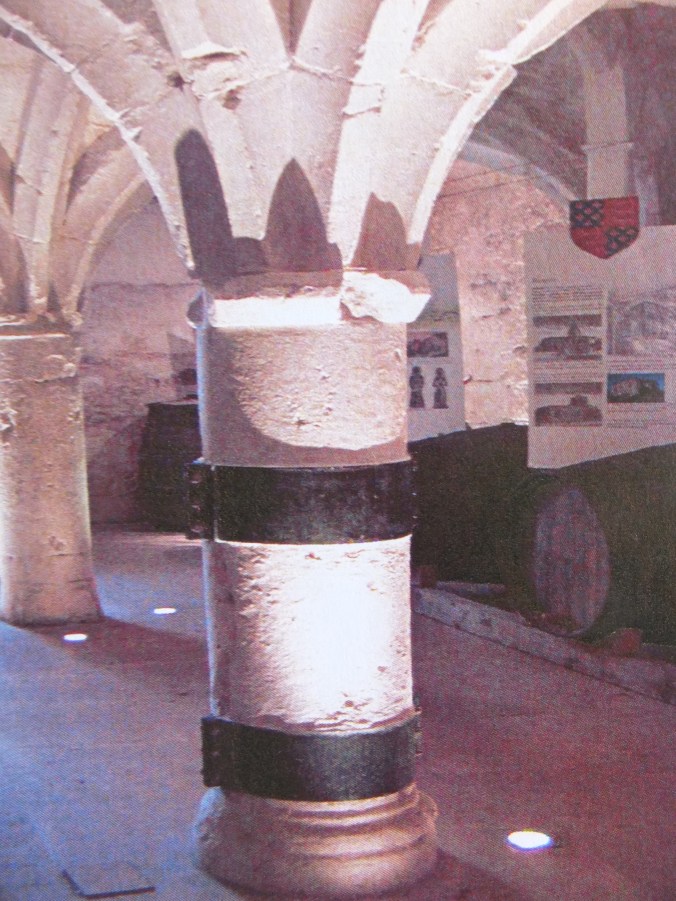
DSCF3070

Not so much art this time, but architecture. I do say in my profile too, that I am a history freak.

Together with other volunteers, my wife and I take turns to open this gem to the public on certain hours throughout the season. It is one of those local treasures that even local people are largely unaware of. I use the words gem and treasures without wishing to sound melodramatic as English Heritage tell us that this undercroft is one of the best preserved in the country

It is in fact a c13 shop, probably selling wine. That is an assumption but a safe one. We have records of wine merchants in the High Street during the c13 but we cannot make a direct link to this building . But that is what informed opinion believes.

The wine would have come from Gascony in SW France, which was English then, hence the trade connection. Wine would have come through Southampton and then by bullock cart overland to towns like Guildford

Guildford was wealthy in the c13. Wealth was derived from the wool trade and especially the trade in woollen cloth, the Guildford Blue for which the town was well known. The population of Guildford was probably less than 1000 in those days, and most would have been employed either directly or indirectly from the wool trade. Guildford controlled every aspect of manufacture. Sheep were raised on the Downs by the monks at Waverley. Weaving, fulling, dyeing, spinning, carding all were done locally

The processes are remembered in local place names. Racks Close was where the cloth was hung out to dry on “tenterhooks” after dyeing. Unscrupulous traders would stretch the damp cloth and make another metre or two. There are records in the Guildhall of such merchants being brought to book and fined. Finally a lead seal of approval was to be affixed to every roll of cloth that left the town to ensure that standards had been met.

Most went to export, especially to Antwerp which was the staple market, and from there across the then world, Europe and the Near East. The word staple is interesting. From the French word “etaple” meaning “main”. The main market or one of them. That is clear. So that buyers could see what they were buying, a small sample of wool was fixed to the label with a metal pin. The metal pin came to be known as a staple.

To come back to the undercroft, the reason that we are so proud of ours is that it was never restored in any way. What we look at is pure c13. The building is of chalk blocks or clunch which is the hard chalk dug deep from the earth. Guildford is on chalk. It was the only building material at the time. The stones are cut with a precision only possible from a master mason. Expensive to employ so the owner was indubitably a wealthy man. Another pointer to the merchant being a dealer in expensive goods.

To this day the c13 vaults take the weight of buildings above

On Saturday from 12 until 2 we had nearly 40 visitors, mostly shoppers who were passing and had never seen us before. Always their jaw drops as they come in, and they are fascinated with the story. Considering we were competing with the tennis, we didn’t think that was bad

Exhibition at Tate Art Gallery: Painting With Light

We went to see this exhibition recently. Painting with light explored the relationship between painting and photography, and was a thought-provoking exhibition. Purists still tend to be critical of painters who use photographs, and yet at the time, artists saw great merit in the use of the camera

John Ruskin was never easy to please, being most exacting in his standards. He drew meticulous architectural studies which would have taken him hours. I cannot remember the quote verbatim, but words to this effect he said that if he could have been saved many hours of detailed drawing with a device that did the job in half a minute, then there would have been no doubt in his mind as to which he would use.

Photography was invented in 1839, and was to lead to a development in new techniques and materials which were to influence painters

Edinburgh was home to a progressive movement amongst scientist and artists. In 1843 the young Robert Adamson was to establish one of the first photographic studios where he was joined by the painter David Octavius Hill and Jessie Mann. Together they took something like two thousand photographs during their four year partnership

Their photographic portraits were admired during their lifetime and their views of Edinburgh were an influence on Hill’s landscapes. These works came to be recognised as some of the earliest collaborations between photographer and artist

Holman Hunt painting of Nazareth

Holman Hunt’s painting of Nazareth

Photography was a gift to the Pre-Raphaelites  of which Holman Hunt was one of the founder members. They looked for inspiration to the medieval period, and their works are known for sharp detail and vivid colours. This was almost a quasi-religious movement, and partly because of the medieval influence and partly because of his deep Christian conviction, many of Holman Hunt’s pictures are of Biblical or religious subjects.

Together with his friend Thomas Seddon, he stayed in Jerusalem for two years at the home of James Graham, a pioneer photographer. Together they took many landscape photographs. The reference material that photographs gave artists certainly helped painters like Holman Hunt in their chosen philosophy of sharper detailing.

Many photographers had trained as painters, and had set up studios. They used models whose posing time was cut dramatically with the use of the camera, especially when complex or spontaneous poses were called for. Photographs were used for preparatory references, which meant that props, costumes and models could be dispensed with.

Thus began the successful collaboration between photography and painting, the former even becoming an art form in its own right.

For me the camera has become the sketch book, enjoyable as sketching might be. I shall never again feel bad about that
Exhibition at Royal Surrey County Hospital

Brewery Dray

Brewery Dray in Guildford

When we were breaking down the exhibition on Friday morning, I sold this painting at the last minute. A young woman arrived breathless with the money and bought it. I was very pleased with this as it raised my score for the whole exhibition to four paintings sold. Not the best that I have ever done but not the worst either, and certainly quite respectable.

The other three were Strolling through Montmartre, Grand Canal Venice and Painshill Park

Paris and Venice are always popular, especially the well-known landmarks. I have almost lost count of how many of each that I have sold. Painshill Park is a new subject for me and I was heartened to sell this picture, as I now feel encouraged to paint some other views, of which there are many to choose from

Painshill is a local estate near Cobham in Surrey. It was laid out in the c18 by a man called Charles Hamilton. It was in the style of a natural landscape made popular at the time by garden architects like Capability Brown and Humphrey Repton. The views were sculpted, whole forests were planted, fake ruins were built and rivers were dammed to form lakes.

Hamilton worked a lot with American species of trees. It was interesting to note that you could import a “box” of plants from American nurserymen, suitably packed to withstand the rough and long sea voyage. Many did survive and are still flourishing in the park today.

Over the years, the place deteriorated and became overgrown. In the 1950s it was rediscovered and lovingly brought back to life. Every year there is a new project. Recently the old boat house was rebuilt using old photographs. The previous year one of the bridges was replaced using an old painting as a reference. I attach my painting

PainshilL Park, Surrey

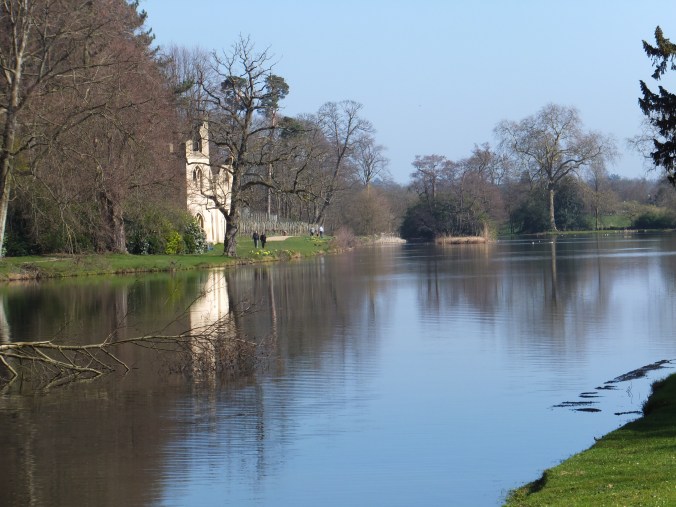
This was an unwary group of people feeding the Canada Geese by the lake at Painshill. There are literally flocks of geese of different species, as well as ducks and swans. Always a lot of activity on the water. In the background is one of the strategically placed follies, which I think is the Gothic Chapel

I am starting to whet my own appetite for painting here again!

DSCF0985

A different view of the lake with a different ruin which could make a good subject. Wants something in the foreground though. I have umpteen swan pictures from which to choose.

I have a commission to do and then I might tackle this one

Schlee Collection at Mottisfont Abbey

DSCF3027

Mottisfont Abbey near Romsey in Hampshire, UK, owned by the National Trust

We were at Mottisfont yesterday to see the roses which are magnificent now. These are grown inside the old walled kitchen garden, which give them a superb backdrop against old brickwork. I took some pictures of specimens, especially blooms which are about to fall, hopefully to do a rose study again. I haven’t done one for a long time. Not just the roses though. We had come to see the art, in the form of the Schlee Collection which is on loan from Southampton Art Gallery until July 3rd

There is an exhibition of the Schlee Collection of drawings and sketches, on loan from Southampton Art Gallery, which lasts until July 3rd. A private collection which was bequeathed to Southampton Art gallery in 2013, which includes work or should I say squiggles, by David Hockney, Henry Moore and Franz Auerbach, plus many others. I would like to say that I was thrilled by them, but I wasn’t. Heavily worked and corrected jottings are not very impressive, even if by one of the great names in British art. I was more pleased to see a drawing by Barbara Hepworth of an operating theatre, placed next to her mentor Henry Moore’s work. The Barbara Hepworth was borrowed from the Derek Hill collection which is in permanent residence at Mottisfont.

Derek Hill was a portrait and landscape painter of note, who became sought-after during the 1960s. From the south of England he moved to the west coast of Ireland and founded the Tory Island School of painting, where he taught the fishermen to paint the wild Irish landscape. He was also an avid collector of modern art, including the post-Impressionists. He was a friend of Maud Russell the last owner of Mottisfont, and bequeathed a portion of his collection there. These are always worth seeing, including many of his own works, time and again.

For me, however, the gem is still the Whistler room. Here we see Rex Whistler’s unfinished murals. Unfinished because he was killed in Normandy in 1944. His trompe l’oeil paint pot and brush high up on the coving below the ceiling, still makes me feel that I want to get a ladder and climb up and get it. I believe several have in the past

DSCF3021

Thames Estuary Sea Forts: Finished Painting

Sea Forts Thames Estuary

This is the finished painting

I had intended to post another work in progress shot, but as I got into the rhythm of the painting, it was as easy to finish, and more interesting to look at anyway

I had one false start, which normally I wouldn’t admit to. I decided the sea looked too pale and insipid, so I scrubbed back the bottom half of the platform legs, so that I could paint over the sea again and deepen the colour. Especially the area around the platforms needed to be darker even though it wasn’t in the photograph. I used Viridian mixed with a little Lamp Black for the sea colour, which works well I always think, with a nod of thanks to Rowland Hilder.

This alteration did leave me with two hard lines which normally I would have been able to blend. I have disguised them a bit with white caps, so not too bad

As for the structures themselves, I used Burnt Sienna with a little Crimson to get close to the colour of rust, and drybrushed as much as possible to look like rusty paintwork. The very deep shadows on the platforms I did with Ultramarine Violet, neat straight out of the tube with as little water as possible and straight over the rust colour. The barnacles at the bottom were painted with Olive Green, but still not dark enough, so I overlaid with the Violet.

There were some red marks where brackets had been fitted, which was probably red oxide base coat in its day. Again some Crimson, with a little free expression, seemed to get that effect.

This turned out better than expected, I am pleased to say. I have learned from it, and it was a welcome change from the usual scenes. Not a painting anyone is likely to buy, so pure self-indulgence really.

Sea Forts Work in Progress

DSCF2988

So far, I have put down a base coat of Cobalt Blue/Phthalo Blue mix right across. I fixed the horizon with a vague idea of coastline. One or two small details were masked out. There is a small buoy next to one leg of the first fort, which will be white eventually. One or two girders or rails facing the light will be pale blue when the mask is removed.

It may not appear so in the photograph but I have washed over the sea, with a dilute Cobalt green, and then rubbed in Raw Sienna at the base of the towers, as the sandbank is visible through the water

With the shadows on the metalwork, I have allowed myself to experiment and used a mix of Cerulean Blue and Ultramarine Violet, a combination I have not used before, but only read about. This makes a pleasant shadow colour, although whether it suits old ironwork is another matter. Some people put shadows in afterwards, and it is a personal choice. I find putting in shadows first gives me a dimensional image to start with, which I find helpful

I couldn’t get near the pale green colour of the paintwork on the towers. I used the Cobalt Green over the original blue wash, and will hope for the best. Time now to work on those delicious rust shades, which I hope will bring a touch of reality

I have absolutely no idea how this painting will end up