Snow Painting Completed

St.Nicholas Church, Pyrford, Surrey

St.Nicholas Church, Pyrford, in Surrey

This is the finished painting of the church to start with, and I will put up one of the stage paintings next, which deals with the masking out and the sky. The sky is probably the trickiest part of the operation as this is done wet-on-wet, and needs some handling, and I will talk about that with the next image

For the trees and bushes I used a fan brush loaded with two  colours at once, ultramarine blue and burnt sienna. These mixed on the paper giving a nice brown/grey or didn’t mix and gave the two colours in the tree which is fine too. Just needed to add some branches with a detail brush
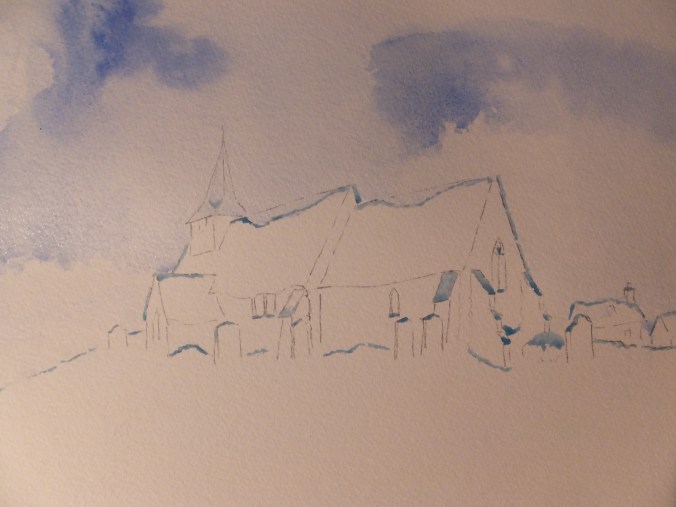
Masking and sky

Masking and sky

I was asked where I would put the masking fluid in this picture. Well, along the snow line on the church roof, as when I come to put the sky in next, there will be quite a lot of water sloshing about, and it will be difficult to keep the blue colour off the virgin snow. Having said that, I have drawn the snow line down the roof line, as though it is thawing slowly, and that is just me, as I think it looks more interesting like that.

Also on the roofs of the house in the background, plus window ledges, grave stones and buttresses. Anywhere you think snow will cling

The sky is a subject in itself. I wanted to have a sky with movement in, and to look cold even though the sun was shining. That was the intention. I have a method which I have evolved and which I prefer, although obviously there are different ways of tackling this

Firstly I wet the area thoroughly with a large brush with clean water, so the paint can move around quickly. Next I brush on cobalt blue mid strength, and then pat out some cloud shapes with paper towel. Whilst the paper is still glistening, and that is very important otherwise the paint will not move, pump in ultramarine blue pigment, where you think you will want to see blue sky. I suggest not too much

I should have said at the beginning, make sure that your board is loose from the easel, as you are now going to pick it up and you won’t have a lot of time. Hold the board vertically and watch the ultramarine blue bleed downwards, and then turn the board on 90 degrees and watch the pigment bleed again this time across the sky, if that makes sense. You will have to decide when you think you have the right effect, and of course the colour will dry lighter than it is now

Put the board back on the easel. Phew!

Let this dry rock hard. I leave it overnight usually. What you should end up with is a swirling sky because with all this water swirling around that is the effect you should get. The cobalt blue will become dark cloud, and where you have blotted out will be the white tops of the clouds. The ultramarine will be the sky showing through

Obviously, when you are doing this, water will run down onto your snow. Just be ready with paper towel to mop that quickly and you should be ok

Apart from the sky, these are simple little paintings to do, yet effective in their simplicity. Hope you liked this
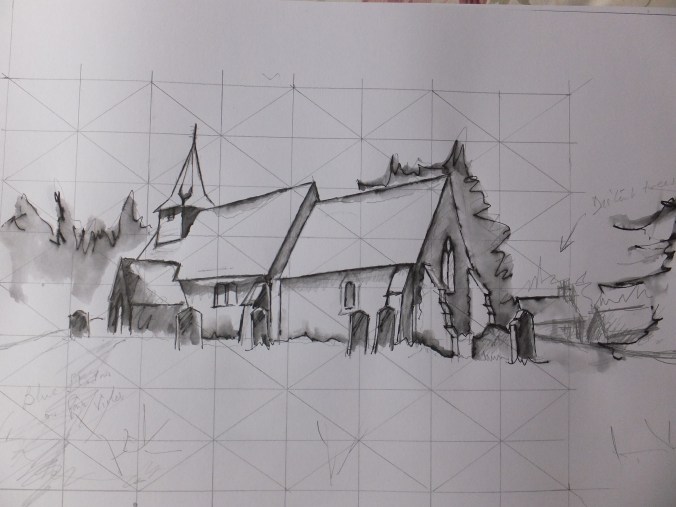
Snow Painting: the Working Sketch

Snow Painting Sketch

This is my sketch, done fairly quickly, which, I think will give me some sense of direction. I need to use the photograph less now and my sketch more

The snow will be denoted by the paper that I shall leave white. There will be some masking out to be done, and as I don’t have a photographic reference for the snow, I shall have to be thorough in planning where the snow would lie. One thing that masking fluid is good for, is making a blobby line which does give the appearance of snow

I must remember to put snow on both sides of the roof. This is easily forgotten. I have certainly forgotten to show this on the drawing. Some will gather in the trough of the broach spire. Window ledges, tops of grave stones, buttresses, snow will cling to horizontal surfaces of these. The ground level must look uneven as snow piles up the wall of the church

I usually like to paint snow-covered buildings as though some slight thaw has taken place, so that the ridge-tiles and part of the roof show through. This makes a bit more interest and relief from all that white.

The church stands on high ground. I have exaggerated the gradient in the drawing, slightly, to increase the interest. Shadows, when I put them in, will tell the eye where the ground lies, and pick out the ups and downs. Also I have put a couple of houses in the background, which are dropped down behind the slope.

I usually put in some frozen looking bushes and dead-looking grasses, strategically, so that hopefully they will indicate that the ground slopes down towards us

So, plenty to do. Best get on.

Snow Painting

Pyrford Parish Church

Using the charming little church of St.Nicholas at Pyrford, one of the Woking villages. To give an idea of the sort of effect I want to achieve, the following painting of Wanborough Barn near Farnham, was done from a photograph without snow, just adding snow from imagination. We don’t get enough snow, I am afraid, to get good snow scene shots to work from, so we will just have to adapt what we haveWanborough Barn near Farnham

Wanborough Barn near Farnham, with added snow

So that is the task to be tackled next. I need a snow scene for my next exhibition, as usually they sell quite well.

Just a word about St.Nicholas Church. It is an unspoiled but humble village church of the 12th century, retaining many of its original Norman features. Unexceptional apart from having a porch on both sides, which is unusual. It is built from local materials, naturally, using pudding stone and clunch, which is the hard form of the local chalk, used quite a lot for building materials in the area. In some parts of the church, not on the shot I have shown, the walls have been stuccoed over, which was done to give the appearance of stone

That should keep me busy for a little while. I will publish the working sketch just out of interest, just to see which way we go with this

Different people have asked to see photographs of my workspace. I have been taking some pictures and will run a post on that. Not very impressive as we live in a 19th century cottage, and space is at a premium, but it is always surprising how well you can operate from a little corner. Good lighting is essential, and the rather expensive lighting I use, I actually prefer to daylight

I will go into detail on that at a later date