Preparatory Drawing for Bosham Painting

Bosham Harbour in Evening Light

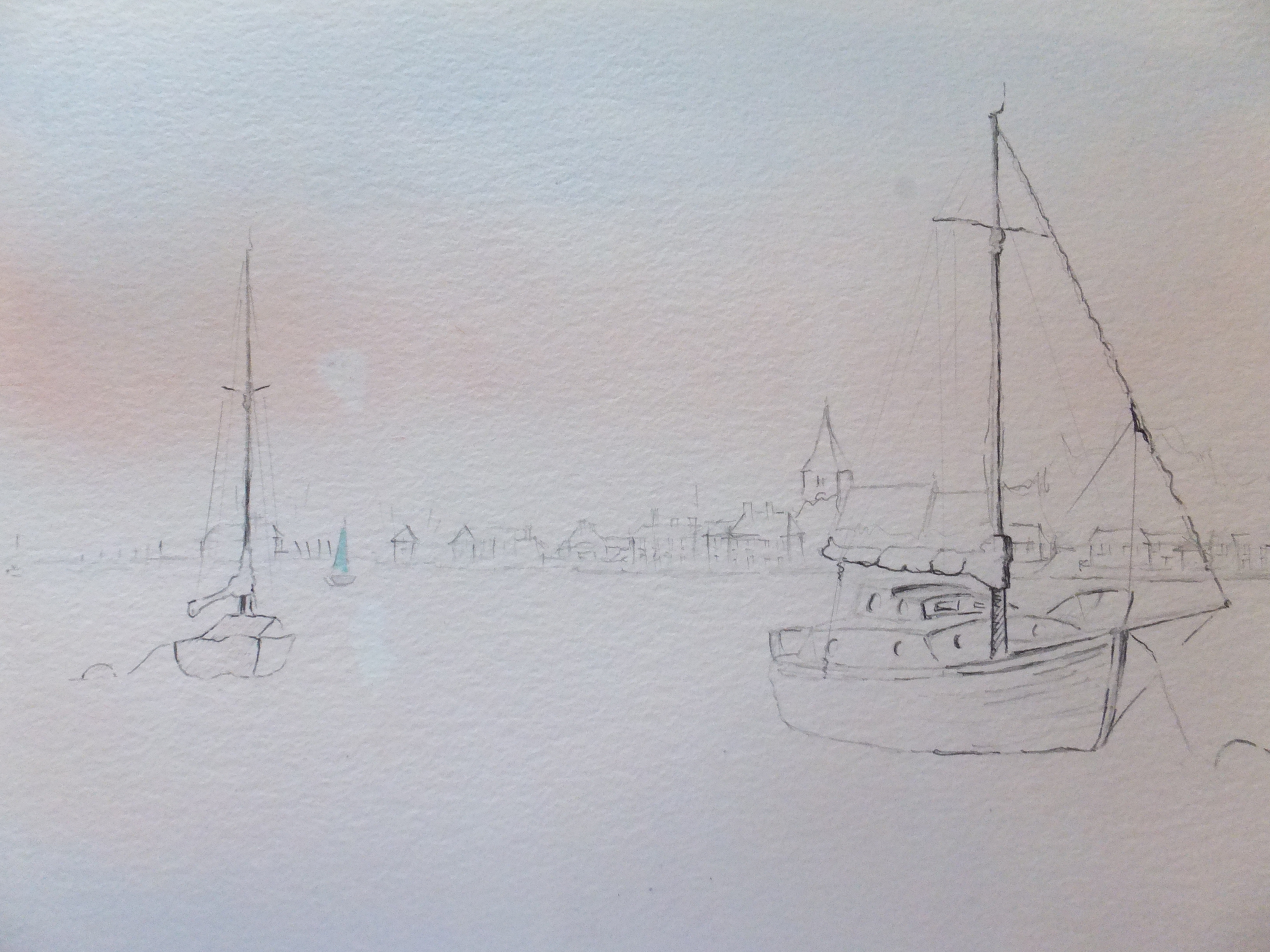
I have made a start. Bosham, always a favourite subject for exhibitions, and I don’t have one ready for my next exhibition which is in October, having sold Bosham Creek at the Guildford Institute.

The drawing is based on an old postcard, which gave me part of the composition, and helped with the relationship of the boat in the foreground, with the shoreline. The other boats I have added from my own library of sketches.

I have added some dark ink lines on the shadow sides of the two boats, and have masked out a tiny boat in the background.

I started to lay in a wash as a base colour. I used Cobalt Blue together with Vermillion. As they mixed on the paper, they have made grey as a basis for shadows to come. Still plenty of red in the sky and sea, although I can play with that when it has dried right out.

I have dabbed out a mark for the evening sun and its reflections across the water, which at the moment is not easy to see.

I am hoping this wash will be enough for background. I don’t want the sky competing with the foreground, but until the painting has dried right out, it will be impossible to say

The Italian Chapel on Orkney

I have been away travelling and sadly haven’t touched any painting or drawing. I would like to mention this wonderful place we visited on our trip round the Northern Isles, which is very much connected to real art.

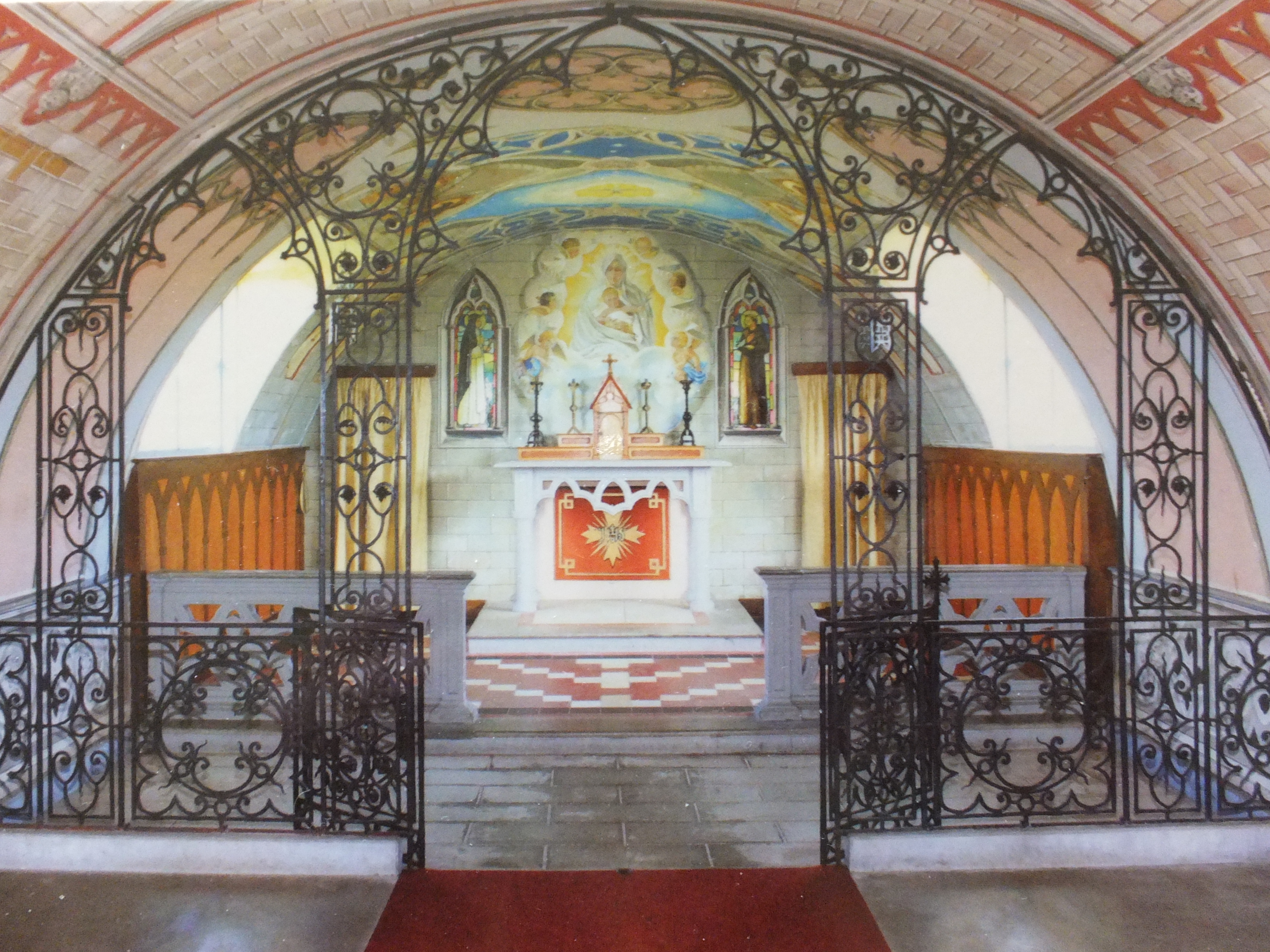
Interior of Italian Chapel

I had to use a postcard for this shot, as when we were there the building was crowded, so a clear shot of the altar was impossible

The chapel was created by Italian POWS in 1943, who were employed building concrete causeways between the islands, which also acted as sea defences against U-boat infiltration. The Royal navy had already lost HMS Royal Oak with 800 lives to an enemy torpedo whilst apparently safe in Scapa Flow, so this work was of great importance.

The Italians requested a chapel, and two Nissen huts were made available, fixed end to end. A man called Domenico Chiocchetti had already been recognised as an artist, and he led the team of interior decorators. He was assisted by Giuseppi Palumbi , a blacksmith and Domenico Buttapasta, a worker in cement

With no materials other than what they could find, they transformed the interior into this beautiful work of art. They were given access to the wrecks in Scapa Flow, some of which were exposed at low tide, and from these anything useful like brass or other exotic materials were obtained.

In 1944, their work done, the POWS were moved south, not before receoiving an assurance from the authorities in Orkney, that the chapel would be preserved. Domenico Chiocchetti’s home town was Moena, and there are strong links between Orkney and Moena. with visits both ways. In 2014, three stations of the cross were stolen and three replacements were carved in Moena and brought over.

Domenico Chiocchetti came back in 1994, and was involved in some restoration work himself

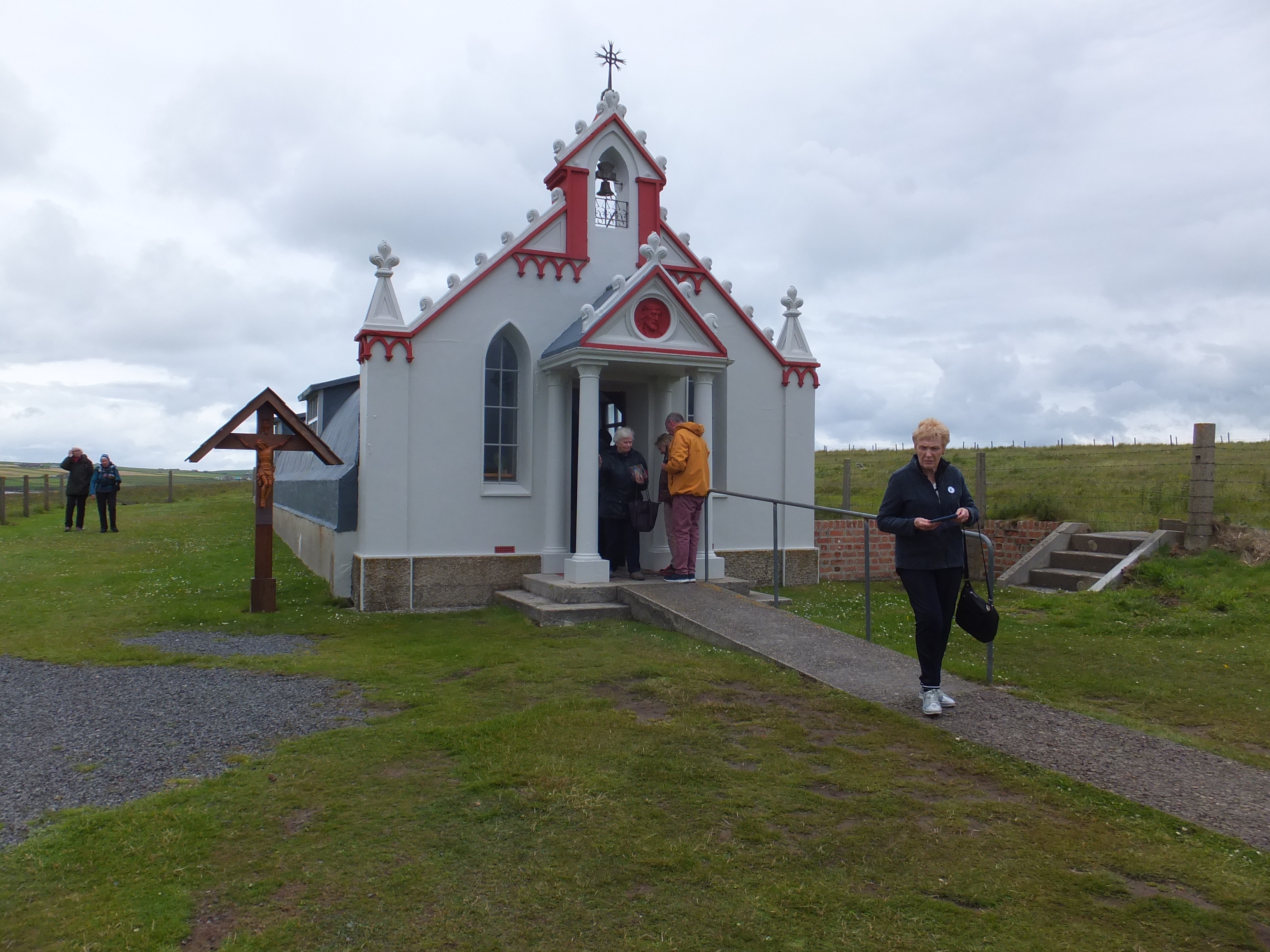
The chapel is one of Orkney’s most important tourist spots and welcomes 100,000 visitors each year

This is my photograph on a very grey day

La Sagrada Familia, Barcelona: the completed painting

The Church of the Sacred Family in Barcelona

The painting is complete and as always, with any of my completed paintings, I am loving parts yet totally unsure of some of the details

The trees were in deep shadow in reality. I put them in deep shadow in the painting. Hmm. not sure. The church immediately went into the background. That wasn’t intended either

I really like the cranes which some might find strange. I think of them as part of the sculpture. I don’t think they clash at all with the basilica, magnificent as it is.

Possibly this composition will still work as a painting. I really am not sure

I am going to post it on line and will invite comment, in fact I would be grateful for comment. I did frame the work, and of course anything framed looks better, so nothing conclusive there

I will start on a new work later. Nothing to do with this one, but when I have done that I may well do a second version of Sacred Family and somehow leave out the foreground trees, and see if I am happier with that.

My next exhibition is in October so I have time. Shortly I am heading north to colder climes, Shetland Isles and the Faroes where recorded temperatures are about 11c. Yesterday at home we had 32c so an abrupt change. No painting for a week or so but maybe some sketchbook work, if I am lucky.

La Sagrada Familia Barcelona Painting in progress

The Church of the Sacred Family Underway

I have been doing some work on the painting. Unfortunately as always the photograph doesn’t show the depth of colour, which is a pity because the church is against a red sky, and the pink glow is reflecting on the building

The drawing was testing as I said before, and easy to see why the building is taking so long. The draughtmanship and architectural work is pure genius. Just making a sketch I have found tricky in the extreme

So far I have just been building up layer upon layer, wet on dry, of a pinky grey colour, which is close to the original, but not showing deep enough in this image which is frustrating.

However, we continue. I will need to introduce green into the trees, and am just wondering which shade. The tops of the trees will need to reflect red from the sky. The undersides of the trees will need to be very dark indeed

I will have to play around with that

I like the cranes. They add to the feeling of sculpture.

Just referring back to the last post showing the dragon of Kew Gardens. This was shown at the Pirbright Village Fair last Saturday along with three other paintings. Nothing of mine sold. Some very favourable comments about the Swan painting but no commitment to purchase. Alas. That’s exhibitions for you.

Barcelona: to continue with the painting of the Church of the Sacred Family

Church of the Sacred Family

Now that the dragon painting is completed, I am back to the attempt on the painting of the Church of the Sacred Family. I say attempt, because so far I have just done the drawing and trying to follow the detail is absolutely mind bending

Small wonder that building the church has been taking so long following the death of Gaudi, and still more than twenty years to go. What is there, is staggeringly beautiful, both outside and in.

My painting I think will be an impression only. Certainly it won’t be an architectural drawing

We shall see when we get some colour going, and that is for later

Dragon on the Roof : The Painting

Dragon on the Roof, as the restored Pagoda at Kew Gardens

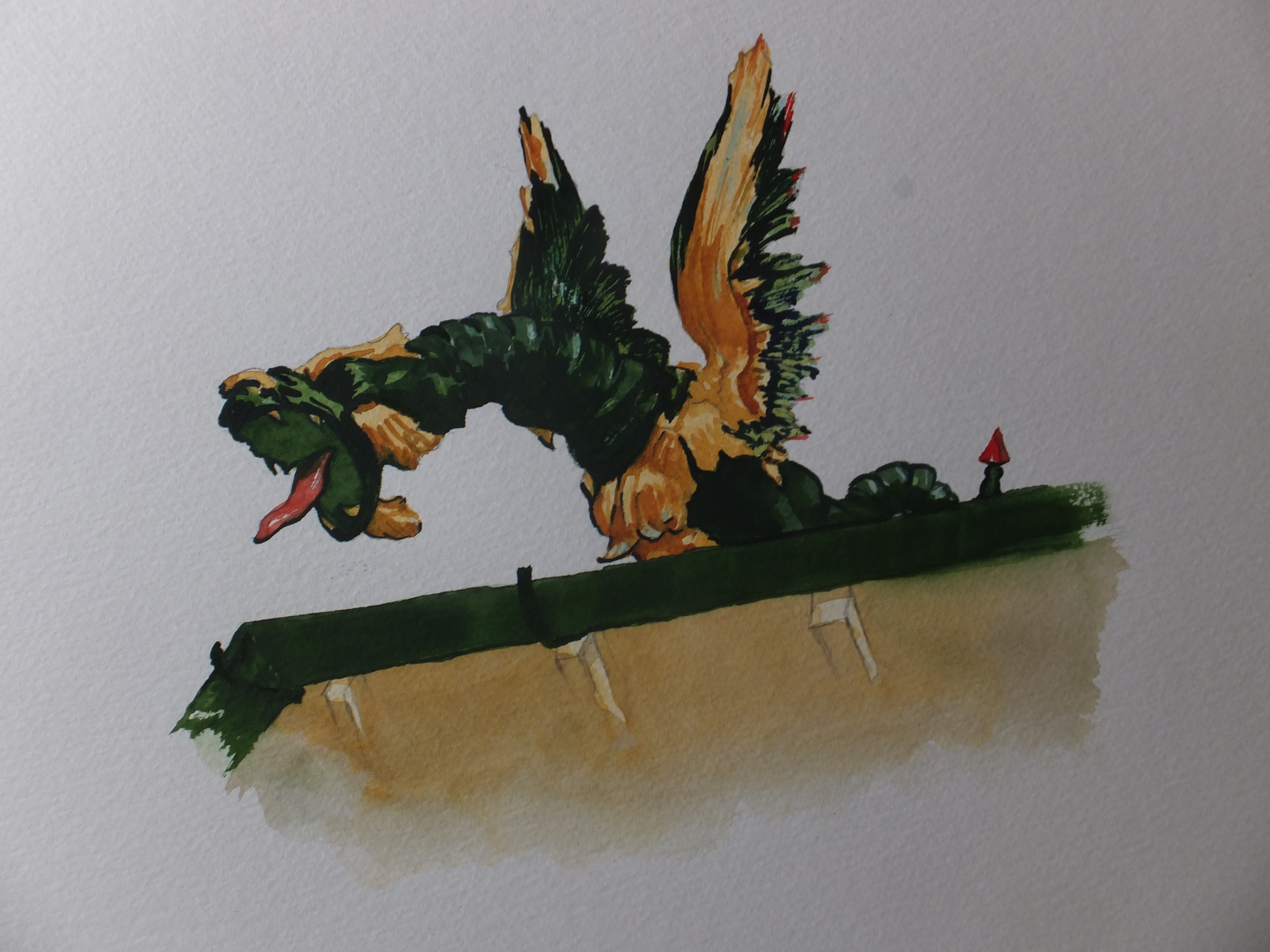
This is my painted submission from the photograph in the last post

Colour matching was a problem. I don’t think that I had ever tried to render gold paint in watercolour before, so I have had to experiment a bit. I haven’t hit the colour square on, but putting the photograph aside, and just looking at the painting, I do feel that my gold does look like gold paint that has been lacquered. Or so I tell myself.

I used a base coat of raw sienna and Naples Yellow. When that was hard, I started to put in shadows with raw sienna. For darker shadows I started to use some more raw sienna but mixing in quinacradone deep gold. For very deep shadows I was using the deep gold straight out of the tube.

The green was more straightforward, a sap green base coat and let that go hard. I mixed some sap green with french Ultramarine to produce that glossy deep green, and started to work in the shadows. For the deep shadows I used more blue. Some artists I know are horrified about putting on several coats of watercolour paint. I don’t agree. I find the finish goes more and more velvety when you do that, and in this case started to look like gloss paint.

Vermilion for the tongue and tail

I have framed this for the exhibition. I cannot imagine this subject being commercial, but with all these dragons we are meeting the requirements of the organisers, and that is good.

The date is the 15th, so we shall see

Dragon on the Roof

Restored Dragons on the Pagoda in Kew Gardens

Our local art club has a presence at the annual fair in Pirbright, which has decided on dragons as its theme for the day. I don’t know why but……Artists have been asked to submit paintings of dragons, so I have had to put Barcelona on hold, whilst I think of something. Totally without inspiration, I remembered going to Kew Gardens about a fortnight ago, and saw the wonderful restoration of the Pagoda

The Pagoda was designed by Sir William Chambers in 1762. The dragons made of wood were part of the original but taken down after twenty years for renovation, but never put back. For years the pagoda was a dreadful shade of red, but now, thanks to a wonderful restoration, the pagoda has been returned to its original colour, and dragons have been superbly made and are back where the original designer had wanted them

The pagoda had been designed as a gift for Princess Augusta, who founded the Royal Botanical Gardens. I’ve not been to the top. I gather that views over London are spectacular. Perhaps one day.

Anyway, i am going to paint, as my submission, one of these rooftop dragons, and see where it gets me. I don’t have long. Paintings must be installed framed early morning on the 15th. We shall see

The Church of the Sagrada Familia in Barcelona

I was here earlier in the year, and I have already written a post on this so won’t dwell on the building and its history, magnificent though it is. This was my second visit in two years, and frankly the interior is breathtaking.

The reason I have put this picture up again, is because I am going to attempt a painting of the exterior. This will probably turn out to be foolhardy, as the intricacies and detailing of the architecture on the facade are legendary. However I will soon start a drawing and see where it takes me. The drawing exercise will be the testing part, I know but it is one that I want to attempt.

I will rearrange some of this shot. The pond in the foreground is not attractive. The colour is an unpleasant shade of yellow, and I would like a lot less of it. The foliage in the foreground may or may not be included

Anyway I will come back when I have something to show

Just to end up, my exhibition at the Guildford Institute produced only one sale, the painting of Bosham Creek. Still at least I wasn’t out for a duck, and the guy who bought it was thrilled with it, so that was good.

Bosham Creek, sold and with its new owner

A lean time now for exhibitions, apart for local shows. October at the Royal Surrey Hospital in the Peter Thompson Gallery, which is usually a good venue, will be the next major show for me. Time to build up stock of some different paintings.

Painting Someone Else’s Photo

With their permission of course

A typical square in the south of France

This was really something of a diversion, while I considered where my priorities lay, for the next painting.

This exercise is really part of a competition, which appealed to me. I don’t usually enter competitions as I never get anywhere, but what intrigued me with this one, was, that it was using ball-point pen with watercolour. Something I had thought of doing but for some reason, not got round to .

This took me back to the days before I retired. I worked for a company that made specialist furniture and fittings for the hotel and restaurant industry. I designed things to customer specification, which is a grand term for drawing out from people what they wanted, and then sketching them during the conversation, until we arrived at a solution. This is very good drawing practice and I can recommend it.

Ball point works well on a hot pressed surface, the motion is fluid and the image is instant. You can’t rub out of course which can be a problem. It doesn’t work very well on cold-pressed watercolour paper which is what I use. The ball clogs and pulls at the paper

Nonetheless it was a useful exercise and interesting to see how it ended up. I sent my entry in after all, very much tongue in cheek. If I never mention it again, you will know that it bombed

Looking Back at Old Work

The London Eye

Do you ever look back at really old stuff? I don’t do that often, but I think it’s a good exercise to do sometimes. Sometimes you can see that you have improved, although looking at some of my old work, i sometimes wonder if I have.

That aside, I found this picture of the London Eye, which was a very good example of rescuing a painting from the jaws of disaster. This had been a much larger painting, crossing the Thames and including the Parliament buildings and some river boats as well,

. Frankly the end result was a mess and I put it away, thinking to reuse the back of the painting for some rough work later on. At another time, someone was talking about cutting down an old painting and using what was left as a presentable picture. I though of that Thames picture and ending up cutting the centre out, leaving out the rubbish, and concentrating on the image shown, which although not perfect, was not too bad.

The final image wasn’t much bigger than a postcard. It centred on the London Eye. I thought it worked well. So did the person who bought it.

So the moral is. Discard nothing until you’re sure there is nothing worth retrieving