Delving into the Archives

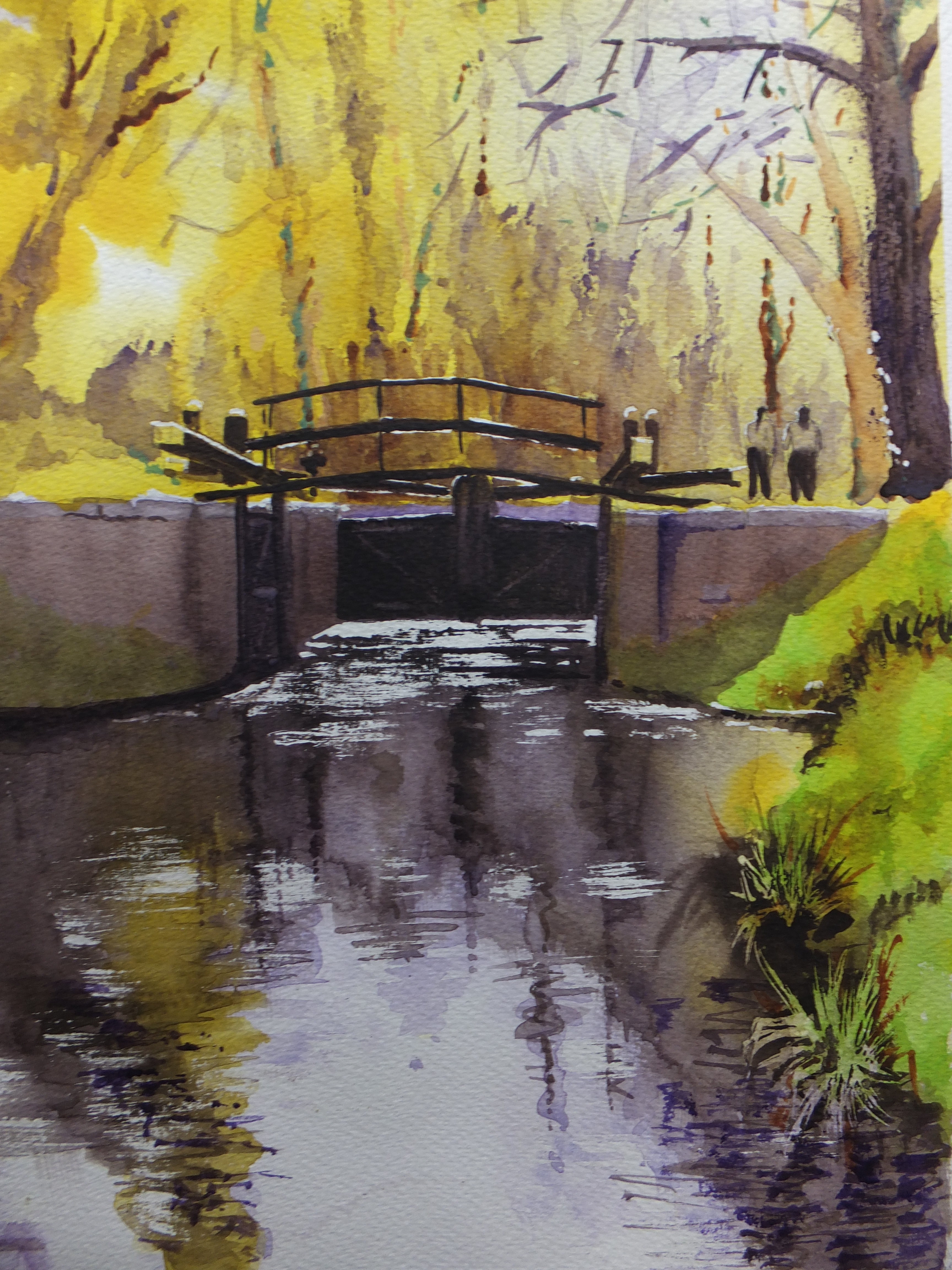
This is a really old favourite. The lock gates on the Basingstoke Canal, which flows quite near where I live. The canal is part of our industrial heritage, cut in the late eighteenth century to provide an inland link between London and Southampton, a major seaport. This was the time of wars or imminent wars with France, and transport by sea was fraught with risk, so the Wey was linked to the Arun by canal and extended to Portsmouth, which lasted for a short while, and this canal now called the Basingstoke was planned to reach Southampton. It never got there. It reached Basingstoke in the north of Hampshire, and then came the railways ,and canals were quickly redundant.

This painting went out to New Zealand by the way. It was bought by a young couple who’d come back to visit an elderly mother. They came to one of my shows, and took this painting home with them. That was years ago. I hope it’s still giving pleasure.

Today this canal is used for leisure only and is a haven for wildlife. It also gives artists and photographers subjects for their art. I’ll include a few
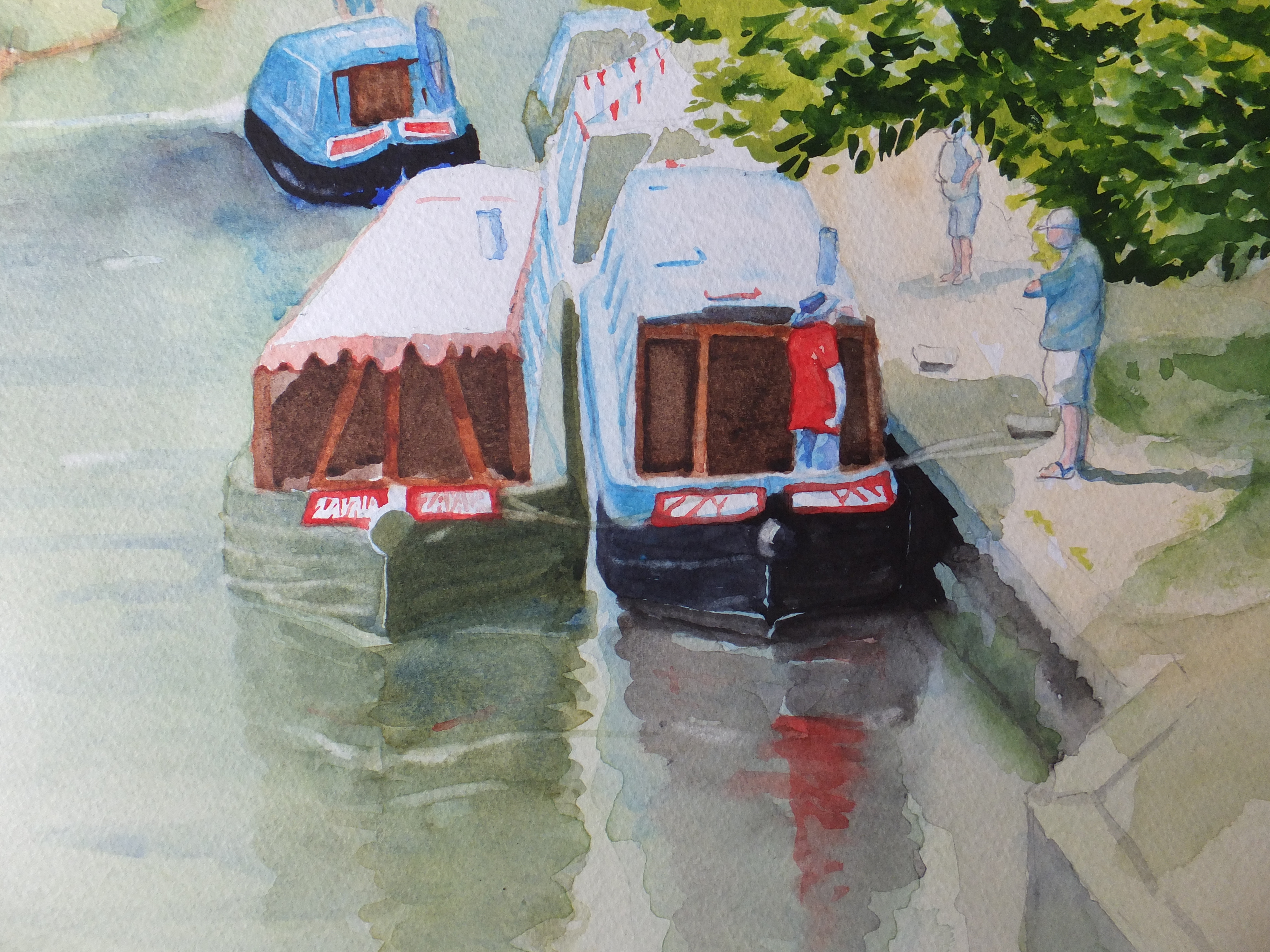
Barges gathering on the Basingstoke Canal

These are barges, of the type used for transportation in times gone by, which are now used for leisure purposes.Every so often there is a gala, when the barges get together as part of their social exercise. This is an ideal spot alongside one of the old wharves, which is outside our local Italian restaurant, which you can’t see, but is to the right of the picture. Delightful on a summer evening to sit outside with a glass of Cava and watch the activity on the water. The old boathouse is there too, long converted to a pharmacy.

I stood on one of the old bridges, Kiln Bridge, to take the reference picture for this painting
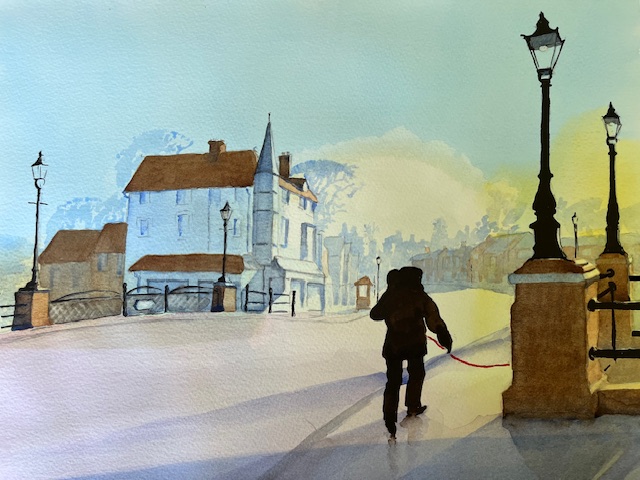
Kiln Bridge in winter sunshine

This is the bridge over the canal leading into the village of St John’s. Kiln Bridge, well the clue is in the name. When they were building the canal, they made the bricks as they went along. The village grew up around the canal in a shanty town sort of way, and most of the buildings are Victorian. The shop opposite in the picture is a restaurant today, but in its day was a haberdashers shop for a while, in those good old days when small shops could make a living selling everyday things, before being driven from the high streets.Today restaurants and beauty parlours proliferate but at least they aren’t empty

The village took its name from the church of St John’s which was built by the rector of Old Woking, as a chapel of ease for the villagers. Very considerate, as everything was a walking distance in those days, and a five mile trudge to church in bad weather would be offputting even to the most pious.

I haven’t painted this church yet although I do intend to. It is a handsome Victorian church by a very well known architect George Gilbert Scott, who was responsible for many new churches up and down the country, not to mention restoration of old churches and cathedrals. Not just churches but also remembered for the Midland Hotel outside St Pancras Station, which was derelict for many years and beautifully restored comparatively recently. There were three generations of architects. Giles the grandson, built power stations like Bankside now Tate Modern and Battersea finally developed into a magnificent shopping mall. He is especially remembered for the red telephone box, which now are collector’s items.

For the moment, that is enough for one post. An interesting journey for me which I hope you enjoyed as well. I am quite elderly now, so if I want to look back again, there is plenty for me to look at

Painting of my home village

This is the centre of my local village, St John’s near Woking. The name St John’s was taken from the local church, built in the c19 by the then rector of Old Woking, as a chapel of ease for the village inhabitants. Quite a long walk to church otherwise in a century when no one had transport.

The village is mostly Victorian, and although surrounded by suburbia, does still retain its village atmosphere and integrity. Life started here in the late c18 when the canal was cut through open heathland. In the distance in my picture, the road makes a hump, as it crosses the canal. This is Kiln Bridge, where as the name suggests bricks were made from local clay, and these were used in the building of the canal. The canal was intended to link London with Southampton, but only reached Basingstoke before the railways were built and superseded canals. This was still a time when war with France was a possibility, and inland links with major south coast ports were desirable.

Today the Basingstoke Canal is maintained by Surrey and Hampshire County Councils. There is some leisure boating but not much. Wild life proliferates and the towpath is used for cycling and walking.

This is the very first time that I have painted my own village. I don’t know why. I put this painting on a local website and had more than 240 hits. All complimentary, I am pleased to say. No offers to buy though.

In the middle of the picture is our comparatively recent coffee shop, which has become the hub of village activity. Walkers and shoppers meet there to relax and catch up. We never had that before and it is a very welcome addition. We do have a pub but located going out of the village, so not so convenient. We have most shops so a useful selection.

At the bottom of my lane, we are blessed with a green open space, called St John’s Lye. Lye, lea or leigh means a green space. It is common land and so protected although we did have to physically resist Woking Borough Council who wanted to build a village hall on the Lye to replace the one that was starting to fall down. Eventually common sense prevailed and the new hall was built on the site of the old one. The Lye is available to all age groups for spontaneous activity including dog walking.

And so you have it. Not a place that many know, but loved by its local population

Plein Air Painting at New Haw Lock

DSCF4301

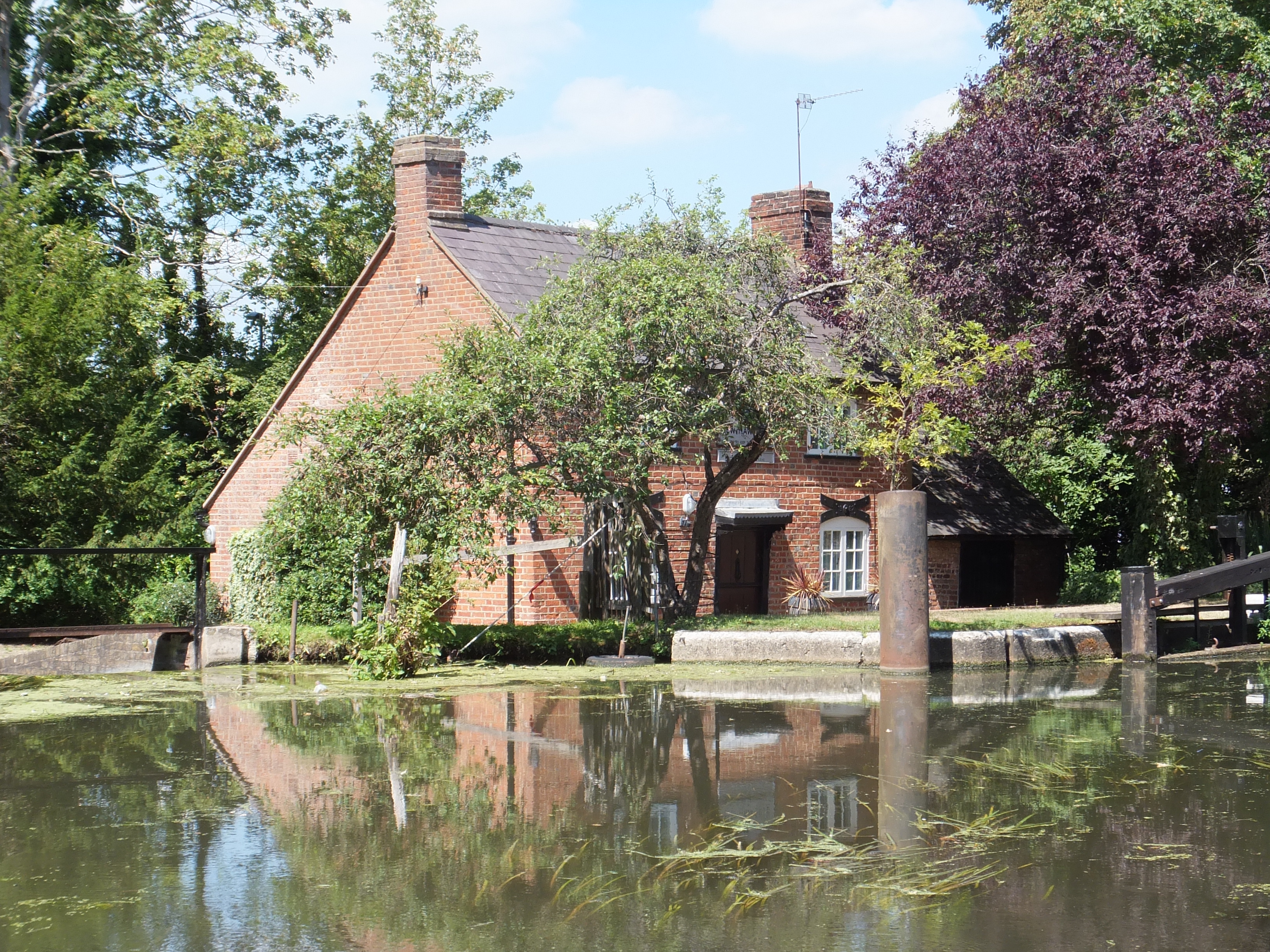
Something I rarely find time for is painting outdoors, but recently did, with our local art group at New Haw Lock, which is one of the many locks along the Wey Navigation in Surrey. The Navigation dates from the c17, and made the river Wey navigable by cutting canals across the meanders and shallows. Thus this mix of river and canal made the Wey navigable for barge traffic from Guildford to the Thames. Amazingly this traffic by horse drawn barge went on until 1959. By then the navigation had been cut through to Godalming in the south, and had been especially useful in carrying gunpowder from nearby Chilworth Mill through to the Thames and on into the Port of London

During the c18 the Wey Navigation linked with the River Arun, and on down to the south coast, but that leg was short lived and proved uneconomic to run. That section fell into disuse, although some sections have been revived by conservationists

In the picture, one of the many lock keeper’s cottages, very charming and very paintable still. New Haw is somewhat underrated and is easily missed when driving by.

We found shade to sit, as the day was hot and became hotter towards midday. The morning was enough for me, so for about 2-3 hours during which time, I worked out my composition, and just sketched putting in the shadows which of course changed quickly. Photography helps the sketch book and I recorded several stages. It is my intention to finish the painting in my “studio”, but for the moment need to finish my Alhambra painting

I shall look forward to painting the New Haw lock. This is a typical Surrey scene and a typical Surrey cottage. I will attach my drawing. I regretted afterwards only taking an A3 pad which didn’t give me enough space but at home i can use a half sheet which will enable me hopefully to include the lock in its entirety

DSCF4307

Now all I have to do is to decide whether or not to include the foreground tree which obscures much of the cottage but nevertheless provides some interesting lights and darks

Basingstoke Canal Bridge

Basingstoke Canal Bridge

Continuing my theme of Waterways in Watercolour which is my next solo exhibition in February, and for which I am worryingly behind schedule, I am going to look again at the Basingstoke Canal which runs near where I live

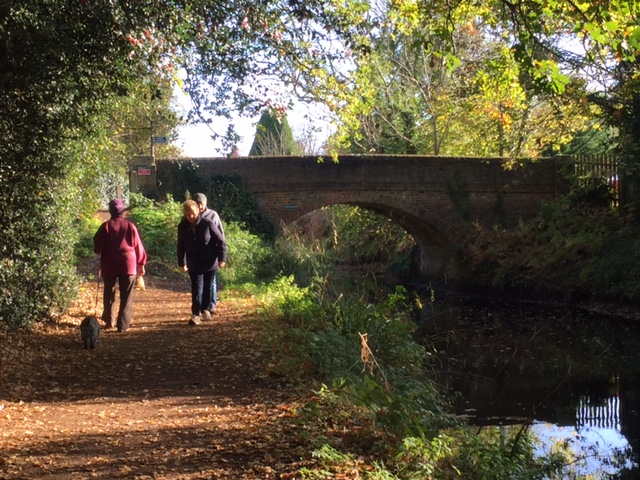
This is a typical Sunday morning walk to exercise the dog and buy a newspaper in the village shop. The tow path is often quite busy with walkers and annoyingly sometimes, bicycles who use their weight to make people jump out of the way. Most are courteous but just a few are inconsiderate

The bridge in the picture is one of the original ones from the c18, brick built with bricks which would have been made in St.Johns nearby, most likely. It is a typical canal bridge, with shaped  walls that curve out on to the tow path. This enabled the bargee to bring the horse over from one side to the other without snagging the rope

I have painted this stretch of the canal many times, and it remains a favourite at exhibitions. My personal favourite which is in the gallery, is of one of the lock gates and which is into the light, contre-jour I think it is called. That sold at one of my exhibitions to a couple who were going back to New Zealand, and I helped them with the packing. I sometimes think of these paintings and where they are, rather like worrying about the children. How stupid can you get!

There is a flight of seven locks along this stretch of the canal, all fairly close to one another. An enormous amount of work for the barge people, getting out and opening the gates, and then closing gates behind the barge when in the lock. Fun to watch though

So far, I have just started to make some sketches, and there are some details I want to change, so nothing to show at the moment

For the future, I came across a lovely photograph which I took along the Amazon, a couple of years ago, of local boys with their pet alligators, small ones obviously, which they had on leads like dogs. This would make a lovely painting if I could bring it off, but might upset some people, so would have to give that one some thought