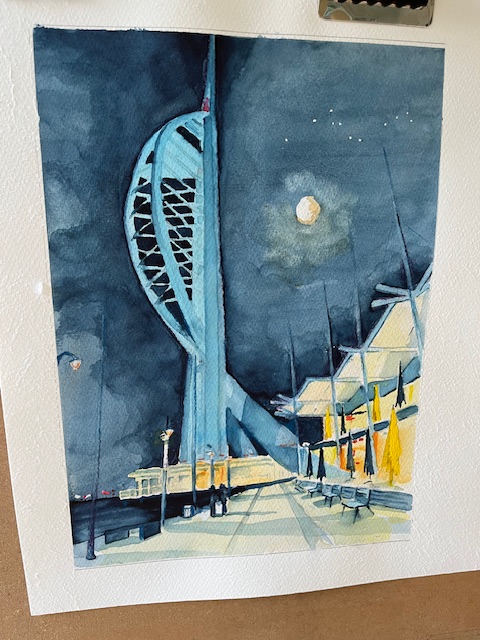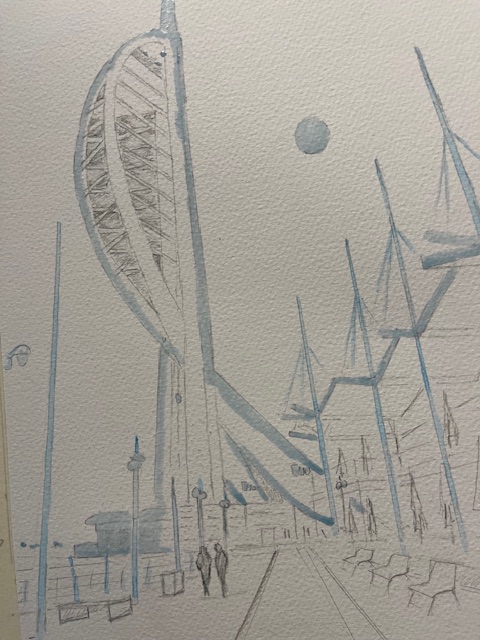
This is the drawing so far and even this took some working out. There was an awful lot of masking out to do. The tower itself has had to be protected as the night sky will be darker than the colour chosen for the tower itself.
Likewise the gables on the rooves over the shops on the right hand side have had to be protected. I don’t usually like a lot of sharp edges in a painting, preferring to let colours blend, but in this case it has been unavoidable. Plastic or metal edges really have to be shrp otherwise just look wrong imho.
I am apprehensive about starting the painting on this one, especially the sky. If that doesn’t work, and I have to start again, then I will have wasted a lot of time. Let’s not go there. I have retrieved worse situations
Back in the summer, we toured the Baltic. At one time we did eight shore excursions in eight days. Even by cruise ship, we found this tiring because of our age, especially my wife who has walking difficulties, so we might not attempt this sort of holiday again. Copenhagen was just one of the stops we made in Denmark
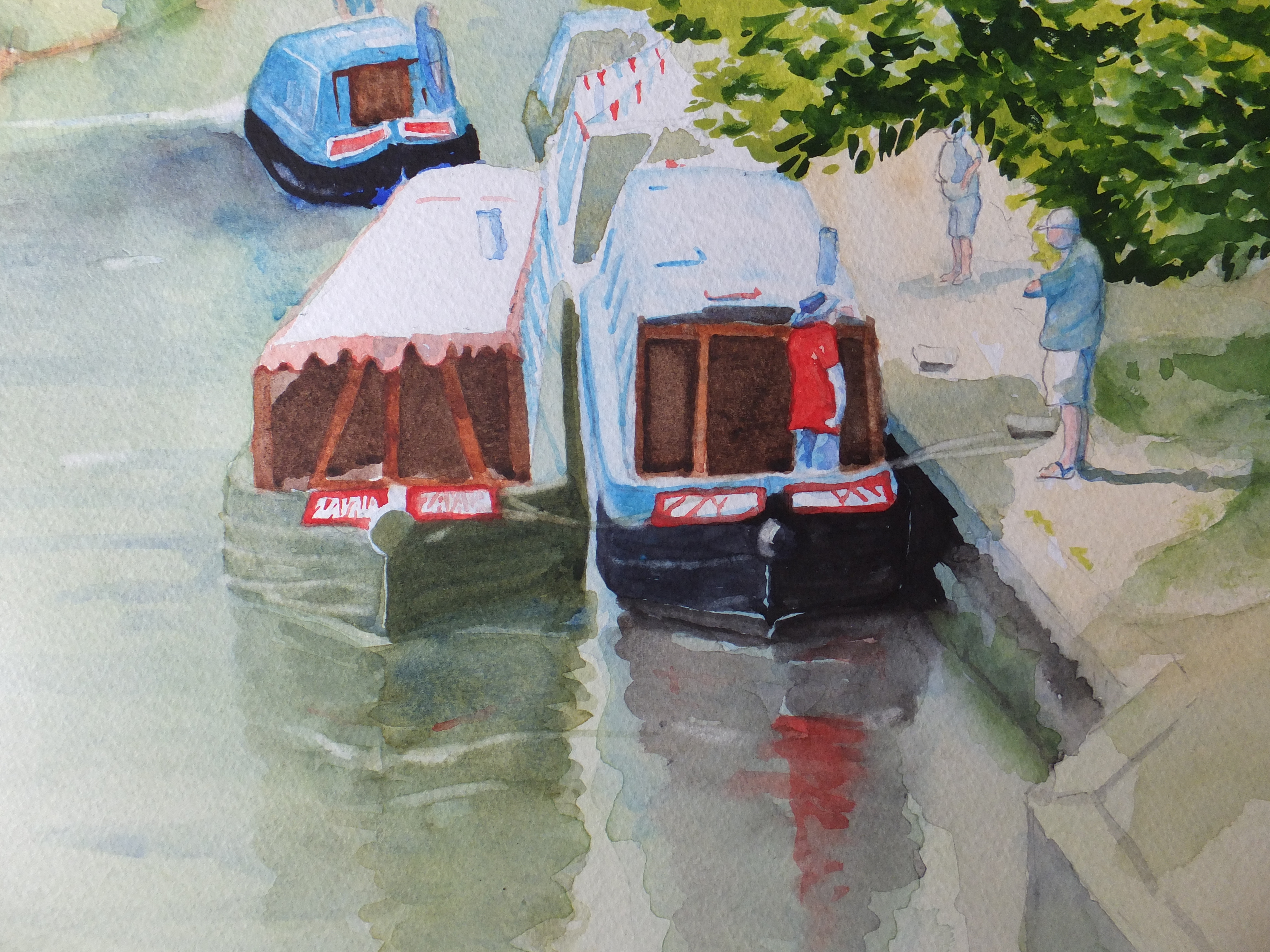
Touring the canal system was fun. i like painting boats and this was just one scene that I snapped for reference. Quite a lot of light and dark in this shot. The sun was very bright especially on the buildings in the background. Deep shadows were cast by the trees, which accentuated the boats. The figures on the canal side were reduced to silhouettes. It took me several glazes to get the water to be an acceptable colour, whilst at the same time still looking transparent. This was more of an exercise about light against dark, than anything else
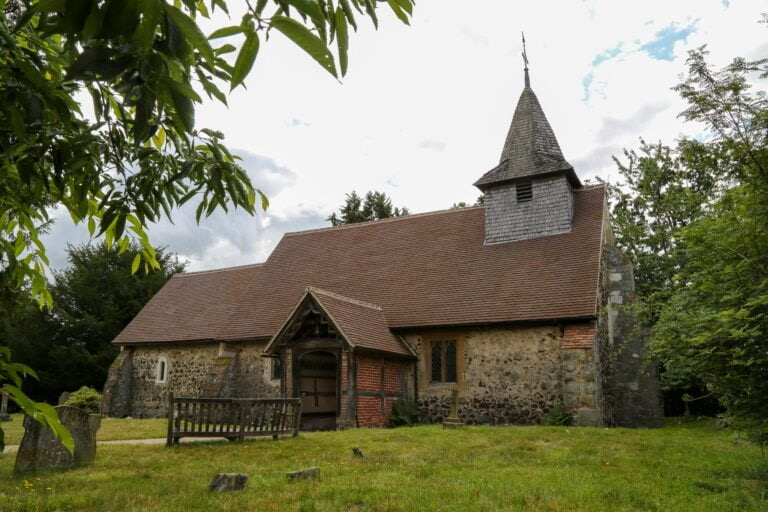
I have been commissioned to paint this church, the village church of Pyrford in Surrey. Ancient yet still in use as a parish church, it is set in a tranquil spot, and is quite charming. The lady who commissioned it no longer lives in the area. Her parents are buried here, so a meaningful place. I always feel very priviliged being asked to paint places that are so important in people’s lives. I am working on it at the moment and will post the result
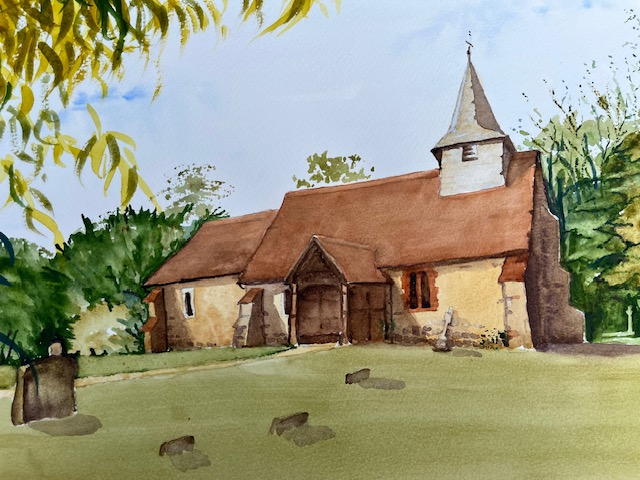
This is how the painting turned out. I have put sunshine into the painting as the photograph was taken on a very dull day, so the colours are brighter. The lady who commissioned this painting was very pleased, which is always a relief
I have another commission now, quite different to the last, This one is a wedding venue, which I get asked to do from time to time. This one involves marqees and the newly wed couple strolling in the grounds around a lake, so quite a lot of different things to worry about, Still it’s good to have these commissions coming through as sales from my gallery are poor at the moment. Times are hard everywhere still and doubtless will be for some time
I’ve been off the air for a while. I had to get a new PC as part of an upgrade, and of course, nothing was where I remembered it. I couldn’t find my way back into my blog, or not at least to the page where I coud write something, and I can’t pretend the seemingly helpful robot was any use to me. Anyhow after a tortuous journey I can now post again
As I have been away for a while I thought I would just do a compendium of more recent paintings, just to catch up, and start with one called Gondolas. Always a favourite subject, and this view with San Giorgio Maggiore in the background I have painted and sold several times. This shot is completely different to any that I have done before
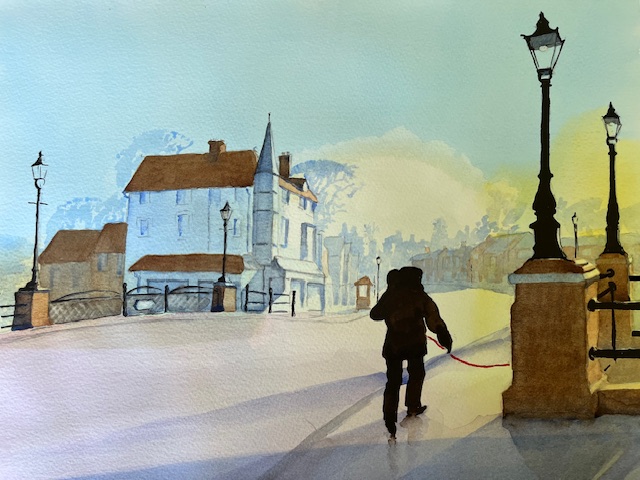
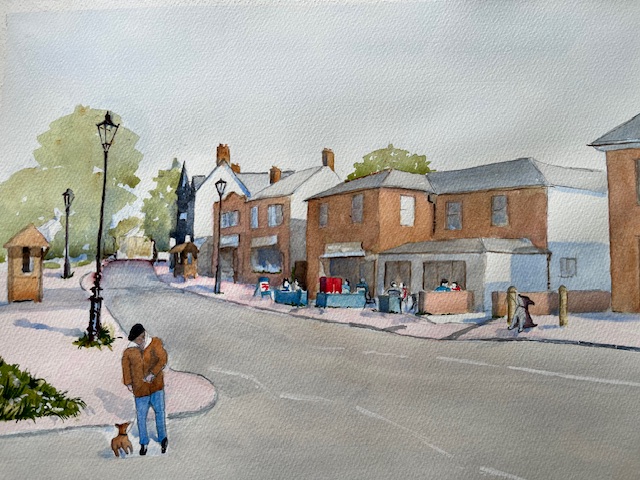
I have also been painting some views of my local village, something I have neglected in the past. This shot I put on the village website and received over 150 hits. I am pleased to say that a gentleman in Canada ,who used to live locally, bought it, Always that extra buzz when a painting makes a long journey
This view just shows some of our shops, so being a village we only have indepemdent shops which is a nice relief to seeing brands all the time. In the background by the trees is the bridge over the canal, which was cut in the late c18. In fact the village grew up around the canal. The name St John’s came from the church which was built here as a Chapel of ease for the villagers
The hub of the village is the coffee shop which was started only about ten years ago and provided a much needed meeting place and alternative to the nearest pub.
I have been getting commissions which is always nice. A more recent one shows a country house hotel called Gravetye Manor, which I have painted before. This is a different view in evening light commissioned by a guest who had a meaningful stay there
This is a mistake but I will leave it there. An old shot of Venice. I will now try and find the shot of Gravetye Manor
Succesful this time. An evening shot with the last of the sun catching the roof tops, so it worked well
There are others but I will leave it there. I am not long back from a trip up the Baltic as far as and including Helsinki so quite a lot to digest. I am going to try and put a post together about that voyage. On the art side, we went to Skagen on the northern most tip of Jutland. Artists in the c19 were attracted there by the wonderful light and their work is just breathtaking
I am going to try and be more regular now that I have got back control, and am grateful for the help I have received
Described as Newark Abbey which is in fact Newark Priory, and even Newark Priory Church. The priory was a huge complex, and the ruined church is all that is left after the Dissolution . It looks to me that Turner sketched this from the road. The view is much the same today. The land is privately owned so close inspection is not possible. Cows are in the field much the same as Turner’s sketch. Newark Abbey is near Ripley as a point of reference. This painting is in Tate Britain
After the dissolution it was said that the priory was bombarded by cannon from nearby Pyrford Hill. After that the site must have been robbed for stone, as the ruined church is all that remains, apart from the odd outcrop
Turner would row down the river. We know that he stayed at the White Lion in Guildford, and at another in inn in Walton-on-Thames. He also thought nothing of sleeping on his boat. He was also a prodigious walker, known to cover 25 miles in a day including making sketches on the way. Sometimes he would set out with company and leave them behind if they couldn’t keep up
This is the entrance to Quarry Street in Guildford today. It is not by Turner! This is my painting made about twenty years ago. There is a link with Turner albeit a tenuous one. In order to take the reference photograph for this painting, I had to step back into the White Lion Walk in order to keep the bright sunshine out of my lens. The White Lion Walk is the shopping arcade which now stands on the site of the old White Lion Hotel. Let’s look at the next picture.
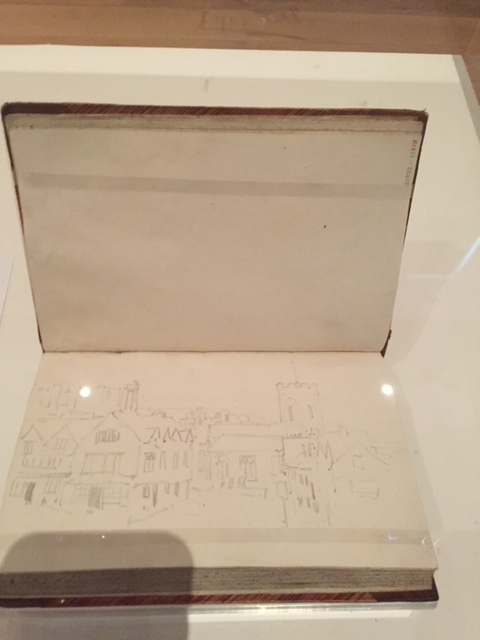
This is by Turner! It is one of his sketch books and shows the same view which I made years later, which still amuses me. I am sorry the image is so pale, but he worked in pencil. You can see the building on the left is much the same and the ancient church of St Mary stands in the background exactly as it does today On the right hand side is an inn much as today. Turner sketched this whilst staying at the White Lion in Guildford. Was he in the lounge relaxing or in his room. We know he didn’t like an audience so maybe the latter
We’ll leave it there for now and continue Turner’s drift down the Wey at some later date
This is a photograph I took myself trying to catch the little ferry crossing from Twickenham over to Ham on the other side. I just missed the ferry but my reason for keeping this picture, is that this must be one of the nearest points on the river from Turner’s house in Twickenham. I dealt with his house a few blogs ago so I won’t repeat that. Turner loved boats, he loved fishing, he loved the river, and he loved picnics with his friends. Was this the sort of spot he came to? We don’t know for sure about him fishing here, but he would have known this location.
I took this picture from the riverside of the grounds of Orleans House Gallery, where we go from time to time. The gallery is what remains of the original Palladian mansion built in the c18. Louis Philippe duc d’Orleans lived here in exile from 1813-1819. Turner met him and they became lifetime friends. Later in 1830 he became king of France, until he was toppled by another revolution, and went into exile in England once more. He died at Claremont in 1850. Turner went to see him in France near the end of his own life in 1845, one of his last visits to Europe, and they talked into the night about ‘Dear Old Twick’
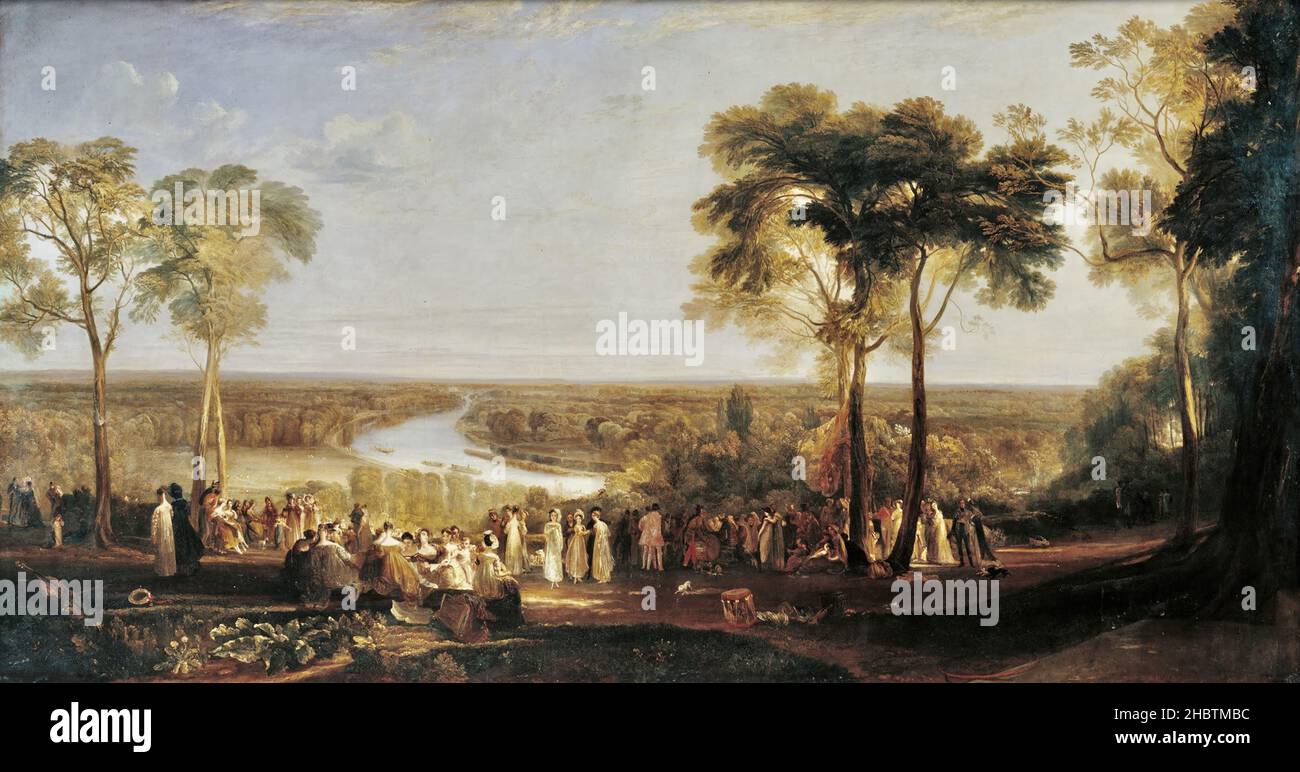
In the background on the hill is the Star and Garter, what used to be a retirement home for disabled service men, and more recently converted into apartments. Nonetheless a powerful landmark, and showing us where Richmond Hill starts. Turner painted the view from there, and I would like to look at one particular painting dated 1819, painted in honour of the Prince Regents birthday
I think that this was an unashamed bid for royal patronage, which was unsuccessful as I believe but nevertheless an interesting painting, which of course looked down on an area which he grew to love. Actually as King George 1V he was able to bestow a seascape on Turner in 1823, but to return to Richmond Hill
I will, if I may quote from Anthony Bailey’s biography, which talks about this painting in some depth. Travel and the proprietorship of Sandycombe Lodge, his country house in Twickenham, had occupied much of his time. His painting output had dropped, and he had no new commissions, so he needed new patronage, or may have felt so. In 1819 he had exhibited this great canvas, kingsize, measuring about six feet by eleven. This was England: Richmond Hill on the Prince Regent’s Birthday. It showed the winding Thames at Twickenham, and Sandycombe hidden in the trees, and on the further bank a game of cricket going on whilst in the foreground a group of partying people which could have been borrowed en masse from Watteau
There were mixed views. Some thought the painting to be unEnglish despite its title. There is a quotation from Bell’s Weekly Messenger (16 May 1819) where the writer admired the painting but qualified his praise.’ The distance, the foreground,the trees,and the figures are all Italian. On Richmond Hill, and on such a day, John Bull with his dame, with the rustic lads and lasses of the village, sporting under the sturdy oak, would have been more characteristic of England’ But this was to request a different nostalgia. Turner had not yet been to Italy and was perhaps looking forward to that country to paint
That is probably enough for writer and reader for now. I am getting some material together for his excursions down the River Wey taking him deeper into Surrey, so we can look at that another time
In a weak moment, I have allowed myself to be talked into researching the work that JMW Turner carried out in Surrey, and writing a talk on my findings, which I will then have to deliver to my history group at a given date in November. this sounds a long way off. I know from experience that it is not, so i have already started gathering stuff from books and internet. A visit to tate Britain when the weather improves will be necessary but enjoyable. The bulk of his bequest to the nation is there so must be something of use. Also Petworth House where he was a frequent house guest of Lord Egremont. Petworth is not in Surrey as we know but is close enough. What I am realising from the start, is that there is precious little written about Turner’s expeditions into Surrey. he did a number of paintings on these trips but none of them became his best known works and so consequently little written about them. perhaps my view will change as I get further into my searches
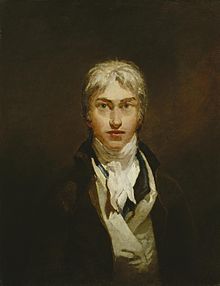
To start with a little background, the painting above is his self portrait. The only one he ever did in his lifetime. He was a private person as we know, and gave little of himself away. His birth date is given as 23rd April 1775, but this is disputed, as Turner would give different dates to different people. he had this aversion to people knowing his personal details. He lived with his parents, which was far from being satisfactory, as his mother had a violent temper, and was later incarcerated in Bedlam Hospital. So he as at School in Brentford and later in Margate, and this is where his love of the river started. He loved boats and messing about in boats. They figure in some of his paintings, and they are a frequent mode of travel on his painting expeditions. later he would row sometimes as far as Windsor on the Thames and down the Wey to Guildford, which we will look at later.
let’s start looking at some of his Surrey paintings and start in date order as far as we can
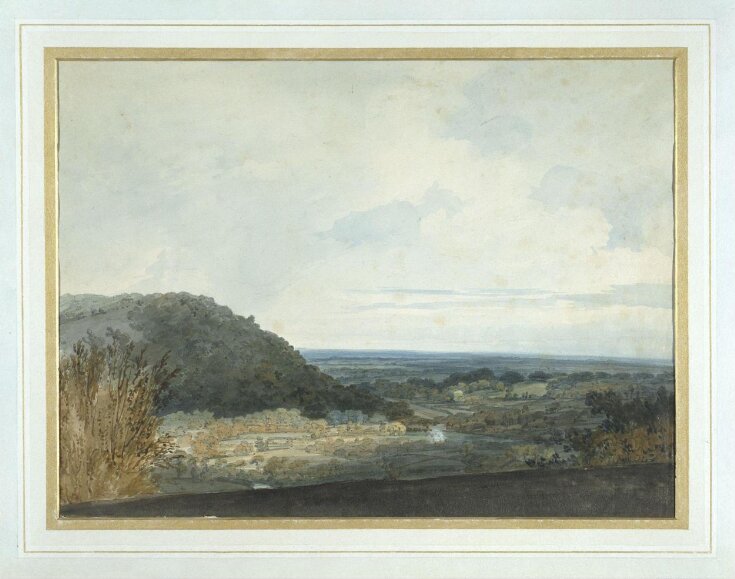
Possibly Box Hill Date….. previously attributed to Tom Girtin, and later to Turner. Girtin was contemporary to Turner, and they were in fact great friends. They would go on expeditions together, and on one of them painted the Savoy palace from a boat on the Thames. Girtin was an acclaimed painter, who sadly died at the age of 29. Turner held him in high esteem and his famous quote said ” if Tom had lived I would have starved”. Turner was definitely in the area that year, as the next painting of Leatherhead shows. This was his so called Student period.
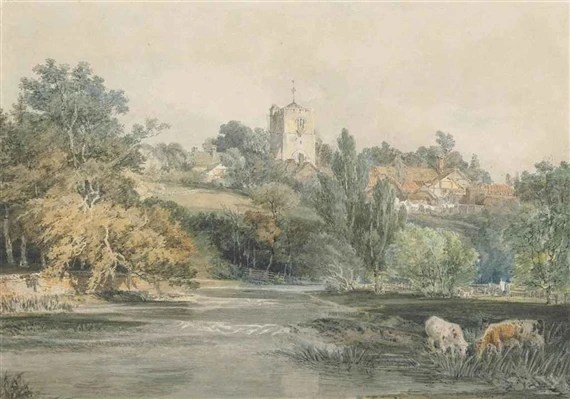
At about the same time, we have this painting of Leatherhead
Leatherhead from the River Mole, with cattle in the foreground, dated 1796, and attributed to Turner. I find this an immature style compared to what we associate with Turner’s work, and it would be as this comes within his student period. Turner had been invited to Norbury Park, near Leatherhead, a place I associate with Fanny Burney who met her future husband there, Comte d’Arblay, an emigre from the French revolution. I wonder if they met Turner. Interesting to conjecture
I will publish so far and go on with this at a later date
This is the centre of my local village, St John’s near Woking. The name St John’s was taken from the local church, built in the c19 by the then rector of Old Woking, as a chapel of ease for the village inhabitants. Quite a long walk to church otherwise in a century when no one had transport.
The village is mostly Victorian, and although surrounded by suburbia, does still retain its village atmosphere and integrity. Life started here in the late c18 when the canal was cut through open heathland. In the distance in my picture, the road makes a hump, as it crosses the canal. This is Kiln Bridge, where as the name suggests bricks were made from local clay, and these were used in the building of the canal. The canal was intended to link London with Southampton, but only reached Basingstoke before the railways were built and superseded canals. This was still a time when war with France was a possibility, and inland links with major south coast ports were desirable.
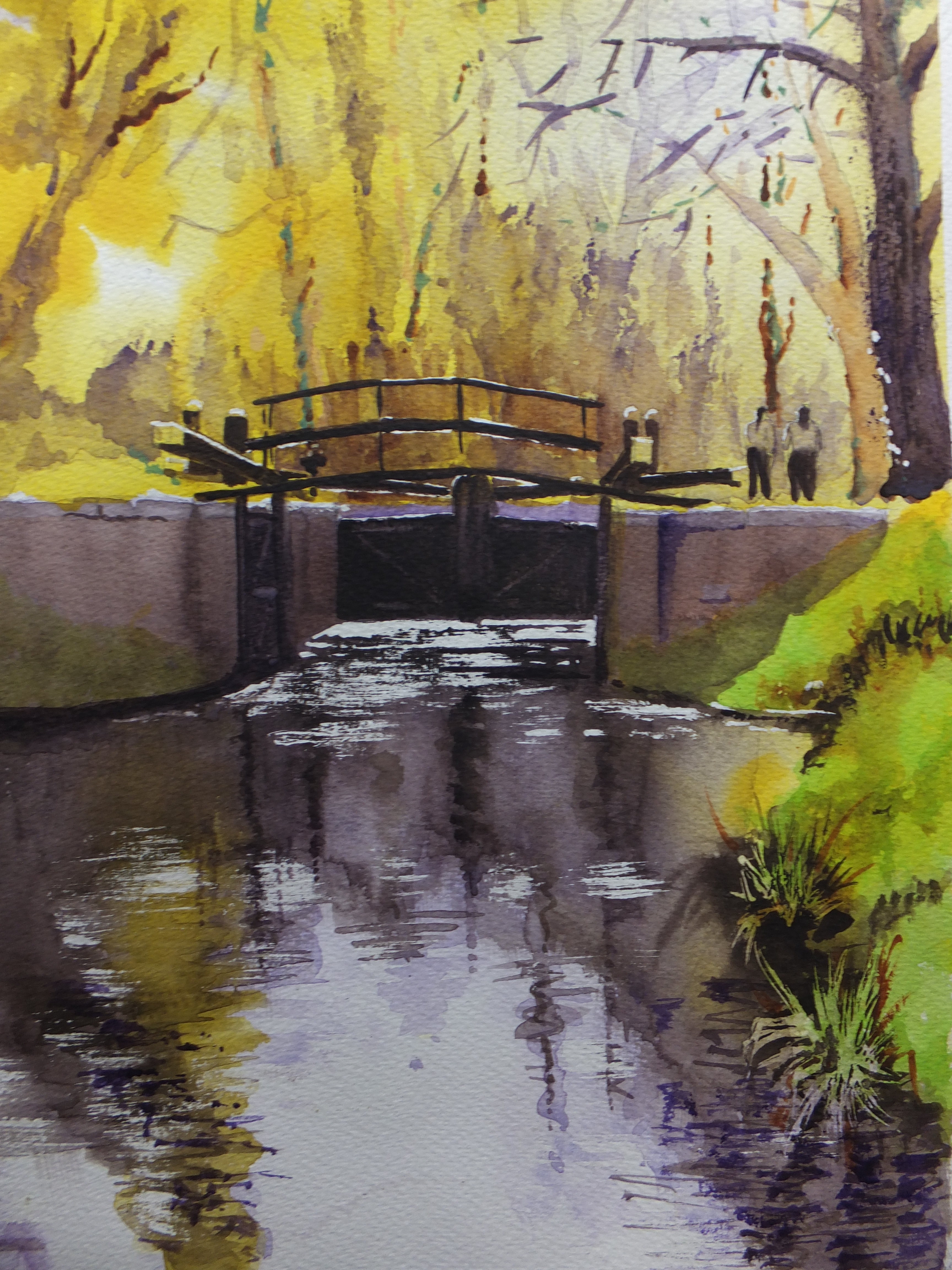
Today the Basingstoke Canal is maintained by Surrey and Hampshire County Councils. There is some leisure boating but not much. Wild life proliferates and the towpath is used for cycling and walking.
This is the very first time that I have painted my own village. I don’t know why. I put this painting on a local website and had more than 240 hits. All complimentary, I am pleased to say. No offers to buy though.
In the middle of the picture is our comparatively recent coffee shop, which has become the hub of village activity. Walkers and shoppers meet there to relax and catch up. We never had that before and it is a very welcome addition. We do have a pub but located going out of the village, so not so convenient. We have most shops so a useful selection.
At the bottom of my lane, we are blessed with a green open space, called St John’s Lye. Lye, lea or leigh means a green space. It is common land and so protected although we did have to physically resist Woking Borough Council who wanted to build a village hall on the Lye to replace the one that was starting to fall down. Eventually common sense prevailed and the new hall was built on the site of the old one. The Lye is available to all age groups for spontaneous activity including dog walking.
And so you have it. Not a place that many know, but loved by its local population
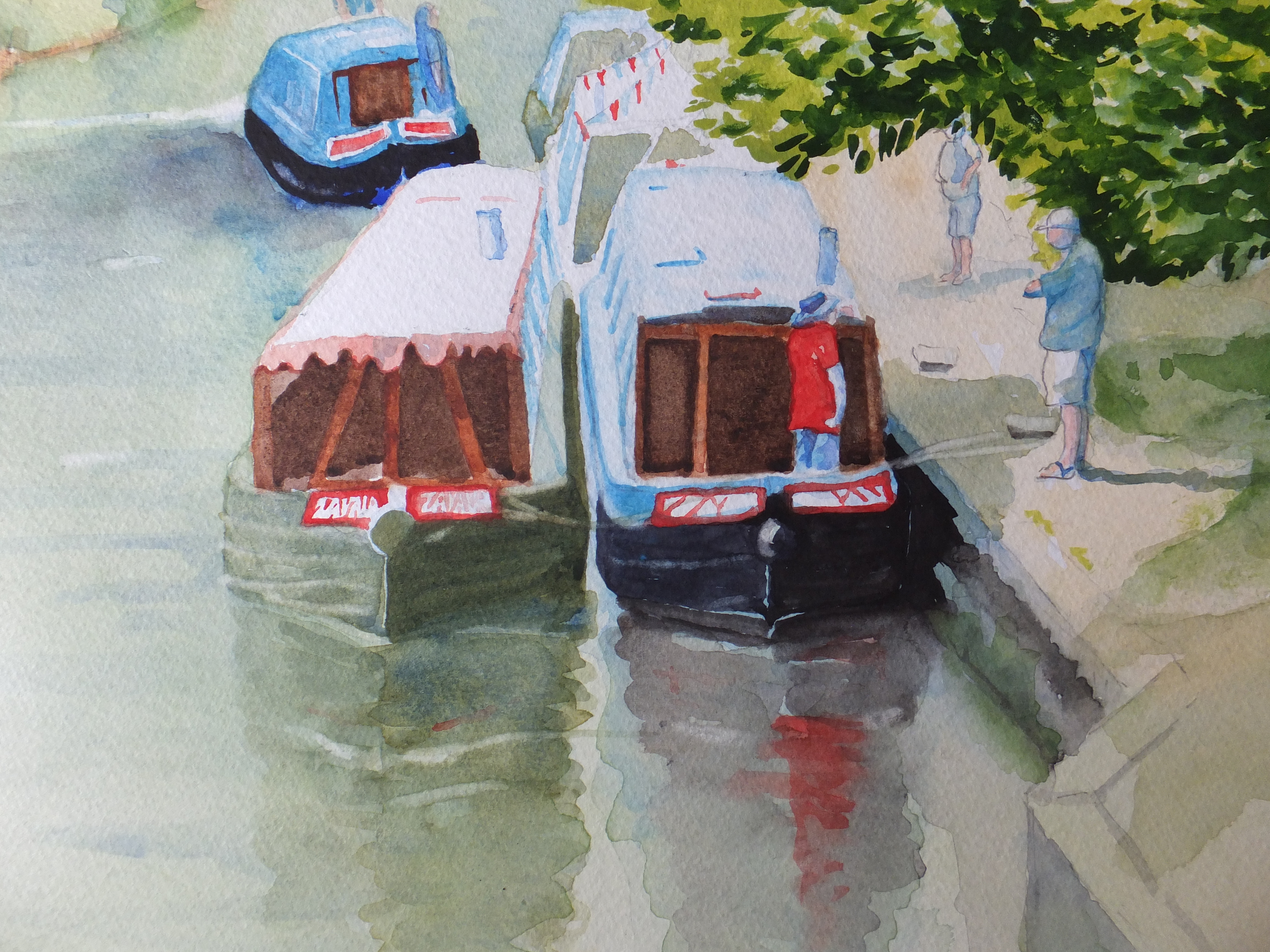
The Basingstoke Canal runs through my village of St.Johns in Surrey. There is very little traffic nowadays as the canal doesn’t go very far, and the short distance there is, is punctuated by locks. Occasionally there is a gathering of barges which seem to tie up mostly at St Johns, where there is an old wharf
The canal was cut in the late c18. The intention was to link London with Southampton but the advent of the railways cut this short. Today the canal is a haven for wildlife and some leisure activities.
It is very near me, and I have painted there often. There are so many subjects. It was nice to go back recently and hopefully capture this meeting of barges and their owners. The colours are always fun and add to the atmosphere
I never tire of looking back to our visit to the Camargue, where tributaries of the Rhone flow into the Mediterranean sea. This wetland area is famous for its wildlife, flamingos which breed here in possibly their only breeding ground in Europe, bulls which are bred for fighting, and, of course, the famous white horses which run wild throughout the area. They are magnificent to watch
I have painted them before. Always a delight. I hope you enjoy looking at this painting. As far as I remember I have only used two watercolours, Cobalt Blue and Vermillion which work well together as a sunset effect.
A favourite view across the Venice lagoon, with La Dogana just visible on the right-hand side , and Santa Maria delle Grazie in the distance. This was not my photograph, and I am grateful to Pixabay for the loan.
I have included the watery sun appearing through the mist, which probably will burn the mist off later. A useful tip that I read about recently was to take a bottle top, cover it with tissue and press it gently but firmly onto the wet paper. You will be left with a faint sun, which you can adjust to what you want
I used a mix of vermillion and cobalt blue to get this hazy effect, in fact no other colour. You can add more or less of one or the other to get whatever effect you want. The lonely gondola is out early by the looks of things
Just a short post this time, as other things await