I am starting to find cats interesting as subjects.
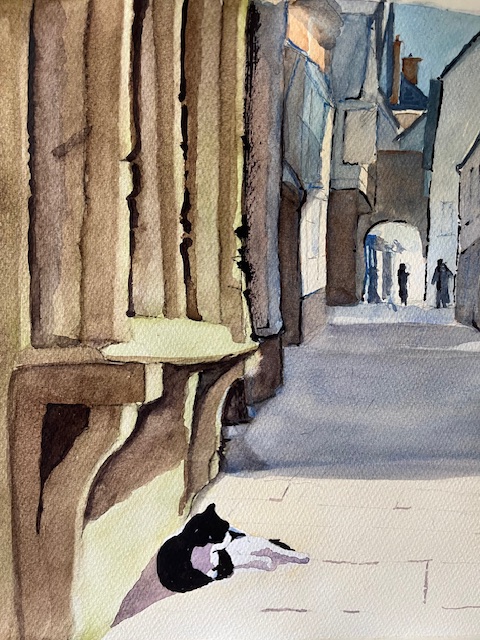
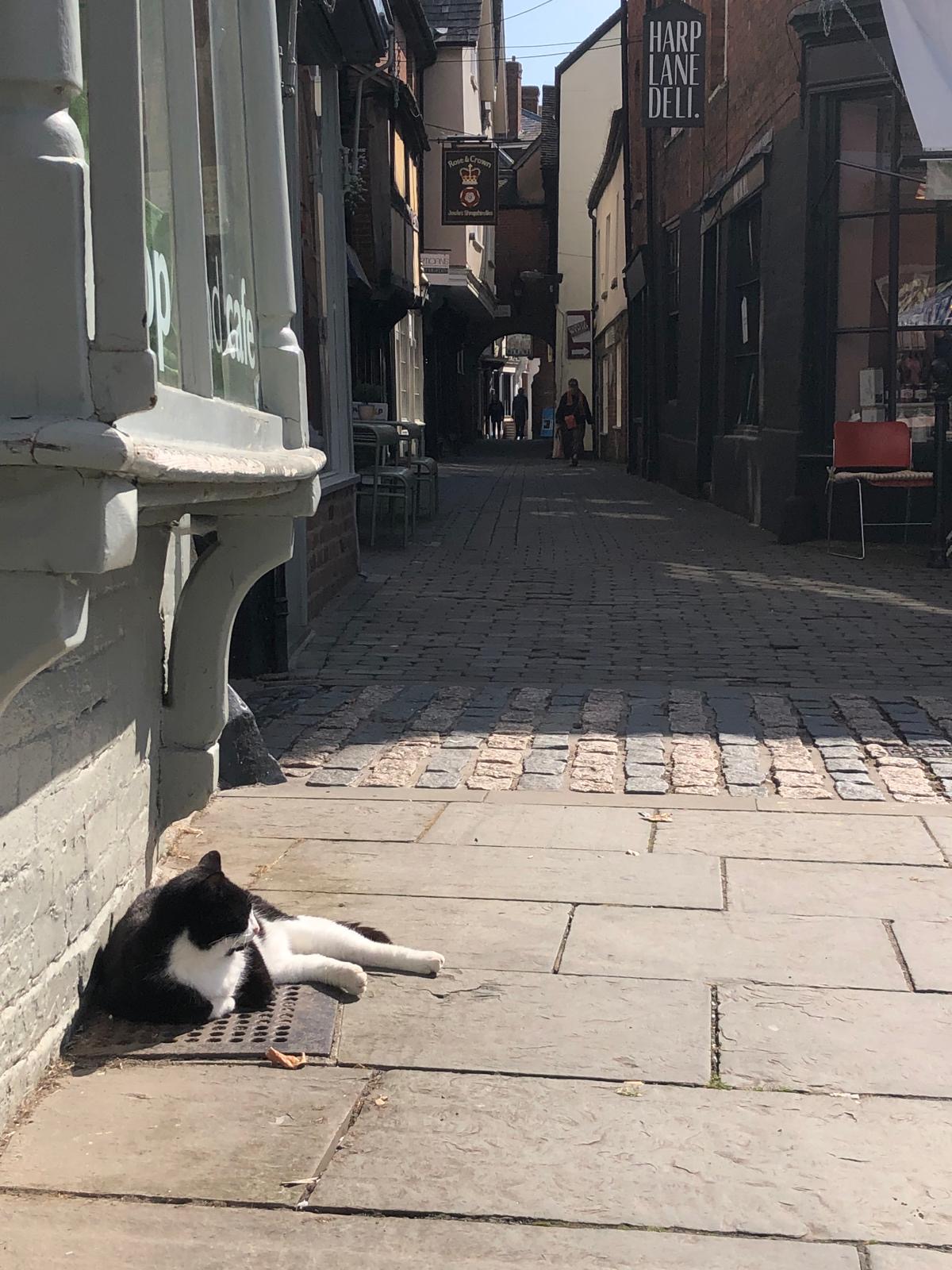
My son sent me a photograph a while back of this cat sunning itself on hot pavements, with a dark alleyway in the background. He had a cat at home which looked remarkably similar which was why he took the picture. They were on holiday in Shropshire at the time, and on this particular day were wandering round the historic town of Ludlow
I had it in mind as a possible painting at the time, and reminded about it recently, decided to do it. I quite liked the result, as I don’t usually do cats. I used a mix of raw sienna and naples yellow for the pavement. I have a favourite mix for black, which gives a glossy black which is good for animal fur or feathers. This is a mix of blue like Windsor Blue and Alizarin crimson, with a dash of Sepia or Burnt Umber. You don’t need much of the dark brown, and that bit is pure trial and error
Since my last, which was my first attempt at a cat portrait, I have received another commission from a cat lover in the same family. Let’s hope I don’t disappoint
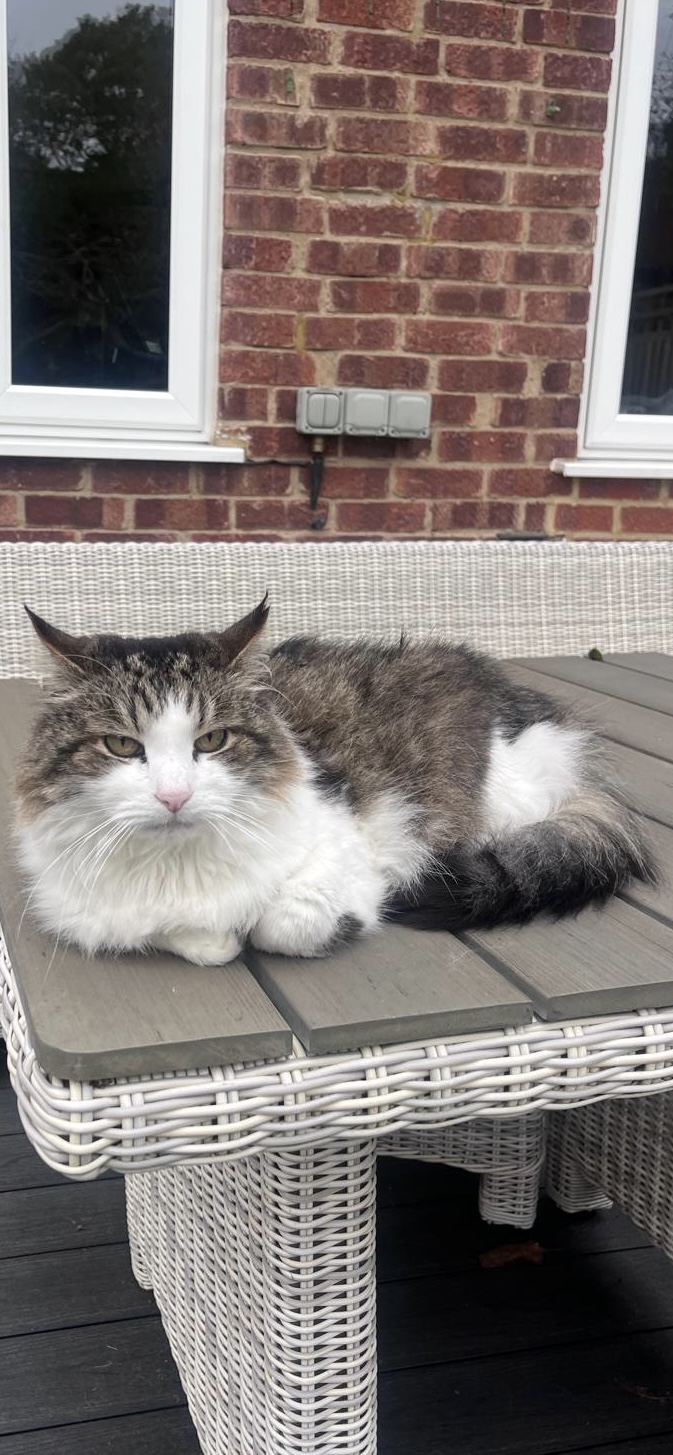
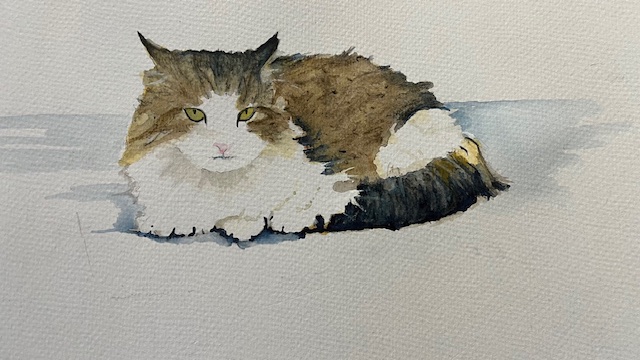
This is Pepe, a neighbour’s cat, a handsome devil, although getting old now. he is good natured but easily spooked, so you have to be careful how you approach him. Iwas asked to paint his portrait and tried to explain that animal portraits are not really my thing, but that I would try my best.
This my best shot
I liked what I had done, but does anyone want my opinion. As it happened his owner and my neighbour loved it, so all was well.
Following on from one cat portrait which I didn’t know I could do, I have decided to try another from a photograph my son sent me, showing a cat basking in the sunshine. He was walking round Ludlow at the time. he called it ‘chilling cat’. I prefer alley cat
Quite a lot in this picture to amuse a watercolour artist. A lot of shadows with a light source at the end of the alley as well as the cat itself. We’ll see how that turns out. It may be one of those pictures that needs a sample done first. Whichever, it will keep me amused
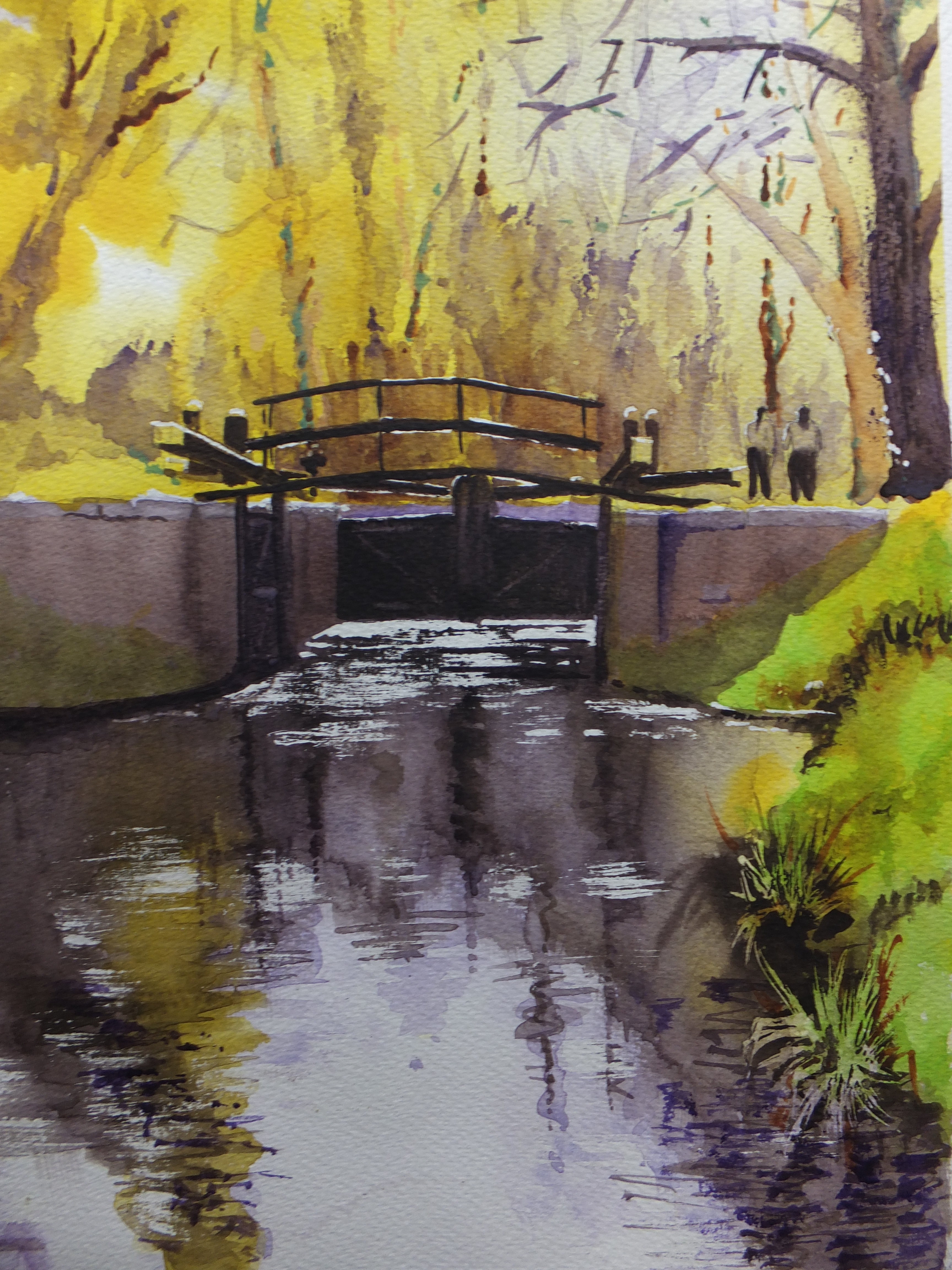
This is a really old favourite. The lock gates on the Basingstoke Canal, which flows quite near where I live. The canal is part of our industrial heritage, cut in the late eighteenth century to provide an inland link between London and Southampton, a major seaport. This was the time of wars or imminent wars with France, and transport by sea was fraught with risk, so the Wey was linked to the Arun by canal and extended to Portsmouth, which lasted for a short while, and this canal now called the Basingstoke was planned to reach Southampton. It never got there. It reached Basingstoke in the north of Hampshire, and then came the railways ,and canals were quickly redundant.
This painting went out to New Zealand by the way. It was bought by a young couple who’d come back to visit an elderly mother. They came to one of my shows, and took this painting home with them. That was years ago. I hope it’s still giving pleasure.
Today this canal is used for leisure only and is a haven for wildlife. It also gives artists and photographers subjects for their art. I’ll include a few
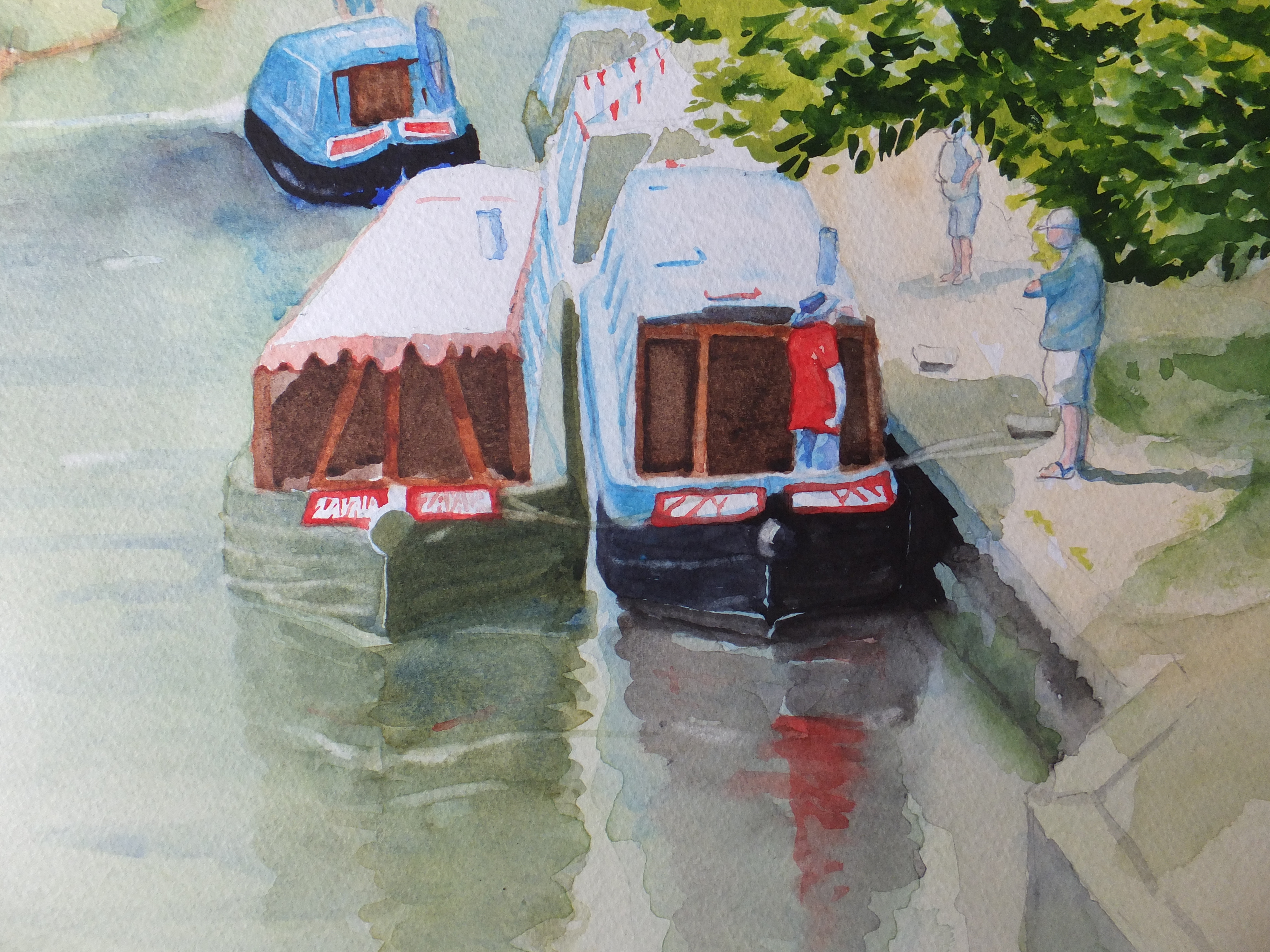
Barges gathering on the Basingstoke Canal
These are barges, of the type used for transportation in times gone by, which are now used for leisure purposes.Every so often there is a gala, when the barges get together as part of their social exercise. This is an ideal spot alongside one of the old wharves, which is outside our local Italian restaurant, which you can’t see, but is to the right of the picture. Delightful on a summer evening to sit outside with a glass of Cava and watch the activity on the water. The old boathouse is there too, long converted to a pharmacy.
I stood on one of the old bridges, Kiln Bridge, to take the reference picture for this painting
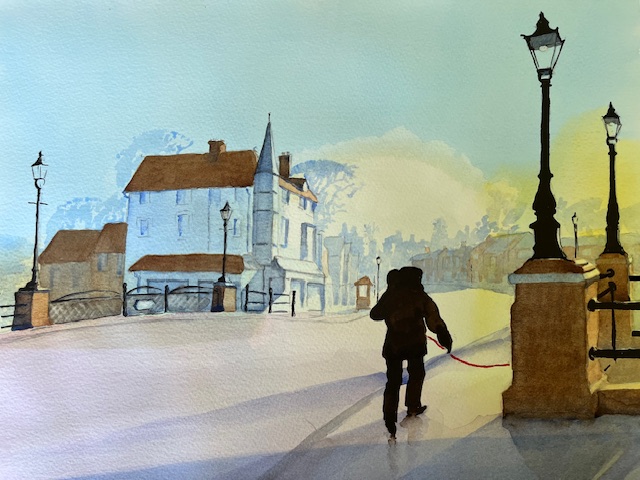
Kiln Bridge in winter sunshine
This is the bridge over the canal leading into the village of St John’s. Kiln Bridge, well the clue is in the name. When they were building the canal, they made the bricks as they went along. The village grew up around the canal in a shanty town sort of way, and most of the buildings are Victorian. The shop opposite in the picture is a restaurant today, but in its day was a haberdashers shop for a while, in those good old days when small shops could make a living selling everyday things, before being driven from the high streets.Today restaurants and beauty parlours proliferate but at least they aren’t empty
The village took its name from the church of St John’s which was built by the rector of Old Woking, as a chapel of ease for the villagers. Very considerate, as everything was a walking distance in those days, and a five mile trudge to church in bad weather would be offputting even to the most pious.
I haven’t painted this church yet although I do intend to. It is a handsome Victorian church by a very well known architect George Gilbert Scott, who was responsible for many new churches up and down the country, not to mention restoration of old churches and cathedrals. Not just churches but also remembered for the Midland Hotel outside St Pancras Station, which was derelict for many years and beautifully restored comparatively recently. There were three generations of architects. Giles the grandson, built power stations like Bankside now Tate Modern and Battersea finally developed into a magnificent shopping mall. He is especially remembered for the red telephone box, which now are collector’s items.
For the moment, that is enough for one post. An interesting journey for me which I hope you enjoyed as well. I am quite elderly now, so if I want to look back again, there is plenty for me to look at
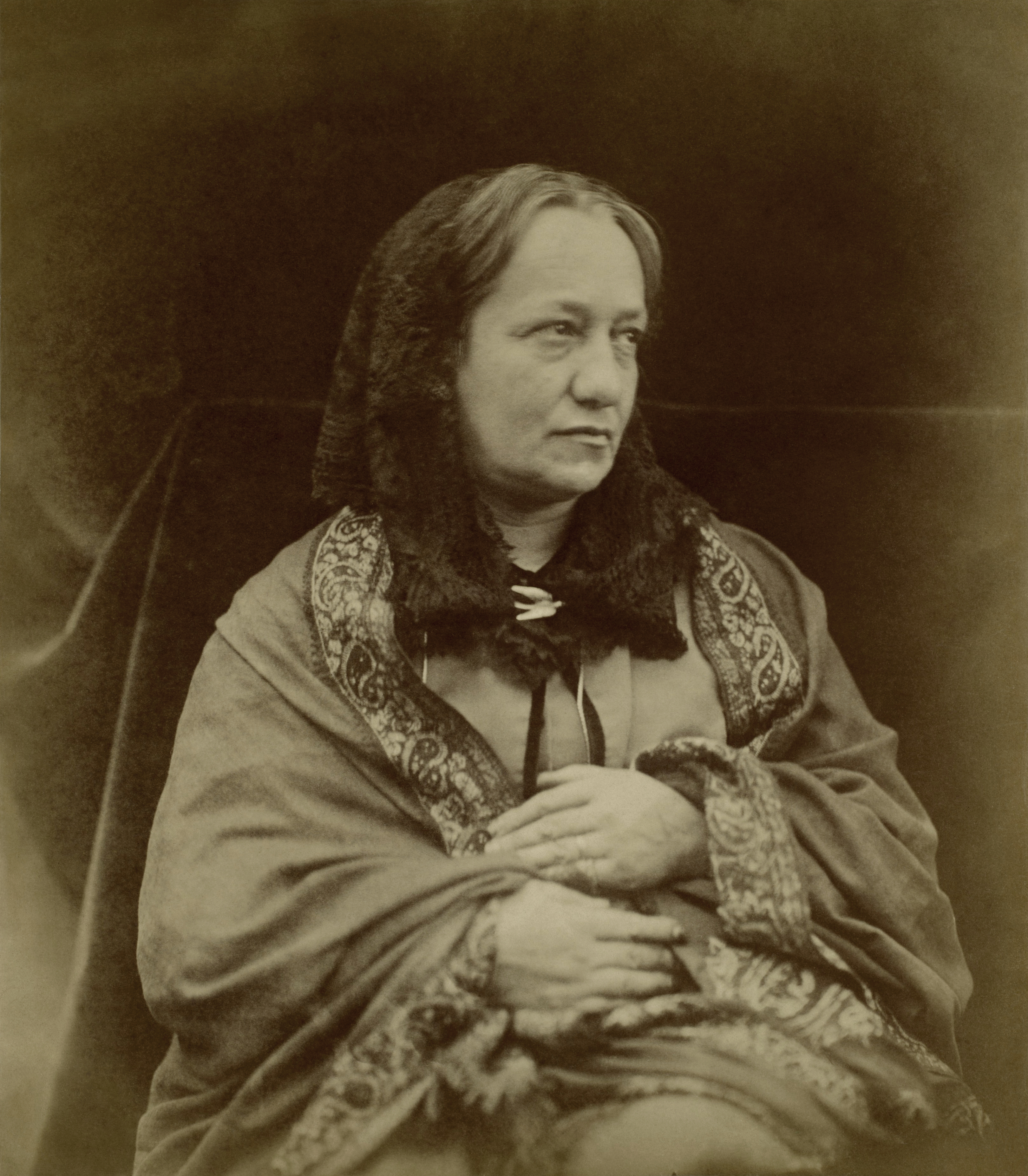
Probably the best known of the Pattle sisters, Julia Margaret Cameron
This is the current exhibition at the Watts Gallery at Compton near Guildford. This is the gallery of the paintings of George Frederick Watts, the famous Victorian painter. He lived nearby at his house called Limnerslease, with his wife Mary. He was a prolific portrait painter. He was also well known for allegorical subjects. His painting called Hope was featured on postage stamps and was also known as Barack Obama’s favourite painting. Likewise he often painted pictures with a social message
His wife Mary, also a painter, gave up painting to support her husband. She founded a pottery workshop in nearby Compton to give employment to local craftsmen. She is also known for building the nearby chapel with designs by her husband, generally regarded as an Art Nouveau masterpiece
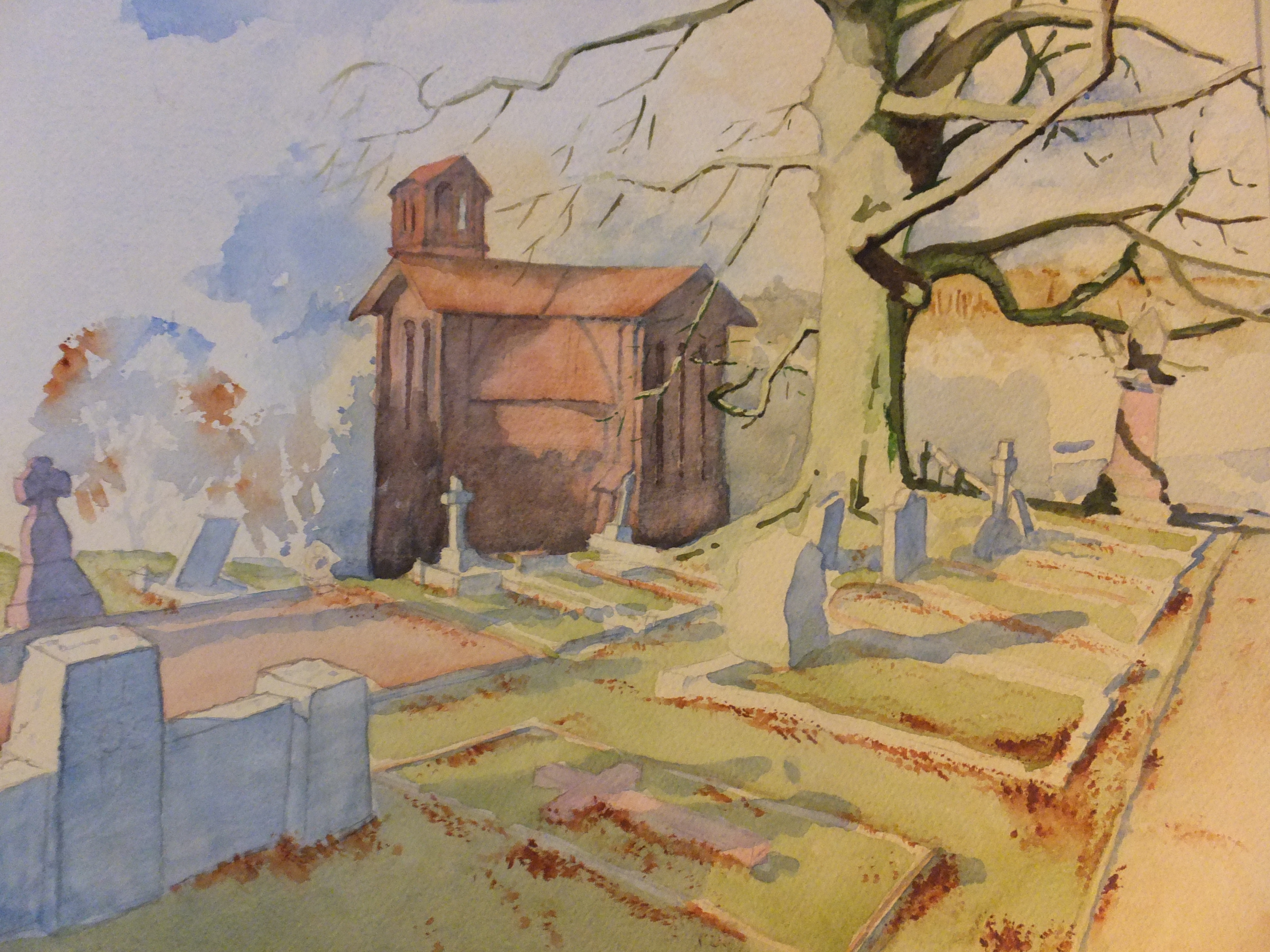
This is the painting of the Watts Chapel that I did once, built in brick and shaped like a Greek cross. The interior is beautifully designed in Arts and Crafts style. The bricks were made locally in Mary Watts works
The Pattle sisters were born in India, and became central figures British art and literary society. Born in Calcutta now Kolkata to James Peter Pattle, a civil servant, and Adeline Maria De l’Etang ,they received education in Paris and India.
Known for their beauty, intelligence and independent spirits they navigated complex social landscapes, bridging cultures and influencing Victorian high society and intellectual movements
George Frederick Watts was one of the prominent figures that they were connected with. There were seven sisters in all, and probaly the best known is Julia Margaret Cameron, the famous photographer, who lived on the Isle of wight for many years. Given a camera by her daughter, she became well known for her photographs of famous people, and also for the ability to capture subjects in a very soft light.
Maria Jackson (nee Pattle) was the mother of Julia Stephen who was mother to Virginia Woolf and Vanessa Bell, thus linking them to the Bloomsbury group
Pattledom was a term coined by Thackeray describing the sister’s powerful social network and bohemian lifestyle, blending Indian heritage with French education and English society
This exhibition is on until May, and well worth a visit if you are within striking distance of Compton
Btw. if you want to see more of my own paintings, they are listed also on my own website davidharmerwatercolour.co.uk. This website is a showcase rather than a shop, but enquiries are nevertheless welcome
Described as Newark Abbey which is in fact Newark Priory, and even Newark Priory Church. The priory was a huge complex, and the ruined church is all that is left after the Dissolution . It looks to me that Turner sketched this from the road. The view is much the same today. The land is privately owned so close inspection is not possible. Cows are in the field much the same as Turner’s sketch. Newark Abbey is near Ripley as a point of reference. This painting is in Tate Britain
After the dissolution it was said that the priory was bombarded by cannon from nearby Pyrford Hill. After that the site must have been robbed for stone, as the ruined church is all that remains, apart from the odd outcrop
Turner would row down the river. We know that he stayed at the White Lion in Guildford, and at another in inn in Walton-on-Thames. He also thought nothing of sleeping on his boat. He was also a prodigious walker, known to cover 25 miles in a day including making sketches on the way. Sometimes he would set out with company and leave them behind if they couldn’t keep up
This is the entrance to Quarry Street in Guildford today. It is not by Turner! This is my painting made about twenty years ago. There is a link with Turner albeit a tenuous one. In order to take the reference photograph for this painting, I had to step back into the White Lion Walk in order to keep the bright sunshine out of my lens. The White Lion Walk is the shopping arcade which now stands on the site of the old White Lion Hotel. Let’s look at the next picture.
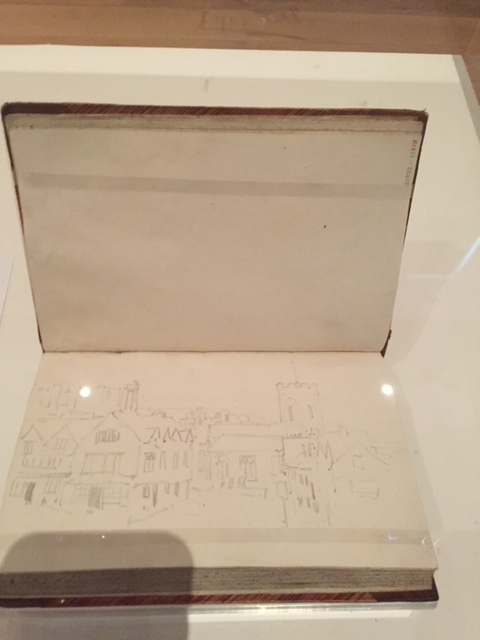
This is by Turner! It is one of his sketch books and shows the same view which I made years later, which still amuses me. I am sorry the image is so pale, but he worked in pencil. You can see the building on the left is much the same and the ancient church of St Mary stands in the background exactly as it does today On the right hand side is an inn much as today. Turner sketched this whilst staying at the White Lion in Guildford. Was he in the lounge relaxing or in his room. We know he didn’t like an audience so maybe the latter
We’ll leave it there for now and continue Turner’s drift down the Wey at some later date
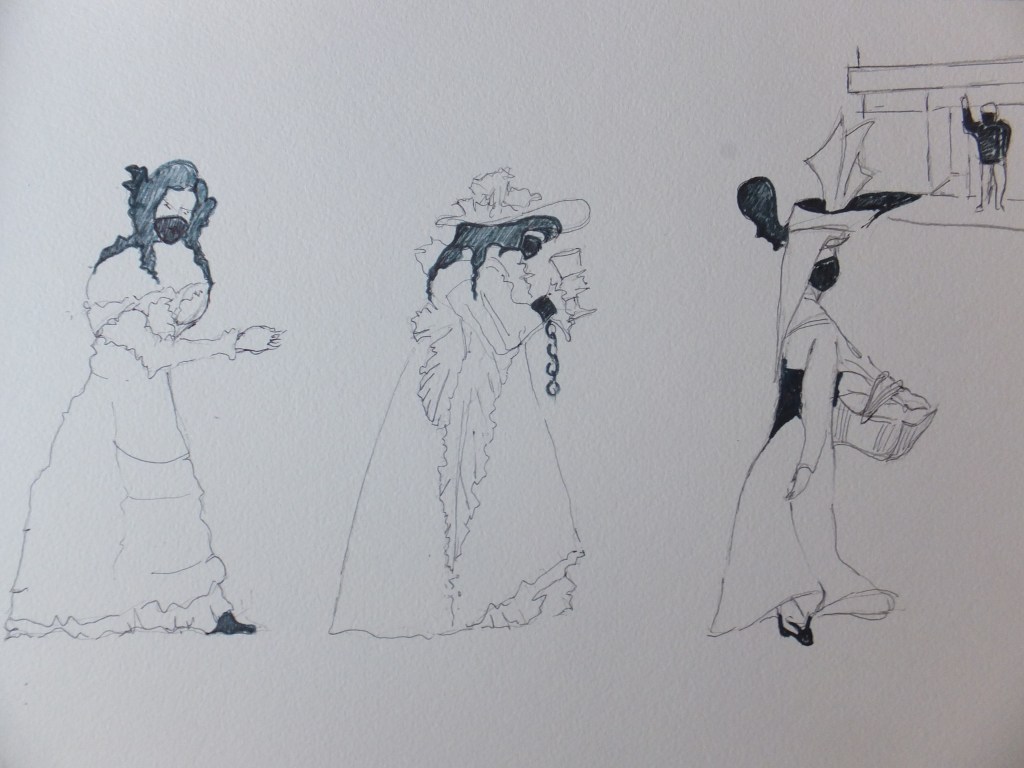
Social Distancing using the style of Aubrey Beardsley
During lockdown we formed a zoom art group within the family, mostly for fun, and yet some of the results were interesting. People who were new to art, were surprised at what they could produce. Old hands like me, who have painted in watercolour for some years, found, when they moved to other media, that they were beginners again. Digital painting was beyond me completely, whereas my grandchildren excelled.
We closed the group for various reasons, although the ground we had covered was amazing. My grandchildren had to devote more time to school work, and as lockdown eased different people were going on holiday
We have started the group up again, with grandparents and friends only. Grandchildren are now even more occupied with studies. How it works, one member of the group sets a task. The current one is to use the style of Aubrey Beardsley, the illustrator, within a scene that is topical. All these tasks make you scratch your head, I can tell you.
My effort is shown above. The topical scene is Social Distancing, some thing we are all familiar with, when queuing for the supermarket or any store.I haven’t been terribly original, as I have borrowed from Beardsley’s many drawings. I have added face masks, which is useful, as it saves you drawing faces. I have added the store front from his picture The Girl in the Red Gown
At the same time, we have to introduce another artist, whose work you were reminded of. I chose Utamaro the c18 Japanese artist who works in line like Beardsley. He, Beardsley was in fact influenced by Japanese art, as were many in the c19, especially the French Impressionists
My submission has gone in. We will see what happens and what the next task will be.
In between time, I am working on the Camargue horses. I have transferred the drawing to watercolour paper, which is the tedious part, and have applied the first wash
I quite like doing these narrative paintings from time to time. This one I have done in a vignette style, again something I do for a change. In some ways this style takes less time, as I don’t have to tape up, and without big expanse of sky or sea, there are no big washes to worry about.
This was not done from one of my reference photos, and my thanks and acknowledgements go to an unknown photographer whom I could not find. This painting is not a copy of but was inspired by a photograph.
This is pure nostalgia in one sense. I don’t know of a visitor to France who didn’t enjoy that early morning trip to the boulangerie for the fresh bread.
In England we don’t have that culture. Our bread is homogenised and comes plastic wrapped, although some of our supermarkets are now baking on site, and producing something worth eating. But we still don’t go for it early morning when it is fresh and still warm
This is Paris obviously. The location was not marked, but looks like Montmartre, with those steep steps. Again a place much visited and much painted.
I changed the background considerably. I have lengthened the perspective so that the Eiffel Tower looks much further away. The buildings are deliberately out of focus, so that we concentrate on the lady in the foreground. We look at her with great compassion as she struggles homeward up that steep slope, heavily laden. I see her almost pushing that basket with her knee, to take some of that strain off her arm.
This painting is smaller than my usual, this time about 30×25 centimetres. I found it a pleasant change to do. At the moment,thanks to lockdown I am sorting and consolidating my reference photographs, so who knows may find more of this type
This has been an enjoyable journey to use that expression, which does seem appropriate, as I did feel I went back there. I took photographs with a view to paint, but never found the time. One thing about lockdown is that I don’t feel guilty about making more time to paint. There is always something to do in the house but generally house and garden are tidy and the allotment is up-to-date, which is unheard of
Also I am managing to paint in natural light which is a plus. So often painting time comes in the evening and artificial light is a handicap
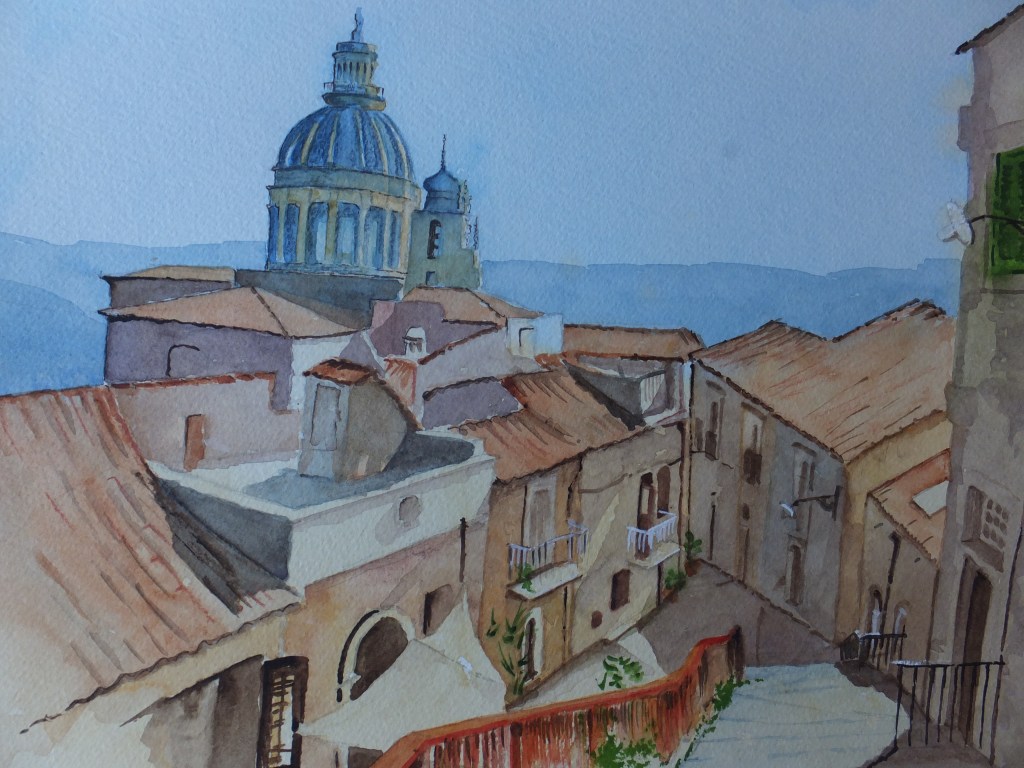
Colours were enjoyable with the mix of phthalo blue and cobalt for sky and cathedral. Just a tad of grey in the blue for accuracy and to stand against the sky. For all the old houses, different shades of Burnt Sienna and orange, with some blue in the steps to balance the colour scheme
There is a competition coming up for 70+ year olds in lockdown so might put this one in. There will be thousands of entries from across the country, so no hope of winning, but as we say, it’s the taking part that counts
I have made a start on the actual painting. Quite a lot of drawing work to be done as one might imagine, and working from three photographs, the perspective drawing was interesting to say the least
I do a small amount most days and look at what I have done when the paint has properly dried. The cathedral is virtually finished although I may still go back in with a sharp brush and reinforce some of the finer details.
For some reason the colours in the photograph are more red than in the original painting.
So this is my version of the original photograph, something I took some while ago, and frankly was something of a muddle. It lent itself to the “less is more” concept, if anything did. I am not saying this is a masterpiece by any means but does improve on the photograph.
The corner of the Doge’s Palace has been detailed although not heavily so and so has the street lamp. The rest has been trailed out, although you can just make out what it is. As I remember the shot in the background forms part of the Basilica of St.Mark, but not enough showing to be recognisable, so not really missed when phased out
I haven’t found someone else’s style easy, as one’s own creeps back, but I have been as disciplined as I could. Nice to draw in ink again, too. I had forgotten the satisfaction that brings. I tend to draw in ink over my pencil lines and then erase the pencil. My pencil lines rarely go in the right place and need a few more tries. When inking over you can pick the line you like and then erase the rest. Ink or ball point, both work well with watercolour
Looking back I can see that I didn’t attach the original photo which I will do now
The original photo
This was the original photograph that I worked from, which is as you can see something of a muddle. A good candidate for “less is more” !
One corner of the Doge’s Palace and behind the street lamp, unrecognisable bits of the Basilica. I took this years ago. I don’t remember why, but it served its purpose with this exercise





 offtoafineart