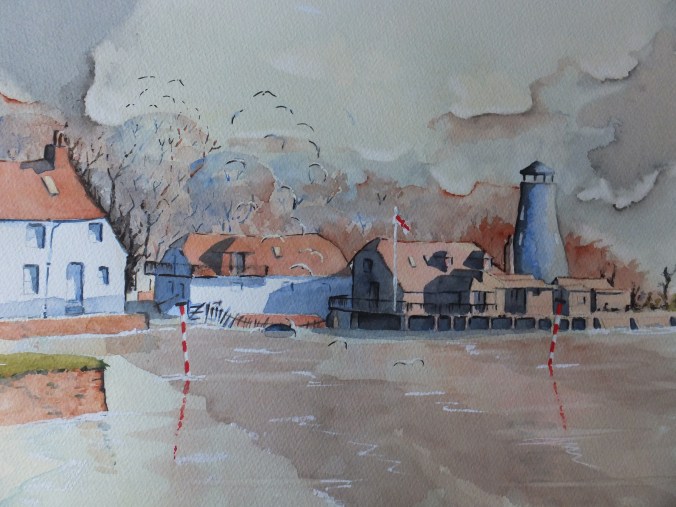
Langstone Mill Reworked

Langstone Mill

This is probably the last painting that I made of Langstone Mill, a couple of years ago, and which sold easily, being a popular subject. I am going to do it again, but differently. I have been painting what I call “panoramics”, which are completely horizontal subjects in  frames about 60 centimetres long but only 21 high, and they have been successful so far

I have done this twice now, and both sold relatively easily. One was of the beached fishing boats at Beer in Devon, and the other was of Bosham Harbour, again an old favourite. They can both be viewed on my website davidharmerwatercolour.co.uk.

Langstone is a little way down the coast from Bosham, and again a place beloved of sailors and painters alike. Another salt water creek, a misty and lonely shoreline even today, the place exudes atmosphere, especially when the weather is on the turn. I am hoping to do a totally different sky to anything I’ve done before. So far I have just started some drawing work but nothing to show as yet

It does have some history. It was a medieval commercial port for the neighbouring town of Havant, trading in exports of leather goods, especially parchment from Havant whilst engaged in coastal traffic generally. It was the link with nearby Hayling Island, either by causeway which was built by the Romans from chalk and flint, we are told, or by boat bringing in supplies to the priory on Hayling at the time.

Barges went out from Langstone to the sandbanks, where they grounded themselves and loaded shingle until the tide turned and they headed back to port. This was sold up and down the country for road mending, and carried on until the early c20.  Skeletons of some of these old hulks can still be seen sticking out of the mud, and again add to the atmosphere

There are two pubs, and the older of the two, now called The Royal Oak, commemorates the escape of Charles Stuart after the Battle of Worcester. He and his comrade in arms, Henry Lord Moffat hid in an oak tree to avoid capture. After making their perilous way south to the coast, they reached Lyme Regis in Dorset where they tried to get a ship to France. Without any luck, they made their way eastwards port by port, and eventually came to Langstone. No luck there either, although they did eat oysters at the pub,and as everyone knows, they met someone in Shoreham further east, who ran a coal barge and he took them to France.

Yet another romantic story attached to Langstone to add to the atmosphere. Let’s hope I can catch some of this in the painting


History of Langstone Harbour and Warblington,Hampshire Coast

Watchman's Hut Warblington.JPG

Just as a change from painting, whilst I work on my Alhambra picture, before I have anything else to say about it, I am at the same time, researching the history of Havant in Hampshire based on my postcard collection, for a talk I am due to give to my local history group in Guildford in November

Havant is an unprepossessing town. I say that as someone who grew up there and therefore has an affection for the place. Nevertheless there is plenty of interesting history around and about. I keep within the confines of my collection, and on the eastern periphery lies Warblington, a Saxon foundation, a remote place by the side of a marshy creek, eerily quiet when I was a boy and still the same today. A week or so back I went to the old church to take some pictures to back up my postcards, and wandered around the churchyard. We were within half a mile of the Havant by-pass with its buzz of traffic and yet within the churchyard you could hear a pin drop. In my mind, I went back to my childhood when I first discovered this place as a schoolboy

The church is c13 and something of an enigma. Why build it there in the middle of nowhere? It still stands in the middle of nowhere. We are told there was a Saxon settlement, and the word Warblington stems from the name of the chieftain, a woman apparently, and there are Saxon elements in the foundations of the church . The church served nearby Emsworth, which still doesn’t explain why it was built at Warblington. On the site of a holy place perhaps? We don’t know

More interesting than the church despite its age, are the two huts, in diametrically opposed corners of the churchyard. If I say they are c19, I am sure you will guess that they had something to do with bodysnatching.  They are nightwatchman’s huts used to watch out for bodysnatchers who had posed  a huge problem until the Anatomy Act of 1832, which required anatomy teachers to be licensed, which effectively put an end to this lucrative trade. Also the medical fraternity were allowed the bodies of executed criminals or even donations from poor families.

In the churchyard of this creekside church are gravestones of sailors drowned at sea, and I quote the one I have always found fascinating.

Sailor's Gravestone

This the gravestone of William Palmer, and perhaps we should start with the inscription

This is in the memory of William Palmer that lost his life and his vessel going into Dublin the 24th February 1750 aged 38 years

The carved relief is intriguing and the work of a very skilled mason. Even the rigging stands out and would need very careful carving. Huge waves are rolling and the ship obviously capsized. The object behind the capsized vessel, I cannot make sense of

So we have a local mariner, a master mariner with his own boat, most likely involved in coastal trade as so many around here and Langstone were, and with a small crew, perhaps ambitiously attempting the crossing of the Irish Sea, not to mention the treacherous rocks around Lands End, and coming to a sad end. Or perhaps this was his regular run, and he was unlucky due to treacherous weather conditions. Dublin was very English in those days, and would be looking to regular supplies of day-to-day items, so one can easily imagine mariners plying a regular and profitable trade.

There are several Palmers buried in the churchyard. William’s wife is buried in the same grave but I can’t make out the dates. I imagine them being a prosperous family, judging from the quality of William’s gravestone

I remember seeing this stone when I was about twelve. It fired my imagination then and still does. It doesn’t look any different

I had thought to talk about Langstone close by, but another time. I have painted Langstone often but never Warblington which perhaps I should add to my list