Turner and Constable, two heavyweights

I am reading a fascinating book at the moment, written by Nicola Moorby which is helping my research into the talk I am preparing on Turner in Surrey, and so am straying into the life of Constable as well. There are striking similarities although they have different characters. What they share in my opinion, is the distinction of starting off the Modern Art Movement.

I will start with an image of the Haywain, probably the best known of Constable’s work, and as an image is better known than any portrait of the artist himself. the scene is Flatford Mill, where you can go today and paint the same view yourself if you want to. Willy Lotte’s cottage on the left is still there, sadly the haywain itself is not. In my youth, I always thought the cart was being driven across a ford, but later realised in fact that it was the practice to drive carts into shallow water after the wooden wheels had got too dry. the wood would shrink and come away from the iron rim. Every so often the wheels would have to be soaked to expand the wheel back tight onto its rim

He was a master of skies. He studied clouds and became something of a meteorologist. East Anglia where he came from was flat, so almost all his paintings were skyscapes.

But we are talking about Turner and Constable together. Did they ever meet? I know of one recorded meeting, and there may have been many more. In June 1813, Constable sat next to him at an Academy dinner, and wrote to his wife Maria ” I was a good deal entertained by Turner….. he is uncouth, but has a wonderful range of mind”. Uncouth, yes I can imagine Constable saying that. An acerbic character, he was not generous to his fellow artists, quite the reverse. On hanging days, he would walk round criticising other artists work, which wasn’t appreciated. Artists naturally were sensitive and nervous on these occasions as much was riding on the outcome. Constable would sneer at London based artists or “the Londoners” as he called them, especially when they attempted rural scenes. He thought they should stick to what they knew. I don’t think he included Turner in these remarks, nor should he as Turner was well established whilst Constable was just starting to become known. Rather he stood in some awe of Turner, as well he might.

Did they cross swords? There was one recorded incident that I can think of. Constable was taking his turn on the Selection Committee, who decided on where paintings were hung at the Academy Exhibitions. This was an unenviable job calling for great diplomacy and tact, not Constable’s greatest talents. He made an unbelievably bad judgement by moving one of Turner’s paintings and replacing it with one of his own at an event in 1831. Turner was down upon him like a sledgehammer. It was no use Constable pleading that the move was to their mutual advantage. Turner kept at it all evening to the amusement of all, who conidered that Constable had brought his fate upn himself

Coming back to the Haywain, this was first shown in Paris which is not generally known, where it caused a sensation. That is one of the great ironies concerning these two great painters. Constable never left these shores. He didn,t want to, through xenophobia or sheer bloody mindedness, and yet he became big in France without making any effort. A French dealer called Arrowsmith, French despite his name , came to one of the Royal Academy exhibitions and discovered Constable and went into raptures. He organised an exhibition in Paris of Constable’s work which Constable did not attend. Great interest was shown but Constable did not follow this up. he was not one for net working. One cannot imagine Turner squandering an opportunity like this

People wanted to meet Constable, including the great Delacroix, who even came to London, but there is no evidence of a meeting taking place. His paintings were to be shown at the Acadamie des Beaux-Arts known as the Salon, the nearest equivelant to the Royal Academy. It was a great success and Constable sold more paintings in a short space of time than he had sold to British buyers in years. Despite all this, Constable refused to travel stating that ” he would sooner be a poor man at home than a rich man in France” be careful what you wish for. The moment passed and Constable failed to capitalise.

Turner on the other hand, despite all his travels throughout Europe from Copenhagen down to Italy, only sold pictures at home, He held two exhibitions in Europe, one in Germany and one in Italy and both were failures. Perhaps the Italians were too used to the deep landscapes of Poussin and others, and found nothing remarkable in Turner’s work

A great book which I am still reading.

Turner in Surrey: the River Wey

Turner, Joseph Mallord William; Newark Abbey on the Wey; Tate; http://www.artuk.org/artworks/newark-abbey-on-the-wey-202538

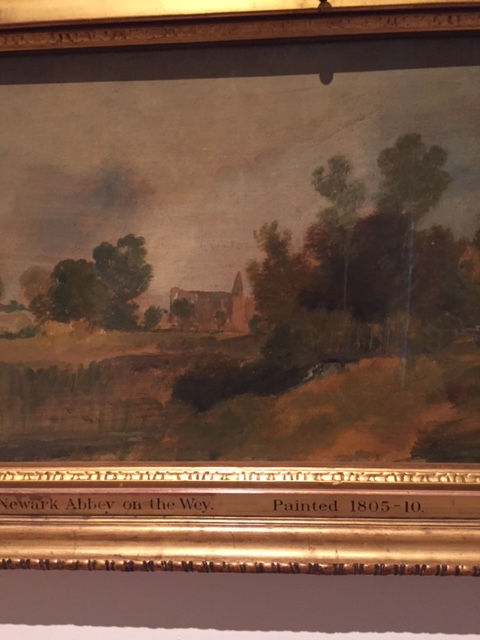
Described as Newark Abbey which is in fact Newark Priory, and even Newark Priory Church. The priory was a huge complex, and the ruined church is all that is left after the Dissolution . It looks to me that Turner sketched this from the road. The view is much the same today. The land is privately owned so close inspection is not possible. Cows are in the field much the same as Turner’s sketch. Newark Abbey is near Ripley as a point of reference. This painting is in Tate Britain

After the dissolution it was said that the priory was bombarded by cannon from nearby Pyrford Hill. After that the site must have been robbed for stone, as the ruined church is all that remains, apart from the odd outcrop

Turner would row down the river. We know that he stayed at the White Lion in Guildford, and at another in inn in Walton-on-Thames. He also thought nothing of sleeping on his boat. He was also a prodigious walker, known to cover 25 miles in a day including making sketches on the way. Sometimes he would set out with company and leave them behind if they couldn’t keep up

This is the entrance to Quarry Street in Guildford today. It is not by Turner! This is my painting made about twenty years ago. There is a link with Turner albeit a tenuous one. In order to take the reference photograph for this painting, I had to step back into the White Lion Walk in order to keep the bright sunshine out of my lens. The White Lion Walk is the shopping arcade which now stands on the site of the old White Lion Hotel. Let’s look at the next picture.

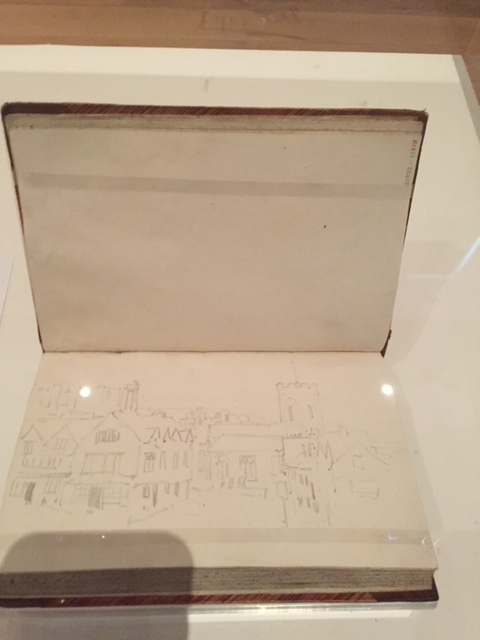
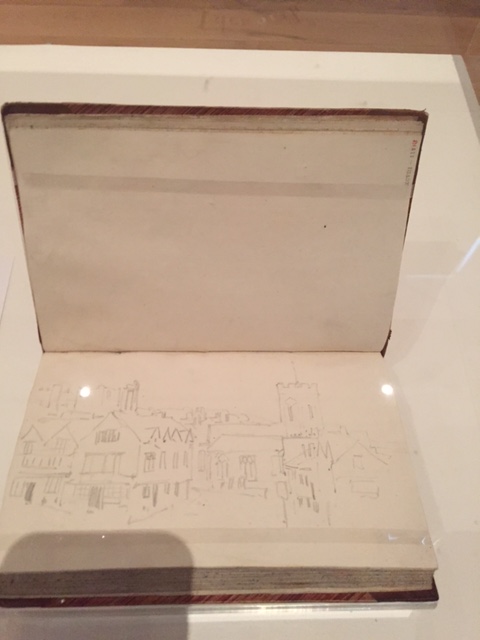
This is by Turner! It is one of his sketch books and shows the same view which I made years later, which still amuses me. I am sorry the image is so pale, but he worked in pencil. You can see the building on the left is much the same and the ancient church of St Mary stands in the background exactly as it does today On the right hand side is an inn much as today. Turner sketched this whilst staying at the White Lion in Guildford. Was he in the lounge relaxing or in his room. We know he didn’t like an audience so maybe the latter

We’ll leave it there for now and continue Turner’s drift down the Wey at some later date

Turner in Surrey Part 2

Thameside Ferry Crossing

This is a photograph I took myself trying to catch the little ferry crossing from Twickenham over to Ham on the other side. I just missed the ferry but my reason for keeping this picture, is that this must be one of the nearest points on the river from Turner’s house in Twickenham. I dealt with his house a few blogs ago so I won’t repeat that. Turner loved boats, he loved fishing, he loved the river, and he loved picnics with his friends. Was this the sort of spot he came to? We don’t know for sure about him fishing here, but he would have known this location.

I took this picture from the riverside of the grounds of Orleans House Gallery, where we go from time to time. The gallery is what remains of the original Palladian mansion built in the c18. Louis Philippe duc d’Orleans lived here in exile from 1813-1819. Turner met him and they became lifetime friends. Later in 1830 he became king of France, until he was toppled by another revolution, and went into exile in England once more. He died at Claremont in 1850. Turner went to see him in France near the end of his own life in 1845, one of his last visits to Europe, and they talked into the night about ‘Dear Old Twick’

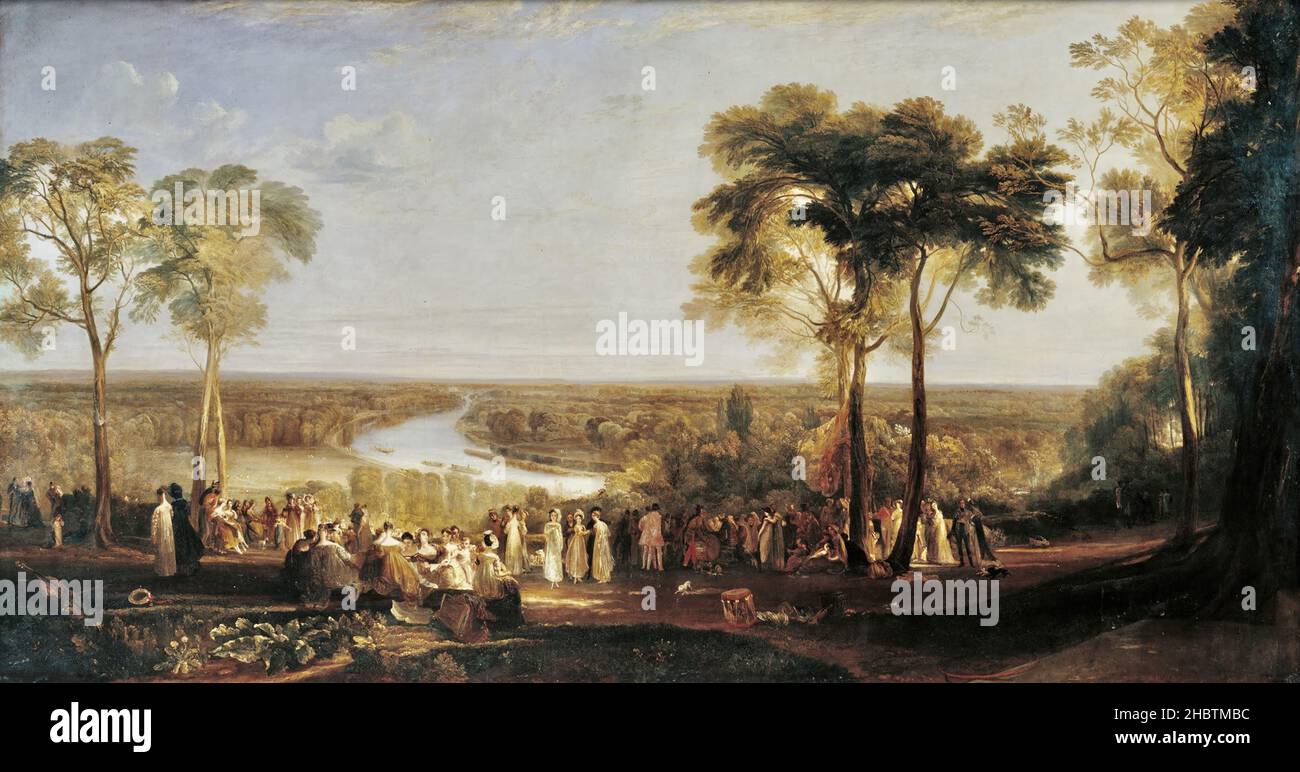
In the background on the hill is the Star and Garter, what used to be a retirement home for disabled service men, and more recently converted into apartments. Nonetheless a powerful landmark, and showing us where Richmond Hill starts. Turner painted the view from there, and I would like to look at one particular painting dated 1819, painted in honour of the Prince Regents birthday

I think that this was an unashamed bid for royal patronage, which was unsuccessful as I believe but nevertheless an interesting painting, which of course looked down on an area which he grew to love. Actually as King George 1V he was able to bestow a seascape on Turner in 1823, but to return to Richmond Hill

I will, if I may quote from Anthony Bailey’s biography, which talks about this painting in some depth. Travel and the proprietorship of Sandycombe Lodge, his country house in Twickenham, had occupied much of his time. His painting output had dropped, and he had no new commissions, so he needed new patronage, or may have felt so. In 1819 he had exhibited this great canvas, kingsize, measuring about six feet by eleven. This was England: Richmond Hill on the Prince Regent’s Birthday. It showed the winding Thames at Twickenham, and Sandycombe hidden in the trees, and on the further bank a game of cricket going on whilst in the foreground a group of partying people which could have been borrowed en masse from Watteau

There were mixed views. Some thought the painting to be unEnglish despite its title. There is a quotation from Bell’s Weekly Messenger (16 May 1819) where the writer admired the painting but qualified his praise.’ The distance, the foreground,the trees,and the figures are all Italian. On Richmond Hill, and on such a day, John Bull with his dame, with the rustic lads and lasses of the village, sporting under the sturdy oak, would have been more characteristic of England’ But this was to request a different nostalgia. Turner had not yet been to Italy and was perhaps looking forward to that country to paint

That is probably enough for writer and reader for now. I am getting some material together for his excursions down the River Wey taking him deeper into Surrey, so we can look at that another time

Turner in Surrey

In a weak moment, I have allowed myself to be talked into researching the work that JMW Turner carried out in Surrey, and writing a talk on my findings, which I will then have to deliver to my history group at a given date in November. this sounds a long way off. I know from experience that it is not, so i have already started gathering stuff from books and internet. A visit to tate Britain when the weather improves will be necessary but enjoyable. The bulk of his bequest to the nation is there so must be something of use. Also Petworth House where he was a frequent house guest of Lord Egremont. Petworth is not in Surrey as we know but is close enough. What I am realising from the start, is that there is precious little written about Turner’s expeditions into Surrey. he did a number of paintings on these trips but none of them became his best known works and so consequently little written about them. perhaps my view will change as I get further into my searches

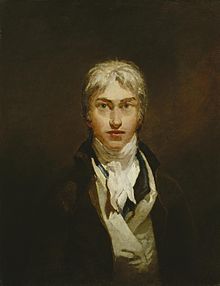
To start with a little background, the painting above is his self portrait. The only one he ever did in his lifetime. He was a private person as we know, and gave little of himself away. His birth date is given as 23rd April 1775, but this is disputed, as Turner would give different dates to different people. he had this aversion to people knowing his personal details. He lived with his parents, which was far from being satisfactory, as his mother had a violent temper, and was later incarcerated in Bedlam Hospital. So he as at School in Brentford and later in Margate, and this is where his love of the river started. He loved boats and messing about in boats. They figure in some of his paintings, and they are a frequent mode of travel on his painting expeditions. later he would row sometimes as far as Windsor on the Thames and down the Wey to Guildford, which we will look at later.

let’s start looking at some of his Surrey paintings and start in date order as far as we can

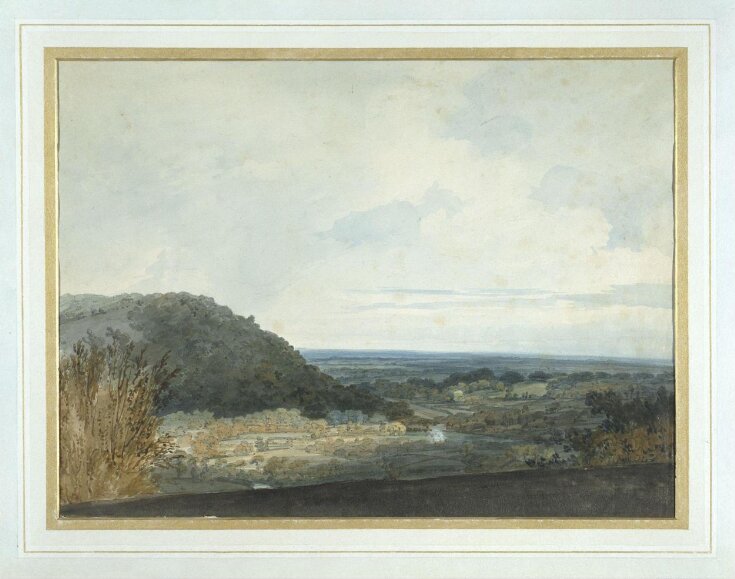
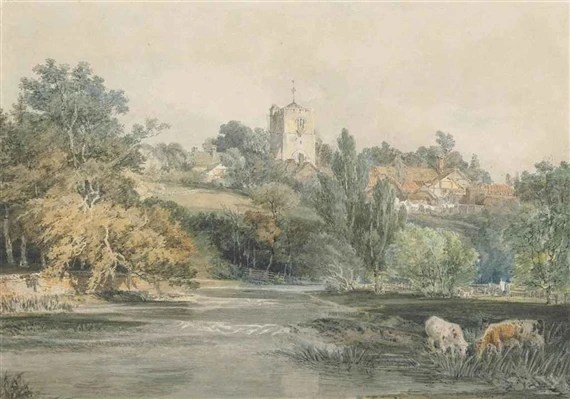
Possibly Box Hill Date….. previously attributed to Tom Girtin, and later to Turner. Girtin was contemporary to Turner, and they were in fact great friends. They would go on expeditions together, and on one of them painted the Savoy palace from a boat on the Thames. Girtin was an acclaimed painter, who sadly died at the age of 29. Turner held him in high esteem and his famous quote said ” if Tom had lived I would have starved”. Turner was definitely in the area that year, as the next painting of Leatherhead shows. This was his so called Student period.

At about the same time, we have this painting of Leatherhead

Leatherhead from the River Mole, with cattle in the foreground, dated 1796, and attributed to Turner. I find this an immature style compared to what we associate with Turner’s work, and it would be as this comes within his student period. Turner had been invited to Norbury Park, near Leatherhead, a place I associate with Fanny Burney who met her future husband there, Comte d’Arblay, an emigre from the French revolution. I wonder if they met Turner. Interesting to conjecture

I will publish so far and go on with this at a later date

JMW Turner’s House in Twickenham

I shall publish a recent picture soon of this fascinating house, which Turner had a hand in designing together with his friend and near neighbout John Soane

And this is it in Sandycoombe Road in Twickenham, where we made a visit recently

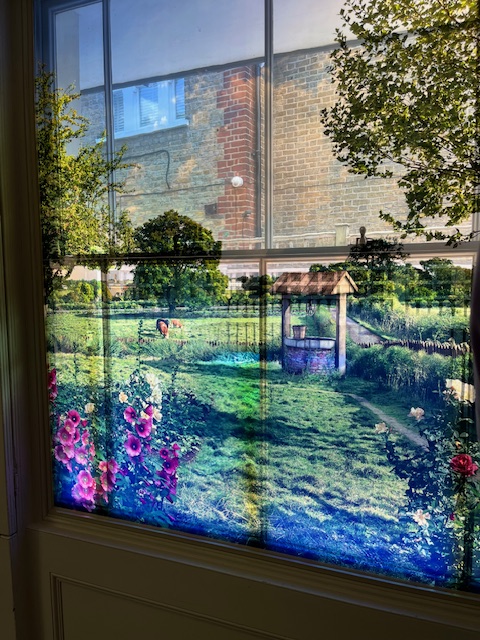
Turner built this house in the style of a small country villa, in 1813, for himself and his “old dad” William, where they spent much time relaxing away from his London gallery. At the time it was way out in the country. Later on in the latter part of the c19 it was surrounded by suburbia, as it still is today. Quite historic suburbia now of course, but suburbia nonetheless. If I can find it I have somewhere a recreated view from the dining room window at the time that Turner lived there.

And this is it. Tranquil pastoral countryside image on the window of the dining room. Quite clever. The garden with well,and meadows beyond. Ignore the brickwork showing through the upper part of the window. That is the house next door today in real life, which we can’t block out

How did Turner live at Sandycombe Lodge? Did he paint there? He always went with sketch book in hand, studying the landscape, and its changing moods. It was believed that he used the drawing room as a studio. It had French windows facing north-east from which friends recollect that Turner would refresh his eye.

He used a pony and gig for getting about on sketching trips.The pony was the “old crop-ear” who may have grazed on Turner’s nearby meadow, and whom Turner buried somewhere on his land. No stables are recorded on of the later maps, he must have been stabled elsewhere, perhaps at the nearby Crown Inn.

Fishing was a quiet pleasure shared with friends, many of them fellow artists.The Thames nearby provided an abundant supply.Turner made some beautiful watercolour studies of tench,trout and perch, the catches of some of these expeditions. Often he was accompanied by John Soane, who was also an enthusiastic eel catcher

One of the most prestigious acquaintances Turner made during his time at Twickenham,was the Duc d’Orleans later Louis Philippe, King of France, who lived with his brothers near the Thames at Highshot House in Crown Lane from 1800-1807. Turner met the Duc at a Royal Academy dinner in 1802. Later, between 1815-1817 the Duc was again in exile in “dear quiet Twick”, this time in a house which is still there, named Orleans House which today houses a prestigious art gallery. They must have become firm friends as Louis Philippe gave him a gold snuff box when he came to England for Queen Victoria’s coronation in 1837. Turner took his last continental excursion in 1845, and called on Louis Philippe, who had a chateau on the coast of Picardy, and enjoyed a convivial evening of chat about Twickenham.

The other incumbent of Sandycombe Lodge, was “old Dad”, Turner’s father William, retired barber of Maiden Lane, Covent Garden. He kept house and also opened up the gallery for his son in Queen Anne Street. They both enjoyed frugal living, as William complained about the cost of getting into London, easily affordable by Turner. He was overjoyed to find a market gardener who would take him in on his cart sitting on the vegetables, for the price of a glass of gin!

After 1815, and the Napoleonic Wares drawing to a close, Turner could at last travel on the continent, and we know well, his wonderful paintings of the Alps which he crossed into Italy. Likewise magnificent views of Venice. The Low Countries and Germany were on his list.

He kept Sandycombe on for his father, who enjoyed the life there, but by 1826, William’s health was failing, and indeed by 1829 died. Turner had removed him back to Queen Anne Street before then. Sandycombe had become an irrelevance by then and I believe was sold for a modest £500, ironically less than Turner might expect for a major oil painting. Old William’s death affected Turner greatly. They were very close.

The house enjoyed a long life after Turner, and has now been fully restored , brought back to life by Harold and Ann Livermore, who bought the house in 1947. Ann died in 1997, and Harold established the Sandy Lodge Trust, now Turner’s House Trust, to preserve and maintain the property, which is now open to visitors and certainly worth a visit.

Turner in Surrey Exhibition at Lightbox in Woking

Turner's Newark Priory

I can highly recommend this exhibition at the Woking Lightbox. Their exhibitions just get better. I had no idea that Turner did so much work in Surrey, especially around Guildford in or around 1805

He painted Newark Priory Church plein air long before the Impressionists, and you may be able to tell from my bad photograph that his style then was getting towards an impressionist one. His later paintings like Rain, Steam and Speed were all about colour and not form, very much like the Impressionists. The ruined priory church is all that remains of a once complete Augustinian foundation, coming under Chertsey as I remember. It stands on private land so it cannot be visited only viewed from the towpath on the Wey Navigation, or from the road, and I rather think Turner made his study from the road. There was probably less traffic on the road than on the canal towpath in those days

He also stayed at the White Lion Inn in Guildford High Street, one of the many old coaching inns in the town. Demolished despite local protest to make way for Woolworths store, the white lion model inn sign was kept, and brought forward again, when Woolworths itself was demolished to make way for the White Lion Walk shopping centre in the 1980s

From his room in the hotel, Turner sketched Quarry Street opposite. The scene is much the same as today, with the historic Star Inn on the right-hand corner and St.Mary’s, the Saxon church behind that. You can see the castle too. The building on the left, which is now Thomas Cook, has changed. I tried to photograph the sketch, but not too successfully

Turner's Sketch Book

I have painted this view myself, so slightly eerie

He also painted and etched a very fine view of St.Catherine’s Chapel which stands just outside of the town on the Portsmouth Road. Ruined 13c, it stands roughly on the old pilgrim’s way, near where pilgrims would have been ferried across the river. No connection with pilgrims though, as it was built as a chapel of ease for the parishioners of Artington, to save them the long journey to St.Nicholas’ Church

There is more and I shall go back