Painting of my home village

This is the centre of my local village, St John’s near Woking. The name St John’s was taken from the local church, built in the c19 by the then rector of Old Woking, as a chapel of ease for the village inhabitants. Quite a long walk to church otherwise in a century when no one had transport.

The village is mostly Victorian, and although surrounded by suburbia, does still retain its village atmosphere and integrity. Life started here in the late c18 when the canal was cut through open heathland. In the distance in my picture, the road makes a hump, as it crosses the canal. This is Kiln Bridge, where as the name suggests bricks were made from local clay, and these were used in the building of the canal. The canal was intended to link London with Southampton, but only reached Basingstoke before the railways were built and superseded canals. This was still a time when war with France was a possibility, and inland links with major south coast ports were desirable.

Today the Basingstoke Canal is maintained by Surrey and Hampshire County Councils. There is some leisure boating but not much. Wild life proliferates and the towpath is used for cycling and walking.

This is the very first time that I have painted my own village. I don’t know why. I put this painting on a local website and had more than 240 hits. All complimentary, I am pleased to say. No offers to buy though.

In the middle of the picture is our comparatively recent coffee shop, which has become the hub of village activity. Walkers and shoppers meet there to relax and catch up. We never had that before and it is a very welcome addition. We do have a pub but located going out of the village, so not so convenient. We have most shops so a useful selection.

At the bottom of my lane, we are blessed with a green open space, called St John’s Lye. Lye, lea or leigh means a green space. It is common land and so protected although we did have to physically resist Woking Borough Council who wanted to build a village hall on the Lye to replace the one that was starting to fall down. Eventually common sense prevailed and the new hall was built on the site of the old one. The Lye is available to all age groups for spontaneous activity including dog walking.

And so you have it. Not a place that many know, but loved by its local population

JMW Turner’s House in Twickenham

I shall publish a recent picture soon of this fascinating house, which Turner had a hand in designing together with his friend and near neighbout John Soane

And this is it in Sandycoombe Road in Twickenham, where we made a visit recently

Turner built this house in the style of a small country villa, in 1813, for himself and his “old dad” William, where they spent much time relaxing away from his London gallery. At the time it was way out in the country. Later on in the latter part of the c19 it was surrounded by suburbia, as it still is today. Quite historic suburbia now of course, but suburbia nonetheless. If I can find it I have somewhere a recreated view from the dining room window at the time that Turner lived there.

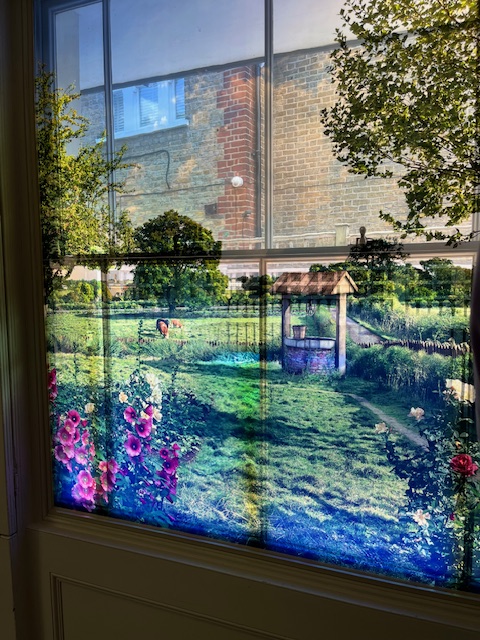
And this is it. Tranquil pastoral countryside image on the window of the dining room. Quite clever. The garden with well,and meadows beyond. Ignore the brickwork showing through the upper part of the window. That is the house next door today in real life, which we can’t block out

How did Turner live at Sandycombe Lodge? Did he paint there? He always went with sketch book in hand, studying the landscape, and its changing moods. It was believed that he used the drawing room as a studio. It had French windows facing north-east from which friends recollect that Turner would refresh his eye.

He used a pony and gig for getting about on sketching trips.The pony was the “old crop-ear” who may have grazed on Turner’s nearby meadow, and whom Turner buried somewhere on his land. No stables are recorded on of the later maps, he must have been stabled elsewhere, perhaps at the nearby Crown Inn.

Fishing was a quiet pleasure shared with friends, many of them fellow artists.The Thames nearby provided an abundant supply.Turner made some beautiful watercolour studies of tench,trout and perch, the catches of some of these expeditions. Often he was accompanied by John Soane, who was also an enthusiastic eel catcher

One of the most prestigious acquaintances Turner made during his time at Twickenham,was the Duc d’Orleans later Louis Philippe, King of France, who lived with his brothers near the Thames at Highshot House in Crown Lane from 1800-1807. Turner met the Duc at a Royal Academy dinner in 1802. Later, between 1815-1817 the Duc was again in exile in “dear quiet Twick”, this time in a house which is still there, named Orleans House which today houses a prestigious art gallery. They must have become firm friends as Louis Philippe gave him a gold snuff box when he came to England for Queen Victoria’s coronation in 1837. Turner took his last continental excursion in 1845, and called on Louis Philippe, who had a chateau on the coast of Picardy, and enjoyed a convivial evening of chat about Twickenham.

The other incumbent of Sandycombe Lodge, was “old Dad”, Turner’s father William, retired barber of Maiden Lane, Covent Garden. He kept house and also opened up the gallery for his son in Queen Anne Street. They both enjoyed frugal living, as William complained about the cost of getting into London, easily affordable by Turner. He was overjoyed to find a market gardener who would take him in on his cart sitting on the vegetables, for the price of a glass of gin!

After 1815, and the Napoleonic Wares drawing to a close, Turner could at last travel on the continent, and we know well, his wonderful paintings of the Alps which he crossed into Italy. Likewise magnificent views of Venice. The Low Countries and Germany were on his list.

He kept Sandycombe on for his father, who enjoyed the life there, but by 1826, William’s health was failing, and indeed by 1829 died. Turner had removed him back to Queen Anne Street before then. Sandycombe had become an irrelevance by then and I believe was sold for a modest £500, ironically less than Turner might expect for a major oil painting. Old William’s death affected Turner greatly. They were very close.

The house enjoyed a long life after Turner, and has now been fully restored , brought back to life by Harold and Ann Livermore, who bought the house in 1947. Ann died in 1997, and Harold established the Sandy Lodge Trust, now Turner’s House Trust, to preserve and maintain the property, which is now open to visitors and certainly worth a visit.