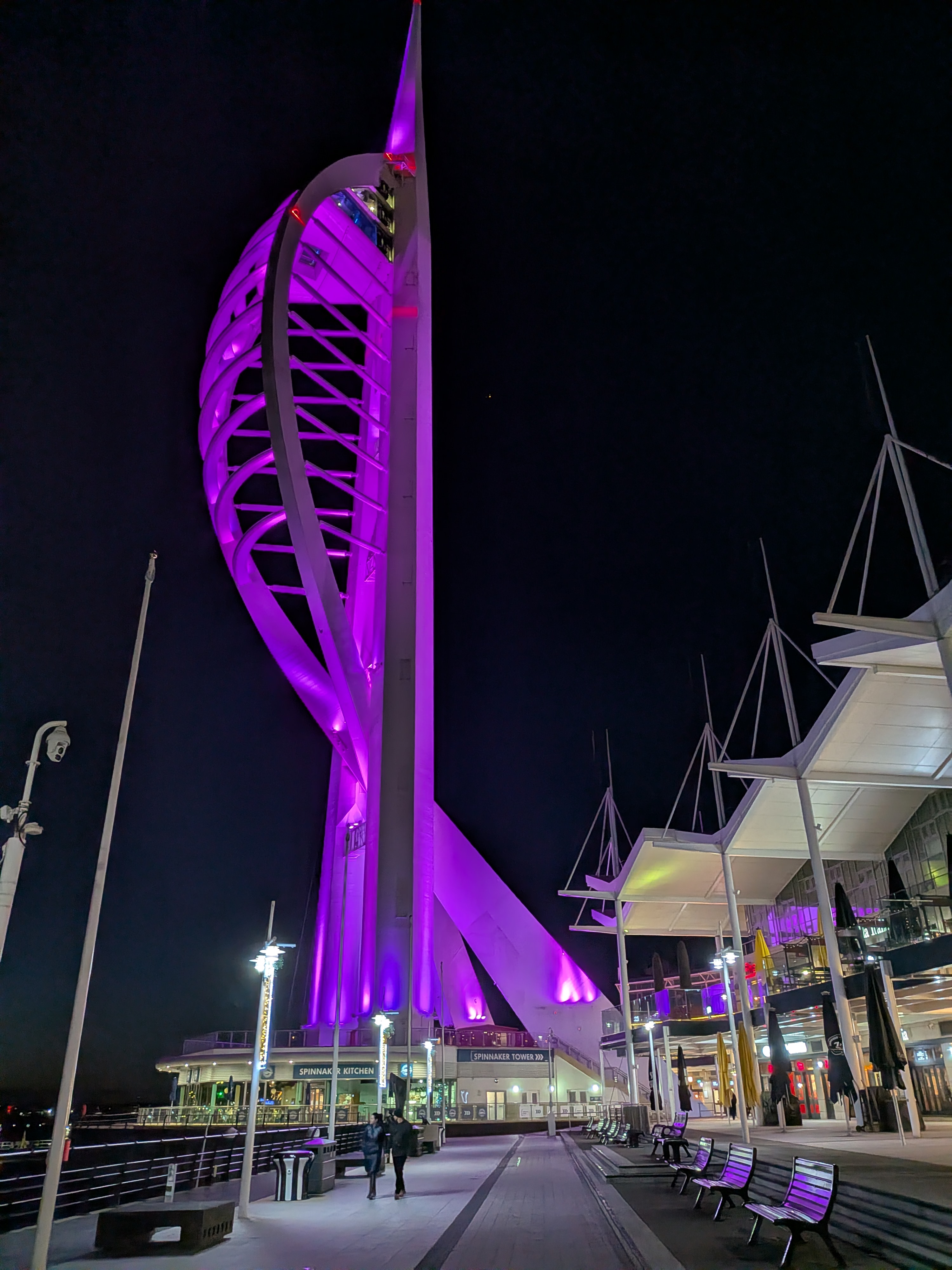
Spinnaker Tower Portsmouth at Night

This must be one of the trickiest commissions that I have ever accepted, and one which questions my wisdom. Firstly working out a colour for night black, and it won’t be black ,has not been easy. Black in large quantities I find tends to flatten the painting, unless it is a raven glossy black which works for many things but not sky imho. Then what colour to use for the illuminated tower itself, and there we have a certain choice of watercolours that have a luminous quality, but which one to use against which night sky that is the question.

This is the client’s photograph btw and is a very good one in terms of composition. So many aren’t and refreshingly I have little or nothing to change other than possibly including the moon, which i have agreed with the client. Perspective is intriguing which I like. All those lines going towards the vanishing point will be fun to work with

I have done various trials and have shared these with the client. For the night sky I looked first at a midnight blue colour, definitely steering away from black per se. To mix a midnight blue I am using indigo with a touch of Payne’s Grey, which is a blue black colour, and is useful. A lot of artists avoid Payne’s Grey but I find it useful at times. in fact that was the other contender for the night sky, as it is not quite black, as I say more of a blue black colour. So that was my submission for the sky. Now for the illuminated tower. The colour needs to be luminous which is not that easy with watercolour. I chose in the end pthalo blue and as an alternative, permanent rose both of which would work. I also glazed pthalo blue over rose just to see what would happen and again the result was workable

The client came back quite quickly. She preferred the indigo version of midnight blue and also the pthalo blue for the tower. I was relieved about that, as both were my preferred option, and in neither case did I lead her in anyway

So I know which direction I am going in, and will proceed with the painting. I will come back about that although probably not too soon

Turner and Constable, two heavyweights

I am reading a fascinating book at the moment, written by Nicola Moorby which is helping my research into the talk I am preparing on Turner in Surrey, and so am straying into the life of Constable as well. There are striking similarities although they have different characters. What they share in my opinion, is the distinction of starting off the Modern Art Movement.

I will start with an image of the Haywain, probably the best known of Constable’s work, and as an image is better known than any portrait of the artist himself. the scene is Flatford Mill, where you can go today and paint the same view yourself if you want to. Willy Lotte’s cottage on the left is still there, sadly the haywain itself is not. In my youth, I always thought the cart was being driven across a ford, but later realised in fact that it was the practice to drive carts into shallow water after the wooden wheels had got too dry. the wood would shrink and come away from the iron rim. Every so often the wheels would have to be soaked to expand the wheel back tight onto its rim

He was a master of skies. He studied clouds and became something of a meteorologist. East Anglia where he came from was flat, so almost all his paintings were skyscapes.

But we are talking about Turner and Constable together. Did they ever meet? I know of one recorded meeting, and there may have been many more. In June 1813, Constable sat next to him at an Academy dinner, and wrote to his wife Maria ” I was a good deal entertained by Turner….. he is uncouth, but has a wonderful range of mind”. Uncouth, yes I can imagine Constable saying that. An acerbic character, he was not generous to his fellow artists, quite the reverse. On hanging days, he would walk round criticising other artists work, which wasn’t appreciated. Artists naturally were sensitive and nervous on these occasions as much was riding on the outcome. Constable would sneer at London based artists or “the Londoners” as he called them, especially when they attempted rural scenes. He thought they should stick to what they knew. I don’t think he included Turner in these remarks, nor should he as Turner was well established whilst Constable was just starting to become known. Rather he stood in some awe of Turner, as well he might.

Did they cross swords? There was one recorded incident that I can think of. Constable was taking his turn on the Selection Committee, who decided on where paintings were hung at the Academy Exhibitions. This was an unenviable job calling for great diplomacy and tact, not Constable’s greatest talents. He made an unbelievably bad judgement by moving one of Turner’s paintings and replacing it with one of his own at an event in 1831. Turner was down upon him like a sledgehammer. It was no use Constable pleading that the move was to their mutual advantage. Turner kept at it all evening to the amusement of all, who conidered that Constable had brought his fate upn himself

Coming back to the Haywain, this was first shown in Paris which is not generally known, where it caused a sensation. That is one of the great ironies concerning these two great painters. Constable never left these shores. He didn,t want to, through xenophobia or sheer bloody mindedness, and yet he became big in France without making any effort. A French dealer called Arrowsmith, French despite his name , came to one of the Royal Academy exhibitions and discovered Constable and went into raptures. He organised an exhibition in Paris of Constable’s work which Constable did not attend. Great interest was shown but Constable did not follow this up. he was not one for net working. One cannot imagine Turner squandering an opportunity like this

People wanted to meet Constable, including the great Delacroix, who even came to London, but there is no evidence of a meeting taking place. His paintings were to be shown at the Acadamie des Beaux-Arts known as the Salon, the nearest equivelant to the Royal Academy. It was a great success and Constable sold more paintings in a short space of time than he had sold to British buyers in years. Despite all this, Constable refused to travel stating that ” he would sooner be a poor man at home than a rich man in France” be careful what you wish for. The moment passed and Constable failed to capitalise.

Turner on the other hand, despite all his travels throughout Europe from Copenhagen down to Italy, only sold pictures at home, He held two exhibitions in Europe, one in Germany and one in Italy and both were failures. Perhaps the Italians were too used to the deep landscapes of Poussin and others, and found nothing remarkable in Turner’s work

A great book which I am still reading.

Memories of another age

It was suggested that I write about the early years of my life. I am 81. What do I remember, and how far back? I don’t remember the last world war. i was born in 1943 in London, and during an air raid, my mother told me. We called these raids the Blitz. We borrowed the German word, Blitzkrieg or lightening war. It was terrifying by all accounts and I arrived in the middle of it. Even today I jump at loud bangs.

So I don’t remember the war but I remember war damage. There was still plenty about as I started to form memories. We lived near Portsmouth about this time, so I remember the magnificent Guildhall gutted by incendiaries, and also the old Theatre Royal standing alone amidst the rubble, and as I recall still putting on plays. I can picture whole streets gone, what were once rows of shops, now identified solely by the names in mosaic in the doorway floor. I remember buddleia growing amongst the rubble, aptly named the bombsite plant.

I remember the late king George VI who died in 1952, and our late queen, then Princess Elizabeth being acclaimed queen on holiday in Kenya. I kept a scrap book of the king’s funeral, which didn’t seem strange at the time. Today it might be considered an odd thing for a child to do. I vividly recall a blood stained photograph of the monarch lying in state in Westminster Hall flanked by four soldiers. It had been used to wrap meat and I rescued it for my album. We didn’t have hygiene in those days and butchers and fish shops used old newspapers to wrap their wares. Fish and chip shops did the same. That is where we took our old newspapers. Eric Sadler was our local chippie. He stirred the boiling fat with an old piece of wood which looked as though he had found it on the seashore. Then he wrapped your fish and chips in someone’s old newspaper. No one was shocked by this. We had survived bombing, don’t forget.

About this time we were still living above our shop. I remember my brother being born in 1948, about the same time as King Charles, so a big gap between us because of my father being away in India and Burma from 1944 to 46. I remember bits about living there. I had measles and was ill for two weeks in a darkened room. Nobody was vaccinated against these diseases, dangerous as they were. They were called childhood diseases, measles, chicken pox, mumps etc and you had them and if you survived you were immune for life. I don’t remember having mumps. My father had it and was hospitalised, as this was a dangerous illness for men. My brother had whooping cough, very young, he was in his cot at the time. I can still see my father holding him upside down like a rabbit, while he struggled for breath. That was horrible to watch, but he survived, I am pleased to say

I started school at five years old. There was no pre-school or nursery school in those benighted times so we were later learning to read than children today. In fact I got off to a bad start, as I was enrolled in the local catholic school, which are very good today, but at the time was very poor. I was moved to the state primary school, and at six years old could not read or write. I caught up quickly enough, and was there until 1954, when I took the iniquitous 11-plus examination, and was one of the few that passed to go to a grammar school. Grammar schools, for those who don’t know the term, date back to the c16 when they were founded in the reign of Edward VI. Grammar meant Latin grammar, by the way, which in those days was the lingua franca throughout Europe. I was taught Latin incidentally, as it was essential to get in to some universities whatever subject you were studying. That changed in 1960

I say iniquitous, It was like separating the bright from the not-so-bright at a very early age. People like me were given an academic education learning Latin for example. The others went to so-called secondary modern schools, and their training included woodwork, domestic science etc as though they were destined for some form of artisan employment. This was to change with the advent of the comprehensive system, when it was recognised that children were all different, and developed at different speeds, and deserved the same training. Even this system needed modification until it was perfected to what we have today

I had intended only to write about my early years and what stuck in my memory. In 1951 when I was eight years of age, my father took us on the train to London to the Festival of Britain. That was a memorable day, and of course 100 years since the Great Exhibition in Hyde Park opened by Queen Victoria. i will try to keep to what i actually remember. I remember the Dome of Discovery which celebrated British achievement in science and technology. I don’t remember details. It would lack the sophistication of today naturally. We had shortly come out of a world war, and had not yet recovered. The festival was about optimism and hope for the future. Crown pieces were minted. I think I have one somewhere. I remember the Skylon, although what it did, goodness knows. I remember the Royal Festival Theatre which is still there today.

Between 1951 and 54 were my early school years before moving on to secondary education. I cannot think of anything worth talking about. I do remember kids with leg irons, due to deficiency in diet. terrible when you think about it. We had free milk daily which must have helped. That was stopped by Margaret Thatcher when Education Secretary in 19 seventy something. Thatcher Thatcher milk snatcher was the cry. Even today children’s diet is wrong only for different reasons. Girls did handstands against the wall, with gym slips tucked into their knickers. Boys didn’t do handstands, which was wise. Girls did a lot of skipping chanting doggerel to the beat. i don’t remember the doggerel. There was quite a lot of fighting in the playground, otherwise football. We were organised into work parties for gardening during lesson time. We dug out quite large tree roots. Imagine that today. parents would be apoplectic. Dancing round the maypole was something else that was done as a showpiece for visitors and quite accomplished as I remember.

Well th ose are a few snatches as they come to mind and take me up to 1954

Memories of school years from 1954

I was asked about my school years. Something I don’t often think about. If I ramble, it’s because I am remembering things as I go along

In 1954, I sat and passed the infamous 11plus exam, which enabled me to move from the primary or first school, on to a grammar school. This was an iniquitous system which separated the sheep from the goats at a very early age. Grammar school places, so soon after the war, were limited and so most students were relegated to the so-called secondary modern system, where the subjects taught were less academic and more practical. Why people assumed that failure of the 11+ meant that students were good with their hands, I don’t know. Mercifully the system broke down and was replaced with the comprehensive system, which had its faults and needed amending, but all in all was fairer, and recognised that some blossomed later, and caught up and maybe overtook.

So there I was, with others ready to take on this great adventure of preparation for later life. It meant making a train journey for a start, on my own, as the grammar school, Churcher’s College was in the next town of Petersfield. This was a school steeped in tradition. Founded in the 18c by one Richard Churcher, an East India Merchantman, to train boys in mathematics and navigation, and to be employed later in the East India Company. A far cry from the classical education that most boys of that class were given. Although a grammar school, that is, state aided, the school was run along the lines of a public school. To us public schools were private and charged fees. Think Eton or Harrow. Some would say we had ideas above our station.

We learned Latin for starters. That was a shock to the system. I struggled with this subject, although later on when I took GCE O level I passed in Latin to the amazement of my teachers. I look back on it as a subject worth studying as a good groundwork for other European languages especially English. Each year was streamed into a and b streams. A stream learned Latin but the b stream did woodwork instead. Once again another group were written out of academic studies

The buildings were old. Masters were mostly old and caricatures. Corporal punishment was given out for minor offences with what seemed like relish, If you asked questions you were slow. Proficiency at games was venerated. Prowess at studies was not. There was a Combined Cadet Force at school, which was like an Officer’s Training Corps. This wasn’t long after the war ended, and conscription was still in force. You could join the CCF at age 14, which I did, and joined the army section, which I enjoyed thoroughly. Officers and NCOs from the regular army came in and drilled us, so all was taken very seriously. Once a term we had a field day and went to the nearby Longmoor Camp. We were issued with Lee Enfield 303 rifles, WW2 vintage, and a handful of blanks. Split into two teams we went off into the woods for mock battles. This was like glorified cowboys and Indians for 14 year olds, with real guns. Officers would fire live rounds over our heads and throw firecrackers at our feet. Amazingly nobody died.

So what was happening in the world in 1954 and were we aware, being without social media in those days. I was aware of some things because my father read aloud from the Daily Telegraph. Colonel Nasser took over Egypt and ousted the king Farouk. I did know about that at the time. I do not remember this being discussed at school, current affairs weren’t. Everyone was too steeped in the Classics. This led to the famous Suez Crisis. Nasser took control of the canal, and Britain and France sent in paratroops. This was a military failure. The Americans were furious as they had not been consulted and the British learned the hard way that they no longer ruled the waves. We were disengaging from our old empire throughout the world. India had become independent in 1947. The whole thing was horribly mismanaged by the British with tragic bloodshed and resultant misery. The word Empire was still around in 1954. I had a pair of Plimsolls which we wore for PE, and they were marked Empire Made. Woefully inadequate, my feet are deformed to this day. A friend of mine at school, Alan Disney, who claimed to be related to Walt and maybe was, had a wonderful stamp collection. He specialised in British Empire stamps. His collection was amazing. I wonder if he still has it.

I said earlier that my father read excerpts from the Daily Telegraph every day. Imagine a Puritan household where the head read from the Bible to assembled members including servants. It was like that. A reading from the word of the Daily Telegraph to start our day, although we didn’t have servants of course. The Daily Telegraph was, and still is, an Establishment newspaper veering to the right. Sometimes hysterical. Always supporting the Tories. There was very little information or opinion to balance our choices. One channel of TV from the BBC until mid fifties when ITV appeared as an independent channel, which my father refused to have as it was funded by advertising. I found that odd as he supported big business versus the state but not this time. So we plodded on with dear old BBC . There was only one radio in the house which he controlled, and would switch off without recourse to anyone else in the household. Some of my friends had transistor radios so could listen to Radio Luxembourg under the bedclothes. This was a pirate radio station broadcasting pop music which was starting to be the rage, but denied me I am afraid.

Prowess at games, I have already said, was admired. Good all-rounders were the heroes of the school. I was miserable at all sports, especially team games like rugby and cricket. I was forced to play and did so with bad grace. When I left school I vowed never to play team sports again, and have kept my vow.

So did I enjoy anything? I have mentioned the CCF which I did enjoy, despite preparing my uniform for inspection at the week end. Had I been left at school long enough, I might well have considered the military as a career. But I wasn’t . After my O levels which weren’t bad with six passes, I was removed to go into the family business, a decision I came to regret and moved out as soon as possible. I always resented being denied sixth form

Those are my few memories of grammar school years. Even the word ‘grammar’ is steeped in antiquity, for those who might not be familiar with the term. Grammar meant Latin grammar in this context, and such schools were set up in the c16, in the reign of Edward VI as I remember. There is a good one in Guildford near where I live, still flourishing today, but not teaching Latin as far as I know.

Did you know that when I was at school, in order to get into Oxford or Cambridge Universities for any subject whatsoever, you needed O level Latin? That stopped in 1960. I leave you with that as a flavour of how schooldays were in my day
Recent Commission

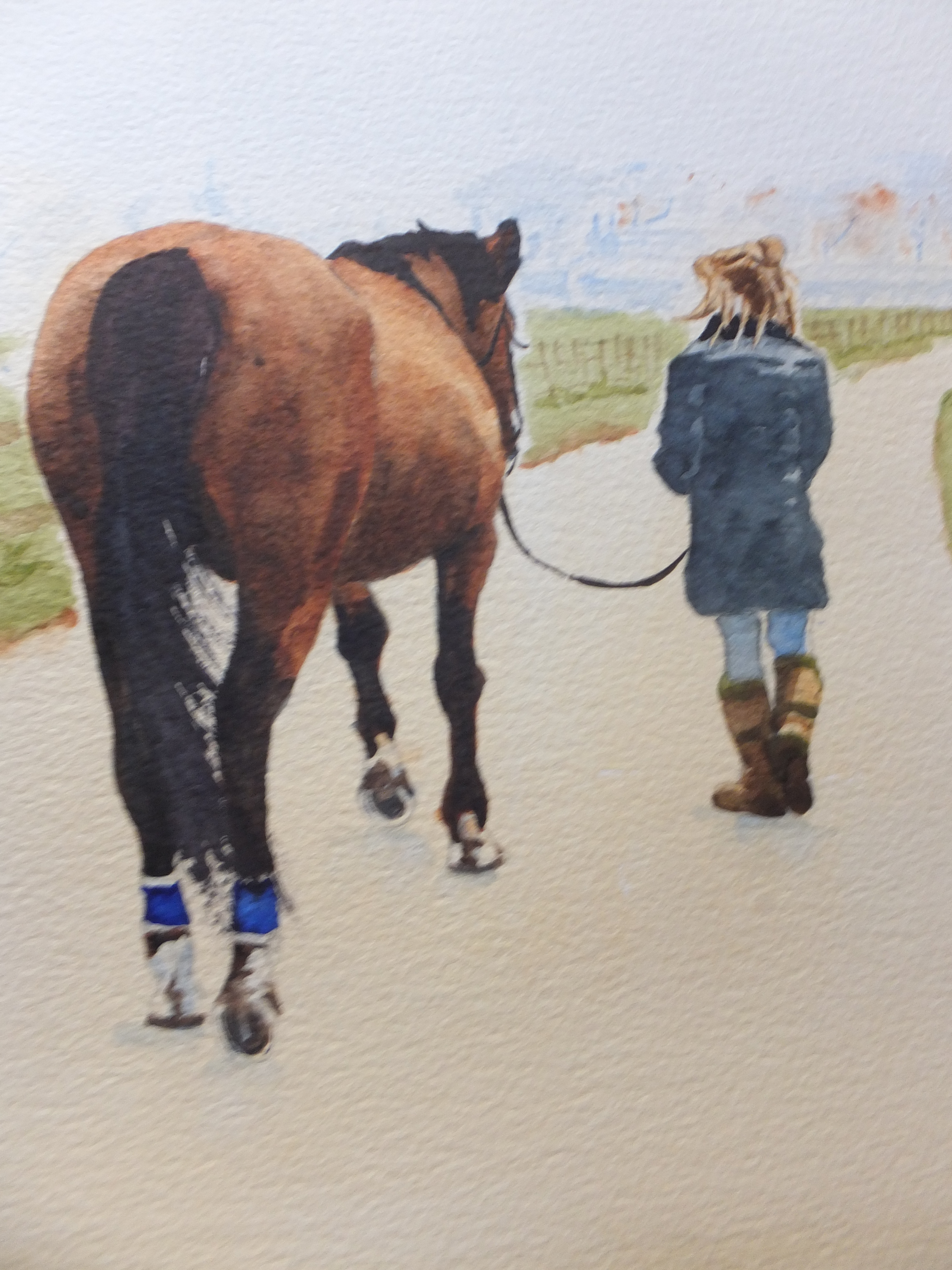
This is the type of commission that I enjoy doing. One of my favourite subjects, painting horses, and in this case, a charming composition, of a horse being brought in to the stables, possibly for saddling up, by her young owner.

One of the most difficult things to get right was the colour of the horse. A brown horse doesn’t sound very complicated but there are many shades of brown, and I needed to get close to the original reference photograph. This horse looked like a bay to me, with black mane and tail, and with black legs. I did the horse over several days, building up the colour and letting it dry overnight. Until the colour was dry, you just could not tell what it would look like. Eventually I was satisfied with the result

Most other things were relatively straightforward. I blurred out the background to increase the feeling of distance. Also in the photograph the background was in direct competition with the main subject.

The composition now worked well and told a story. I was a rider myself once long ago, and this picture reminded me of those days. My son and I would go north for a week to Northumberland, where there are some very open spaces. We would ride from place to place, and overnight the horses with local farms. They would stay out overnight, and in the morning we would have to go and find them, and bridle them up. Horses are cunning and when they saw you coming would make for the higher ground. You really worked hard to catch them. Once you got the bridle on, you could bring them down to be saddled for the day’s ride. This picture reminded me. Incidentally all this happened nearly forty years ago. My son is 53 now and me, well, I don’t ride anymore.

Grayson Perry Exhibition of Tapestrys at Woking Lightbox Gallery

The Agony in the Car Park

The Adoration of the Cage Fighters

Excellent exhibition on at the moment until June, featuring colourful tapestries designed by Grayson Perry and woven in Belgium. They echo the Rakes Progress series of paintings by Hogarth depicting the hero Tom Rakewell squandering his fortune on riotous living and plunging into debt and madness. The hero of the tapestries is Tim Rakewell, who becomes a computer genius, makes a fortune and moves socially upward. His nemesis comes when his luck affects his judgement and going too fast, drives his powerful car into a lamp post and goes through the windscreen. he was not wearing a seat belt. He dies at the roadside. As the attending medic says” with all his money and he dies in the gutter”

The first tapestry in the collection is The Adoration of the Cage Fighters with all its echoes of the Virgin Birth. The genius is born and is worshiped by the cage fighters who bring him gifts like the shepherds paying homage to the newborn Saviour. He will grow up into a man embarking on a journey of upward social mobility. I can’t see that he will benefit the world in any way but there it is.

This tapestry is said to be inspired by The Adoration of the Shepherds by Andrea Montegna

The other tapestry that I am showing is entitled The Agony in the Car Park. Here compare Gethsemane or the Agony in the Garden by Bellini. The scene is a hill outside Sunderland. The central figure is Tim’s stepfather, a night club singer. The scene hints at Grunewalds ‘Isenheim Altarpiece’. The large crane stands in for the crucifix. In the bottom corner Tim in school uniform blocks his ears with embarrassment. In his pocket a magazine betrays his interest in software. As we shall see, this will be his way out from a miserable childhood

These are just two panels from the complete story. There is the story of him leaving home after his girlfriend rows with his mother, his company which he sells for an enormous sum and then his demise at the roadside. What is the moral of the story. perhaps too much, too soon, or the dangers of moving upwardly mobile too quickly and being unable to cope. Woking Borough Council could perhaps learn from this story. Our town is officially bankrupt, through inept investment and squandering of people’s money. The townsfolk are looking at reduced services and increased costs. We shall never be solvent in my lifetime that is for sure. Even our beloved Lightbox is under threat and talks are ongoing about how to save it. Tragic to lose it. Woking is not a city of culture. The Lightbox gallery has been the jewel in the crown, and given us great prestige in the art world

We await our fate