Exhibition of Women Artists at Tate Britain

Magnificent exhibition at Tate Britain entitled Now You See Us is on until early next month. I wish I had gone sooner as this is an exhibition that needs more than one visit. It covers the work of women artists from 1520 – 1920, during ages obviously when women were subservient to men in most walks of life. Their work very often epitomises their struggle for recognition.
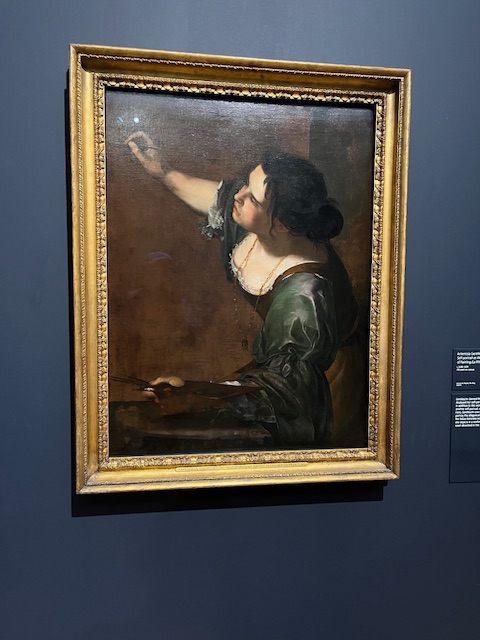
One of the earlier examples, a self portrait by Artemesia Gentileschi, an Italian artist working in London during the reign of Charles I, In London she worked for Charles I and Queen Henrietta Maria, and two works in this exhibition are from the Royal Collection. The other one is Susannah and the Elders, a popular Old Testament sory who was observed bathing by two of the elders, and sexually assaulted. The usual story, the elders tried to make out she was a whore but later her innocence was proved.

There were an amazing number of artists represented working through the ages. Very few did I recognise. Gwen John was one, and her self portrait was used in the exhibition publicity. In fact the work of hers shown was in my view some of the least inspiring.

During the 18c the work of the Royal Academy centred round oil paintings. Other media was looked down upon. Joshua Reynolds was especially sniffy about watercolour, pastel, embroidery and any sort of craft as being work that women did at home for their own amusement.

Gradually, and as we move into the c19 women are starting to meet men on equal ground. Two paintings which greatly impressed me were:

Colt Hunting in the New Forest by Lucy-Kemp Welch

The Roll Call by Elizabeth Butler, a painting of Guards Regiment in the Crimea. This painting was summoned to the palace for a special viewing by Queen Victoria. It sold for the staggering sum of £1200

Both of these were sensations in the art world at the time. Both were hung “on the line”, which means they were hung at eye-level, a great tribute by the hanging committee of the Royal Academy

Colt Hunting in the New Forest which is an enormous painting
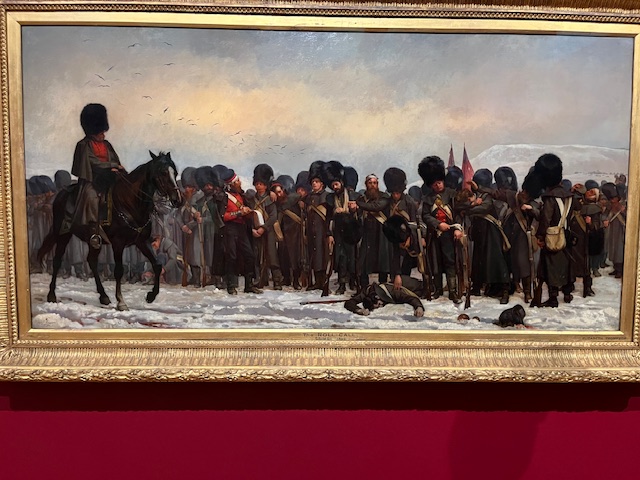
The Roll Call by Elizabeth Butler

My photographs are not very good alas, done quickly avoiding other viewers.
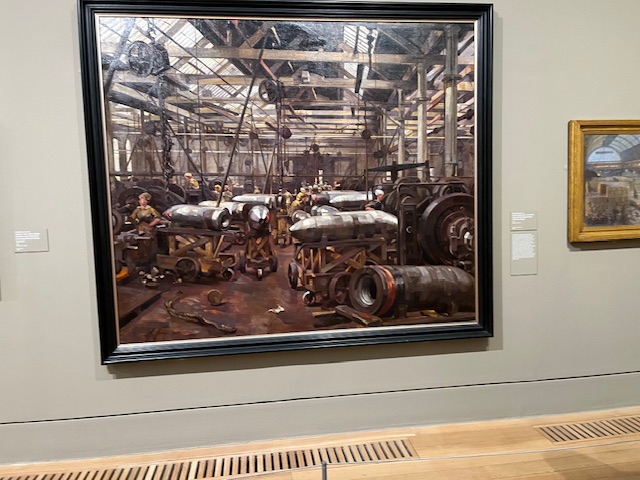
Finally. a painting by Anna Airy, commissioned by the Imperial War Museum, Shop for Machining 15″ Shells, shows women doing factory work in 1918. This was the old Singer sewing machine Company factory on Clydebank. Important work and an important painting

Burne-Jones Exhibition at the Tate Art Gallery

Golden Stairs by Edward Burne-Jones (1833-1898)

One of many well-known paintings by Sir Edward Burne-Jones featured in a special exhibition currently at Tate Britain until February 2019 which is the first major retrospective to be held for forty years. Inspired by the church and the medieval period, his work represented the antidote to the ugliness and the materialism of the Victorian period.

We went there recently. As always a superlative exhibition. To be seen if you can

There were seven rooms of drawings and paintings. Burne Jones was a superlative draughtsman . The second room deals with his time in Fulham, when he finally had space enough to embark on major projects for which he needed countless preparatory drawings, each one of which could be considered a work of art in its own right.

Renaissance art and four visits to Italy encouraged his approach to the body. His male figures appeared troubled while women were portrayed beautiful yet sinister. About this time he was experimental with media, using gouache with chalk and later metallic pigments.

His attitude to the male figure caused him to resign from the Old Watercolour Society which had been shocked by his work. . He was becoming known as one of the most daring artists of his time. After a blissful period of working to his own pace, his exhibition pictures started to take London by storm, and later Paris, so that he became known throughout Europe.

Most impressive were the rooms containing his Series Paintings, massive works commissioned by serious clients with rooms that can show these works as they should be shown. This was of course the era of the seriously wealthy patron who could command works like these., such as the Perseus series, commissioned by the young future prime Minister Arthur Balfour for his London residence.  Curiously Balfour was later to be president of Woking Golf Club, close to where I live. The only prime minister to be president of a golf club. I wondered what these wonderful paintings would look like in the golf club lounge, but that was me being facetious.

I cannot describe the paintings of the Perseus Story, as they were too magnificent. Like wise the Briar Rose which is really the story of Sleeping Beauty. Wonderful illustrations of knights and princesses. Burne Jones I think today would have been in his element illustrating Game of Thrones or the Harry Potter stories.

He worked closely with William Morris, from whom he derived the bulk of his income. He became especially well-known for designing stained glass windows for churches and cathedrals the breadth of the land and indeed the old Empire.

One of the last great figures of the Pre-Raphaelite movement. This is a wonderful collection gathered together for a short time

Paul Nash and the Turner Prize Finalists

Hoping to go to the Tate Britain Art gallery tomorrow, weather and circumstances permitting to see amongst other things , the Paul Nash exhibition

Paul Nash, known as a war artist covering both world wars, not as a documentary reporter, but with his own surrealist style, was also a superb landscape artist in his own right

In fact an artist of many facets

I shall look forward to writing about him and his work when i have learned more myself

Exhibition at Tate Art Gallery: Art and Empire

Risaldar Jagat Singh and Risaldar Man Singh by Philip de Laszlo 1916

Risaldar Jagat Singh and Risaldar Man Singh painted by Philip de Laszlo in 1916

We went up to London earlier today, to see this exhibition at the Tate. It was a very big exhibition, drawn from collections from everywhere, which took us about two hours to get round.

There was early stuff, mostly to do with exploration and discovery. The maps reminded me of those in my classroom at primary school, which of course today would be very non-PC

Quite a lot of paintings, as one might expect, were to do with Imperial Heroics or what Victorians considered to be heroics. Not always ending with a British victory, like the battle of Isandlwana (spelling probably wrong) in Zululand, where 1400 infantrymen were slaughtered in a very short space of time. There was an amazing painting of that last stand by an artist named Fripp, who was attached to the newspaper The Graphic. He actually visited the site afterwards to get the atmosphere before embarking on this massive reconstruction. Other memorable pictures were the Death of Wolfe and the Death of General Gordon, all good heroic stuff. The British did quite a lot of bad things around the world, but hopefully left something behind that was worthwhile as well.

If I were to be asked to name the one painting that impressed me the most, I think I would have to choose the double portrait that I have shown. This is an amazingly expressive picture by Philip de Laszlo of two Indian Army officers, named above, painted in a single sitting. What is it about working at speed, that adds so much to a painting?  They were presented to George V at Buckingham Palace, before embarking for France and the Battle of the Somme, where who knows what became of them after that dreadful slaughter. We are told that one in six British soldiers came from the Indian Subcontinent! The contribution from Commonwealth countries was staggering.

Moslem Burial Ground

Moslem Military Burial Ground, Horsell Common

This links into a local monument of which we are justifiably proud, the burial ground pictured above, built by the War Office in 1917, for Moslem soldiers from the Indian Army who died in British hospitals from wounds received in France.

Various hospitals along the south coast housed Indian wounded from the Front. Some tragically did not survive. Sikhs and Hindus were cremated but Moslems were interred, and they were brought here for burial because of the proximity of the mosque at Woking, which is the earliest purpose built mosque in the country.

There were 28 graves in the cemetery which were moved in the 1960’s to the main War Graves Cemetery at nearby Brookwood. Sadly vandalism had been a problem. After a period of neglect, this burial ground was restored in 2014 as part of the centenary remembrance. A Garden of Remembrance has been laid out within the walls, and the names of the 28 soldiers who died are commemorated on a tablet.

Nothing jolly or frivolous to report from this exhibition, I am afraid, all rather heavy, moving stuff. On a lighter note, I am moving along with the Blue Mosque painting. The drawing has been transferred to watercolour paper and various bits masked out where appropriate.