Gondolas, and other recent paintings

I’ve been off the air for a while. I had to get a new PC as part of an upgrade, and of course, nothing was where I remembered it. I couldn’t find my way back into my blog, or not at least to the page where I coud write something, and I can’t pretend the seemingly helpful robot was any use to me. Anyhow after a tortuous journey I can now post again

As I have been away for a while I thought I would just do a compendium of more recent paintings, just to catch up, and start with one called Gondolas. Always a favourite subject, and this view with San Giorgio Maggiore in the background I have painted and sold several times. This shot is completely different to any that I have done before

I have also been painting some views of my local village, something I have neglected in the past. This shot I put on the village website and received over 150 hits. I am pleased to say that a gentleman in Canada ,who used to live locally, bought it, Always that extra buzz when a painting makes a long journey
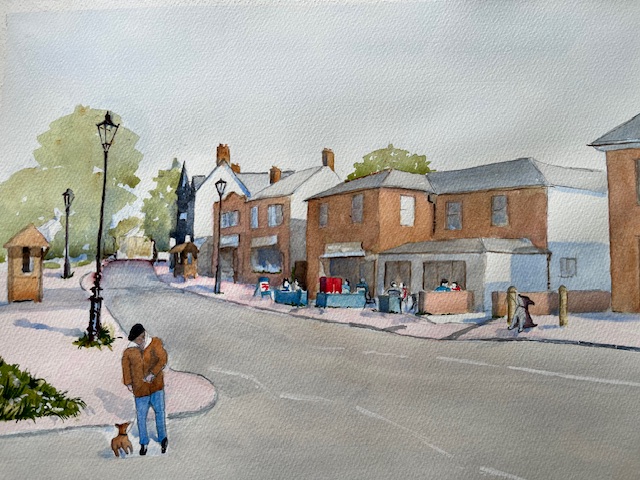
This view just shows some of our shops, so being a village we only have indepemdent shops which is a nice relief to seeing brands all the time. In the background by the trees is the bridge over the canal, which was cut in the late c18. In fact the village grew up around the canal. The name St John’s came from the church which was built here as a Chapel of ease for the villagers

The hub of the village is the coffee shop which was started only about ten years ago and provided a much needed meeting place and alternative to the nearest pub.

I have been getting commissions which is always nice. A more recent one shows a country house hotel called Gravetye Manor, which I have painted before. This is a different view in evening light commissioned by a guest who had a meaningful stay there

This is a mistake but I will leave it there. An old shot of Venice. I will now try and find the shot of Gravetye Manor

Succesful this time. An evening shot with the last of the sun catching the roof tops, so it worked well

There are others but I will leave it there. I am not long back from a trip up the Baltic as far as and including Helsinki so quite a lot to digest. I am going to try and put a post together about that voyage. On the art side, we went to Skagen on the northern most tip of Jutland. Artists in the c19 were attracted there by the wonderful light and their work is just breathtaking

I am going to try and be more regular now that I have got back control, and am grateful for the help I have received

Turner in Surrey Part 2

Thameside Ferry Crossing

This is a photograph I took myself trying to catch the little ferry crossing from Twickenham over to Ham on the other side. I just missed the ferry but my reason for keeping this picture, is that this must be one of the nearest points on the river from Turner’s house in Twickenham. I dealt with his house a few blogs ago so I won’t repeat that. Turner loved boats, he loved fishing, he loved the river, and he loved picnics with his friends. Was this the sort of spot he came to? We don’t know for sure about him fishing here, but he would have known this location.

I took this picture from the riverside of the grounds of Orleans House Gallery, where we go from time to time. The gallery is what remains of the original Palladian mansion built in the c18. Louis Philippe duc d’Orleans lived here in exile from 1813-1819. Turner met him and they became lifetime friends. Later in 1830 he became king of France, until he was toppled by another revolution, and went into exile in England once more. He died at Claremont in 1850. Turner went to see him in France near the end of his own life in 1845, one of his last visits to Europe, and they talked into the night about ‘Dear Old Twick’

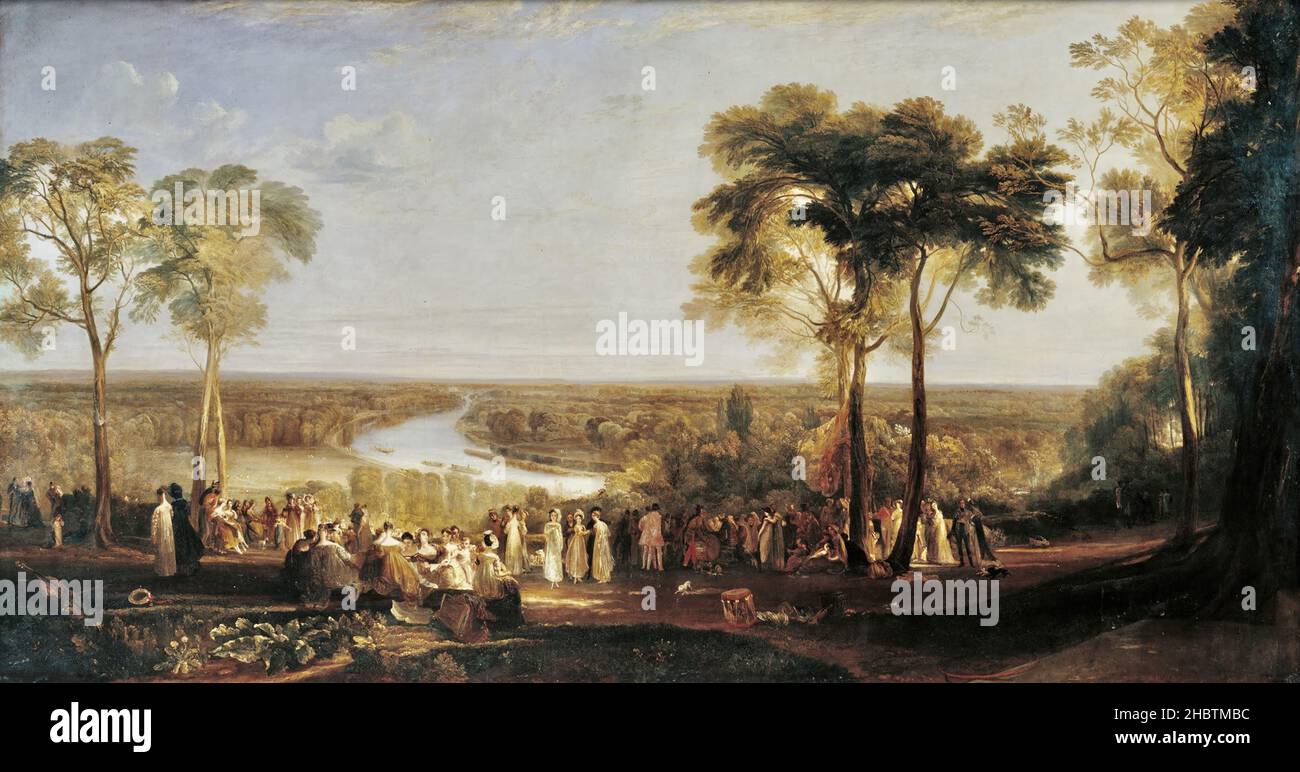
In the background on the hill is the Star and Garter, what used to be a retirement home for disabled service men, and more recently converted into apartments. Nonetheless a powerful landmark, and showing us where Richmond Hill starts. Turner painted the view from there, and I would like to look at one particular painting dated 1819, painted in honour of the Prince Regents birthday

I think that this was an unashamed bid for royal patronage, which was unsuccessful as I believe but nevertheless an interesting painting, which of course looked down on an area which he grew to love. Actually as King George 1V he was able to bestow a seascape on Turner in 1823, but to return to Richmond Hill

I will, if I may quote from Anthony Bailey’s biography, which talks about this painting in some depth. Travel and the proprietorship of Sandycombe Lodge, his country house in Twickenham, had occupied much of his time. His painting output had dropped, and he had no new commissions, so he needed new patronage, or may have felt so. In 1819 he had exhibited this great canvas, kingsize, measuring about six feet by eleven. This was England: Richmond Hill on the Prince Regent’s Birthday. It showed the winding Thames at Twickenham, and Sandycombe hidden in the trees, and on the further bank a game of cricket going on whilst in the foreground a group of partying people which could have been borrowed en masse from Watteau

There were mixed views. Some thought the painting to be unEnglish despite its title. There is a quotation from Bell’s Weekly Messenger (16 May 1819) where the writer admired the painting but qualified his praise.’ The distance, the foreground,the trees,and the figures are all Italian. On Richmond Hill, and on such a day, John Bull with his dame, with the rustic lads and lasses of the village, sporting under the sturdy oak, would have been more characteristic of England’ But this was to request a different nostalgia. Turner had not yet been to Italy and was perhaps looking forward to that country to paint

That is probably enough for writer and reader for now. I am getting some material together for his excursions down the River Wey taking him deeper into Surrey, so we can look at that another time

Turner in Surrey

In a weak moment, I have allowed myself to be talked into researching the work that JMW Turner carried out in Surrey, and writing a talk on my findings, which I will then have to deliver to my history group at a given date in November. this sounds a long way off. I know from experience that it is not, so i have already started gathering stuff from books and internet. A visit to tate Britain when the weather improves will be necessary but enjoyable. The bulk of his bequest to the nation is there so must be something of use. Also Petworth House where he was a frequent house guest of Lord Egremont. Petworth is not in Surrey as we know but is close enough. What I am realising from the start, is that there is precious little written about Turner’s expeditions into Surrey. he did a number of paintings on these trips but none of them became his best known works and so consequently little written about them. perhaps my view will change as I get further into my searches

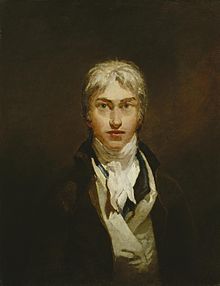
To start with a little background, the painting above is his self portrait. The only one he ever did in his lifetime. He was a private person as we know, and gave little of himself away. His birth date is given as 23rd April 1775, but this is disputed, as Turner would give different dates to different people. he had this aversion to people knowing his personal details. He lived with his parents, which was far from being satisfactory, as his mother had a violent temper, and was later incarcerated in Bedlam Hospital. So he as at School in Brentford and later in Margate, and this is where his love of the river started. He loved boats and messing about in boats. They figure in some of his paintings, and they are a frequent mode of travel on his painting expeditions. later he would row sometimes as far as Windsor on the Thames and down the Wey to Guildford, which we will look at later.

let’s start looking at some of his Surrey paintings and start in date order as far as we can

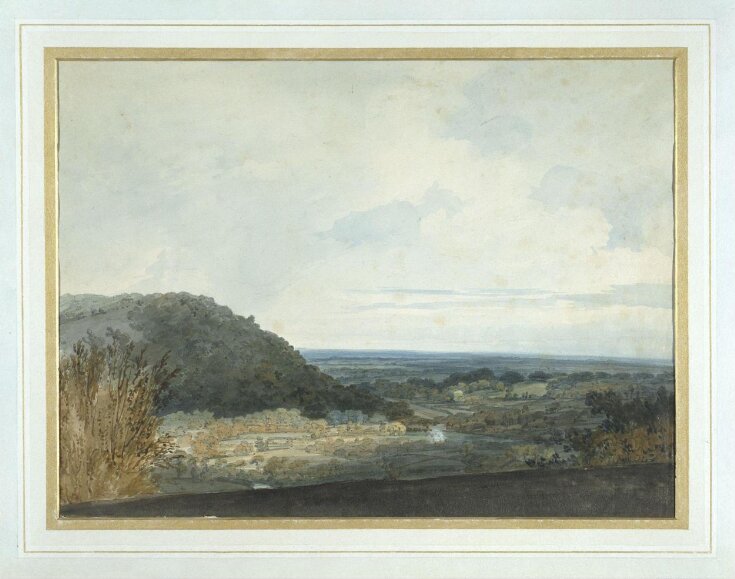
Possibly Box Hill Date….. previously attributed to Tom Girtin, and later to Turner. Girtin was contemporary to Turner, and they were in fact great friends. They would go on expeditions together, and on one of them painted the Savoy palace from a boat on the Thames. Girtin was an acclaimed painter, who sadly died at the age of 29. Turner held him in high esteem and his famous quote said ” if Tom had lived I would have starved”. Turner was definitely in the area that year, as the next painting of Leatherhead shows. This was his so called Student period.

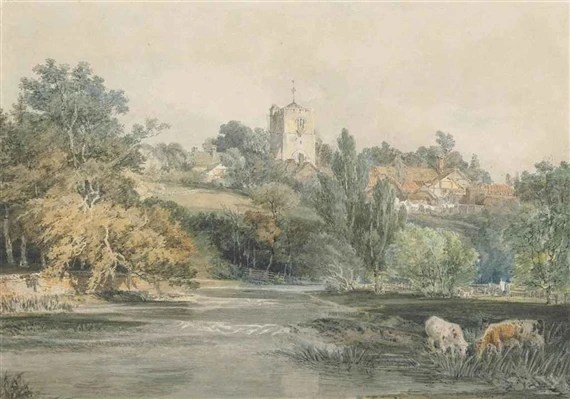
At about the same time, we have this painting of Leatherhead

Leatherhead from the River Mole, with cattle in the foreground, dated 1796, and attributed to Turner. I find this an immature style compared to what we associate with Turner’s work, and it would be as this comes within his student period. Turner had been invited to Norbury Park, near Leatherhead, a place I associate with Fanny Burney who met her future husband there, Comte d’Arblay, an emigre from the French revolution. I wonder if they met Turner. Interesting to conjecture

I will publish so far and go on with this at a later date

Burne-Jones Exhibition at the Tate Art Gallery

Golden Stairs by Edward Burne-Jones (1833-1898)

One of many well-known paintings by Sir Edward Burne-Jones featured in a special exhibition currently at Tate Britain until February 2019 which is the first major retrospective to be held for forty years. Inspired by the church and the medieval period, his work represented the antidote to the ugliness and the materialism of the Victorian period.

We went there recently. As always a superlative exhibition. To be seen if you can

There were seven rooms of drawings and paintings. Burne Jones was a superlative draughtsman . The second room deals with his time in Fulham, when he finally had space enough to embark on major projects for which he needed countless preparatory drawings, each one of which could be considered a work of art in its own right.

Renaissance art and four visits to Italy encouraged his approach to the body. His male figures appeared troubled while women were portrayed beautiful yet sinister. About this time he was experimental with media, using gouache with chalk and later metallic pigments.

His attitude to the male figure caused him to resign from the Old Watercolour Society which had been shocked by his work. . He was becoming known as one of the most daring artists of his time. After a blissful period of working to his own pace, his exhibition pictures started to take London by storm, and later Paris, so that he became known throughout Europe.

Most impressive were the rooms containing his Series Paintings, massive works commissioned by serious clients with rooms that can show these works as they should be shown. This was of course the era of the seriously wealthy patron who could command works like these., such as the Perseus series, commissioned by the young future prime Minister Arthur Balfour for his London residence.  Curiously Balfour was later to be president of Woking Golf Club, close to where I live. The only prime minister to be president of a golf club. I wondered what these wonderful paintings would look like in the golf club lounge, but that was me being facetious.

I cannot describe the paintings of the Perseus Story, as they were too magnificent. Like wise the Briar Rose which is really the story of Sleeping Beauty. Wonderful illustrations of knights and princesses. Burne Jones I think today would have been in his element illustrating Game of Thrones or the Harry Potter stories.

He worked closely with William Morris, from whom he derived the bulk of his income. He became especially well-known for designing stained glass windows for churches and cathedrals the breadth of the land and indeed the old Empire.

One of the last great figures of the Pre-Raphaelite movement. This is a wonderful collection gathered together for a short time