Constable was big in France : Part 2

This is the painting that we always think of and this was shown for the first time in Paris in 1824

This became the style that the French referred to as a la Constable, rustic cottages,wagons in ponds and open fields and skies.

In the light of his French success, Constable’s continues determination not to travel abroad seems nothing short of bloody-mindedness if not pure rudeness. In spite of all inducements from Arrowsmith, from his friend Fisher, and even despite his gold medal was about to be presented by King Charles X himself he was adamant about refusing to go to France.He was thrilled with the medal which was later presented to him in London by the French ambassador. But he was resolved not to go to France

“I hope not to go to Paris as long as I live” he said. ” I would rather be a poor man here than a rich man abroad”. Well, be careful what you wish for. All of a sudden, as quickly as it came,Constable’s moment of French fame passed. By the end of 1825 he had fallen out with Arrowsmith. When the French market crashed like the British one during the mid-1820s, Arrowmith and another of Constable’s dealers Claude Scroth, went out of business. Constable’s commercial conduit dried up. He had sold more landscapes in a short space of time than had been bought by British buyers in years, but now the HayWain came back and The Cornfield was sent back from the Louvre in 1827 unsold

And there it is. It is in the National Gallery now

Constable hadn’t been the only successful british Painter at the 1824 salon. In fact so many British painters were showing , that it was known as the Salon des Anglais, which was quite a coup for the national contingent. Two others like Constable were awarded medals, and another made a Chevalier of the Legion d’Honneur. There seemed to be widespread approval of the so-called “British style” in landscape painting. If only Constable had been more amenable to travel and doing some networking he might well have prolonged his popularity. Delacroix for one was anxious to meet him, but although Delacroix came to London in 1825, and met other painters, there is no record of him meeting with Constable. You can’t imagine Turner squandering an opportunity to make such an important relationship. Quite the contrary, Turner went to a lot of trouble to meet Delacroix in Paris, in either 1829 or 1832. The urbane Frenchman was underimpressed with Turner’s appearance. Constable he described as ‘an admirable man…one of the glories of England’. He recorded Turner as looking’like an English farmerwith his rough black coat and heavy boots, and his cold, hard expression’. Later on though we was to concede that both Turner and Constable were the ‘true reformers’ of landscape painting

So on that note, let’s bring Turner bck into the story. Did Turner also fly the flag for the British School in Paris. No he didn’t.

He was conspicuous by his absence. Despite his enthusiasm for European landscape and despite his frequent travels, and the way he reinforced the preeminece of European culture, he was never represented at the Salon.

He rarely exhibited outside of his own country, only on two occasions and both times probably wished he hadn’t. The first was a solo exhibition in Rome in 1828 when reaction to his work was vitriolic to say the least. There was a cartoon going round which said ‘O Charlatan excrement is not art’ ! The second occasion was in Munich in 1845. Turner was the only British artist showing at an exhibition called ‘Congress of European Art’ Again his painting horrified the locals. The Germans were appalled by the loose handling and lack of form and regrettably interpreted this as a satire upon their country. To add insult to injury the picture was returned to Turner damaged , with additional carriage costs to pay. He was furious and apparently fussed over it ‘like a hen in a a fury’

An interestin paradox then in Turner’s relationship with Europe. Despite his extensive travels and his European outlook, his paintings had limited appeal abroad during his lifetime. It was Constable who was the more prominent of the two. To this day, it remains one of the more unlikely developments in Western art history.

Constable was big in France

Something I didn’t know until I started reading about him with a view to preparing a talk later this year entitled Turner and Constable. In 1821 when he showed at the Royal Academy and showed The haywain in fact, he was wildly embraced by the French art market, not quite literally although he might have been. he was totally unprepared for all this enthusiasm which he certainly wasn’t used to at home

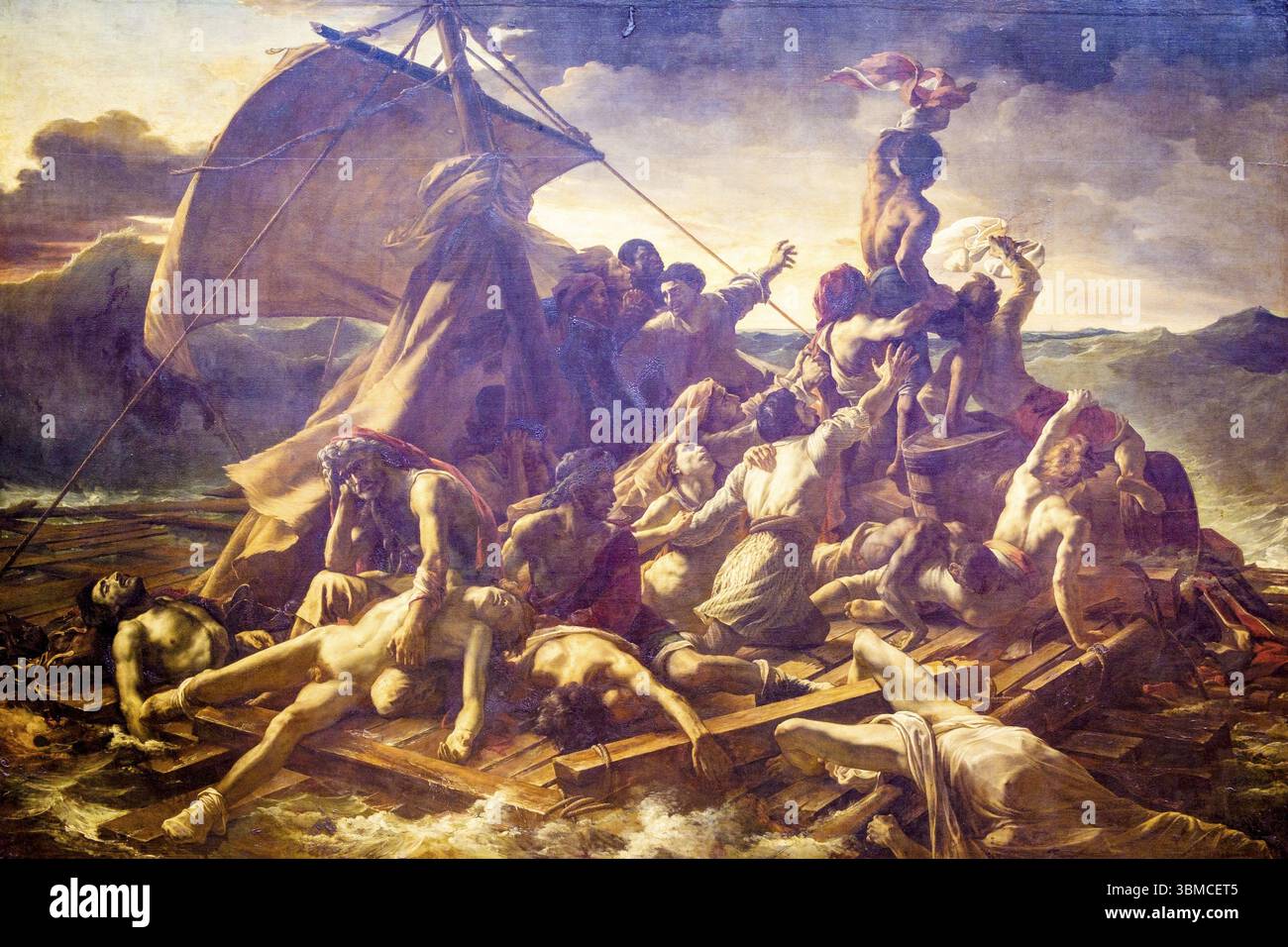
One of the first to discover him was the French Romanticist Theodor Gericault. He is probably best known for his famous painting The Raft of the Medusa, which he had brought to London, and which we are told thrilled 70,000 Londoners

And this is Gericault’s famous painting, which I will just talk about before talking about Gericault’s reaction to Constable’s work

This painting was based on a real incident which shocked the French nation. The French naval frigate ran aground off the coast of Mauretania on 2 July 1816. At least 150 people were set adrift on a hurriedly constructed raft. Only 15 survived and were picked up. The event fascinated Gericault and he could be said to have hooked into national grief. He undertook extensive research including visiting morgues for the skin colour of the dying and the dead. The painting was shown in the Salon of 1819 and received national approbation. He brought it to London where it thrilled Londoners including one Turner who went back to his studio and reworked his own great work The Shipwreck

Whilst in London Gericault visited the Academy exhibition and there discovered Constable. He thought that The Haywain was the best in the exhibition. Other French visitors thought the same and waxed lyrical.

Much to Constable’s surprise the interest quickly snowballed. A Parisian art dealer called Arrowsmith, French despite his name, offered to buy The Hay Wain and offered a derisory sum. The negotiations broke down but two years later, when Constable was short of money, he agreed to sell the painting to Arrowsmith for £250, as well as other pieces. The paintings caused a stir when they arrived in Paris.

The arrival of the Hay wain in 1824 was like a pebble dropping in a Parisian mill pond. The effect was immediate. At the epi-centre of the quake was another influential figure, Eugene Delacroix, who was so influened by the Hay Wain that he went back to his studio and repainted background on his great work The Massacre at Chios. He was blown away by Constable’s greens and tried to copy them. Critics viewing this picture at the time couldn’t find much evidence of green being used, but there we are.

If Delacroix was talking about the Hay Wain, then others were bound to be listening. A few weeks later it was these two paintings which received the greatest share of the attention at the Academie des Beaux-Arts, known as the Salon. The Salon dominated taste and opinion in France to an even greater extent than the Academy in Britain

Constable was embraced at the Salon in a way that had never happened to him at home. His large paintings were removed to positions of prominence, and Monsieur Constable, Peintre de Paysage was awarded a gold medal of excellence. His friend John Fisher couldn’t resist commenting that plain old Constable, who didn’t speak a word of French, was the talk and admiration of the French. His name entered the language. Landscapes were described as a la Constable!. More French exhibitions followed in Lille including another gold medal, Douai and the Salon again in1827, where there were plenty of landscapes a la Constable, with rustic cottages, wagons in ponds and open fields and skies.

Constable nevertheless refused to visit France, his attitude seemingly bloody-minded bordering on rude.

This is probably a good place to take a break. We are about half way, so a lot of writing and a lot of reading for you guys. It will take another post to complete the subject which I will do soonest

Delving into the Archives

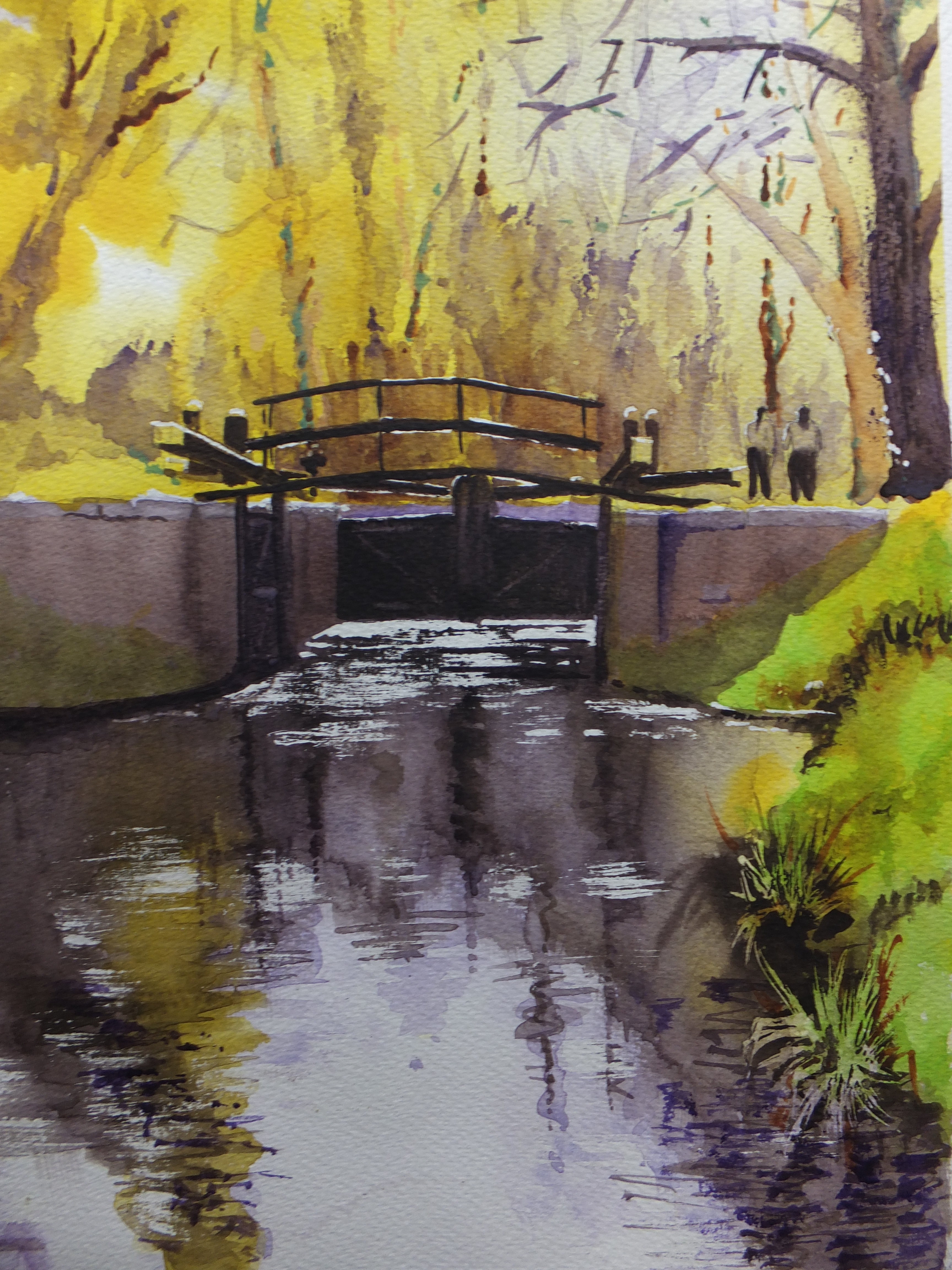
This is a really old favourite. The lock gates on the Basingstoke Canal, which flows quite near where I live. The canal is part of our industrial heritage, cut in the late eighteenth century to provide an inland link between London and Southampton, a major seaport. This was the time of wars or imminent wars with France, and transport by sea was fraught with risk, so the Wey was linked to the Arun by canal and extended to Portsmouth, which lasted for a short while, and this canal now called the Basingstoke was planned to reach Southampton. It never got there. It reached Basingstoke in the north of Hampshire, and then came the railways ,and canals were quickly redundant.

This painting went out to New Zealand by the way. It was bought by a young couple who’d come back to visit an elderly mother. They came to one of my shows, and took this painting home with them. That was years ago. I hope it’s still giving pleasure.

Today this canal is used for leisure only and is a haven for wildlife. It also gives artists and photographers subjects for their art. I’ll include a few

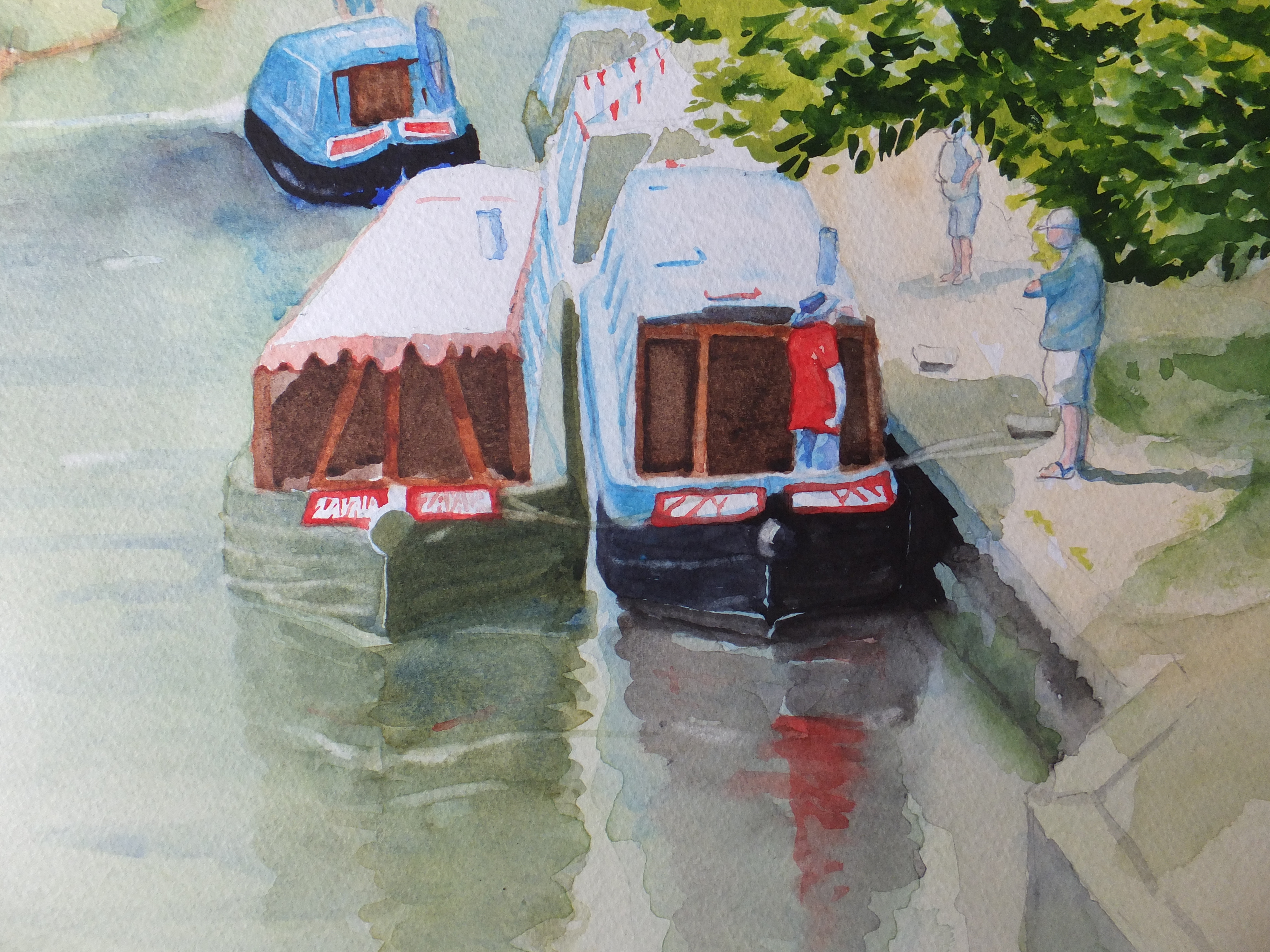
Barges gathering on the Basingstoke Canal

These are barges, of the type used for transportation in times gone by, which are now used for leisure purposes.Every so often there is a gala, when the barges get together as part of their social exercise. This is an ideal spot alongside one of the old wharves, which is outside our local Italian restaurant, which you can’t see, but is to the right of the picture. Delightful on a summer evening to sit outside with a glass of Cava and watch the activity on the water. The old boathouse is there too, long converted to a pharmacy.

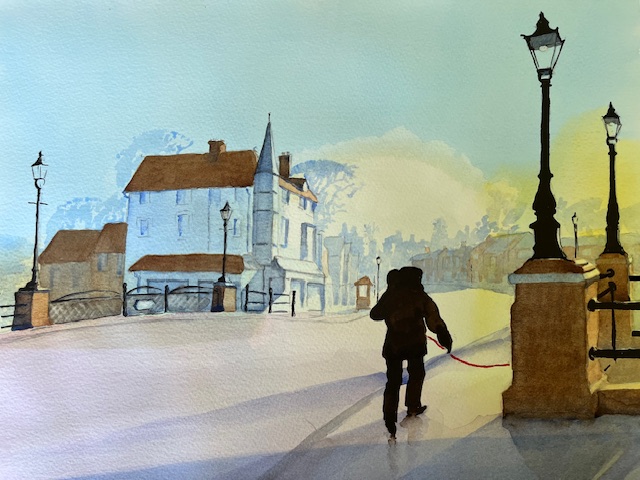
I stood on one of the old bridges, Kiln Bridge, to take the reference picture for this painting

Kiln Bridge in winter sunshine

This is the bridge over the canal leading into the village of St John’s. Kiln Bridge, well the clue is in the name. When they were building the canal, they made the bricks as they went along. The village grew up around the canal in a shanty town sort of way, and most of the buildings are Victorian. The shop opposite in the picture is a restaurant today, but in its day was a haberdashers shop for a while, in those good old days when small shops could make a living selling everyday things, before being driven from the high streets.Today restaurants and beauty parlours proliferate but at least they aren’t empty

The village took its name from the church of St John’s which was built by the rector of Old Woking, as a chapel of ease for the villagers. Very considerate, as everything was a walking distance in those days, and a five mile trudge to church in bad weather would be offputting even to the most pious.

I haven’t painted this church yet although I do intend to. It is a handsome Victorian church by a very well known architect George Gilbert Scott, who was responsible for many new churches up and down the country, not to mention restoration of old churches and cathedrals. Not just churches but also remembered for the Midland Hotel outside St Pancras Station, which was derelict for many years and beautifully restored comparatively recently. There were three generations of architects. Giles the grandson, built power stations like Bankside now Tate Modern and Battersea finally developed into a magnificent shopping mall. He is especially remembered for the red telephone box, which now are collector’s items.

For the moment, that is enough for one post. An interesting journey for me which I hope you enjoyed as well. I am quite elderly now, so if I want to look back again, there is plenty for me to look at

Watts Gallery Exhibition: The Pattle Sisters

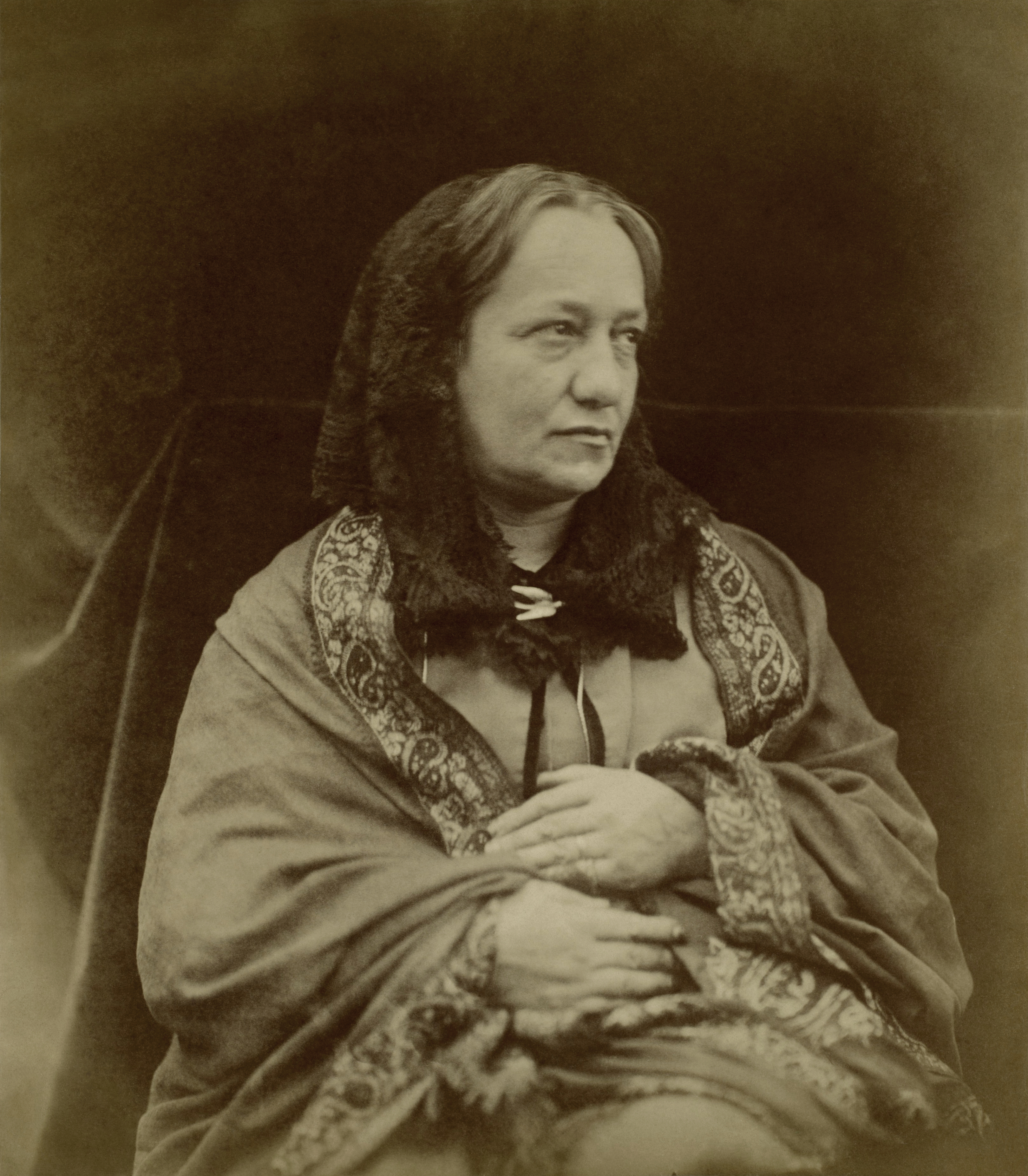
Probably the best known of the Pattle sisters, Julia Margaret Cameron

This is the current exhibition at the Watts Gallery at Compton near Guildford. This is the gallery of the paintings of George Frederick Watts, the famous Victorian painter. He lived nearby at his house called Limnerslease, with his wife Mary. He was a prolific portrait painter. He was also well known for allegorical subjects. His painting called Hope was featured on postage stamps and was also known as Barack Obama’s favourite painting. Likewise he often painted pictures with a social message

His wife Mary, also a painter, gave up painting to support her husband. She founded a pottery workshop in nearby Compton to give employment to local craftsmen. She is also known for building the nearby chapel with designs by her husband, generally regarded as an Art Nouveau masterpiece

This is the painting of the Watts Chapel that I did once, built in brick and shaped like a Greek cross. The interior is beautifully designed in Arts and Crafts style. The bricks were made locally in Mary Watts works

The Pattle sisters were born in India, and became central figures British art and literary society. Born in Calcutta now Kolkata to James Peter Pattle, a civil servant, and Adeline Maria De l’Etang ,they received education in Paris and India.

Known for their beauty, intelligence and independent spirits they navigated complex social landscapes, bridging cultures and influencing Victorian high society and intellectual movements

George Frederick Watts was one of the prominent figures that they were connected with. There were seven sisters in all, and probaly the best known is Julia Margaret Cameron, the famous photographer, who lived on the Isle of wight for many years. Given a camera by her daughter, she became well known for her photographs of famous people, and also for the ability to capture subjects in a very soft light.

Maria Jackson (nee Pattle) was the mother of Julia Stephen who was mother to Virginia Woolf and Vanessa Bell, thus linking them to the Bloomsbury group

Pattledom was a term coined by Thackeray describing the sister’s powerful social network and bohemian lifestyle, blending Indian heritage with French education and English society

This exhibition is on until May, and well worth a visit if you are within striking distance of Compton

Btw. if you want to see more of my own paintings, they are listed also on my own website davidharmerwatercolour.co.uk. This website is a showcase rather than a shop, but enquiries are nevertheless welcome

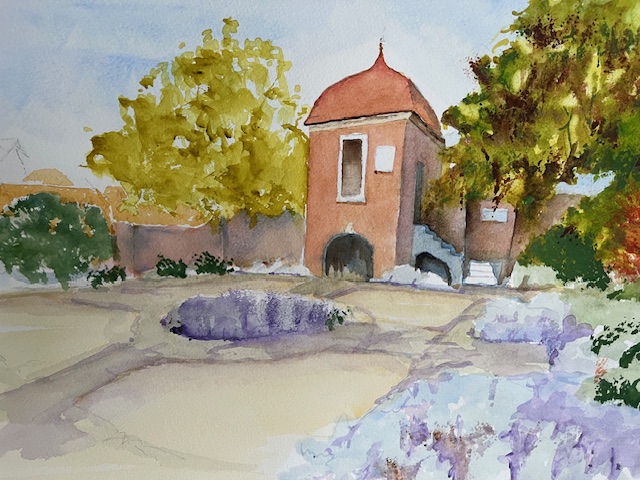
The Havant Gazebo Painting

This was a nostalgic trip for me. I used to live literally round the corner from this lovely building, although at that time you could only see the top half as it was surrounded by a high wall. Pieces of glass were set into the top of the wall, to stop people climbing over. Even in those benighted times, this was illegal and constituted a man trap. Goodness knows when these shards were mounted into the wall, well into previous centuries certainly

Since then, walls were taken down and this delightful gazebo was exposed for all to see. It is from the c18 and was built as all gazebos were, to enable the leisured classes to enjoy the view from over the wall, and no doubt in those days for quite a distance. It would have looked out over the Fair Field, a large green space which would have hosted an annual fair. This is long gone, and today is commemorated by a road called Fairfield Road. The row of houses in this road was built in the reign of Queen Victoria, quite late in her reign as I remember, from building material taken from the demolition of the old manor house opposite.

Coming back to the gazebo, this was in a large garden at the back of a beautiful Georgian house called Magnolia House, occupied by two generations of dentists, now gone. Still a dentists surgery but the original old Havant family is no longer there. The house is one of the very few Georgian buildings to have survived a great fire in the c18. It is slightly uphill from the rest of the town which may have saved it from the flames.

I did this little watercolour quite quickly just to preserve a childhood memory. Havant is not a town which escaped development and there are very few gems like this remaining

I don’t live in Havant now, haven’t done for many years. My father lived in the family home in nearby Manor Close, named after the manor house which disappeared. I used to go down regularly so was able to look at the gazebo in all its glory, although could never go in as that is by appointment only, and time did not allow. The only problem with going back to scenes of one’s childhood, is that you start to hear voices of people you knew at the time, so stop and move on

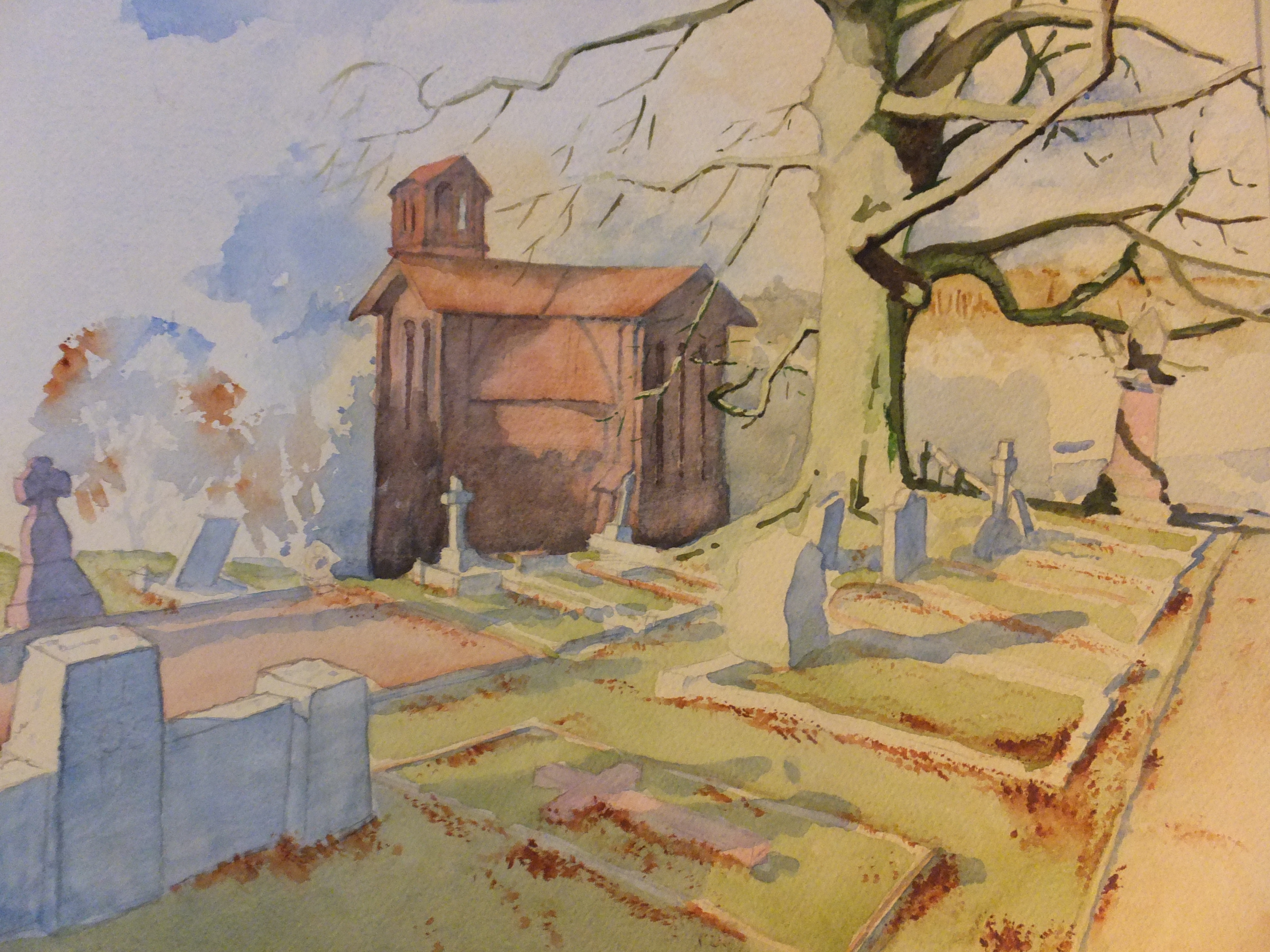
Painting of Pirbright Church

I come back to a subject I never tire of painting. The historic church in the parish of Pirbright in Surrey

Dedicated to St Michael and all Angels, the church has saxon foundations and was a site of worship before then. The current church building dates from the c18. The churchyard is notable for its wildlife and also contains the grave of Sir Henry Morton Stanley, the explorer, he who found Livingstone, and said the immortal words “Doctor Livingstone I presume”. He is also well known for the discovery of the sources of the Nile and the Congo rivers The headstone is a huge piece of granite with his African name, Bula Matari 1841-1904 The funeral service was in Westminster Abbey but the interment was here at Pirbright, near his country home at Furze Hill.

This is my photograph of Stanley’s grave with its monolithic headstone

I have painted this church on a couple of occasions over the years. One painting I did in the snow which was well received. I was especially thrilled at the end of last year, for that particular painting to be printed as a greeting card by the church and sent to everyone in the parish, setting out the times of services over the Christmas period. I will see if I still have an image

This was the painting done in the snow. I’m not sure that I don’t prefer it to the one that I have just done. Looser somehow. Also there is something about snow with sunshine that softens the light beautifully. The trees on the left have been removed since I did this painting

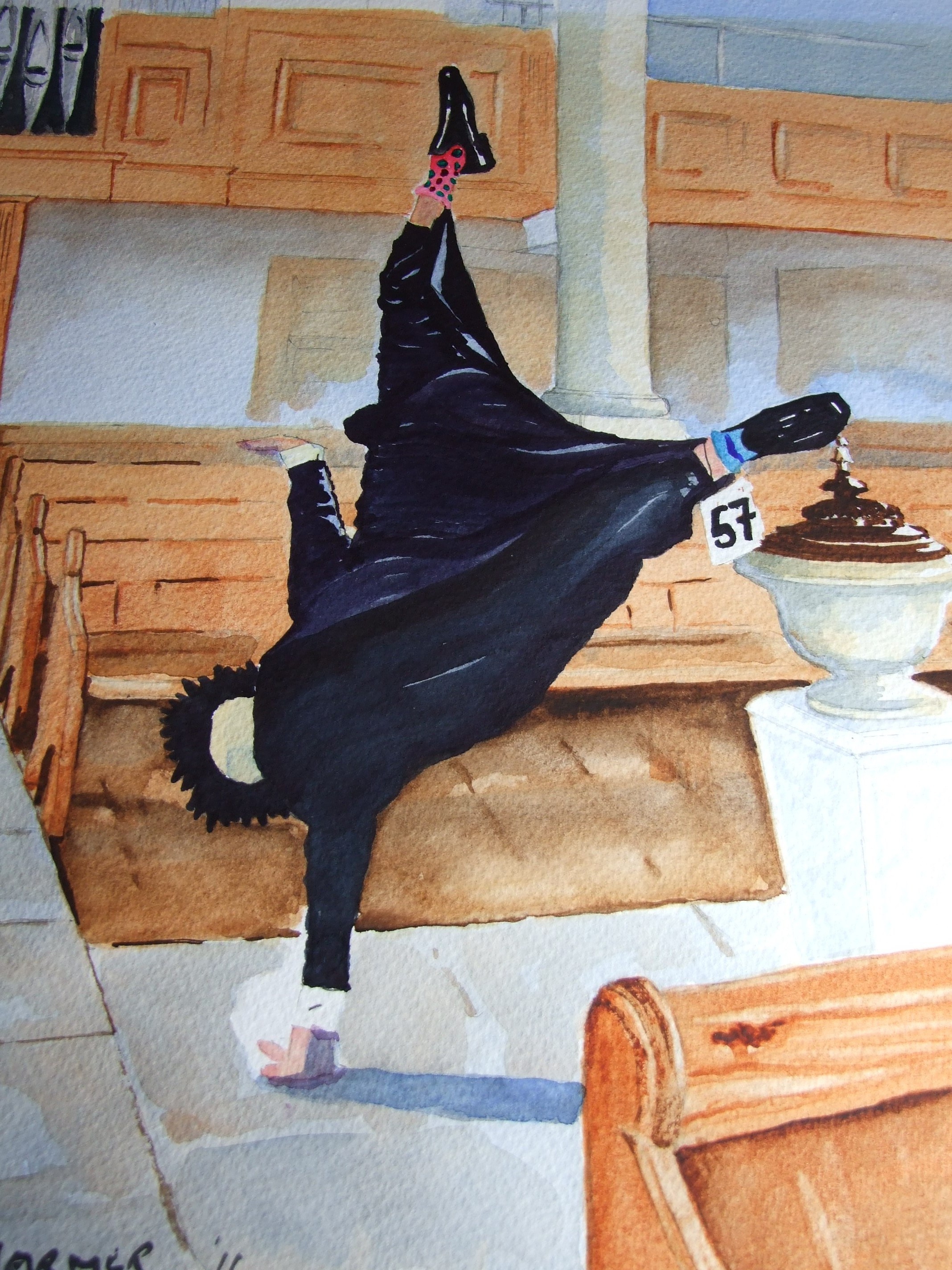
Although I don’t actually live in Pirbright, I do get involved through the Pirbright Art Club which i have belonged to for many years. Pirbright like so many villages, has an annual fair and the art club would take a stall. The theme for some years was scarecrows, and ingenious examples were made, very often characters from literature. Do you remember the wedding of the Prince and Princess of Wales? After the service the Dean of Westminster cartwheeled down the centre aisle, presumably overjoyed. An amazing scarecrow was made and was on display in the church. I painted it. I’ll see if I can find it

I was proud of this painting. I exhibited it locally expecting it to be snapped up. It wasn’t! In the end, I sold it online to a buyer in the north east of England. How strange was that. Afterwards the buyer wrote to me and told me he looks at it every morning and it cheers him up for the day, so it was worth doing just for that.

Turner in Surrey: the River Wey

Turner, Joseph Mallord William; Newark Abbey on the Wey; Tate; http://www.artuk.org/artworks/newark-abbey-on-the-wey-202538

Described as Newark Abbey which is in fact Newark Priory, and even Newark Priory Church. The priory was a huge complex, and the ruined church is all that is left after the Dissolution . It looks to me that Turner sketched this from the road. The view is much the same today. The land is privately owned so close inspection is not possible. Cows are in the field much the same as Turner’s sketch. Newark Abbey is near Ripley as a point of reference. This painting is in Tate Britain

After the dissolution it was said that the priory was bombarded by cannon from nearby Pyrford Hill. After that the site must have been robbed for stone, as the ruined church is all that remains, apart from the odd outcrop

Turner would row down the river. We know that he stayed at the White Lion in Guildford, and at another in inn in Walton-on-Thames. He also thought nothing of sleeping on his boat. He was also a prodigious walker, known to cover 25 miles in a day including making sketches on the way. Sometimes he would set out with company and leave them behind if they couldn’t keep up

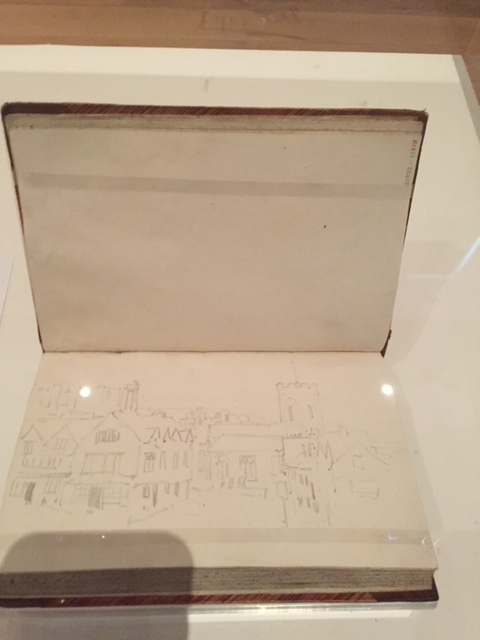
This is the entrance to Quarry Street in Guildford today. It is not by Turner! This is my painting made about twenty years ago. There is a link with Turner albeit a tenuous one. In order to take the reference photograph for this painting, I had to step back into the White Lion Walk in order to keep the bright sunshine out of my lens. The White Lion Walk is the shopping arcade which now stands on the site of the old White Lion Hotel. Let’s look at the next picture.

This is by Turner! It is one of his sketch books and shows the same view which I made years later, which still amuses me. I am sorry the image is so pale, but he worked in pencil. You can see the building on the left is much the same and the ancient church of St Mary stands in the background exactly as it does today On the right hand side is an inn much as today. Turner sketched this whilst staying at the White Lion in Guildford. Was he in the lounge relaxing or in his room. We know he didn’t like an audience so maybe the latter

We’ll leave it there for now and continue Turner’s drift down the Wey at some later date

Turner in Surrey Part 2

Thameside Ferry Crossing

This is a photograph I took myself trying to catch the little ferry crossing from Twickenham over to Ham on the other side. I just missed the ferry but my reason for keeping this picture, is that this must be one of the nearest points on the river from Turner’s house in Twickenham. I dealt with his house a few blogs ago so I won’t repeat that. Turner loved boats, he loved fishing, he loved the river, and he loved picnics with his friends. Was this the sort of spot he came to? We don’t know for sure about him fishing here, but he would have known this location.

I took this picture from the riverside of the grounds of Orleans House Gallery, where we go from time to time. The gallery is what remains of the original Palladian mansion built in the c18. Louis Philippe duc d’Orleans lived here in exile from 1813-1819. Turner met him and they became lifetime friends. Later in 1830 he became king of France, until he was toppled by another revolution, and went into exile in England once more. He died at Claremont in 1850. Turner went to see him in France near the end of his own life in 1845, one of his last visits to Europe, and they talked into the night about ‘Dear Old Twick’

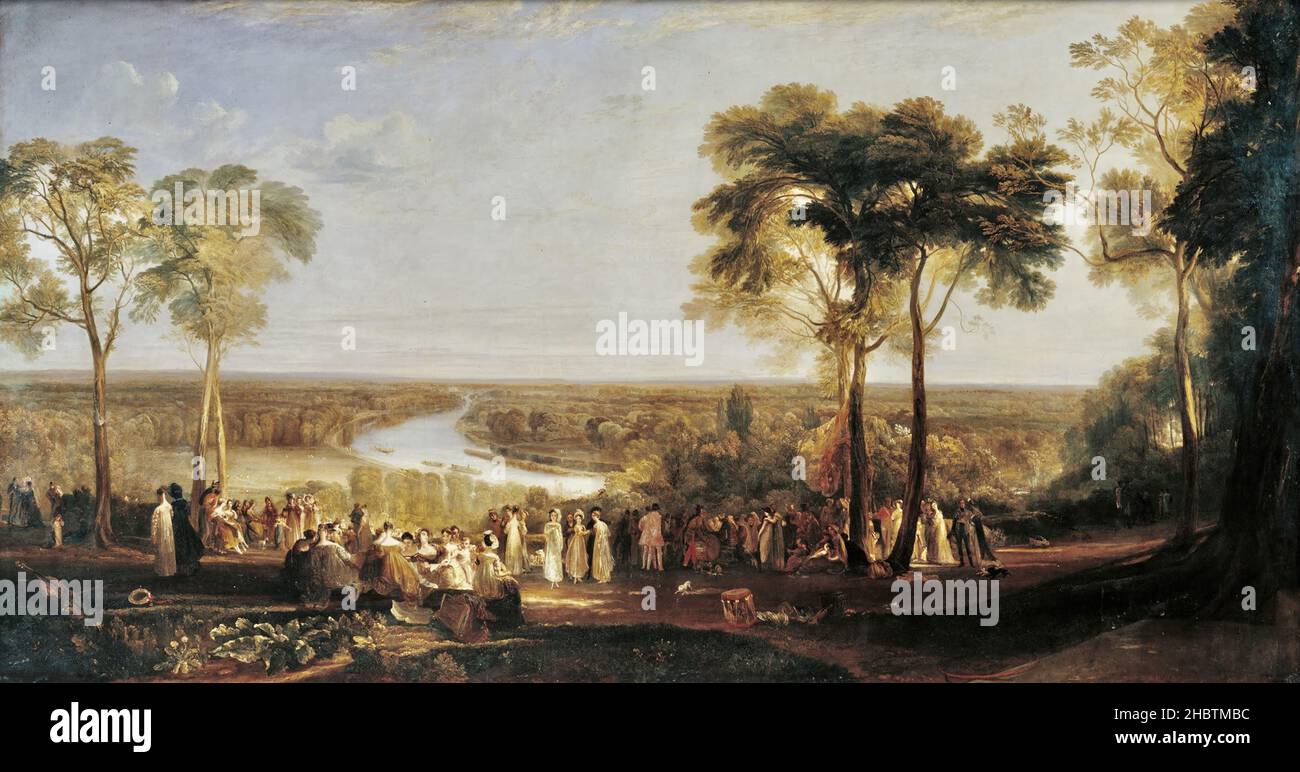
In the background on the hill is the Star and Garter, what used to be a retirement home for disabled service men, and more recently converted into apartments. Nonetheless a powerful landmark, and showing us where Richmond Hill starts. Turner painted the view from there, and I would like to look at one particular painting dated 1819, painted in honour of the Prince Regents birthday

I think that this was an unashamed bid for royal patronage, which was unsuccessful as I believe but nevertheless an interesting painting, which of course looked down on an area which he grew to love. Actually as King George 1V he was able to bestow a seascape on Turner in 1823, but to return to Richmond Hill

I will, if I may quote from Anthony Bailey’s biography, which talks about this painting in some depth. Travel and the proprietorship of Sandycombe Lodge, his country house in Twickenham, had occupied much of his time. His painting output had dropped, and he had no new commissions, so he needed new patronage, or may have felt so. In 1819 he had exhibited this great canvas, kingsize, measuring about six feet by eleven. This was England: Richmond Hill on the Prince Regent’s Birthday. It showed the winding Thames at Twickenham, and Sandycombe hidden in the trees, and on the further bank a game of cricket going on whilst in the foreground a group of partying people which could have been borrowed en masse from Watteau

There were mixed views. Some thought the painting to be unEnglish despite its title. There is a quotation from Bell’s Weekly Messenger (16 May 1819) where the writer admired the painting but qualified his praise.’ The distance, the foreground,the trees,and the figures are all Italian. On Richmond Hill, and on such a day, John Bull with his dame, with the rustic lads and lasses of the village, sporting under the sturdy oak, would have been more characteristic of England’ But this was to request a different nostalgia. Turner had not yet been to Italy and was perhaps looking forward to that country to paint

That is probably enough for writer and reader for now. I am getting some material together for his excursions down the River Wey taking him deeper into Surrey, so we can look at that another time

Memories of another age

It was suggested that I write about the early years of my life. I am 81. What do I remember, and how far back? I don’t remember the last world war. i was born in 1943 in London, and during an air raid, my mother told me. We called these raids the Blitz. We borrowed the German word, Blitzkrieg or lightening war. It was terrifying by all accounts and I arrived in the middle of it. Even today I jump at loud bangs.

So I don’t remember the war but I remember war damage. There was still plenty about as I started to form memories. We lived near Portsmouth about this time, so I remember the magnificent Guildhall gutted by incendiaries, and also the old Theatre Royal standing alone amidst the rubble, and as I recall still putting on plays. I can picture whole streets gone, what were once rows of shops, now identified solely by the names in mosaic in the doorway floor. I remember buddleia growing amongst the rubble, aptly named the bombsite plant.

I remember the late king George VI who died in 1952, and our late queen, then Princess Elizabeth being acclaimed queen on holiday in Kenya. I kept a scrap book of the king’s funeral, which didn’t seem strange at the time. Today it might be considered an odd thing for a child to do. I vividly recall a blood stained photograph of the monarch lying in state in Westminster Hall flanked by four soldiers. It had been used to wrap meat and I rescued it for my album. We didn’t have hygiene in those days and butchers and fish shops used old newspapers to wrap their wares. Fish and chip shops did the same. That is where we took our old newspapers. Eric Sadler was our local chippie. He stirred the boiling fat with an old piece of wood which looked as though he had found it on the seashore. Then he wrapped your fish and chips in someone’s old newspaper. No one was shocked by this. We had survived bombing, don’t forget.

About this time we were still living above our shop. I remember my brother being born in 1948, about the same time as King Charles, so a big gap between us because of my father being away in India and Burma from 1944 to 46. I remember bits about living there. I had measles and was ill for two weeks in a darkened room. Nobody was vaccinated against these diseases, dangerous as they were. They were called childhood diseases, measles, chicken pox, mumps etc and you had them and if you survived you were immune for life. I don’t remember having mumps. My father had it and was hospitalised, as this was a dangerous illness for men. My brother had whooping cough, very young, he was in his cot at the time. I can still see my father holding him upside down like a rabbit, while he struggled for breath. That was horrible to watch, but he survived, I am pleased to say

I started school at five years old. There was no pre-school or nursery school in those benighted times so we were later learning to read than children today. In fact I got off to a bad start, as I was enrolled in the local catholic school, which are very good today, but at the time was very poor. I was moved to the state primary school, and at six years old could not read or write. I caught up quickly enough, and was there until 1954, when I took the iniquitous 11-plus examination, and was one of the few that passed to go to a grammar school. Grammar schools, for those who don’t know the term, date back to the c16 when they were founded in the reign of Edward VI. Grammar meant Latin grammar, by the way, which in those days was the lingua franca throughout Europe. I was taught Latin incidentally, as it was essential to get in to some universities whatever subject you were studying. That changed in 1960

I say iniquitous, It was like separating the bright from the not-so-bright at a very early age. People like me were given an academic education learning Latin for example. The others went to so-called secondary modern schools, and their training included woodwork, domestic science etc as though they were destined for some form of artisan employment. This was to change with the advent of the comprehensive system, when it was recognised that children were all different, and developed at different speeds, and deserved the same training. Even this system needed modification until it was perfected to what we have today

I had intended only to write about my early years and what stuck in my memory. In 1951 when I was eight years of age, my father took us on the train to London to the Festival of Britain. That was a memorable day, and of course 100 years since the Great Exhibition in Hyde Park opened by Queen Victoria. i will try to keep to what i actually remember. I remember the Dome of Discovery which celebrated British achievement in science and technology. I don’t remember details. It would lack the sophistication of today naturally. We had shortly come out of a world war, and had not yet recovered. The festival was about optimism and hope for the future. Crown pieces were minted. I think I have one somewhere. I remember the Skylon, although what it did, goodness knows. I remember the Royal Festival Theatre which is still there today.

Between 1951 and 54 were my early school years before moving on to secondary education. I cannot think of anything worth talking about. I do remember kids with leg irons, due to deficiency in diet. terrible when you think about it. We had free milk daily which must have helped. That was stopped by Margaret Thatcher when Education Secretary in 19 seventy something. Thatcher Thatcher milk snatcher was the cry. Even today children’s diet is wrong only for different reasons. Girls did handstands against the wall, with gym slips tucked into their knickers. Boys didn’t do handstands, which was wise. Girls did a lot of skipping chanting doggerel to the beat. i don’t remember the doggerel. There was quite a lot of fighting in the playground, otherwise football. We were organised into work parties for gardening during lesson time. We dug out quite large tree roots. Imagine that today. parents would be apoplectic. Dancing round the maypole was something else that was done as a showpiece for visitors and quite accomplished as I remember.

Well th ose are a few snatches as they come to mind and take me up to 1954