Painting of my home village

This is the centre of my local village, St John’s near Woking. The name St John’s was taken from the local church, built in the c19 by the then rector of Old Woking, as a chapel of ease for the village inhabitants. Quite a long walk to church otherwise in a century when no one had transport.

The village is mostly Victorian, and although surrounded by suburbia, does still retain its village atmosphere and integrity. Life started here in the late c18 when the canal was cut through open heathland. In the distance in my picture, the road makes a hump, as it crosses the canal. This is Kiln Bridge, where as the name suggests bricks were made from local clay, and these were used in the building of the canal. The canal was intended to link London with Southampton, but only reached Basingstoke before the railways were built and superseded canals. This was still a time when war with France was a possibility, and inland links with major south coast ports were desirable.

Today the Basingstoke Canal is maintained by Surrey and Hampshire County Councils. There is some leisure boating but not much. Wild life proliferates and the towpath is used for cycling and walking.

This is the very first time that I have painted my own village. I don’t know why. I put this painting on a local website and had more than 240 hits. All complimentary, I am pleased to say. No offers to buy though.

In the middle of the picture is our comparatively recent coffee shop, which has become the hub of village activity. Walkers and shoppers meet there to relax and catch up. We never had that before and it is a very welcome addition. We do have a pub but located going out of the village, so not so convenient. We have most shops so a useful selection.

At the bottom of my lane, we are blessed with a green open space, called St John’s Lye. Lye, lea or leigh means a green space. It is common land and so protected although we did have to physically resist Woking Borough Council who wanted to build a village hall on the Lye to replace the one that was starting to fall down. Eventually common sense prevailed and the new hall was built on the site of the old one. The Lye is available to all age groups for spontaneous activity including dog walking.

And so you have it. Not a place that many know, but loved by its local population

JMW Turner’s House in Twickenham

I shall publish a recent picture soon of this fascinating house, which Turner had a hand in designing together with his friend and near neighbout John Soane

And this is it in Sandycoombe Road in Twickenham, where we made a visit recently

Turner built this house in the style of a small country villa, in 1813, for himself and his “old dad” William, where they spent much time relaxing away from his London gallery. At the time it was way out in the country. Later on in the latter part of the c19 it was surrounded by suburbia, as it still is today. Quite historic suburbia now of course, but suburbia nonetheless. If I can find it I have somewhere a recreated view from the dining room window at the time that Turner lived there.

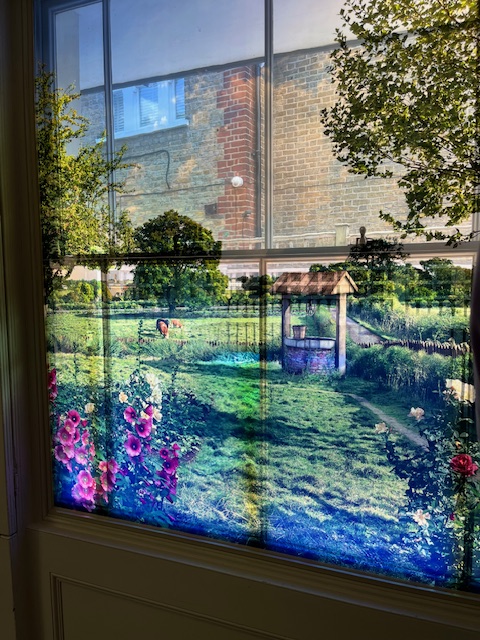
And this is it. Tranquil pastoral countryside image on the window of the dining room. Quite clever. The garden with well,and meadows beyond. Ignore the brickwork showing through the upper part of the window. That is the house next door today in real life, which we can’t block out

How did Turner live at Sandycombe Lodge? Did he paint there? He always went with sketch book in hand, studying the landscape, and its changing moods. It was believed that he used the drawing room as a studio. It had French windows facing north-east from which friends recollect that Turner would refresh his eye.

He used a pony and gig for getting about on sketching trips.The pony was the “old crop-ear” who may have grazed on Turner’s nearby meadow, and whom Turner buried somewhere on his land. No stables are recorded on of the later maps, he must have been stabled elsewhere, perhaps at the nearby Crown Inn.

Fishing was a quiet pleasure shared with friends, many of them fellow artists.The Thames nearby provided an abundant supply.Turner made some beautiful watercolour studies of tench,trout and perch, the catches of some of these expeditions. Often he was accompanied by John Soane, who was also an enthusiastic eel catcher

One of the most prestigious acquaintances Turner made during his time at Twickenham,was the Duc d’Orleans later Louis Philippe, King of France, who lived with his brothers near the Thames at Highshot House in Crown Lane from 1800-1807. Turner met the Duc at a Royal Academy dinner in 1802. Later, between 1815-1817 the Duc was again in exile in “dear quiet Twick”, this time in a house which is still there, named Orleans House which today houses a prestigious art gallery. They must have become firm friends as Louis Philippe gave him a gold snuff box when he came to England for Queen Victoria’s coronation in 1837. Turner took his last continental excursion in 1845, and called on Louis Philippe, who had a chateau on the coast of Picardy, and enjoyed a convivial evening of chat about Twickenham.

The other incumbent of Sandycombe Lodge, was “old Dad”, Turner’s father William, retired barber of Maiden Lane, Covent Garden. He kept house and also opened up the gallery for his son in Queen Anne Street. They both enjoyed frugal living, as William complained about the cost of getting into London, easily affordable by Turner. He was overjoyed to find a market gardener who would take him in on his cart sitting on the vegetables, for the price of a glass of gin!

After 1815, and the Napoleonic Wares drawing to a close, Turner could at last travel on the continent, and we know well, his wonderful paintings of the Alps which he crossed into Italy. Likewise magnificent views of Venice. The Low Countries and Germany were on his list.

He kept Sandycombe on for his father, who enjoyed the life there, but by 1826, William’s health was failing, and indeed by 1829 died. Turner had removed him back to Queen Anne Street before then. Sandycombe had become an irrelevance by then and I believe was sold for a modest £500, ironically less than Turner might expect for a major oil painting. Old William’s death affected Turner greatly. They were very close.

The house enjoyed a long life after Turner, and has now been fully restored , brought back to life by Harold and Ann Livermore, who bought the house in 1947. Ann died in 1997, and Harold established the Sandy Lodge Trust, now Turner’s House Trust, to preserve and maintain the property, which is now open to visitors and certainly worth a visit.

Out of my comfort zone part 2

This is the finished painting which I have called Windswept

I have done quite a lot of work on the horses as you can see. One horse in a familiar grey colour whilst the other in deep chestnut with black mane and tail, whilst also with black legs. Manes are swept out in one direction, as well as tails. Powdered snow is being kicked up by their hooves. The general effect I like to believe, is one of storm and threat even of chaos. I will let others judge

I have, I hope kept the strong light coming in from the left. The snow heightens that effect.

Not an easy one to put together. At times I was tempted to abandon, but I usually like to finish before condemning a painting to the bin. I am generally happy with this one, and comments on social media have been enthusiastic

So I will leave it there

Singer Sargent and Fashion

We went to the exhibition of Singer Sargent’s work at Tate Britain recently . His work is stunning. He was without doubt the leading society portrait painter of his day

This was one of the first paintings that Sargent made after moving to London from Paris,and it helped make his reputation in Britain, when it was purchased for the nation by the Chantrey Bequest The painting was made over two years, mostly painted outdoors, when the light was as Sargent wanted it. He painted the work in the Cotswolds, in Broadway at the home of the Millets, who were friends of his.The sight of Chinese lanterns hanging in the trees and beds of lilies was his initial inspiration. The two girls were added later. The white dresses were made especially for the painting known as Carnation, Lily, Lily, Rose

I never knew how much attention to detail he made with the costumes of his sitters. He would apparently visit their home and go through their wardrobe and almost dress the sitter in the way that he wanted them. He created roughly 900 oil portraits and approximately 1200 watercolours. He was highly prolific adding drawings and charcoal sketches to this list

Born in Florence to North American parents, he was truly international.. Working first in Paris and then in London, he was successful as a career portraitist. His work was characterised by drawing with the brush which was novel, and drew admiration. He was also drawn to Impressionism for a short time and was a guest of Monet. He traveled widely after training in Paris with Carolus-Duran, visiting Spain where he was greatly influenced by Velazquez and later to Italy where he sketched in preparation for Venetian genre street scenes,

His works and influences are too numerous to mention. London became his home and he died there in 1925. He is interred in Brookwood Cemetery in Surrey, about ten minutes from where I live as it happens. I don’t know why he was brought out from London to be buried. He had no links with this area as far as I know. Brookwood is a vast cemetery probably the largest in Britain, built as an overflow to the overcrowded graveyards of London. Maybe that was the reason. I have not been able to find out

Mont St Michel, Normandy

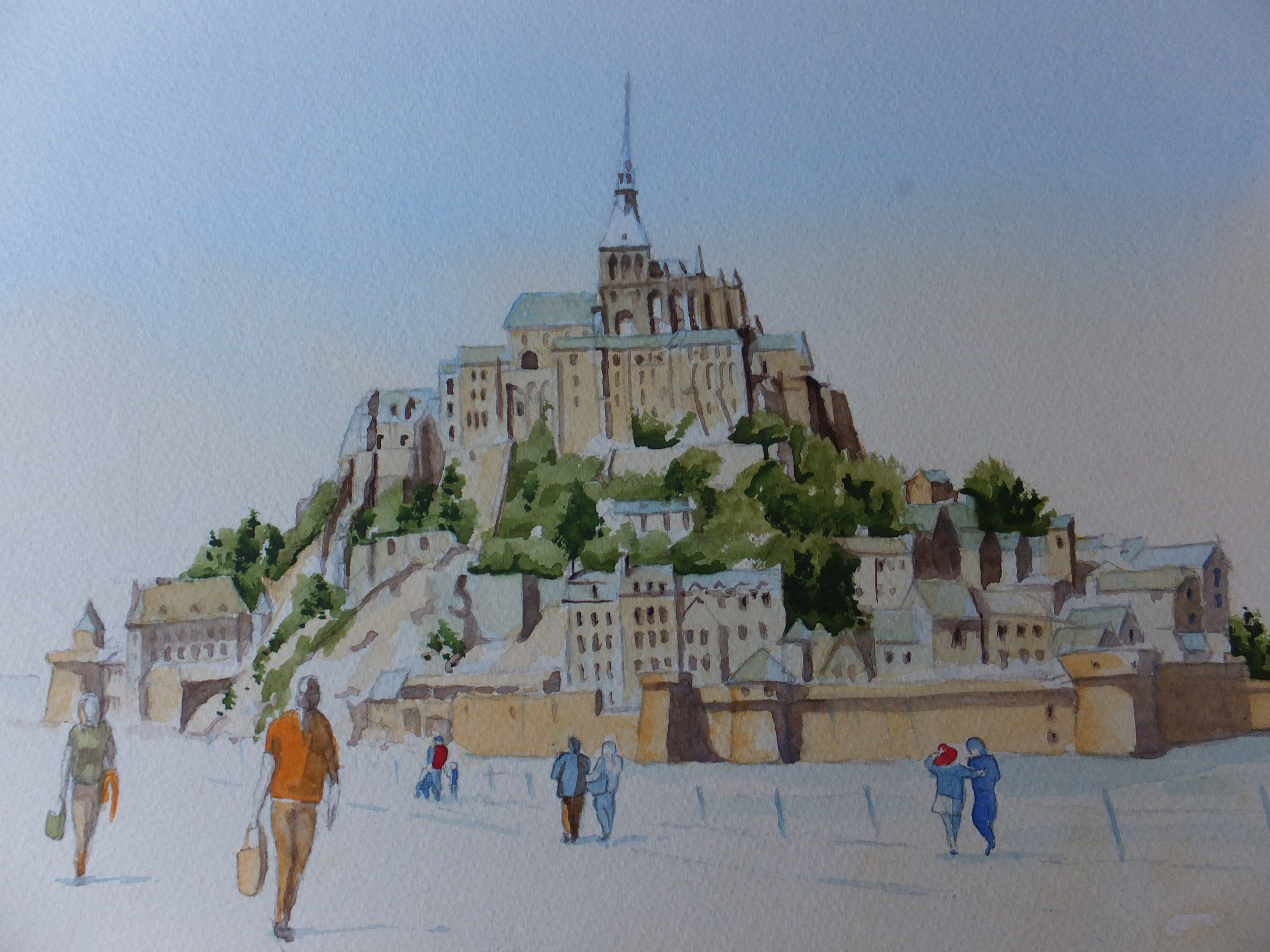
The island fortress of Mont St Michel

Firstly my thanks to Oska Siobhan photographer in Mont St Michel, for the use of her photograph as reference

We first visited Mont St Michel when our children were small, so nearly fifty years ago, and went back again much later, both times on holiday in Brittany, such a beautiful region of France

Steeped in history, high tide gave protection from would be assailants, whilst at low tide access was allowed to pilgrims to the abbey. The island remained unconquered during the hundred years war despite two sieges by the English. In fact the island’s spirited resistance inspired the French and Joan of Arc.. Louis XI recognised the benefits of the location and turned it into a prison. The abbey was used regularly as a prison during the Ancien Regime

In England we have a look-alike off the coast of Cornwall. In 1067 the Mont gace full support to William the Conqueror’s claim to the English throne. William rewarded this with lands on the other side of the channel, including a small island off the coast of Cornwall, on which the Norman monks built their priory, called St Michael’s Mount of Penzance

Mont St Michel also features on the Bayeux Tapestry. Scenes 16 and 17 show William and Harold there . Harold is rescuing knights from quicksand. This would have been during the period from Harold’s shipwreck on the coast of France, when he was entertained by William

My painting, as usual is in watercolour. Quite a lot of drawing in this one as you might expect

Abinger Hammer: the finished painting

The village of Abinger Hammer with its striking clock

As I said in a previous post, this is the village of Abinger Hammer, what used to be one of the iron villages in the Surrey Hills area. The blacksmith on the striking clock strikes the bell with a hammer, but the name refers to the giant hammer which was powered by the nearby river Tillingbourne up to the c18, which pounded the hot iron into shape.

Today Abinger is a tranquil place on the road from Guildford to Dorking. The buildings are attractive, in what is named the Surrey vernacular, using terracotta tiles and the local sandstone. They are very paintable, hence my choice, especially as I wanted the painting for a local exhibition starting on Freedom Day! The last start date over Christmas was cancelled so we hold our breath for this one.

The pallette was a simple one which is nice. raw Sienna and Burnt Sienna do most things. Cobalt blue for the shadows. i did experiment with the trees though. I have used quinacritone gold with violet for shadows and green gold for the hedge in the background, just for a change really.

We will see how we get on

Work Started on the Fountain of Love Commission

Fountain of Love Detail

I have been working on the drawing of the Fountain of Love commission, which has been testing to say the least. I have just included a detail here, otherwise the image would be too faint to show

The photograph of the fountain itself was included in my last post, and I may have explained that the fountain is in the grounds of Cliveden House in Buckinghamshire. The house is magnificent and is now an hotel but the grounds are run by the National Trust and are extensive.

Over the ages, Cliveden was associated with powerful women. One of the more recent being Nancy Astor, American heiress as well as an MP in Westminster, possibly the first woman MP. More recently still, Cliveden was the scene of the scandalous liaison between Christine Keeler and John Profumo, a married government minister

Again I have been balancing two commission projects, as I have just finished the sketch study of a rather lovely yacht in St.Katherine’s Dock, just to agree the composition with the client before going on the finished painting. I drew this with the help of a grid but there is something about the sleek almost feminine lines of a boat which seem to elude me, no matter how many measurements I take.

Dancing Girl Sketch

As usual the camera leaches out the colour but the essence is there. I did find it useful to make a sketch on this occasion. So many mistakes could be made and were made. At least these have been cleared out of the way, hopefully not to reappear

There is something about highly polished surfaces like plastic or metal, which don’t work well in watercolour. Give me some rough old wood or rusty iron any day, and that will look realistic enough to touch. Still, if you owned a rusty old tub, you probably wouldn’t want it commemorated in a painting

We will await the client’s comment to see whether I have got the composition right as a first step

Morning in Bosham Finished Painting

Morning in Bosham

The finished picture entitled Morning in Bosham

This was the first of the two paintings which I was hoping to plan together. But it was not to be. As the poet said, or something like, the best laid plans of mice and men go oft awry.

They certainly do. I have done a few sketches of the horse picture, but last Thursday the phone rang and a regular client phoned with a commission for an extremely ornate fountain called the Fountain of Love which is in the grounds of a mansion called Cliveden House in Buckinghamshire

I went to look at it, at the week end and took some reference shots and append one for your interestDSCF4449

I have just had to arrange a professional copy so that all the detailing is picked out clearly. This will be a test of drawing skill and no mistake. Too late however, as I have said yes.

Cliveden House is now an hotel. It is c18 I believe and is associated over the years with a succession of powerful women. The latest was Nancy Astor, the American heiress who became a Westminster MP, the first woman MP I think, and certainly a forceful lady.

The house is remembered for being the scene of the scandal involving Christine Keeler a model, and John Profumo the then Minister of Defence during the 1960s. She was also having an affair with a Russian diplomat, so the whole thing was considered a threat to national security. Profumo lied to Parliament and the whole thing nearly brought down the MacMillan government

The same day i received another commission to paint a boat in St Katherine’s Dock which might be postponed and give me a breather. Today I received a request to do yet another view of beloved Bosham Harbour and Church

That will teach me to boast about doing two paintings simultaneously.  The gods have a habit of looking down and teaching you a lesson if you appear over-confident. They have, and it serves me right.

Two Paintings worked on simultaneously

Camargue Wild Horses

I was kindly sent images of Camargue horses, which frankly have spoiled me for choice. Many were of the herd charging through the shallow water kicking up spray, and these make for very dramatic paintings of the type I love to do, and which I will do. For the moment I do have one such painting in my collection ready for exhibiting and that is currently on my Artfinder site and also on my own web site.

As I went through the images again, I was drawn to the one shown. Completely different to the others, it is almost pastoral in quality, with that feeling of peace that one gets after a long gallop, when everybody gets their breath back before moving on. I think I will try using this one for inspiration. Drawing will be a challenge as the shapes are so dark but nonetheless will be fun to try.

We watched them when we were there. I took some pictures but the quality just wasn’t there, so I have to look at other images which made a better job of capturing these lovely horses

I have also been asked to provide another Bosham picture similar to ones that I have sold so often. There is only one shot that people want, so I have to scratch my head to think of ways to make each one individual so in this case, I will be changing background colours to something I haven’t tried before

Just as a by the way, I am pleased and relieved to be able to report that my Artfinder sale reached its American buyer safely and promptly. If I have already mentioned this, my apologies and please ignore. I had a very nice text back from a happy buyer, telling me how pleased she was with the painting, so pleased with that

Back to the easel!

Langstone Mill Finished Painting

Misty Morning in Langstone

Well, this is the finished painting in its frame which I have entitled Misty Morning in Langstone, as I have deliberately kept the colours pale to give that effect. That is my story anyway. In reality it works well, I think but photographing it was difficult. I had to wait for really flat daylight so as not to get reflections in the glass.

I quite like the trick of leaving out the horizon line which gives the scene a more misty look. I read this somewhere not so long ago.

Maybe another time I will try and deepen the colours a little, but always the danger that the misty effect might be lost

I am just packing up paintings for the Leatherhead exhibition which starts on Tuesday and goes on for two weeks. We will see what that brings. Nothing last time, but we live in hope

A very rare happening a couple of weeks ago, I actually sold a painting from my Artfinder site, thus proving that everything comes to he who waits. The painting was of the Bosphorus Waterfront, and went to a collector in the United States, which I am very pleased about