Turner in Surrey

In a weak moment, I have allowed myself to be talked into researching the work that JMW Turner carried out in Surrey, and writing a talk on my findings, which I will then have to deliver to my history group at a given date in November. this sounds a long way off. I know from experience that it is not, so i have already started gathering stuff from books and internet. A visit to tate Britain when the weather improves will be necessary but enjoyable. The bulk of his bequest to the nation is there so must be something of use. Also Petworth House where he was a frequent house guest of Lord Egremont. Petworth is not in Surrey as we know but is close enough. What I am realising from the start, is that there is precious little written about Turner’s expeditions into Surrey. he did a number of paintings on these trips but none of them became his best known works and so consequently little written about them. perhaps my view will change as I get further into my searches

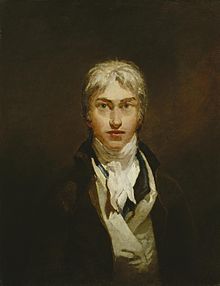
To start with a little background, the painting above is his self portrait. The only one he ever did in his lifetime. He was a private person as we know, and gave little of himself away. His birth date is given as 23rd April 1775, but this is disputed, as Turner would give different dates to different people. he had this aversion to people knowing his personal details. He lived with his parents, which was far from being satisfactory, as his mother had a violent temper, and was later incarcerated in Bedlam Hospital. So he as at School in Brentford and later in Margate, and this is where his love of the river started. He loved boats and messing about in boats. They figure in some of his paintings, and they are a frequent mode of travel on his painting expeditions. later he would row sometimes as far as Windsor on the Thames and down the Wey to Guildford, which we will look at later.

let’s start looking at some of his Surrey paintings and start in date order as far as we can

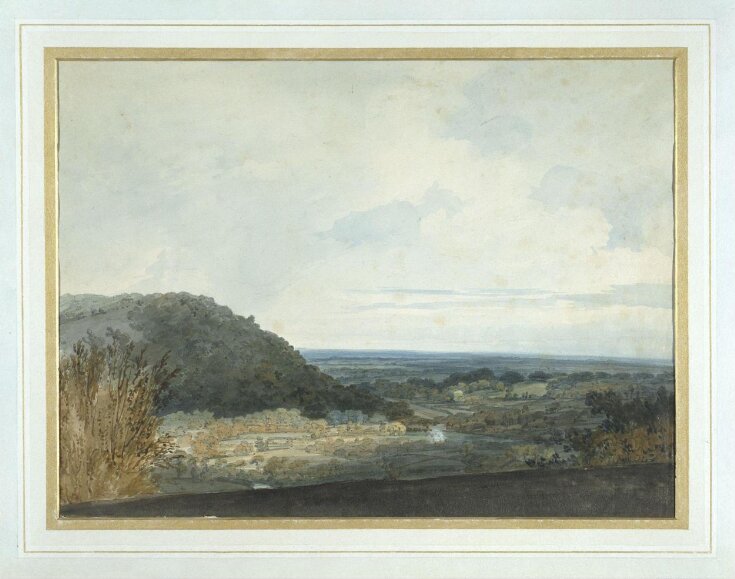
Possibly Box Hill Date….. previously attributed to Tom Girtin, and later to Turner. Girtin was contemporary to Turner, and they were in fact great friends. They would go on expeditions together, and on one of them painted the Savoy palace from a boat on the Thames. Girtin was an acclaimed painter, who sadly died at the age of 29. Turner held him in high esteem and his famous quote said ” if Tom had lived I would have starved”. Turner was definitely in the area that year, as the next painting of Leatherhead shows. This was his so called Student period.

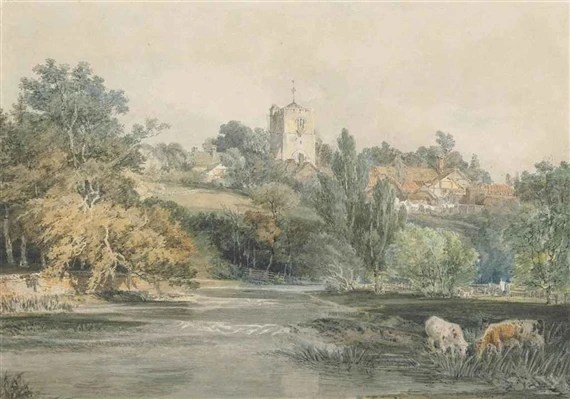
At about the same time, we have this painting of Leatherhead

Leatherhead from the River Mole, with cattle in the foreground, dated 1796, and attributed to Turner. I find this an immature style compared to what we associate with Turner’s work, and it would be as this comes within his student period. Turner had been invited to Norbury Park, near Leatherhead, a place I associate with Fanny Burney who met her future husband there, Comte d’Arblay, an emigre from the French revolution. I wonder if they met Turner. Interesting to conjecture

I will publish so far and go on with this at a later date

Leaf Spirit by Simon Gudgeon- a Tribute

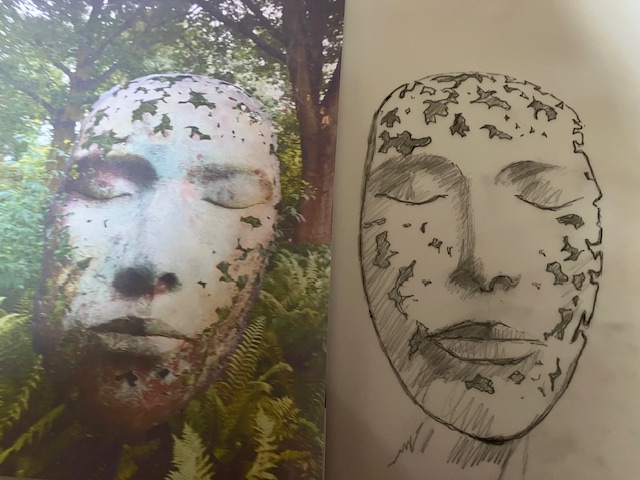
I have talked about this sculpture before. Leaf Spirit by the sculptor Simon Gudgeon, which is in Kew gardens. This isn’t the only example of this sculpture but the only one that I have seen. I did a blog about this some years back. It is in my opinion, an amazing piece of work, and I did wonder at the time whether I could attempt a painting of it, and in watercolour too, which will be a handicap in this instance.

This isn’t about the result, but more about the exercise and what I will learn from it. i suspect that it will be a steep learning curve, to coin a well worn phrase

I have found this to be a very hard year for selling paintings. I am not alone in this. There is a dearth of disposable income around the world. Competition for sales is fierce at the moment. Fortunately this is not my day job but for some artists life is tough. My mentor at our local art club has given me very good advice. Step out of your comfort zone, and paint things which challenge you. Don’t necessarily paint subjects that you expect to sell. So I have made a start on Leaf Spirit. I have done the drawing which has been surprisingly tricky. No matter how often I checked my measurements, the expression on my face is not quite the same as the one in the photograph. Mine looks more feminine for some reason, but it could change again with colour added.

I will go on with this at another date. I have some other projects queuing up and they too hopefully will take me in new directions. This could be the start of something totally different, a change of style even. For now, we will see where it takes us. Good I am starting to get inspired again

Exhibition of Women Artists at Tate Britain

Magnificent exhibition at Tate Britain entitled Now You See Us is on until early next month. I wish I had gone sooner as this is an exhibition that needs more than one visit. It covers the work of women artists from 1520 – 1920, during ages obviously when women were subservient to men in most walks of life. Their work very often epitomises their struggle for recognition.

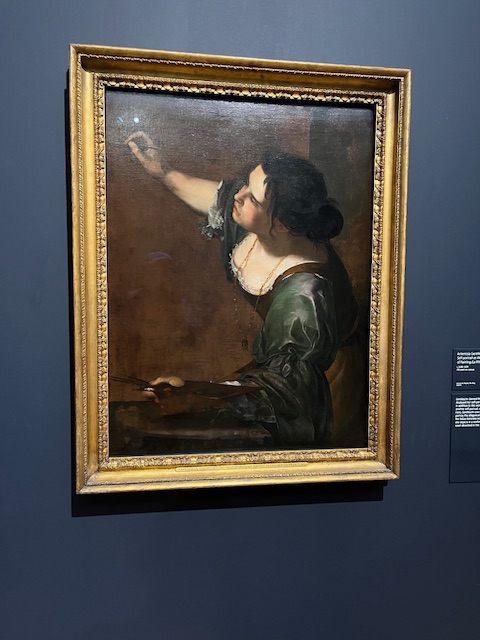
One of the earlier examples, a self portrait by Artemesia Gentileschi, an Italian artist working in London during the reign of Charles I, In London she worked for Charles I and Queen Henrietta Maria, and two works in this exhibition are from the Royal Collection. The other one is Susannah and the Elders, a popular Old Testament sory who was observed bathing by two of the elders, and sexually assaulted. The usual story, the elders tried to make out she was a whore but later her innocence was proved.

There were an amazing number of artists represented working through the ages. Very few did I recognise. Gwen John was one, and her self portrait was used in the exhibition publicity. In fact the work of hers shown was in my view some of the least inspiring.

During the 18c the work of the Royal Academy centred round oil paintings. Other media was looked down upon. Joshua Reynolds was especially sniffy about watercolour, pastel, embroidery and any sort of craft as being work that women did at home for their own amusement.

Gradually, and as we move into the c19 women are starting to meet men on equal ground. Two paintings which greatly impressed me were:

Colt Hunting in the New Forest by Lucy-Kemp Welch

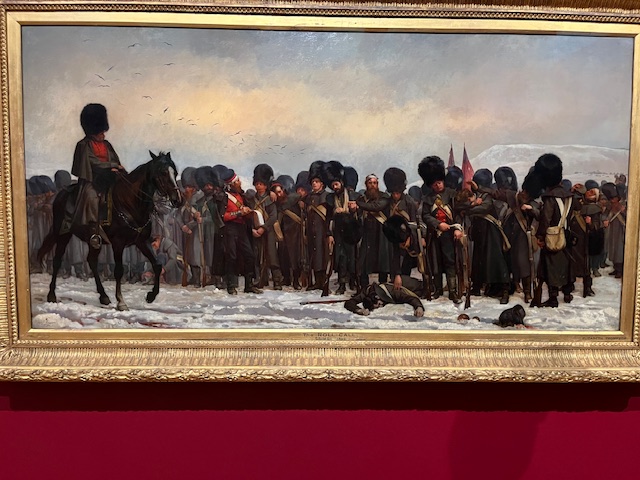
The Roll Call by Elizabeth Butler, a painting of Guards Regiment in the Crimea. This painting was summoned to the palace for a special viewing by Queen Victoria. It sold for the staggering sum of £1200

Both of these were sensations in the art world at the time. Both were hung “on the line”, which means they were hung at eye-level, a great tribute by the hanging committee of the Royal Academy

Colt Hunting in the New Forest which is an enormous painting

The Roll Call by Elizabeth Butler

My photographs are not very good alas, done quickly avoiding other viewers.

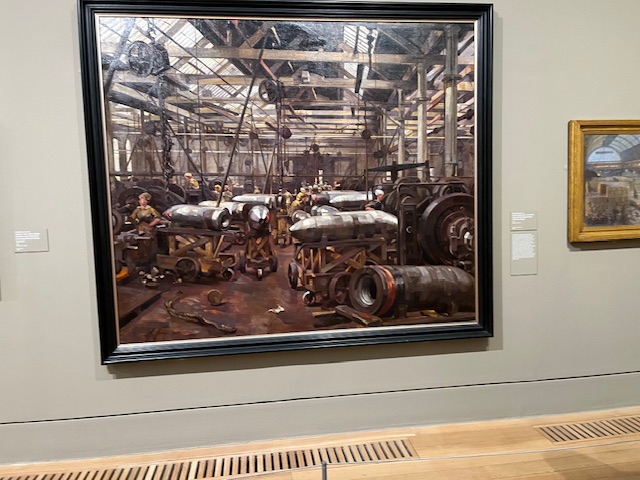
Finally. a painting by Anna Airy, commissioned by the Imperial War Museum, Shop for Machining 15″ Shells, shows women doing factory work in 1918. This was the old Singer sewing machine Company factory on Clydebank. Important work and an important painting

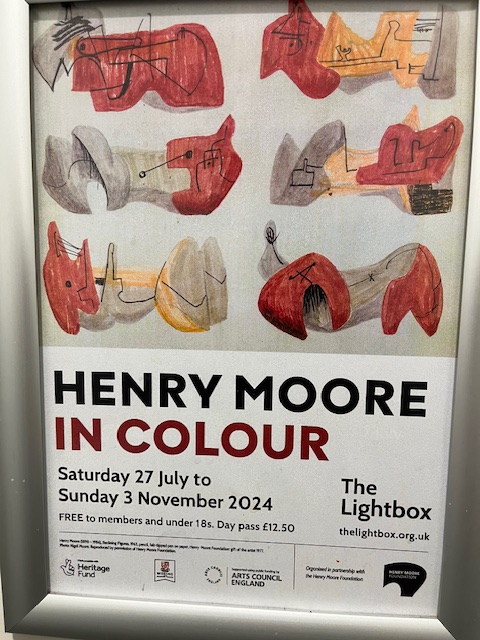
Henry Moore in Colour at the Lightbox

Yet another excellent exhibition at Woking’s Lightbox art gallery. Small, obviously, size dictated by the venue but focused and to the point. We, in Woking, are so pleased as following the bankruptcy of the town brought about by reckless investment, the fate of the Lightbox has been in the balance. Deep cuts are having to be made, and when difficult choices and sacrifices are having to be made, then difficult sometimes to make a case for our wonderful art gallery to be saved. So far it has been managed by the new local government and we are grateful for that. The Lightbox is relatively new, in a town with virtually nothing by the way of heritage or culture, so the rise in prominence of our gallery has been a matter of civic pride. We hope it will continue

Henry Moore is well known, and if like me you tend to remember his wonderful sculptures, then it is useful to be reminded that he painted as well, and some while ago too. When reminded, of course I remember his drawings and paintings of people taking shelter during air raids in London, in the underground railway stations. This exhibition highlights some of these works, known as the Shelter drawings commissioned by the War Artists Advisory Committee during the last war. These Shelter drawings were responsible for achieving widespread recognition for the artist following their display in the National Gallery. When you look at some of these drawings you start to see forming some of his later sculptures and I will show one if I can as an example

Certainly the first one I think I have seen as one of his sculptures!

Many years ago, there was a major exhibition of his sculptures in Kew Gardens, and I painted one of them that was placed in front of the Palm House. By way of light relief, I will end with it here

A figure stretching after a night on a cold platform? Might be

Recent Commission

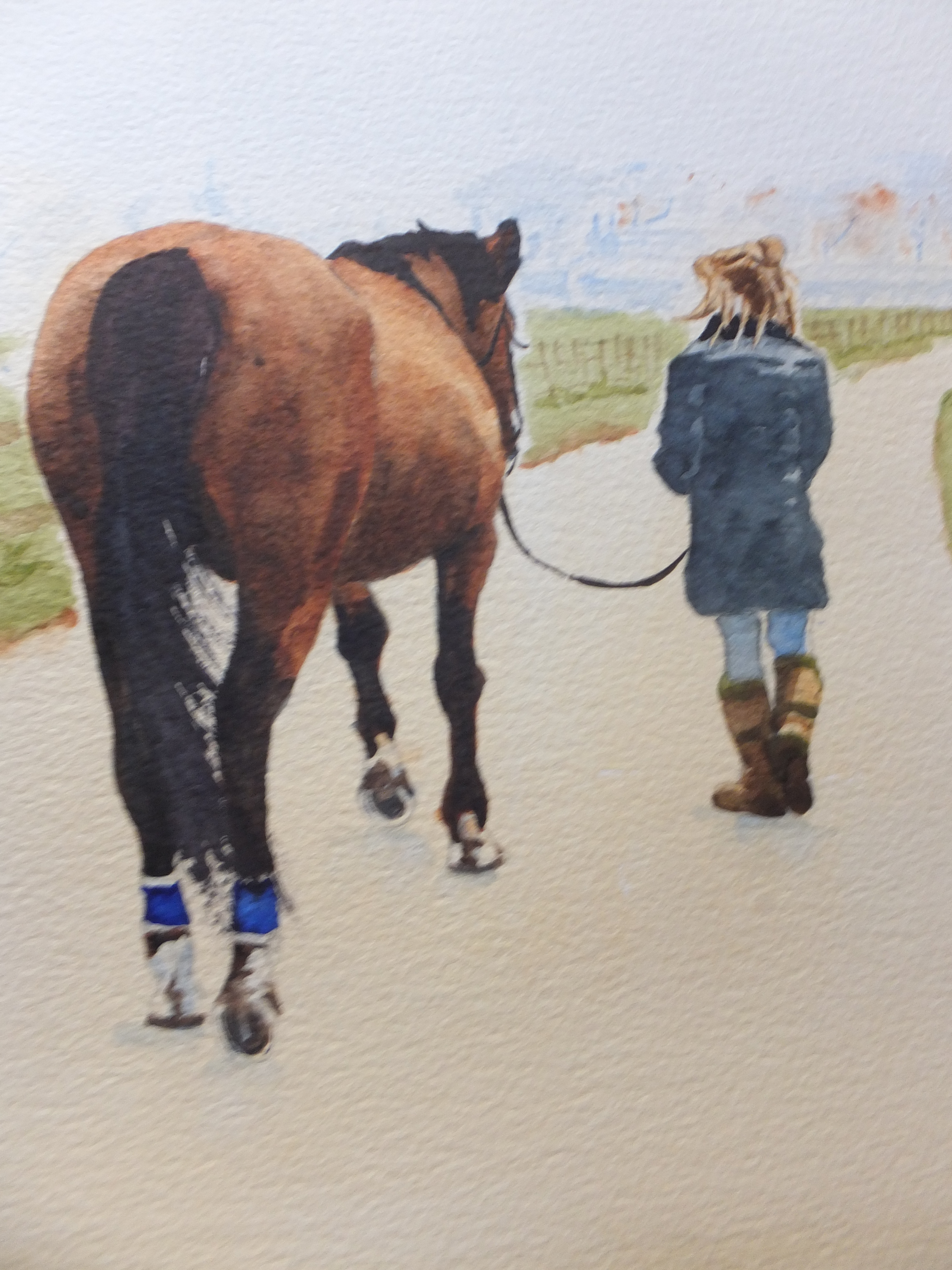
This is the type of commission that I enjoy doing. One of my favourite subjects, painting horses, and in this case, a charming composition, of a horse being brought in to the stables, possibly for saddling up, by her young owner.

One of the most difficult things to get right was the colour of the horse. A brown horse doesn’t sound very complicated but there are many shades of brown, and I needed to get close to the original reference photograph. This horse looked like a bay to me, with black mane and tail, and with black legs. I did the horse over several days, building up the colour and letting it dry overnight. Until the colour was dry, you just could not tell what it would look like. Eventually I was satisfied with the result

Most other things were relatively straightforward. I blurred out the background to increase the feeling of distance. Also in the photograph the background was in direct competition with the main subject.

The composition now worked well and told a story. I was a rider myself once long ago, and this picture reminded me of those days. My son and I would go north for a week to Northumberland, where there are some very open spaces. We would ride from place to place, and overnight the horses with local farms. They would stay out overnight, and in the morning we would have to go and find them, and bridle them up. Horses are cunning and when they saw you coming would make for the higher ground. You really worked hard to catch them. Once you got the bridle on, you could bring them down to be saddled for the day’s ride. This picture reminded me. Incidentally all this happened nearly forty years ago. My son is 53 now and me, well, I don’t ride anymore.

Arundel Castle in Sussex

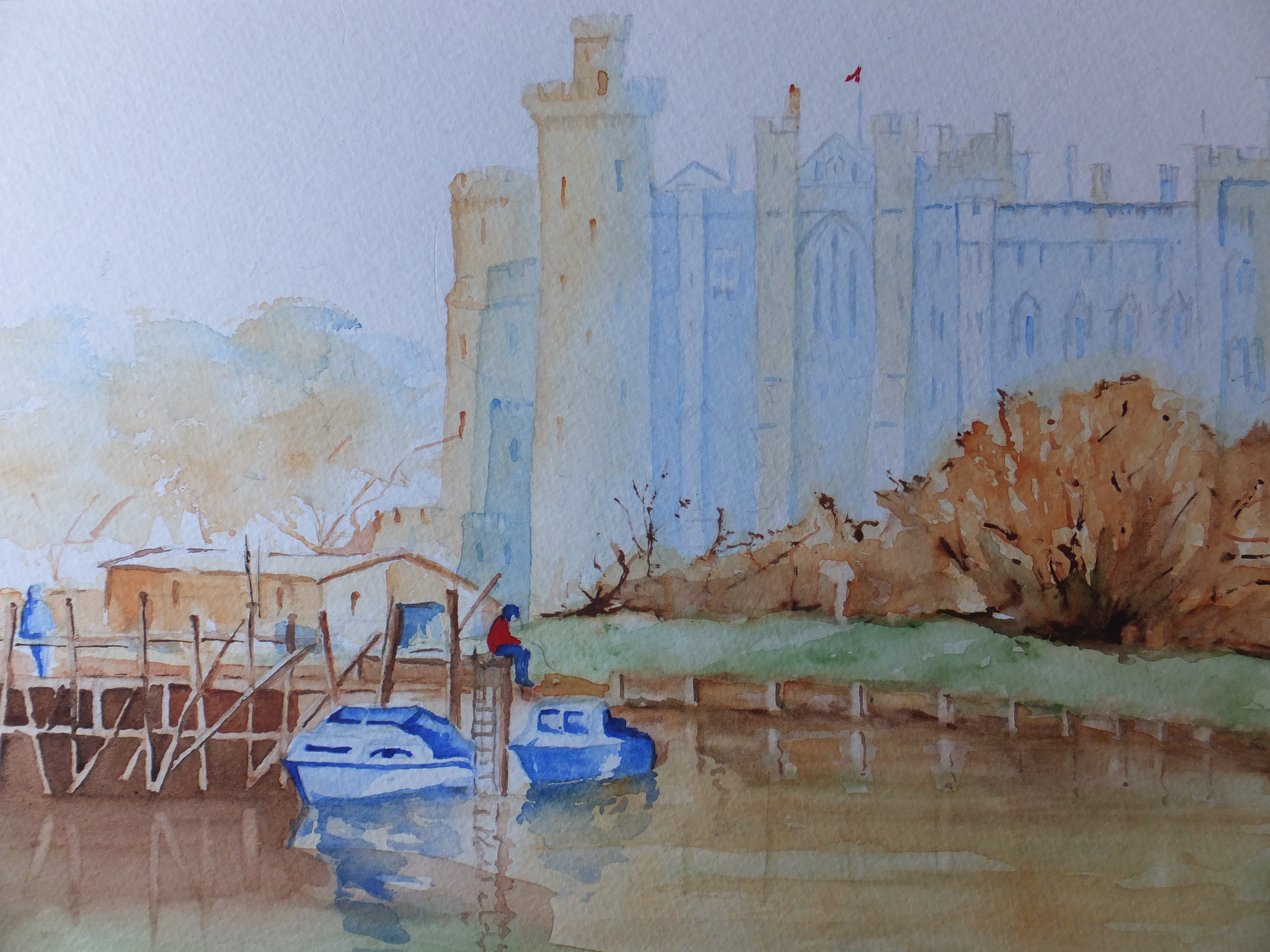
A view of a mistry Arundel castle across the River Arun

Probably one of the best-known castles along the south coast, Arundel castle is ancient but largely restored in the c19.

Arundel is the seat of the Norfolks, who would have moved here from Framlingham during the c16. A family with close association with the monarchy, their fortunes rose and fell throughout history.

In 1485, at the battle of Bosworth, they were on the losing side, and lost the Norfolk title. They reverted to the earldom of Surrey.

In 1513, they regained their title of Dukes of Norfolk, after defeating a Scottish Army at Flodden Field in Northumberland. The Scots had invaded England after Henry VIII had invaded France. Catherine of Aragon had despatched the Earl of Surrey northwards to meet the Scottish Threat. After an ingenious manoeuvre whereby the English worked their way round the Scottish position during the night, they approached the Scottish Army from the north, whilst the Scots were entrenched facing south

The result was a massive slaughter of the Scottish nobility including the king James IV, whose body was taken to London and put on show. Scottish losses were about 30,000

The Earl of Surrey was restored to his old title of Duke of Norfolk.

The Norfolks were and still are the leading Catholic family in the land. Their fortunes changed with the religious struggles in the 16c

Today they are often in charge of large events like coronations, and doubtless will be this year too

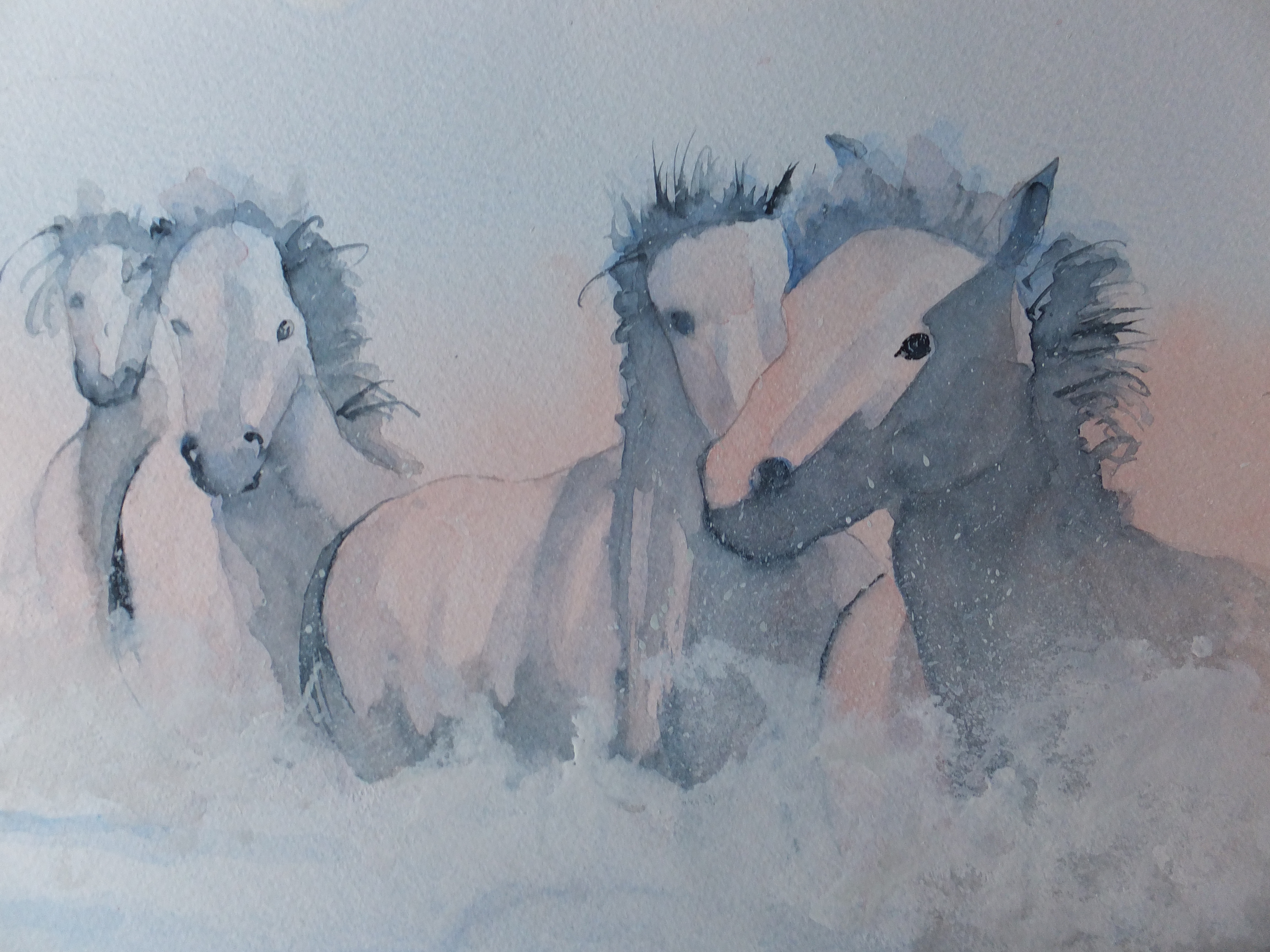
More Horses in the Wetlands

I have trieed a different image and with it a different style

I was intrigued by this image, having decided in my mind to give horses a rest for a while. I was struck by the simplicity of the subject, and wanted to capture that. Detail has been kept to a minimum. Despite the activity, the horses seem calm. The water is churned up, yet the painting gives a feeling of peace

I think this is a painting that you can look at for quite a long time.

Others may disagree which is fair comment

Sunset Horses in the Wetlands

Horses galloping through water in the sunset

I never tire of looking back to our visit to the Camargue, where tributaries of the Rhone flow into the Mediterranean sea. This wetland area is famous for its wildlife, flamingos which breed here in possibly their only breeding ground in Europe, bulls which are bred for fighting, and, of course, the famous white horses which run wild throughout the area. They are magnificent to watch

I have painted them before. Always a delight. I hope you enjoy looking at this painting. As far as I remember I have only used two watercolours, Cobalt Blue and Vermillion which work well together as a sunset effect.

Southsea Pier Sunrise in Watercolour

Sunrise over South Parade Pier in Southsea

A favourite place from my childhood. We were taken there and allowed to play on the gaming machines, which were not very sophisticated in those days. I remember putting in one old penny which was the pre-decimal currency, so value today, one half of a new penny. The aim was to flick a ball bearing round at speed and see where it landed, hopefully in a slot which gave you a payback. As I say, extremely unsophisticated

This painting relates to the reference photograph which I posted last time, which I was kindly allowed to use by Vicky Stovell of Smiley Sunshine Photography.

I used few colours. Cadmium Orange, Ultramarine Violet, Dark Mauve and Cobalt Blue. I combined the blue and the violet for the sky as well as the wet sand at the bottom of the picture. The uprights for the pier were in deep, deep shadow so i used the dark mauve, instead of black which I avoid where possible.

In order to get the bright sun image, I held a tissue in place with one finger, and then applied the first wash. There are probably better ways of getting that result, but that was the best I could think pf at the time

This painting will be going in my September exhibition at Denbies Wine Estate, so hopefully will freshen up the collection

I have another Istanbul painting in preparation so will post that at a later date

Marzamemi in Sicily- a different view

Fishing Boats in Marzameni Sicily

I have painted a view of Marzameni before some years ago. It is a delightful fishing village, where we stopped just for a coffee break, and then wandered down to the water’s edge. Many of the boats were obviously old and maintained by their owners, Some of them were hand painted, just bright Mediterranean colours, vivid reds and blues, together with dazzling whites.

The sea was the brightest blue, and as always I hope I do the colours justice. I used Pthalo Blue modified with Cobalt Blue for the sky and the sea, which seemed to work. The same colour strengthened seemed to work for the boats as well, although I did get an opportunity to use Windsor Blue for a really deep blue stripe on one of the boats

As we watched ,the boat with the umbrella hove into view and rowed slowly by, eventually finding a place to tie up. This boat was smarter but the colours were more muted

I enjoy painting Sicily. Always the colours are so vibrant, and the shadows so pronounced

I am exhibiting at the moment at Denbies Wine Estate near Dorking, and have sold a painting of Horses in the Wetlands, another favourite subject