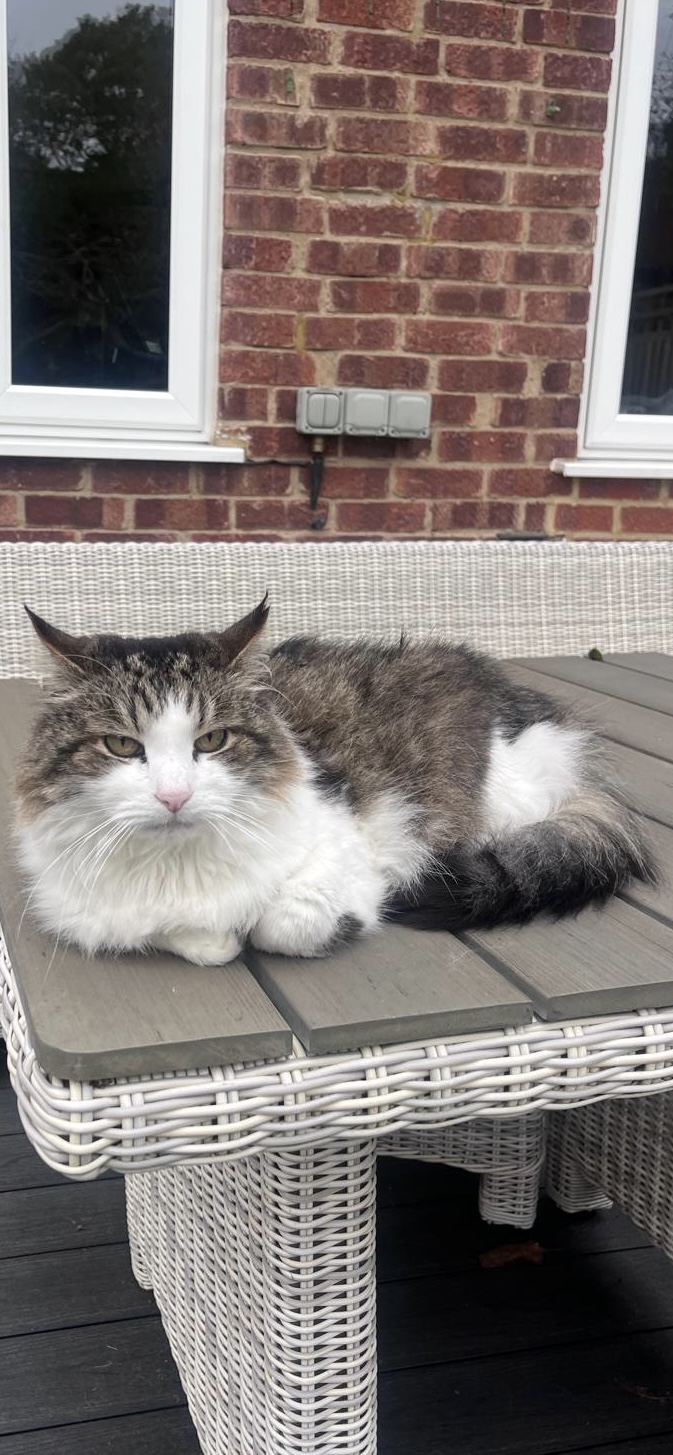
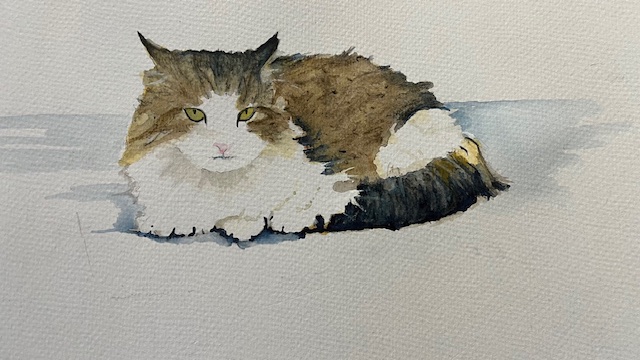
This is Pepe, a neighbour’s cat, a handsome devil, although getting old now. he is good natured but easily spooked, so you have to be careful how you approach him. Iwas asked to paint his portrait and tried to explain that animal portraits are not really my thing, but that I would try my best.
This my best shot
I liked what I had done, but does anyone want my opinion. As it happened his owner and my neighbour loved it, so all was well.
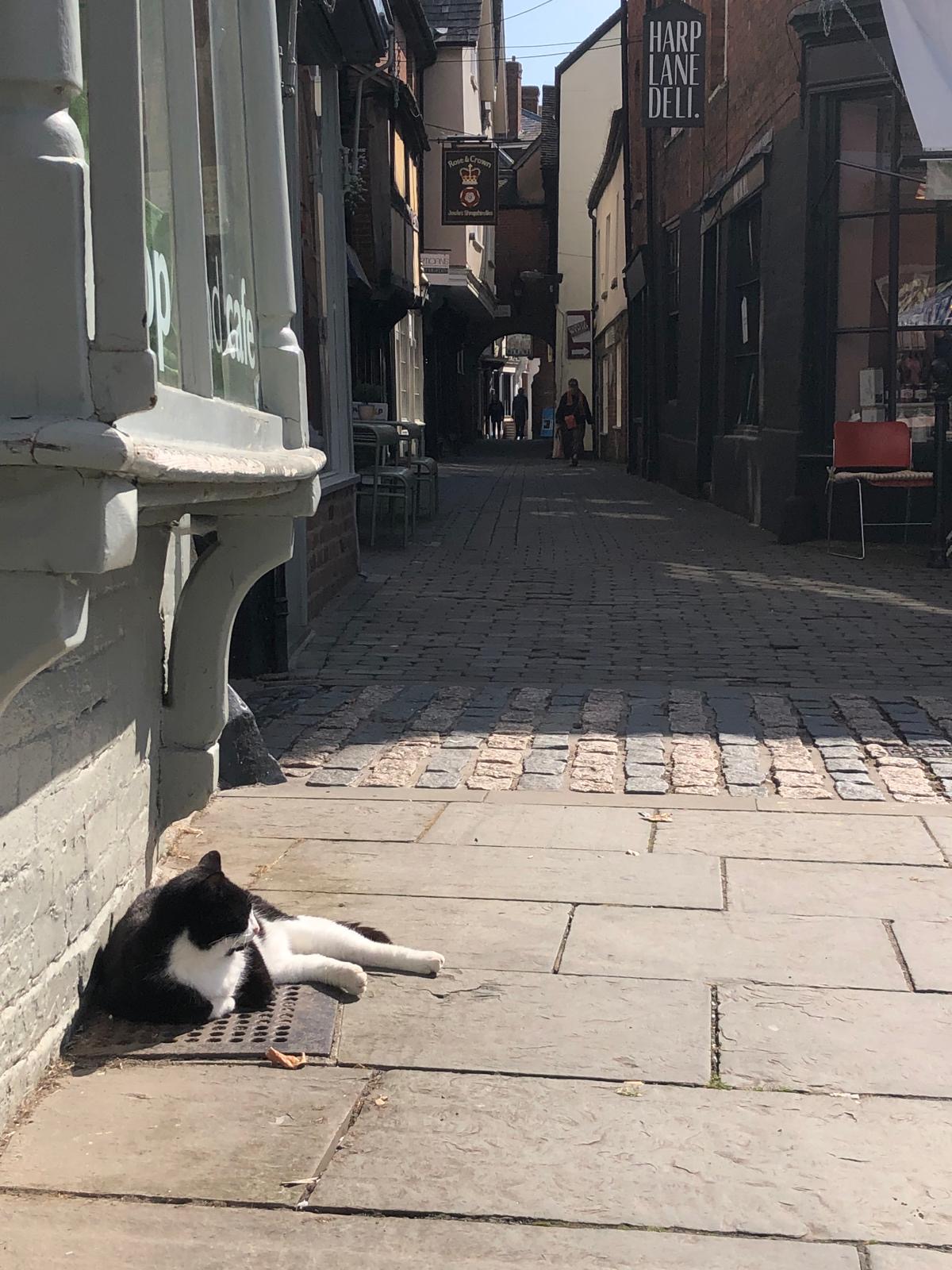
Following on from one cat portrait which I didn’t know I could do, I have decided to try another from a photograph my son sent me, showing a cat basking in the sunshine. He was walking round Ludlow at the time. he called it ‘chilling cat’. I prefer alley cat
Quite a lot in this picture to amuse a watercolour artist. A lot of shadows with a light source at the end of the alley as well as the cat itself. We’ll see how that turns out. It may be one of those pictures that needs a sample done first. Whichever, it will keep me amused
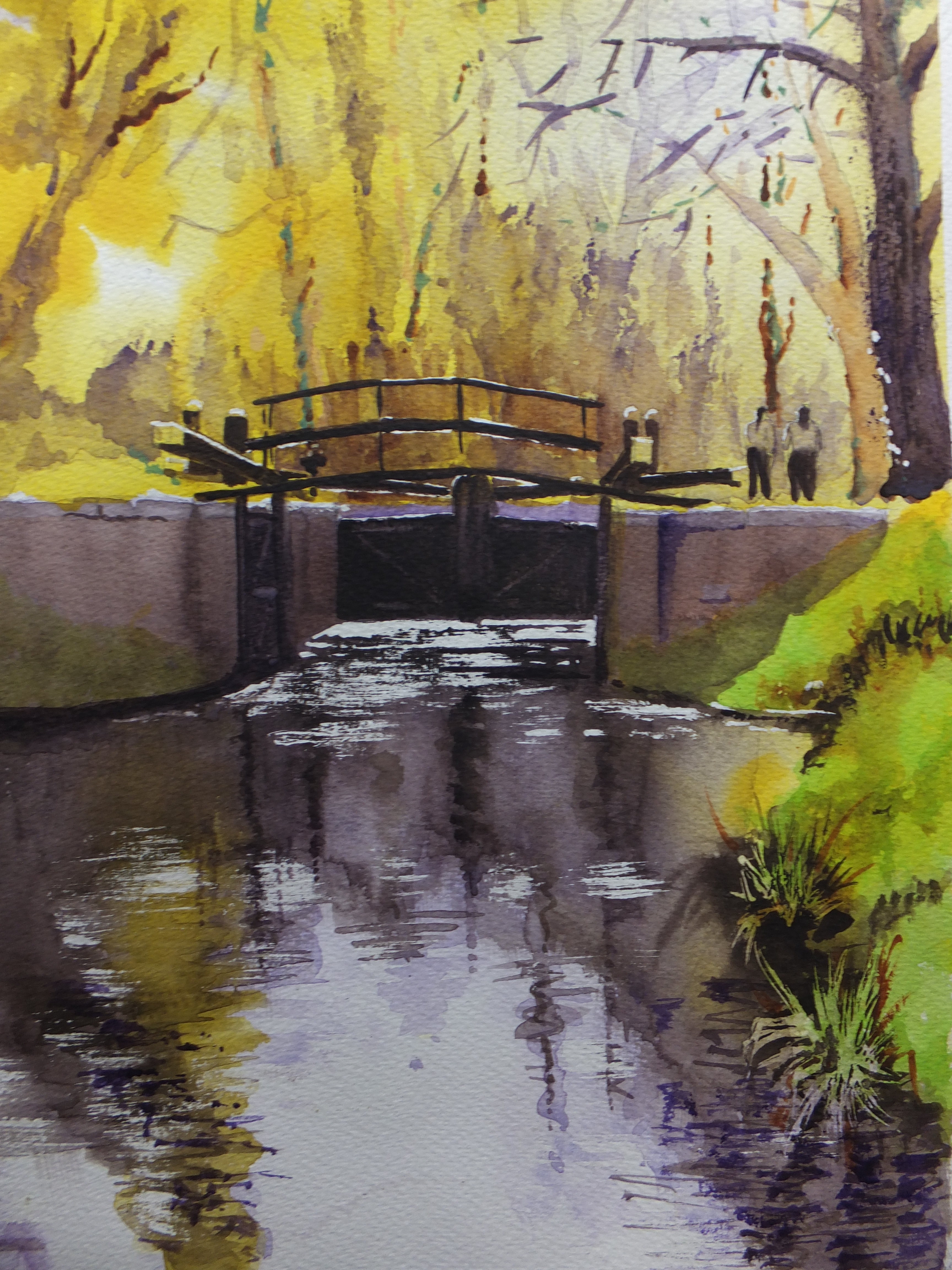
This is a really old favourite. The lock gates on the Basingstoke Canal, which flows quite near where I live. The canal is part of our industrial heritage, cut in the late eighteenth century to provide an inland link between London and Southampton, a major seaport. This was the time of wars or imminent wars with France, and transport by sea was fraught with risk, so the Wey was linked to the Arun by canal and extended to Portsmouth, which lasted for a short while, and this canal now called the Basingstoke was planned to reach Southampton. It never got there. It reached Basingstoke in the north of Hampshire, and then came the railways ,and canals were quickly redundant.
This painting went out to New Zealand by the way. It was bought by a young couple who’d come back to visit an elderly mother. They came to one of my shows, and took this painting home with them. That was years ago. I hope it’s still giving pleasure.
Today this canal is used for leisure only and is a haven for wildlife. It also gives artists and photographers subjects for their art. I’ll include a few
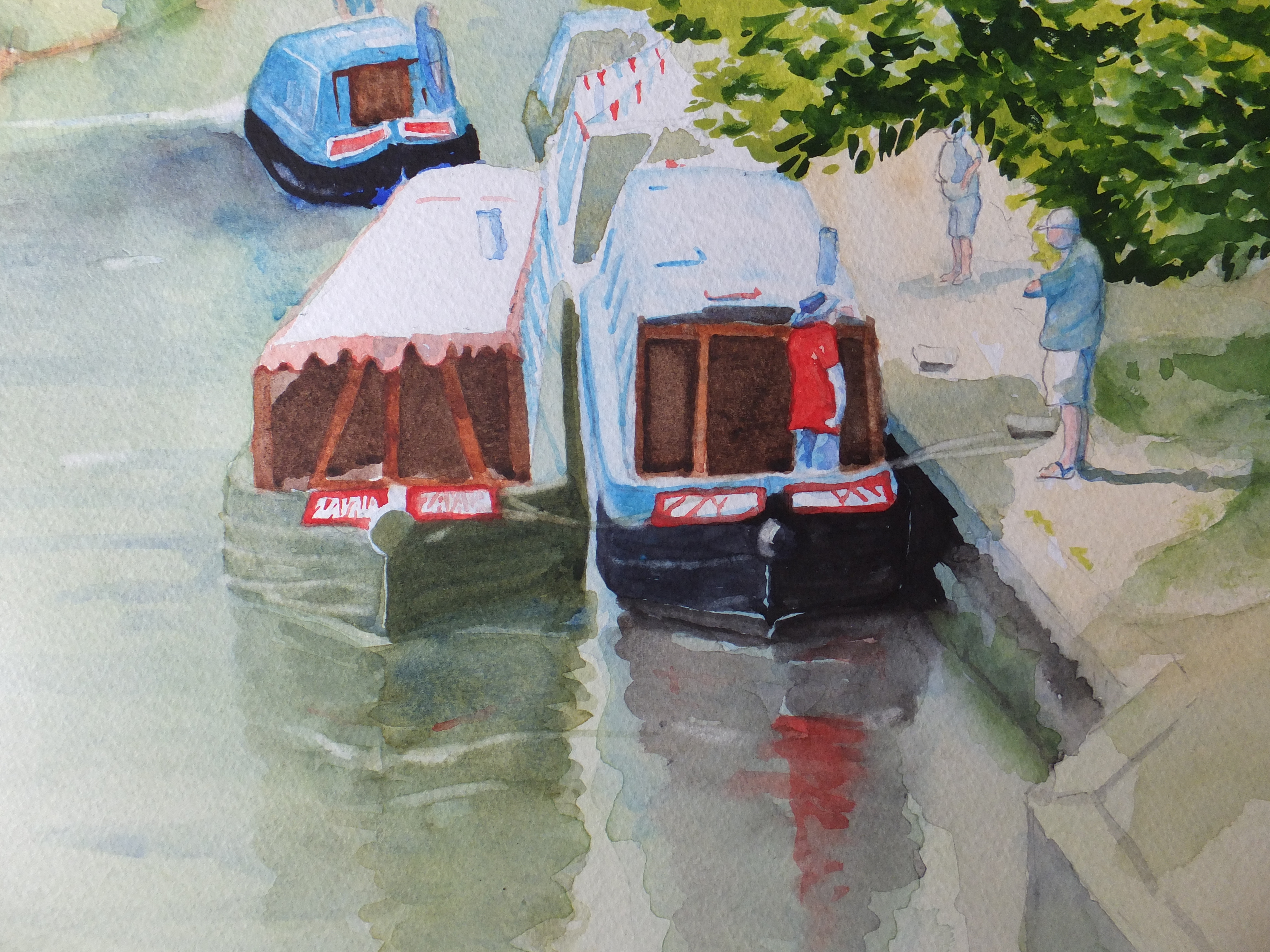
Barges gathering on the Basingstoke Canal
These are barges, of the type used for transportation in times gone by, which are now used for leisure purposes.Every so often there is a gala, when the barges get together as part of their social exercise. This is an ideal spot alongside one of the old wharves, which is outside our local Italian restaurant, which you can’t see, but is to the right of the picture. Delightful on a summer evening to sit outside with a glass of Cava and watch the activity on the water. The old boathouse is there too, long converted to a pharmacy.
I stood on one of the old bridges, Kiln Bridge, to take the reference picture for this painting
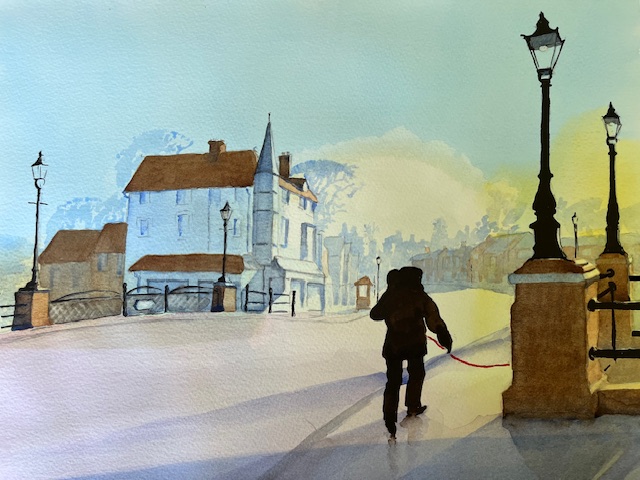
Kiln Bridge in winter sunshine
This is the bridge over the canal leading into the village of St John’s. Kiln Bridge, well the clue is in the name. When they were building the canal, they made the bricks as they went along. The village grew up around the canal in a shanty town sort of way, and most of the buildings are Victorian. The shop opposite in the picture is a restaurant today, but in its day was a haberdashers shop for a while, in those good old days when small shops could make a living selling everyday things, before being driven from the high streets.Today restaurants and beauty parlours proliferate but at least they aren’t empty
The village took its name from the church of St John’s which was built by the rector of Old Woking, as a chapel of ease for the villagers. Very considerate, as everything was a walking distance in those days, and a five mile trudge to church in bad weather would be offputting even to the most pious.
I haven’t painted this church yet although I do intend to. It is a handsome Victorian church by a very well known architect George Gilbert Scott, who was responsible for many new churches up and down the country, not to mention restoration of old churches and cathedrals. Not just churches but also remembered for the Midland Hotel outside St Pancras Station, which was derelict for many years and beautifully restored comparatively recently. There were three generations of architects. Giles the grandson, built power stations like Bankside now Tate Modern and Battersea finally developed into a magnificent shopping mall. He is especially remembered for the red telephone box, which now are collector’s items.
For the moment, that is enough for one post. An interesting journey for me which I hope you enjoyed as well. I am quite elderly now, so if I want to look back again, there is plenty for me to look at
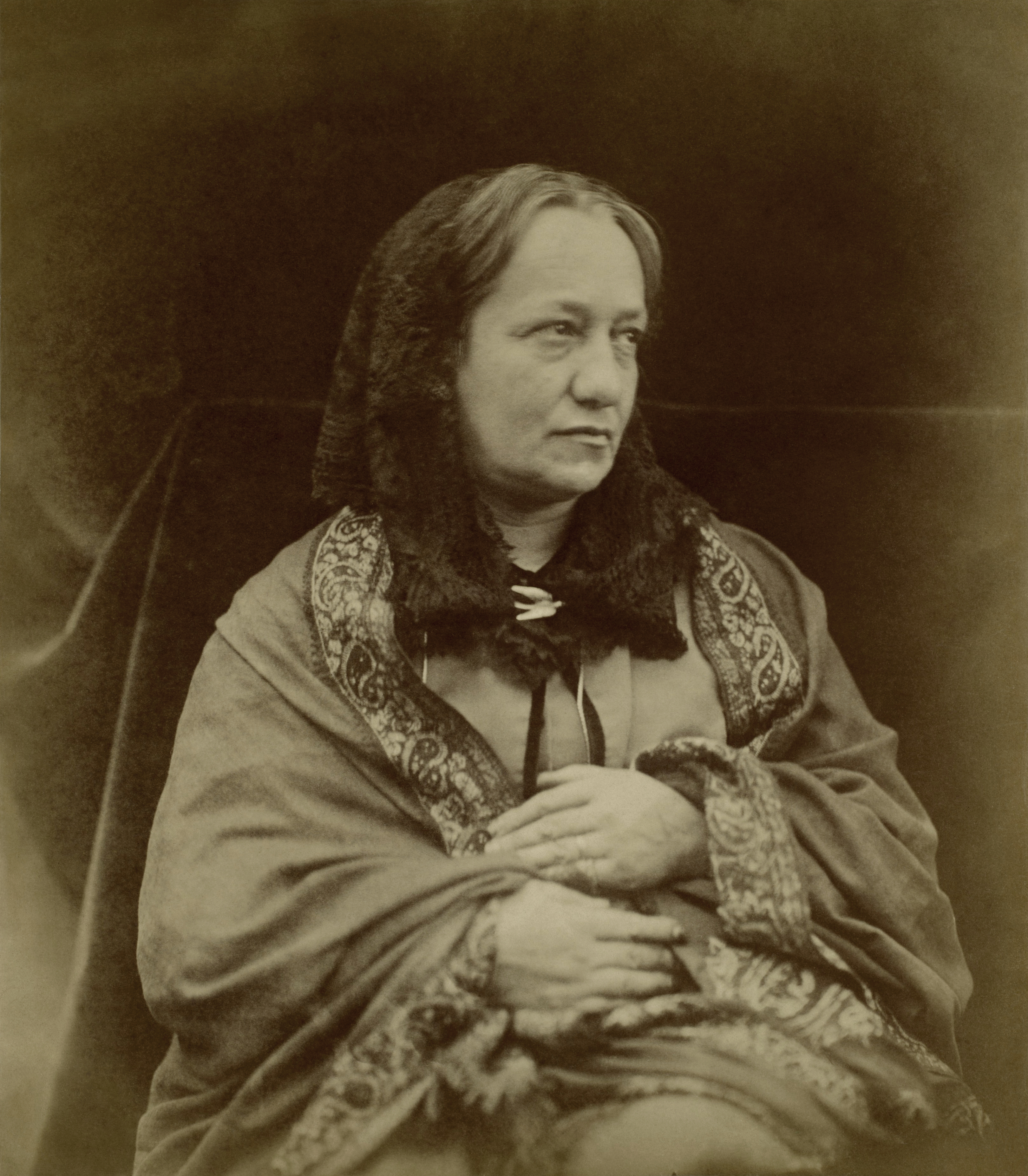
Probably the best known of the Pattle sisters, Julia Margaret Cameron
This is the current exhibition at the Watts Gallery at Compton near Guildford. This is the gallery of the paintings of George Frederick Watts, the famous Victorian painter. He lived nearby at his house called Limnerslease, with his wife Mary. He was a prolific portrait painter. He was also well known for allegorical subjects. His painting called Hope was featured on postage stamps and was also known as Barack Obama’s favourite painting. Likewise he often painted pictures with a social message
His wife Mary, also a painter, gave up painting to support her husband. She founded a pottery workshop in nearby Compton to give employment to local craftsmen. She is also known for building the nearby chapel with designs by her husband, generally regarded as an Art Nouveau masterpiece
This is the painting of the Watts Chapel that I did once, built in brick and shaped like a Greek cross. The interior is beautifully designed in Arts and Crafts style. The bricks were made locally in Mary Watts works
The Pattle sisters were born in India, and became central figures British art and literary society. Born in Calcutta now Kolkata to James Peter Pattle, a civil servant, and Adeline Maria De l’Etang ,they received education in Paris and India.
Known for their beauty, intelligence and independent spirits they navigated complex social landscapes, bridging cultures and influencing Victorian high society and intellectual movements
George Frederick Watts was one of the prominent figures that they were connected with. There were seven sisters in all, and probaly the best known is Julia Margaret Cameron, the famous photographer, who lived on the Isle of wight for many years. Given a camera by her daughter, she became well known for her photographs of famous people, and also for the ability to capture subjects in a very soft light.
Maria Jackson (nee Pattle) was the mother of Julia Stephen who was mother to Virginia Woolf and Vanessa Bell, thus linking them to the Bloomsbury group
Pattledom was a term coined by Thackeray describing the sister’s powerful social network and bohemian lifestyle, blending Indian heritage with French education and English society
This exhibition is on until May, and well worth a visit if you are within striking distance of Compton
Btw. if you want to see more of my own paintings, they are listed also on my own website davidharmerwatercolour.co.uk. This website is a showcase rather than a shop, but enquiries are nevertheless welcome
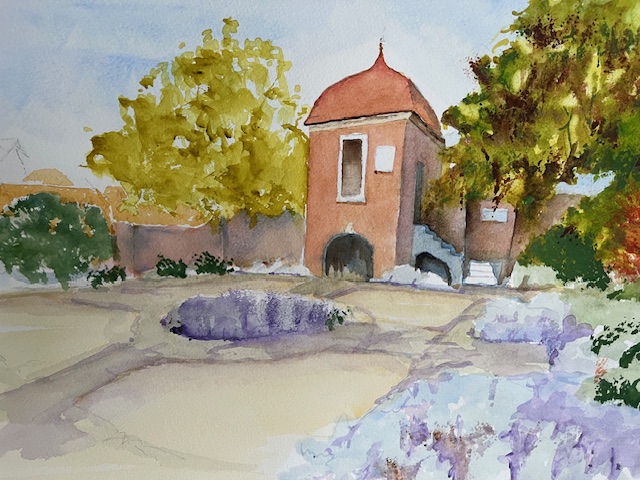
This was a nostalgic trip for me. I used to live literally round the corner from this lovely building, although at that time you could only see the top half as it was surrounded by a high wall. Pieces of glass were set into the top of the wall, to stop people climbing over. Even in those benighted times, this was illegal and constituted a man trap. Goodness knows when these shards were mounted into the wall, well into previous centuries certainly
Since then, walls were taken down and this delightful gazebo was exposed for all to see. It is from the c18 and was built as all gazebos were, to enable the leisured classes to enjoy the view from over the wall, and no doubt in those days for quite a distance. It would have looked out over the Fair Field, a large green space which would have hosted an annual fair. This is long gone, and today is commemorated by a road called Fairfield Road. The row of houses in this road was built in the reign of Queen Victoria, quite late in her reign as I remember, from building material taken from the demolition of the old manor house opposite.
Coming back to the gazebo, this was in a large garden at the back of a beautiful Georgian house called Magnolia House, occupied by two generations of dentists, now gone. Still a dentists surgery but the original old Havant family is no longer there. The house is one of the very few Georgian buildings to have survived a great fire in the c18. It is slightly uphill from the rest of the town which may have saved it from the flames.
I did this little watercolour quite quickly just to preserve a childhood memory. Havant is not a town which escaped development and there are very few gems like this remaining
I don’t live in Havant now, haven’t done for many years. My father lived in the family home in nearby Manor Close, named after the manor house which disappeared. I used to go down regularly so was able to look at the gazebo in all its glory, although could never go in as that is by appointment only, and time did not allow. The only problem with going back to scenes of one’s childhood, is that you start to hear voices of people you knew at the time, so stop and move on
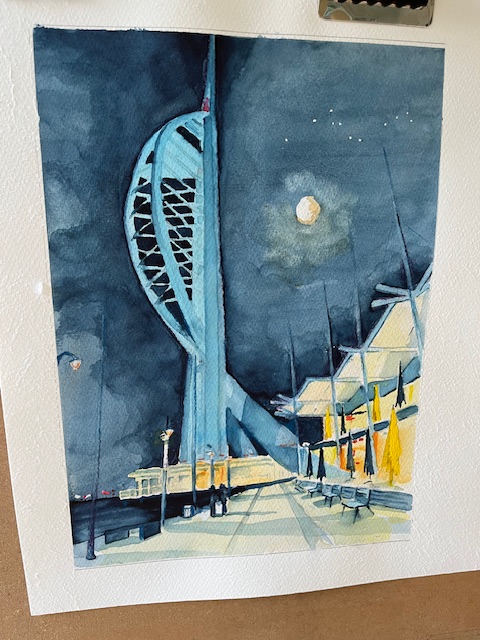
This is the finished painting literall hot of the easel. This was a commissioned painting which the client has previewed, and is delighted with. That is always a relief. I was happy with it, but art is subjective, so one is never sure. i don’t remember tackling a night time scene before one that is highly illuminated. It is quite tricky as so many light sources to take into account. Interesting nonethe less.
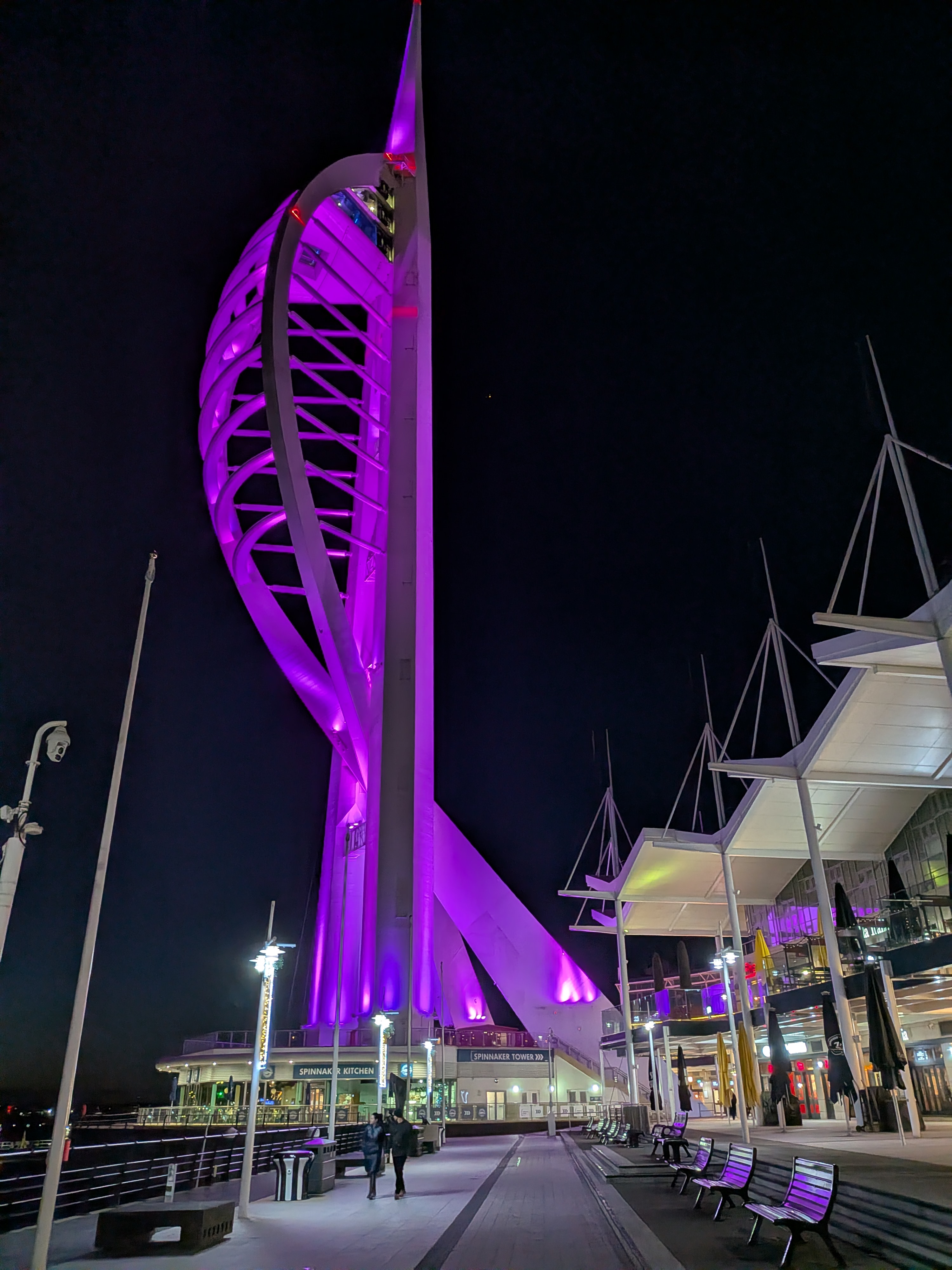
I used indigo for the night sky and introduced cloud and the moon to make it more interesting. An occasional dab of black where I wanted the sky to be really dark. Quite a lot of masking out on this one. The tower itself for one which was a big job, plus the gables over the restaurants. Also I had to do a lot of lifting of colour for example to produce the tall poles which are shown in deep shadow on the photograph. They worked well. I was pleased from some of the comments afterwards that the mood created was what I was trying to get. Some drama and some romanticism, bearing in mind that this was someone’s special place
As always I was privileged to be entrusted with something that is special to someone, and as always so pleased that it turned out well.
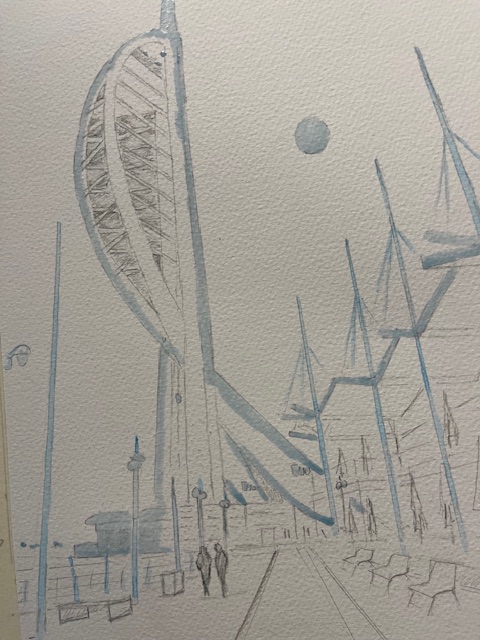
This is the drawing so far and even this took some working out. There was an awful lot of masking out to do. The tower itself has had to be protected as the night sky will be darker than the colour chosen for the tower itself.
Likewise the gables on the rooves over the shops on the right hand side have had to be protected. I don’t usually like a lot of sharp edges in a painting, preferring to let colours blend, but in this case it has been unavoidable. Plastic or metal edges really have to be shrp otherwise just look wrong imho.
I am apprehensive about starting the painting on this one, especially the sky. If that doesn’t work, and I have to start again, then I will have wasted a lot of time. Let’s not go there. I have retrieved worse situations
This must be one of the trickiest commissions that I have ever accepted, and one which questions my wisdom. Firstly working out a colour for night black, and it won’t be black ,has not been easy. Black in large quantities I find tends to flatten the painting, unless it is a raven glossy black which works for many things but not sky imho. Then what colour to use for the illuminated tower itself, and there we have a certain choice of watercolours that have a luminous quality, but which one to use against which night sky that is the question.
This is the client’s photograph btw and is a very good one in terms of composition. So many aren’t and refreshingly I have little or nothing to change other than possibly including the moon, which i have agreed with the client. Perspective is intriguing which I like. All those lines going towards the vanishing point will be fun to work with
I have done various trials and have shared these with the client. For the night sky I looked first at a midnight blue colour, definitely steering away from black per se. To mix a midnight blue I am using indigo with a touch of Payne’s Grey, which is a blue black colour, and is useful. A lot of artists avoid Payne’s Grey but I find it useful at times. in fact that was the other contender for the night sky, as it is not quite black, as I say more of a blue black colour. So that was my submission for the sky. Now for the illuminated tower. The colour needs to be luminous which is not that easy with watercolour. I chose in the end pthalo blue and as an alternative, permanent rose both of which would work. I also glazed pthalo blue over rose just to see what would happen and again the result was workable
The client came back quite quickly. She preferred the indigo version of midnight blue and also the pthalo blue for the tower. I was relieved about that, as both were my preferred option, and in neither case did I lead her in anyway
So I know which direction I am going in, and will proceed with the painting. I will come back about that although probably not too soon
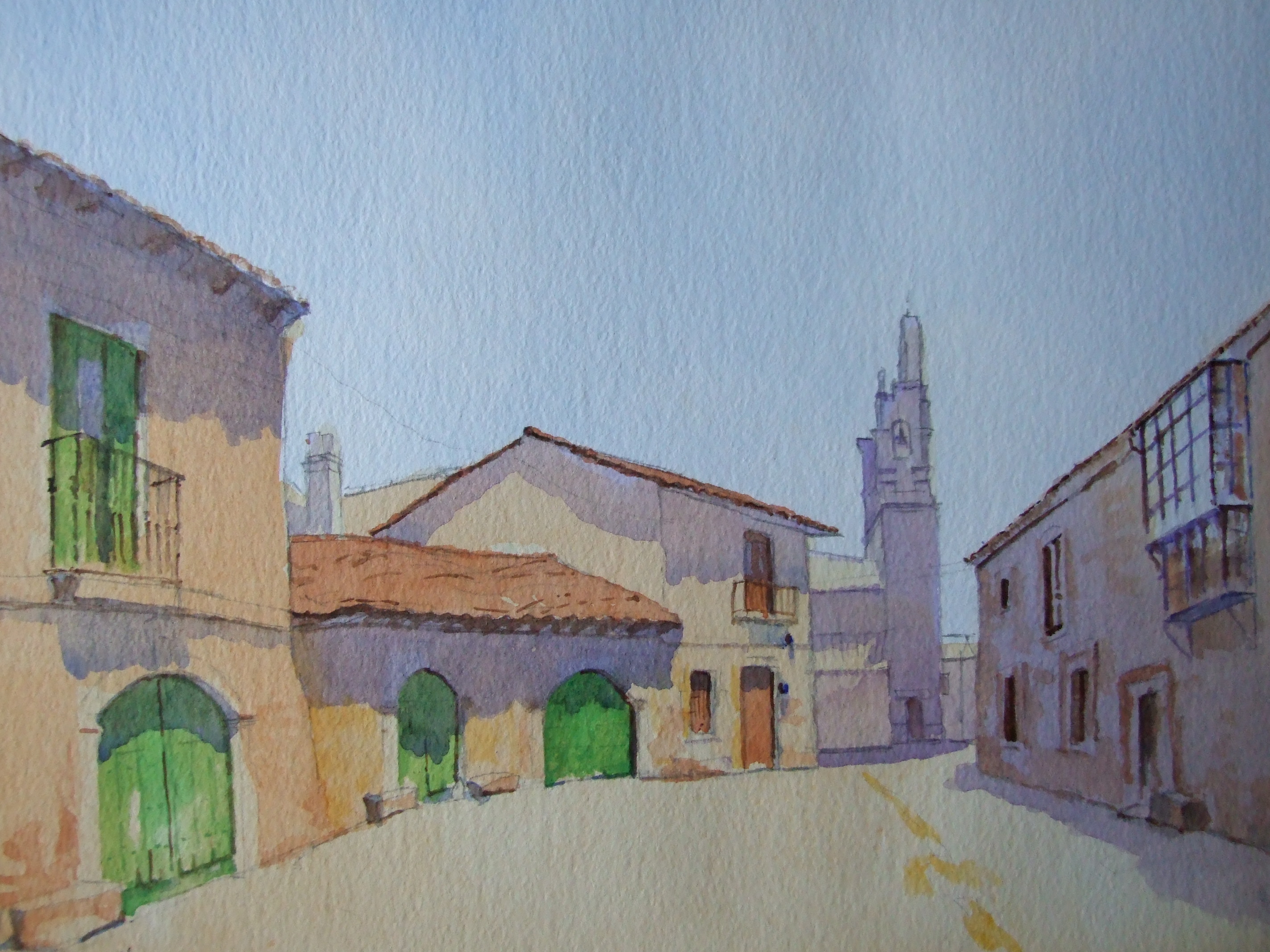
This is a painting that I made many years ago. We were on our way to Santiago de Compostela, and we broke our journey at this village. Unfortunately i couldn’t remember the name. It was about mid day and it was very hot. The street was deserted. Everyone was taking refuge from the sun. I took a reference photo and painted it later
I showed it once or twice, and eventually put it into store where it stayed out of mind. Just recently it sold on line out of the blue. The buyer was a lady who bought it for her father who comes from Galicia, so in effect it is going home, which is nice.
Looking at old paintings is rather like looking at old photographs, a pleasant reminder of a trip that one made some time ago. We flew into Madrid and travelled north by coach, stopping first in Rioja. When we got into Galicia, I was impressed by the green countryside which looked similar to the UK. Nice to see an old friend off to its new home
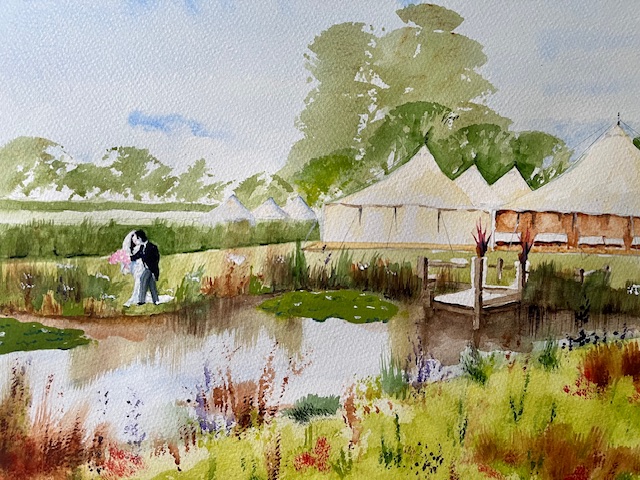
Despite abysmal performance from my gallery this year, my belief in myself is maintained by a steady flow or is it trickle of commissions from various sources. The last one was for a parish church which brought happy memories for that particular client. This one, which I am going to show an image of shortly, is of a wedding venue, which the client is going to present to the happy couple. It should make a nice memento. The client has seen it btw and is very happy.
This took quite a bit of arranging. I had to move the bridal pair who were over by the hedge and very small in the reference photograph, enlarge them to a workable size, paint them that size and then shrink them to the position they are now, which was what the client asked for. That was the hardest part
In comparison, enlarging the pond as requested was easy. Quite a lot of wild flowers was time consuming but straightforward in itself
As this painting drew to a close, I was approached with a request for another wedding venue, this time a church, always a favourite. Waiting for a reference photograph before I can move on. Whilst waiting I have started on something for myself, an c18 brick gazebo, an elegant building in the not so elegant town of Havant, my home town, so I am allowed to criticise. This is a building I knew from boyhood, not that you could see much of it, behind a high garden wall
Today the building has been exposed to view, and is regularly maintained. I believe it can be opened to the public on appointment, but quite a distance for me these days.
I will publish the painting when I am happy with it.
Back in the summer, we toured the Baltic. At one time we did eight shore excursions in eight days. Even by cruise ship, we found this tiring because of our age, especially my wife who has walking difficulties, so we might not attempt this sort of holiday again. Copenhagen was just one of the stops we made in Denmark
Touring the canal system was fun. i like painting boats and this was just one scene that I snapped for reference. Quite a lot of light and dark in this shot. The sun was very bright especially on the buildings in the background. Deep shadows were cast by the trees, which accentuated the boats. The figures on the canal side were reduced to silhouettes. It took me several glazes to get the water to be an acceptable colour, whilst at the same time still looking transparent. This was more of an exercise about light against dark, than anything else
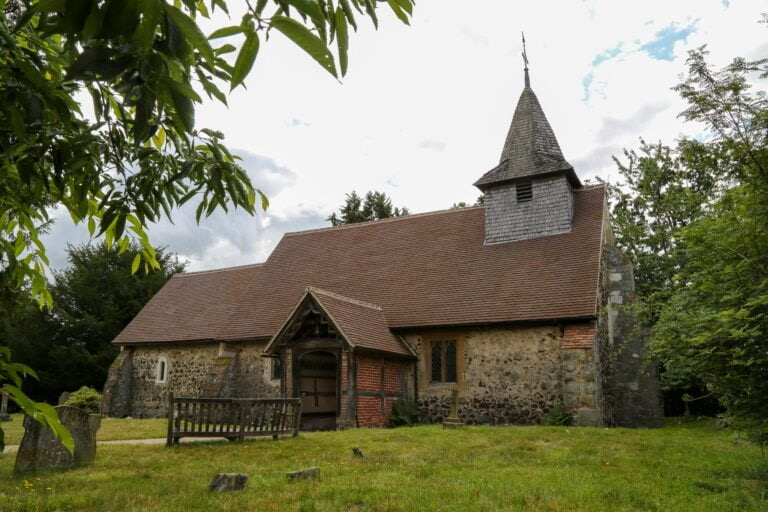
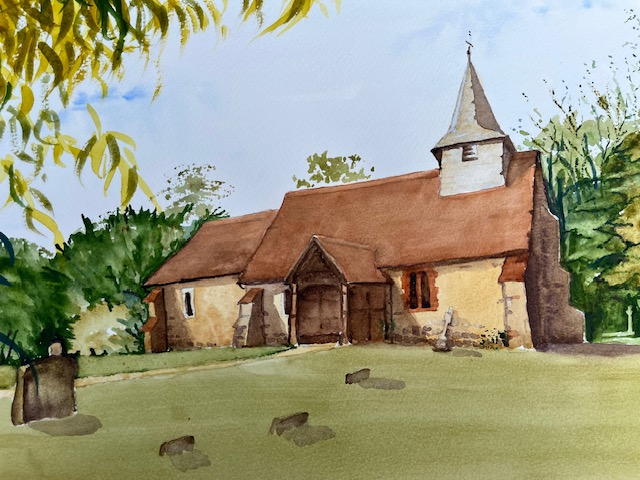
I have been commissioned to paint this church, the village church of Pyrford in Surrey. Ancient yet still in use as a parish church, it is set in a tranquil spot, and is quite charming. The lady who commissioned it no longer lives in the area. Her parents are buried here, so a meaningful place. I always feel very priviliged being asked to paint places that are so important in people’s lives. I am working on it at the moment and will post the result
This is how the painting turned out. I have put sunshine into the painting as the photograph was taken on a very dull day, so the colours are brighter. The lady who commissioned this painting was very pleased, which is always a relief
I have another commission now, quite different to the last, This one is a wedding venue, which I get asked to do from time to time. This one involves marqees and the newly wed couple strolling in the grounds around a lake, so quite a lot of different things to worry about, Still it’s good to have these commissions coming through as sales from my gallery are poor at the moment. Times are hard everywhere still and doubtless will be for some time

 offtoafineart