We went to the exhibition of Singer Sargent’s work at Tate Britain recently . His work is stunning. He was without doubt the leading society portrait painter of his day
This was one of the first paintings that Sargent made after moving to London from Paris,and it helped make his reputation in Britain, when it was purchased for the nation by the Chantrey Bequest The painting was made over two years, mostly painted outdoors, when the light was as Sargent wanted it. He painted the work in the Cotswolds, in Broadway at the home of the Millets, who were friends of his.The sight of Chinese lanterns hanging in the trees and beds of lilies was his initial inspiration. The two girls were added later. The white dresses were made especially for the painting known as Carnation, Lily, Lily, Rose
I never knew how much attention to detail he made with the costumes of his sitters. He would apparently visit their home and go through their wardrobe and almost dress the sitter in the way that he wanted them. He created roughly 900 oil portraits and approximately 1200 watercolours. He was highly prolific adding drawings and charcoal sketches to this list
Born in Florence to North American parents, he was truly international.. Working first in Paris and then in London, he was successful as a career portraitist. His work was characterised by drawing with the brush which was novel, and drew admiration. He was also drawn to Impressionism for a short time and was a guest of Monet. He traveled widely after training in Paris with Carolus-Duran, visiting Spain where he was greatly influenced by Velazquez and later to Italy where he sketched in preparation for Venetian genre street scenes,
His works and influences are too numerous to mention. London became his home and he died there in 1925. He is interred in Brookwood Cemetery in Surrey, about ten minutes from where I live as it happens. I don’t know why he was brought out from London to be buried. He had no links with this area as far as I know. Brookwood is a vast cemetery probably the largest in Britain, built as an overflow to the overcrowded graveyards of London. Maybe that was the reason. I have not been able to find out
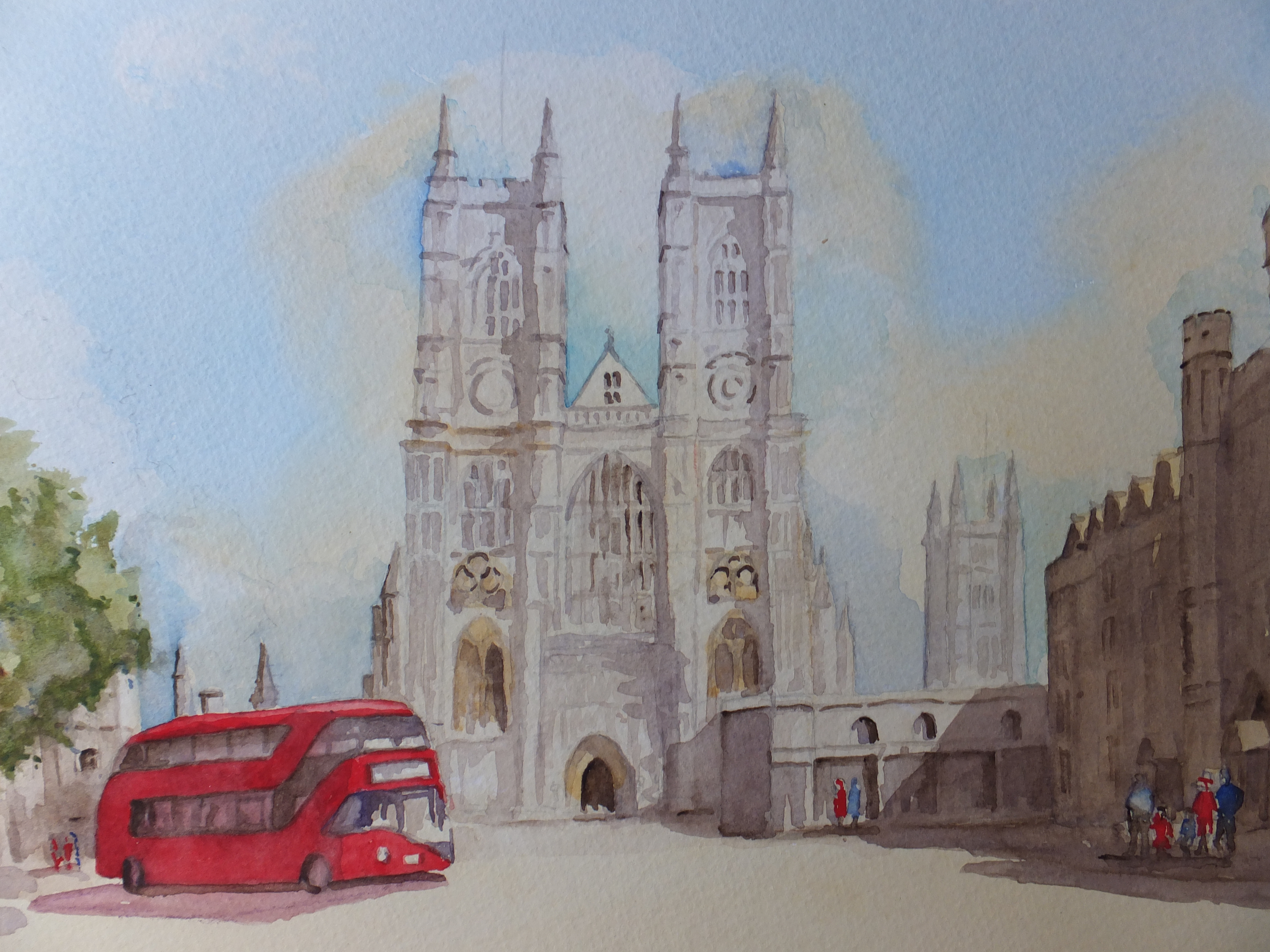
Not inspired by the coronation, because I have looked at this amazing abbey for some time, as a possible painting. A lot of architectural detail which I love to have a go at. I work by allusion. I could not reproduce all the detail exactly, especially with a brush. I put in some detail, some shading and get the colour as close as possible to the original stonework, which is a pinky grey colour, and this seems to work. I sometimes think that the eye of the neholder finishes off the image and fills in the gaps that I have left.
I sorted through various photographic references. I had plenty to choose from. Part of the facade was obscured by two buses and other traffic. There is a column of pink granite in front of the abbey which I felt was in the way, so just left it out. I took out one bus and moved the other one as far left as I could manage, and painted in the red livery that you expect of a London bus. As far as I could see, this is one of the new Routemasters. I am not an expert. I just eclipsed the abbey with the bus, just to show they belonged in the same picture, not placed together artificially. I felt they worked together. I echoed the red with pedestrians in different parts of the composition.
St James Palace on the left I put in heavy shadow, much heavier than the photograph reference. I liked the effect. The spotlight was now on the abbey. The tower of the Houses of Parliament I painted in very pale violet. The image faded away, giving an impression of distance.
I felt satisfied with the composition. The facade of the abbey needed some work. I sharpened some of the detail on tracery, and put extra shadow in to let the eye see where everything was. I don’t do much more than that. The allusion is complete. The eye of the viewer can fill in what is missing
The painting is finished . I would have preferred not to introduce green but there was a tree which couldn’t be left out. This painting will be shown next month in Chichester where I have been invited by a gallery to take part in an exhibition. So a new area which I am looking forward to.
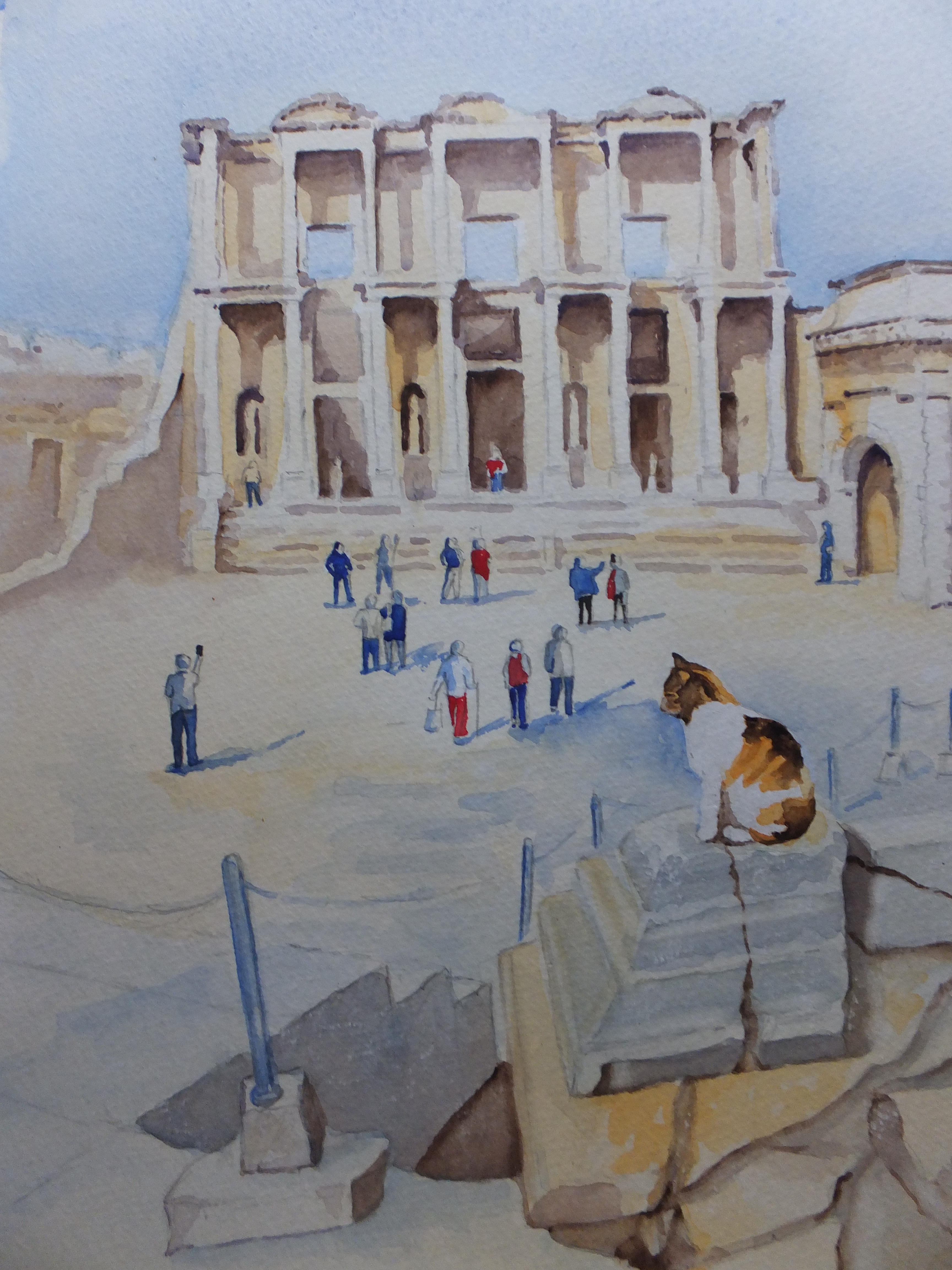
This was our second visit to Ephesus, following in the footsteps of St.Paul. Hot of course, and dusty clambering over the ruins, but worthwhile as this is typically a fascinating Roman city. In the background, the Library of Celsus, which at the time was the third largest library in the Roman empire, after Alexandria and Pergamum. It was built by the son as a funerary tribute about 110 AD I think. A full history can be found on Wikipedia
In the foreground, a handsome cat, one of many feral cats that inhabit ruined cities like this one. In a superior fashion, as cats do, he was watching the tourists, as though he was wondering what they were doing in the heat, scrambling over all these ruins. He was being sensible and keeping still.
I thought he made a good picture, and photographed him against the ruined library. I thought maybe I would paint him, and finally after some years, I have
I think he turned out well, as I am not really a painter of cats
This charming book will one day be one of those works, which will define a place in history
Three Blind Mice ( but only temporarily)
I was pleased to be asked to provide illustrations for this delightful book, which was recently published. The author, John Griffiths, a well-known stage actor, was playing in the second run of the stage play Three Blind Mice. The first year’s tour had been a great success, and the second tour was well underway. On that fateful night, the audience arrived with their tickets and so did the cast, expecting to perform. They all had to be told that there would be no performance that night or any night. Theatres were closed, the tour was cancelled. Lockdown 1 had begun
The book goes on from there. Actors like John were suddenly unemployed. He was at home, doing all those things he had never had time for, and then what? He did what he had always done and performed. Social media was his platform. There were songs and hymns delivered in a stentorian Welsh voice, boyhood memories and anecdotes from Swansea, poetry readings and many more. They became a regular feature, and people started to expect them. The audience grew. It became viral. Peole suggested that he write these episodes down and so he did. After many months work, sixteen I think, this collection has now been published
I said at the beginning that this book will one day define a place in history. I believe it will. Historians will read it when researching life during the Great Pandemic and how we adapted in order to cope.
Since I started this post in July just before going away, much has happened which has delayed me finishing this properly. In Holyhead Docks we went ashore by tender. Coming down the ramp on to the Quayside, my knee went and I fell on the quayside screaming in an undignified manner but the pain was indescribable. The local hospital told me I had torn the tendons from my kneecap and fractured the patella. Our cruise was cut short and good old Saga sent us home in a taxi. I attended our local hospital and was admitted for an operation to have the tendons refixed.
The operation was more than three weeks ago now and I have had the clips removed . The wound is healing well. My next assessment is on September 9th. I am looking at another 4-6 weeks for full mobility
I can’t even paint which is a pity as I cannot balance
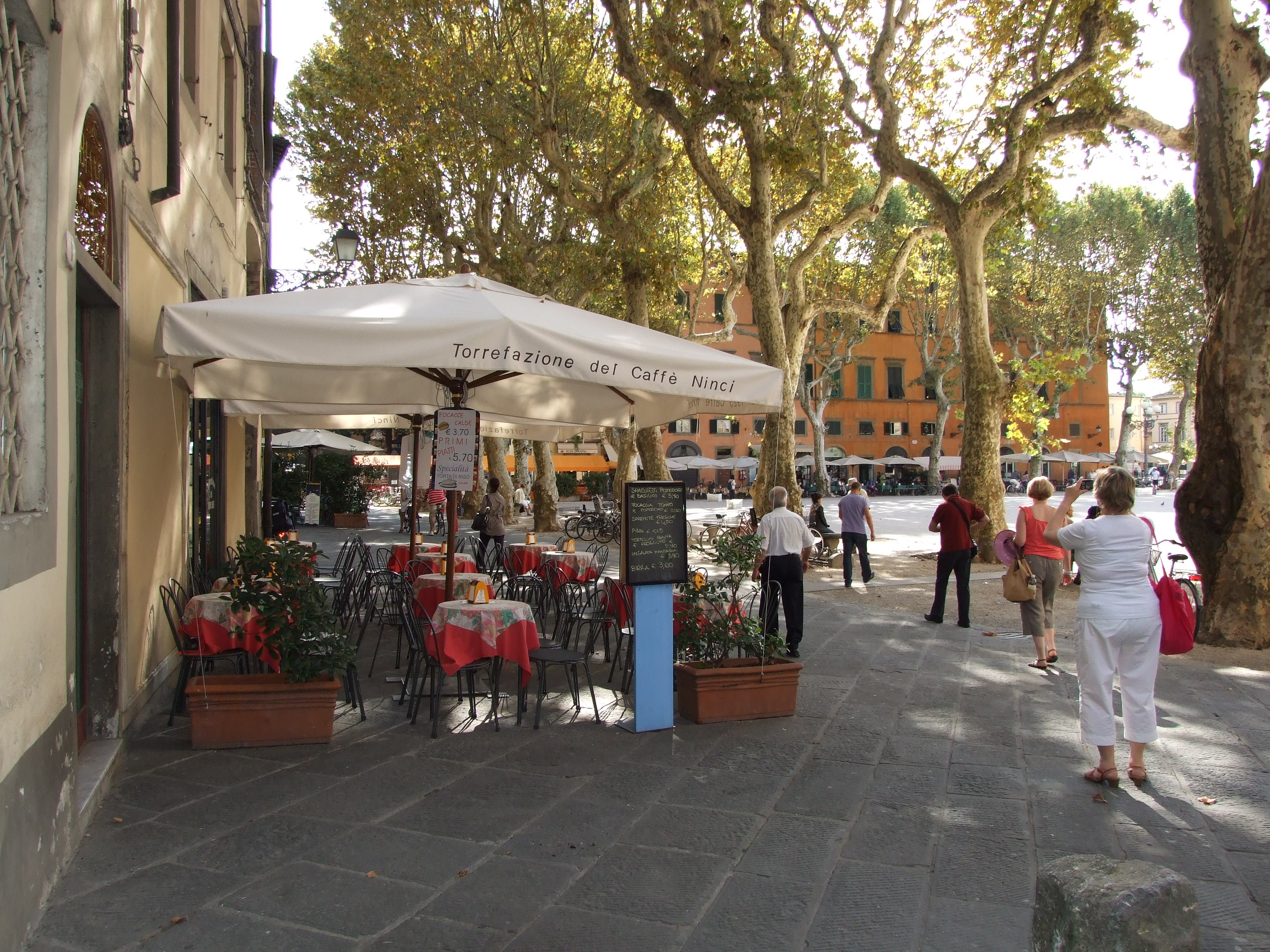
I have just started looking at this picture with a view to producing a painting from it. We were here some years ago now. Lucca was one stop on a railway tour that we did of Tuscany. We were staying in Montecatini at the time which was lovely. All the towns we wanted to visit were on the same railway line which was very convenient
Florence, Pisa, Siena and Lucca were all very accessible. We combined a short visit to Lucca with a visit to Pisa. I would have liked more time in Lucca but as you can imagine Pisa with its cathedral and leaning tower was more demanding. This photograph of the old square reminded me that I wanted to paint it one day. Some years back I did paint another view of the square, and sold it last year to someone in Portugal, which sounds strange, but not really as so many buy my pictures as a souvenir of a happy visit.
I have started sketching in some of the larger features of the picture. The trees dominate. They are amazingly tall, dwarfing the buildings let alone the people. I am not sure what type of tree it is, maybe lime or plane. The bark colouring is distinctive, a sort of greenish gold which will be interesting to replicate. An empty restaurant doesn’t inspire, and cries out for a few diners and maybe a waiter.
It will be interesting to see what I can make of it
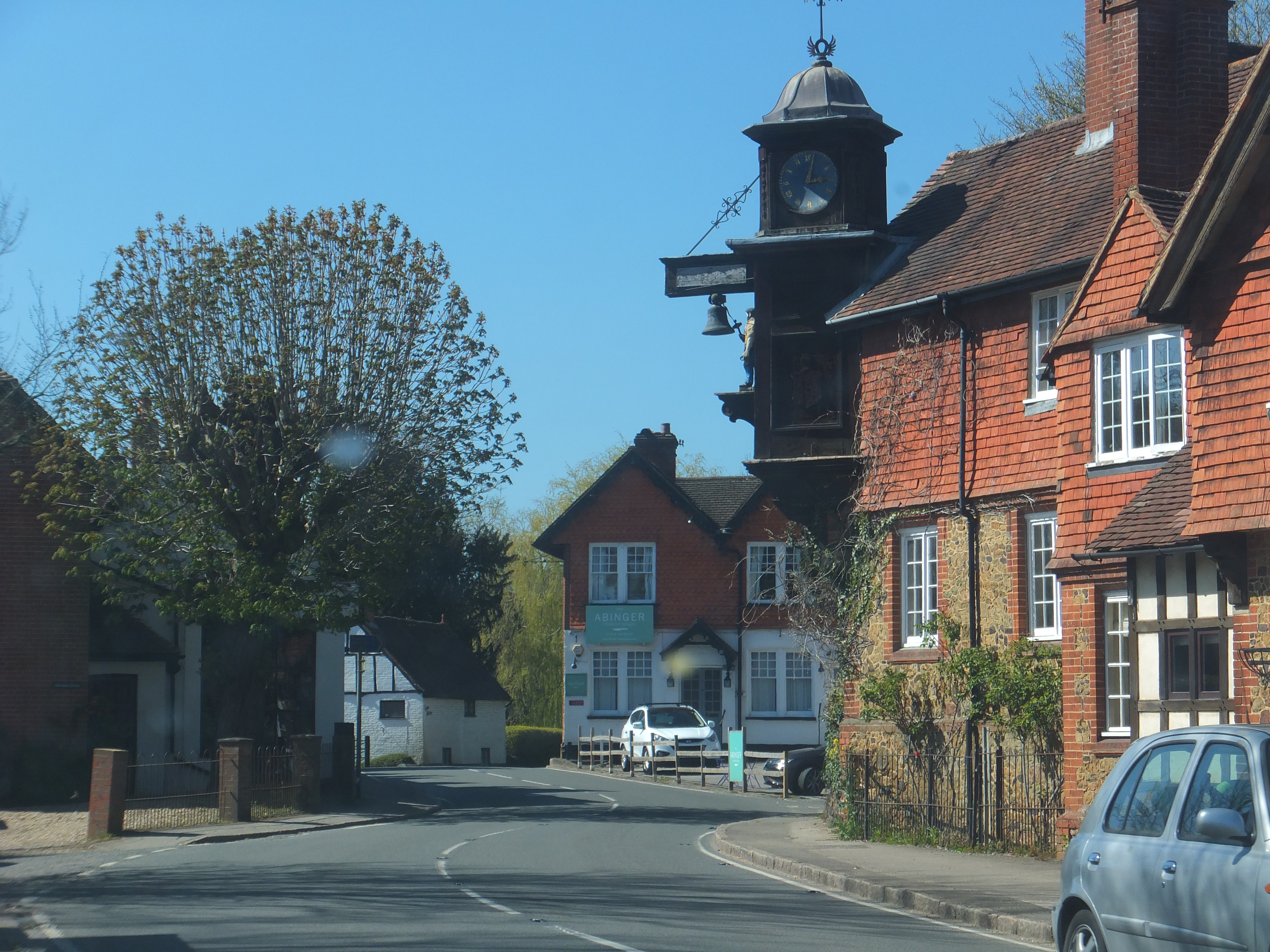
The village of Abinger Hammer with its striking clock
As I said in a previous post, this is the village of Abinger Hammer, what used to be one of the iron villages in the Surrey Hills area. The blacksmith on the striking clock strikes the bell with a hammer, but the name refers to the giant hammer which was powered by the nearby river Tillingbourne up to the c18, which pounded the hot iron into shape.
Today Abinger is a tranquil place on the road from Guildford to Dorking. The buildings are attractive, in what is named the Surrey vernacular, using terracotta tiles and the local sandstone. They are very paintable, hence my choice, especially as I wanted the painting for a local exhibition starting on Freedom Day! The last start date over Christmas was cancelled so we hold our breath for this one.
The pallette was a simple one which is nice. raw Sienna and Burnt Sienna do most things. Cobalt blue for the shadows. i did experiment with the trees though. I have used quinacritone gold with violet for shadows and green gold for the hedge in the background, just for a change really.
Next month unless emergency restrictions are reimposed, I expect to be exhibiting at a real exhibition locally. This is due to start on June 21st at Denbies Winery near Dorking. Denbies is the largest vineyard in England, and has been developing its reputation for some years now. Amongst the other buildings in the Denbies complex is a well-known art gallery which is open for group exhibitions. This will be the first time that i have shown here so will be interesting to see how I get on
Looking through the pictures that I have earmarked to show, I see I am short of local pictures, so I thought I would do something like the photograph shown, which is the village of Abinger Hammer on the River Tillingbourne. The Tillingbourne flows from east to west and runs into the River Wey near Guildford, which in turn flows north to join the mighty Thames with access to London. Today the Tillingbourne is idyllic and pastoral. A few hundred years ago, it was an industrial river, powering mills at frequent intervals, mills that ground corn, mills that ground gunpowder and mills that produced paper.
Abinger takes the word Hammer into its name, as it was at the centre of the iron industry until the late 17c. The Tillingbourne was enchannelled into “ponds”to drive the huge hammer which pounded the hot iron in the forge. Forges had been fuelled from charcoal produced from timber from the vast forests in the district known as the Weald, parts of Sussex and Surrey today. Finally the timber gave out, and the industry moved north to Coalbrookdale where Abraham Darby had discovered how to smelt iron from coke. The clock in the photograph was installed in the late 19c to commemorate the village’s connection with the iron industry.
Today the hammer ponds still exist, and are used for growing watercress. There are also trout farms using these old ponds as well, and once they have been relined, are very suitable
The gunpowder mill is at nearby Chilworth, ruined now and standing in woodland, with many tales of terrible accidents and loss of life and limb. There is a heritage trail around the mill buildings which is well worth doing. The strange thing about Chilworth Gunpowder Mill is that during World War I, it was owned by a German company ! If you have ever read any of William Cobbett’s rural rides, you will know that he undertook one along the Tillingbourne, and did a serious rant about the Chilworth Gunpowder mill as well as the paper mill nearby which produced the bank notes. Both he maintained did the devil’s work.
I am partway through the drawing of Abinger. I won’t be able to work on it for a while but will continue as soon as I can
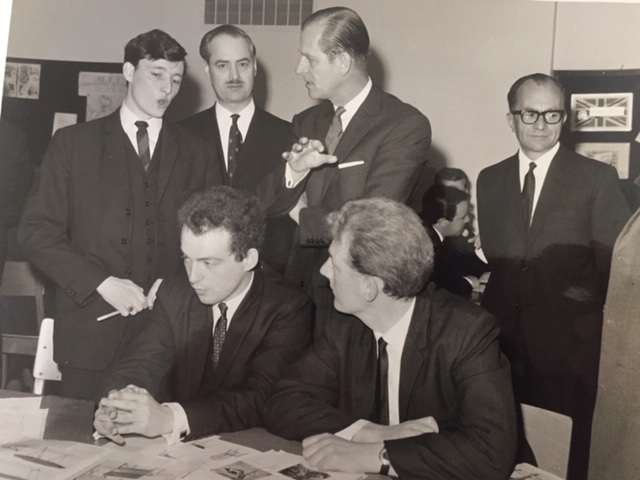
In 1967 I was studying at High Wycombe College of Technology, as it was then. It will have university status by now along with all the other ‘techs’ in the land. The course was a new one, and groundbreaking at the time. we were being trained in export marketing, and the course was a combination of business studies and languages, three to be precise. I say groundbreaking because this country was waking up to the need for a renewed effort in marketing our goods overseas. Other countries had rebuilt their industry since the war, notably Germany and Japan, whose economies were racing ahead of ours. We stayed in the past with outdated plant and methods. Our industrial relations record was lamentable, and held us back. Our balance of payments situation was dire in the extreme
Training was seen as part of the answer. This course was one of those that provided the means. It was an exciting start
Prince Philip, whom we all know was very interested in opportunities for the young, and in rebuilding this country. he paid us a flying visit, literally by helicopter, and spent some hours talking to us individually and informally so that he could learn about what we were doing. In the photograph, one of my colleagues is explaining the project we were involved in. Two students seated, and one is me, are waiting their turn.
I remember he spoke to us in German for a little while, which put us on our mettle. I am happy to say that we acquitted ourselves well. We were greatly impressed by his visit. It was a tremendous boost
Many of us went on to take up overseas sales post in industry. Today in our global economy and instantaneous communication worldwide, selling overseas is a natural function, but at that time it seemed intrepid and trailblazing
We know how much Prince Philip did in encouraging all our efforts and are grateful
When I posted this painting previously I thought the horses were floating which was not an effect that I had been trying to get. It was suggested that I add spatter so that it would appear the horses were kicking up mud. So that is what I have done, and I prefer the result. They do now look as though they have feet on the ground
That really finishes this painting, and I can move on to other things
I came across a photograph of Tower Bridge in London, which looks like early morning with very deep orange in the sky and reflected in the water. It is the sort of colouring that I like doing in watercolour. The bridge itself is silhouetted against this bright sky, so not too much detail in the architecture. There are a couple of large boats but little more. It will be very much an exercise in tonal values, which should be enjoyable
This is my finished version of the photograph for which I am grateful to Pixabay
I am not sure about the marbling, not that I have tried to emulate the original exactly. I have used more orange and more blue, which has made the painting brighter, rightly or wrongly. My eye at the moment, is going from one image to the other. I don’t think I have captured the same feeling of movement as the original . When I look at the original I can almost hear the hoofbeats. My horses seem to float on a cloud, which is weird or ethereal depending on your preference.
Still it has been an interesting exercise and one of the most taxing that I have tried for a long time. Certainly a change from architecture





 offtoafineart