Bosham Harbour: Second Version, Preparatory Drawing

bosham-preparatory-drawing

I painted Bosham Harbour in West Sussex as a commission a few weeks ago. I painted it in evening light which I hadn’t done before, and was very pleased with the way it turned out, and relieved too seeing as it was a commission. The colours worked exceptionally well, and I was left wishing that I had something like it, to include in next year’s crop of exhibitions.

Using a number of different photographs, some of my own and some from different sources, especially the boats, I compiled the composition which I have drawn above. The church and houses I have thrown back into the distance, and extended out at the left past the boat house. The boats themselves are entirely different to my previous painting, so everything will be new, which I prefer.

One day I will be stumped as to how to paint Bosham Harbour without referring to something I have painted previously. There are other views, but this is the one people always want, with the church in the background and boats in the foreground. Move along the coast, I suppose, but there is something about Bosham which is hard to find elsewhere. Perhaps it is the historical associations with Saxon kings like Cnut and Harold, with the symbolic Saxon church as a reminder, or maybe just the sheer charm of the place, that makes it difficult to replicate

Anyway, I am going to attempt this composition as a watercolour painting and see what happens. I shall use my previous painting as a colour guide but may still experiment along the way, but still the objective will be to create a painting in evening light

We shall see how we get on

Exhibition in Woking Lightbox: The Camden Town Group

dscf3467

This painting is by Robert Bevan 1865-1925, one of the the Camden Art School, painting as the name suggests in North London during the Edwardian period

This painting is entitled Dunns Cottage and was painted in Devon, although Bevan was just as at home painting in London, usually horse fairs and horse drawn vehicles. Bevan studied in Brittany in Pont Aven painting alongside Gauguin, and the influence on this painting is plain to see, large blocks of flat colour and unrealistic shades

Other artists represented at this exhibition are Walter Sickert, sometimes known as the father of them all, Spencer Gore and Ginner

Rather like the French Impressionists a few decades before, the Camden group painted contemporary scenes of city life, the streets, theatres, places of entertainment like pubs and circuses. Sickert portrayed young women in the nude at their toilette rather in the style of Degas, who was a great influence. Non erotic portraits of women in dingy surroundings were something he often came back to, as though the flatness of their life was something which fascinated him.

Preparatory drawings of the figures for his famous painting Ennui are also there, a study of tedium and of people trapped in their lives

dscf3470

The Balcony, Mornington Crescent  by Spencer Gore (1878-1914)

dscf3475

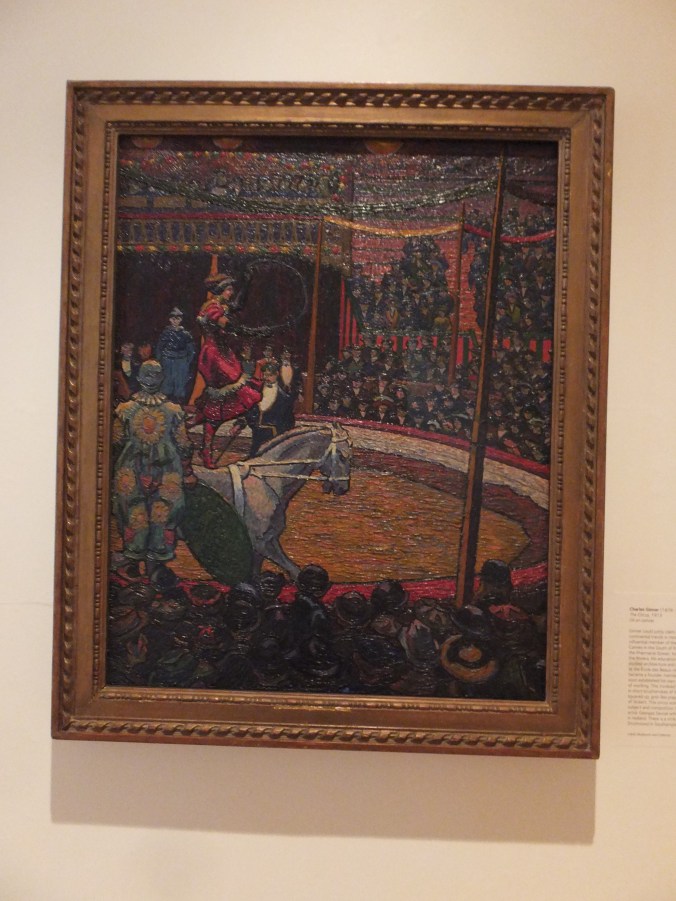
The Circus by Charles Ginner (1878-1952)

Ginner was born in Cannes of a British father who established the Pharmacie Ginner. His brother was a doctor on the Riviera . Ginner himself studied art at the Ecole des Beaux-Arts and was influenced by the French art of the day. The circus was a favourite subject, and this picture can be compared by one of Seurat, which is in the Kroller Muller Museum in Holland

Ginner moved to London and became an influential member of the Camden group

The quality of exhibitions at the Lightbox continues to improve, and well worth a visit if you are in striking distance. The other exhibition one floor below, on the History of the Comic, extremely informative and comprehensive for those interested in graphic art

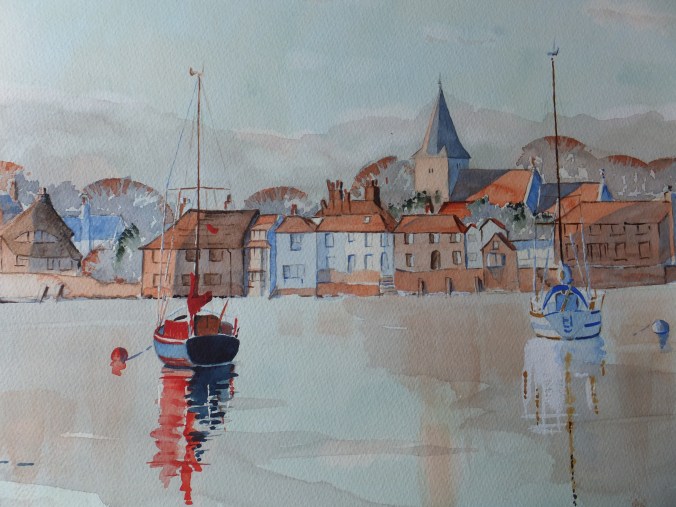
Bosham Harbour in West Sussex

bosham-harbour-and-church

Bosham Harbour and Church

I was commissioned to paint this view of Bosham Harbour. This is a favourite spot for sailors and visitors generally, as well as being beloved by photographers and artists alike.I was given the Contented Donkey commission at the same time, so have been working on them both from time to time. Bosham has been finished first, so will write about that now.

Bosham harbour is used by people who sail now, but historically this was a port for cross-channel traffic. It was used by the Saxons. The church is Saxon, and has a connection with King Cnut. His daughter is buried in the church. If you have heard the apocryphal story of Cnut trying to hold back the waves, because his courtiers had told him that he was that powerful, that was supposed to have happened at Bosham.

Cnut was a Dane, a Viking who was King of England, Denmark and Norway from 1018 to 1035. An important man and a great king, who returned England to prosperity following the Viking raids, his reign is largely obscured by the events of 1066

The power struggle for the throne just before 1066, involved Bosham. Harold Godwinson (and I expect I have spelled that wrongly,) sailed from Bosham to discuss the succession with Duke William of Normandy, and as we know was shipwrecked on the French coast. He was delivered to William as a prisoner, albeit treated as a guest, and during his stay was tricked into swearing on holy relics, that he would support William’s claim to the throne of England.

This gave William’s claim legality. He invaded England and landed at Pevensey, and met Harold in battle on Senlac Hill. The rest as they say, is history

Why was it called the Battle of Hastings when it was nowhere near there?  I’ve never been given a satisfactory answer to that question

The donkey painting will be next on the easel


A Week in Sicily

dscf3364

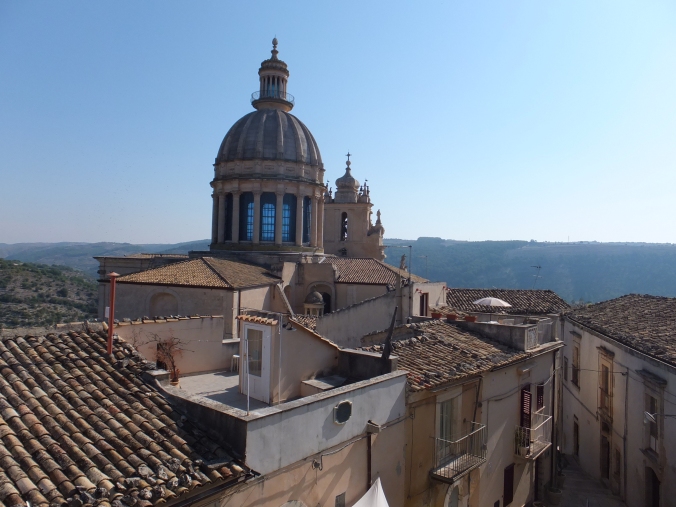
The Rooftops of Ragusa

We have just returned from a wonderful week in Sicily. I am exhausted as we packed a lot in, and did more walking than I am used to. The city of Ragusa is beautiful built on the sides of gorges, so dramatic in themselves. However everything is steep, and the climb we did to get this picture was no exception. I am not sure how many steps as I lost count at 150.

We were about ten minutes too early for the lovely baroque church in the background, so our guide took us to the top for the view, one picture and straight back down. Bit of a killer in the hot sun

dscf3366

This is the way down, only more of it, as the steps wind on round the houses.

Sicily has been hit by several earthquakes in its history, but the big one in the c17 destroyed nearly everything. Consequently all the churches seem to be in the Baroque style following a massive rebuilding programme, in whichever town you visit.

Syracuse was fascinating with its wonderful archaeological park. Sicily was Greek from 750BC, and the park shows where slaves quarried massive stone blocks from the hillside for their building programme. Greek theatres followed by Roman amphitheatres abound. The Romans took Syracuse from Greek hands in the early third century, and also drove out the last of the Carthaginians

Sicily changed hands so many times throughout its long history. Goths and Vandals after the Romans, Arabs and then the Norman Conquest in the c11, creating the Kingdom of Sicily, curiously matching England which became Norman in 1066 just before Sicily

You often see images of St Thomas a Becket in churches in Sicily. Henry II of England’s daughter, Joan married King William II of Sicily. You may remember that Henry had Becket murdered in Canterbury Cathedral, an act that horrified the rest of Europe. William venerated Becket in Sicily in order to distance himself from Henry’s crime, which later Henry was to do penance for

Of more recent interest, were the location shots for the Montalbano  detective series shown on TV. These were in Raguso, Scipli and Punta Secca. Lost on me as I never watched the series however

Some superb shots for paintings, including the roof top view which I have shown, and also the beautiful Medieval windmills on the west side of the island. Still, for now, I shall be getting back to the drawing of the Camargue horses which I left before I went away

A nice message waiting for me when I got back. Someone is buying the painting of Langstone Harbour, which is shown in the archive of this blog somewhere

dscf3421

The Medieval windmills and saltpans near Trapani

Van Gogh and Arles

I have been away for the past week. We cruised down the River Rhone from Lyon to Arles which was lovely, and took three places off my bucket list. One was the Pont du Gard, that amazing section of Roman aqueduct still remaining crossing the River Gard. Very hot that day but still summoned the energy to go down to the water’s edge and look up at this amazing structure whilst envying the people in the water. The second place was the Camargue National Park to see the famous white horses and the black bulls, as well as of course the flamingos who breed there, the only breeding ground of this bird in Europe. Curiously they are not very pink. The third place, as an artist that I wanted to visit was Arles made famous by Van Gogh, and those of us who wanted, were treated to a fascinating walking tour taking in some of the places made famous by the artist.

Van Gogh arrived in Arles in 1888, and took a room in a house near the railway station. he called it the Yellow House and it is depicted in one of his paintings. The house isn’t there anymore. It was destroyed by bombing in WW2. The house next door is still there, not yellow but a sort of buttermilk colour, and curiously enough still a cafe.

The light in Arles is extremely attractive for artists. The sun shines and the sky is blue nearly every day. More importantly, the famous wind, the Mistral blows down the Rhone like a corridor and clears the air of water vapour, dust etc, and produces a clarity of colour that would be hard to find elsewhere. The Mistral in summer is like a cooling breeze, like an electric fan in the heat of the city. In winter, I am told, it is something of a tyrant, getting inside your head, making you ill, and in some cases inducing madness. It goes in three-day cycles. If it doesn’t stop after three days, it will go on for another three, and so on

Vincent’s time in Arles was highly productive, producing something like 300 paintings.He was bi polar so was capable of great energy at times.  On our walk we visited some of the sites made famous by van Gogh. One of them was the Night Cafe or Le Cafe la Nuit. The exterior of the cafe is depicted in Cafe Terrace at Night painted in September 1888. My picture follows.
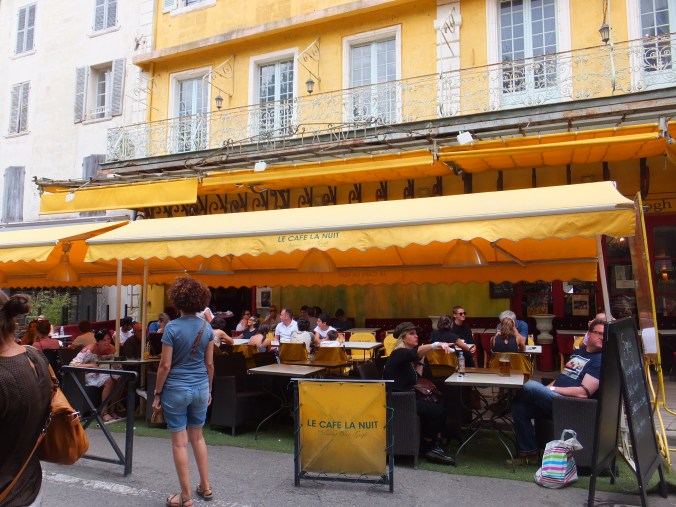
DSCF3231

Another shot with the van Gogh painting as a reference

DSCF3234

He wanted to set up a society of artists in Arles, and to this end, persuaded his brother Theo, who was already financing him, to persuade Gauguin with financial inducements, to come to Arles, which he did. The two of them had a turbulent relationship which turned violent and Gauguin left.

Van Gogh’s despair and self recrimination led to the famous self mutilation incident, when he took a razor to his ear and sliced off a lobe. He wrapped it in newspaper and gave it to a prostitute whom he knew. She reported him to the police, who thought he had killed Gauguin. He was admitted to a hospital in Arles for treatment, where he continued to work, and produced the following painting of the hospital garden

DSCF3230

The garden which he painted is not dissimilar today. Later his condition was to worsen and he was admitted to a nearby asylum in St.Remy.He was estranged from Theo who was about to marry. As we know he was to shoot himself in a nearby field, amidst some controversy. He shot himself in the chest and did not die immediately. People usually shoot themselves in the head and then death is instant. How did he come by a gun. He was unpopular in the town, because of his strange behaviour. Had someone else shot him? All unanswerable questions

I have tried to condense the walk down to as few words as possible. Not easy to convey so much information, but hope you find it interesting nonetheless
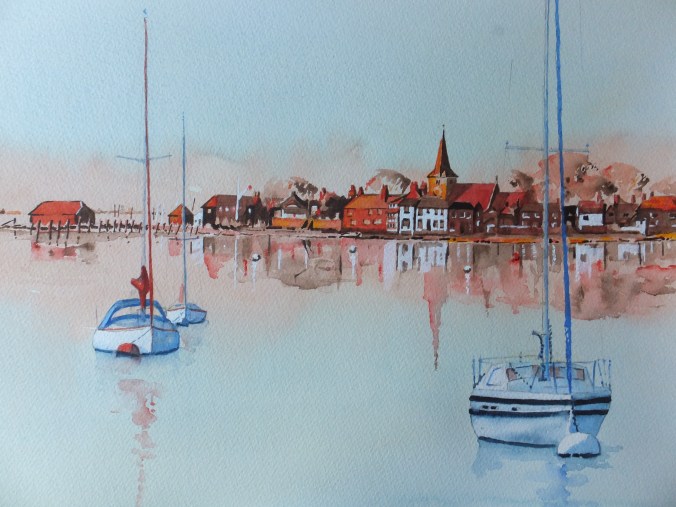
Shere Village and Church: the Finished Painting

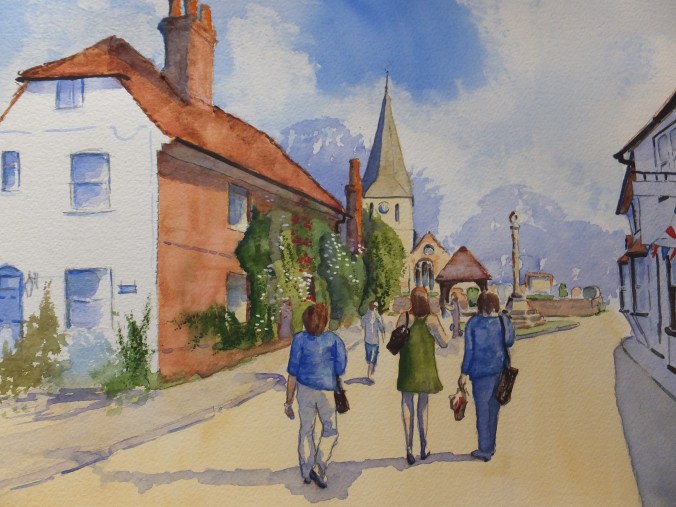
Shere Village and Church

Well, the painting is finished, and turned out better than I thought. I dulled down the roof of the lychgate as one critic advised. It had come far too forward, so I scraped it back, and added grey violet which has pushed the image back into the middle distance.

I lifted the paint off the foreground figures and let that dry. I painted shadows in first with dark grey violet, and let that dry hard. I finished them with their local colour, and they turned out well enough. It is possible to correct mistakes in watercolour sometimes

I added shadows cast by the figures, and deepened shadows under eaves and around windows. As soon as you do that,  it is like the sun coming out. Pure illusion but it always works

I might still tackle this subject again but from a different angle. As someone pointed out, it would have been nice to show more of the old church, and I accept that argument. I do have references taken closer to the church, and may well do that later, but not just yet. I need a change from this subject

Perhaps something from France would be nice to do, and perhaps experiment with some different skies, just to make life interesting

Shere Village and Church Painting which is not going too well

DSCF3091

Usually I like to say that the painting is proceeding nicely. In this case it just isn’t. It is one of those paintings that is popular at exhibitions, or should be. A local scene which people recognise and identify with. The sort of scene I have painted so many times, and yet seem to have made mistake after mistake. Oh well, suitably chastened, perhaps I will be more careful as I continue

Just above the church spire, and out of the camera frame, the sky went awry, and left a large blue patch right in the centre, just where I didn’t want it. This type of cloudy blue sky has to be done wet-in-wet, as we know, and apart from lots of frenetic board tilting, there is only so much control you can exert over the finished item.

The roof over the lychgate came up much too bright, so I have scrubbed that back, and will add less colour next time

Likewise the figures in the foreground were disappointing, and these I have scrubbed back with a lifting out brush. When they are really bone dry, I will attempt them again. I don’t know why but I seemed to lose all sense of colour control. I applied paint too thickly and the shadow areas which I had already put in, just did not show through

The brick colour of the cottage on the left-hand side which usually works well, is almost acidic with the green foliage, or am I being paranoid. Perhaps I have been looking at it for too long

On both sides I have painted more of each building. The camera frame would only take the image shown, which looking at, I prefer. There is certainly a case for cropping top and bottom, and maybe quite a bit from each side, and making a smaller picture of it

I will see what I can salvage. I have some ideas now. Being humbled occasionally, never hurt anyone

Have you ever had a bad picture day? Always pleased to hear about it if you have

Preparing a Painting of Shere Village in the Surrey Hills

DSCF3003

This is a view of Shere Village with its medieval church

Shere stands amongst the Surrey Hills and on the River Tillingbourne. Hard to imagine that in the c13-c15 it was industrial, producing woollen cloth. Today it is idyllic, like a postcard, attracting visitors from far and wide

I have been given an exhibition slot at the Royal Surrey Hospital, for July 2017, which does sound a long way off, but now starts the long slow build-up of exhibits. I need at least twelve that I haven’t shown before, so although I have some, I still want some more in reserve

I haven’t painted Shere for many years and then not from this angle. I think I can make something from this photograph, but for starters all these cars must go. I do sometimes put cars in, but in this case they are just hiding anything attractive. I shall probably broaden the composition by taking in more of the building on the left. I do also want some figures in the foreground looking towards the church, which will be a focal point.

The figures will be from my sketch book. I have drawn them free-hand from the screen, and will transpose them onto the drawing of the village street later. I will leave some pictures of the drawing and will post again when I have done some painting

Sketches of Figures

This is the page from my sketchbook. Figures kindly modelled by members of my family, although they didn’t know it, as we walked up to the old church.  What I do now, is to trace my sketch, and then slide the tracing around the drawing of the street, until the perspective looks right

Figures transposed to Shere Village scene

and so this is the sketch drawing which in turn will be transposed onto watercolour paper, after which it will be enhanced with more freehand drawing. When I have done that I will post the result

Medieval Undercroft in Guildford High Street

DSCF3070

Not so much art this time, but architecture. I do say in my profile too, that I am a history freak.

Together with other volunteers, my wife and I take turns to open this gem to the public on certain hours throughout the season. It is one of those local treasures that even local people are largely unaware of. I use the words gem and treasures without wishing to sound melodramatic as English Heritage tell us that this undercroft is one of the best preserved in the country

It is in fact a c13 shop, probably selling wine. That is an assumption but a safe one. We have records of wine merchants in the High Street during the c13 but we cannot make a direct link to this building . But that is what informed opinion believes.

The wine would have come from Gascony in SW France, which was English then, hence the trade connection. Wine would have come through Southampton and then by bullock cart overland to towns like Guildford

Guildford was wealthy in the c13. Wealth was derived from the wool trade and especially the trade in woollen cloth, the Guildford Blue for which the town was well known. The population of Guildford was probably less than 1000 in those days, and most would have been employed either directly or indirectly from the wool trade. Guildford controlled every aspect of manufacture. Sheep were raised on the Downs by the monks at Waverley. Weaving, fulling, dyeing, spinning, carding all were done locally

The processes are remembered in local place names. Racks Close was where the cloth was hung out to dry on “tenterhooks” after dyeing. Unscrupulous traders would stretch the damp cloth and make another metre or two. There are records in the Guildhall of such merchants being brought to book and fined. Finally a lead seal of approval was to be affixed to every roll of cloth that left the town to ensure that standards had been met.

Most went to export, especially to Antwerp which was the staple market, and from there across the then world, Europe and the Near East. The word staple is interesting. From the French word “etaple” meaning “main”. The main market or one of them. That is clear. So that buyers could see what they were buying, a small sample of wool was fixed to the label with a metal pin. The metal pin came to be known as a staple.

To come back to the undercroft, the reason that we are so proud of ours is that it was never restored in any way. What we look at is pure c13. The building is of chalk blocks or clunch which is the hard chalk dug deep from the earth. Guildford is on chalk. It was the only building material at the time. The stones are cut with a precision only possible from a master mason. Expensive to employ so the owner was indubitably a wealthy man. Another pointer to the merchant being a dealer in expensive goods.

To this day the c13 vaults take the weight of buildings above

On Saturday from 12 until 2 we had nearly 40 visitors, mostly shoppers who were passing and had never seen us before. Always their jaw drops as they come in, and they are fascinated with the story. Considering we were competing with the tennis, we didn’t think that was bad

Finished Painting entitled Christmas Shopping:Guildford High Street

Signed revised Christmas Shopping Guildford High Street

Christmas Shopping: Guildford High Street

The historic High Street of Guildford is always a joy to paint. This street is actually Saxon in origin, although nothing that early remains above ground. The plan of the street though goes back that far, and the dimensions of the actual plots are still the same

There are still buildings from the c13. The iconic clock which I have mentioned before is dated 1683, when the facade of the old Guildhall was restored. A relative newcomer, the classical arch in the centre was built in 1819, and was the last corn market in the town. Known as the Tunsgate Arch this was built on the site of the old Tun Inn, one of the many coaching inns in the town. The Tun Inn went bankrupt and was demolished in 1818. The columns used to be equidistant until the middle two were moved to accommodate motor traffic in the 1930’s. In the 1990’s the arch was closed to motor traffic, and paved over. To celebrate the twinning of Guildford with Freiburg in Germany at the time, the coats of arms of both towns were let into the floor in mosaic.

This painting was commissioned by a charity called Cards for Good Causes, and I am pleased to say has been approved, and will go forward for reproduction as a Christmas card.  They will be on sale in pop-up shops in every town in the UK from 18th October onwards.  Details on their web site. The proceeds are distributed amongst 25 well-known charities and should you wish to support, thank you.

An extremely detailed painting which has taken me some time to complete, but enjoyable nonetheless. The framed original will also go on sale in support of the above