Exhibition of Women Artists at Tate Britain

Magnificent exhibition at Tate Britain entitled Now You See Us is on until early next month. I wish I had gone sooner as this is an exhibition that needs more than one visit. It covers the work of women artists from 1520 – 1920, during ages obviously when women were subservient to men in most walks of life. Their work very often epitomises their struggle for recognition.
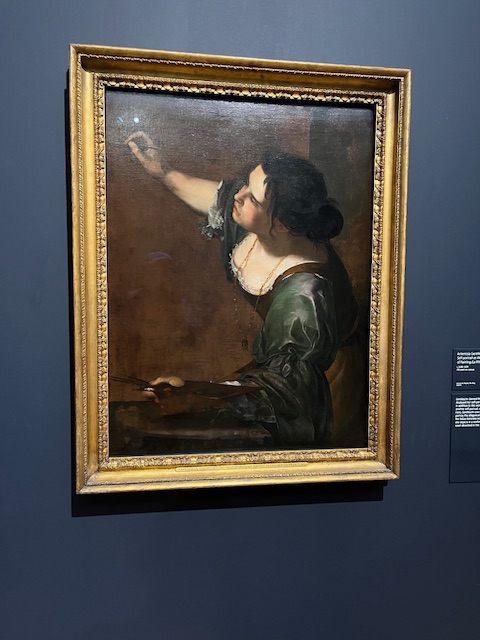
One of the earlier examples, a self portrait by Artemesia Gentileschi, an Italian artist working in London during the reign of Charles I, In London she worked for Charles I and Queen Henrietta Maria, and two works in this exhibition are from the Royal Collection. The other one is Susannah and the Elders, a popular Old Testament sory who was observed bathing by two of the elders, and sexually assaulted. The usual story, the elders tried to make out she was a whore but later her innocence was proved.

There were an amazing number of artists represented working through the ages. Very few did I recognise. Gwen John was one, and her self portrait was used in the exhibition publicity. In fact the work of hers shown was in my view some of the least inspiring.

During the 18c the work of the Royal Academy centred round oil paintings. Other media was looked down upon. Joshua Reynolds was especially sniffy about watercolour, pastel, embroidery and any sort of craft as being work that women did at home for their own amusement.

Gradually, and as we move into the c19 women are starting to meet men on equal ground. Two paintings which greatly impressed me were:

Colt Hunting in the New Forest by Lucy-Kemp Welch

The Roll Call by Elizabeth Butler, a painting of Guards Regiment in the Crimea. This painting was summoned to the palace for a special viewing by Queen Victoria. It sold for the staggering sum of £1200

Both of these were sensations in the art world at the time. Both were hung “on the line”, which means they were hung at eye-level, a great tribute by the hanging committee of the Royal Academy

Colt Hunting in the New Forest which is an enormous painting
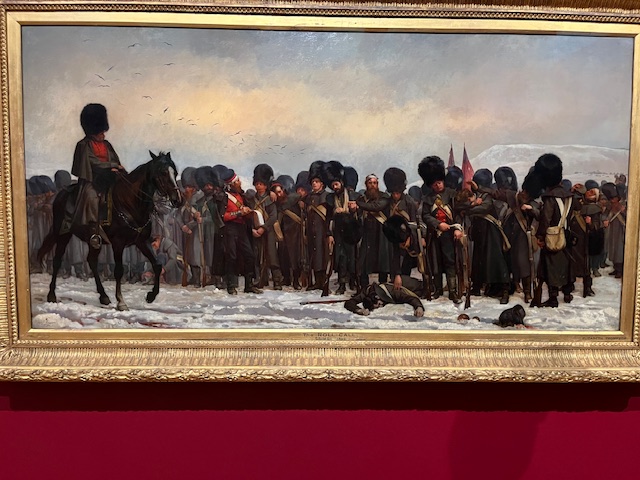
The Roll Call by Elizabeth Butler

My photographs are not very good alas, done quickly avoiding other viewers.
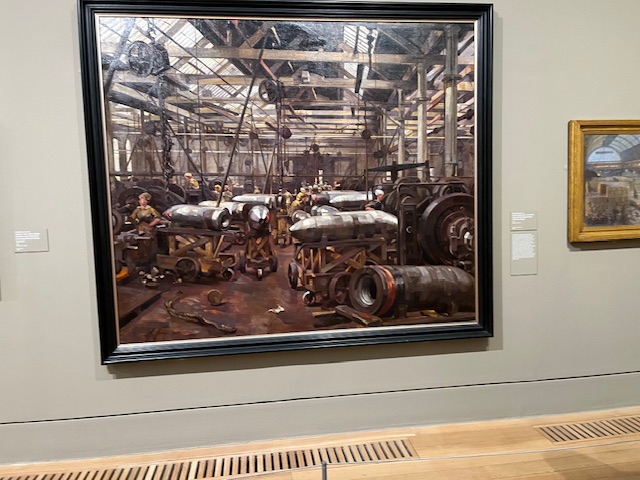
Finally. a painting by Anna Airy, commissioned by the Imperial War Museum, Shop for Machining 15″ Shells, shows women doing factory work in 1918. This was the old Singer sewing machine Company factory on Clydebank. Important work and an important painting
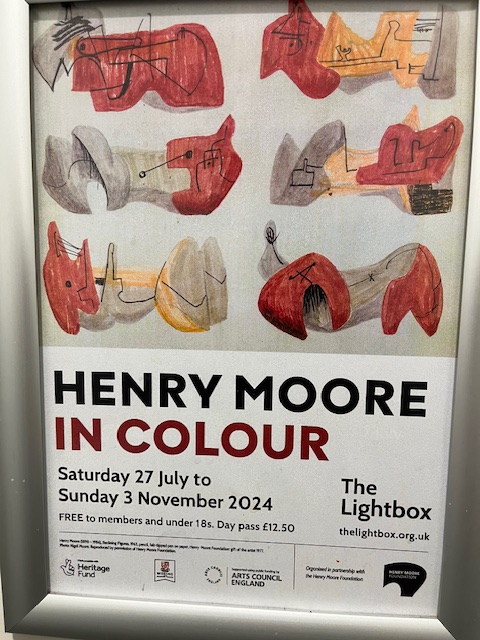
Henry Moore in Colour at the Lightbox

Yet another excellent exhibition at Woking’s Lightbox art gallery. Small, obviously, size dictated by the venue but focused and to the point. We, in Woking, are so pleased as following the bankruptcy of the town brought about by reckless investment, the fate of the Lightbox has been in the balance. Deep cuts are having to be made, and when difficult choices and sacrifices are having to be made, then difficult sometimes to make a case for our wonderful art gallery to be saved. So far it has been managed by the new local government and we are grateful for that. The Lightbox is relatively new, in a town with virtually nothing by the way of heritage or culture, so the rise in prominence of our gallery has been a matter of civic pride. We hope it will continue

Henry Moore is well known, and if like me you tend to remember his wonderful sculptures, then it is useful to be reminded that he painted as well, and some while ago too. When reminded, of course I remember his drawings and paintings of people taking shelter during air raids in London, in the underground railway stations. This exhibition highlights some of these works, known as the Shelter drawings commissioned by the War Artists Advisory Committee during the last war. These Shelter drawings were responsible for achieving widespread recognition for the artist following their display in the National Gallery. When you look at some of these drawings you start to see forming some of his later sculptures and I will show one if I can as an example

Certainly the first one I think I have seen as one of his sculptures!

Many years ago, there was a major exhibition of his sculptures in Kew Gardens, and I painted one of them that was placed in front of the Palm House. By way of light relief, I will end with it here

A figure stretching after a night on a cold platform? Might be

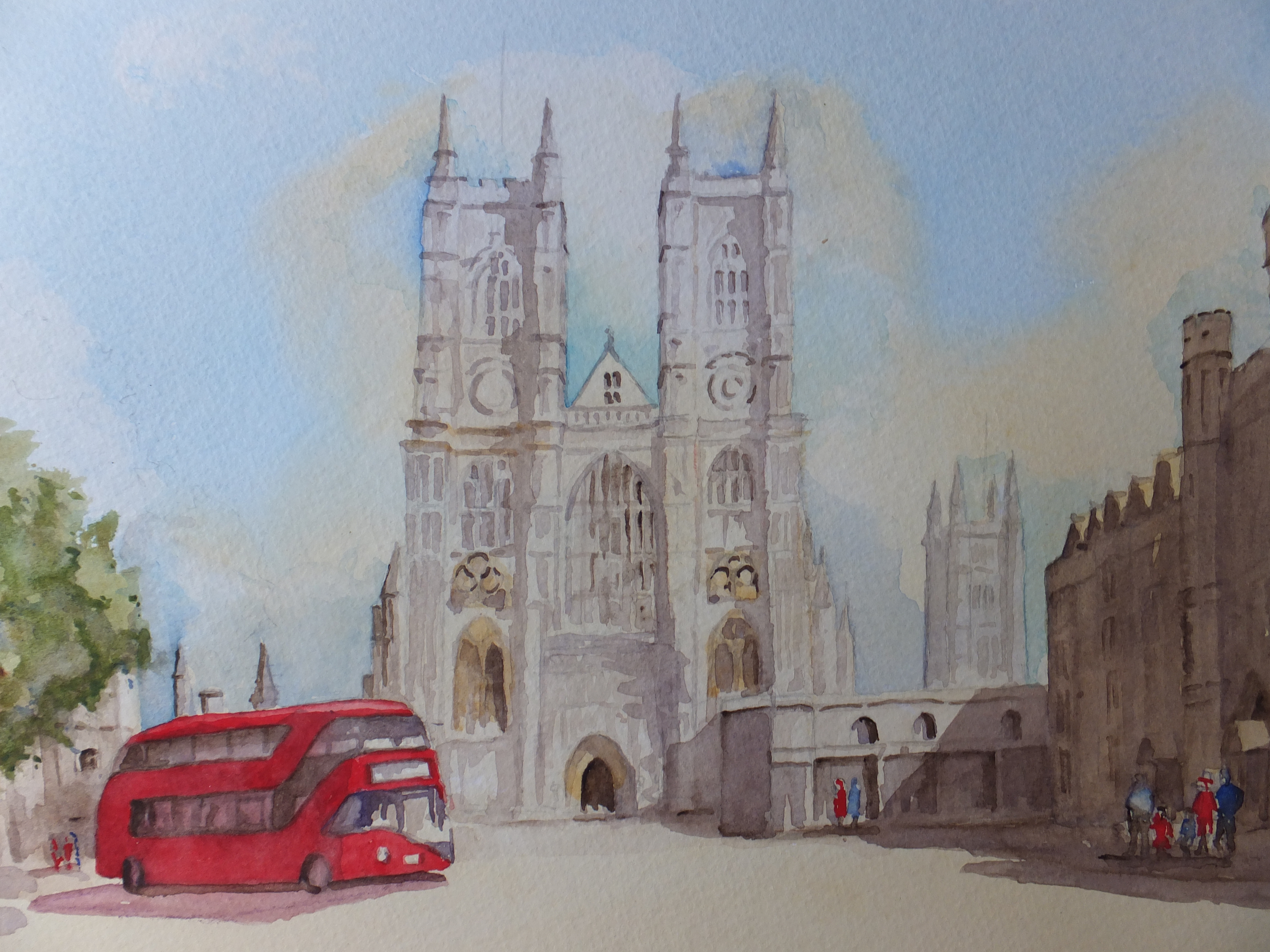
Painting Westminster Abbey

Westminster Abbey

Not inspired by the coronation, because I have looked at this amazing abbey for some time, as a possible painting. A lot of architectural detail which I love to have a go at. I work by allusion. I could not reproduce all the detail exactly, especially with a brush. I put in some detail, some shading and get the colour as close as possible to the original stonework, which is a pinky grey colour, and this seems to work. I sometimes think that the eye of the neholder finishes off the image and fills in the gaps that I have left.

I sorted through various photographic references. I had plenty to choose from. Part of the facade was obscured by two buses and other traffic. There is a column of pink granite in front of the abbey which I felt was in the way, so just left it out. I took out one bus and moved the other one as far left as I could manage, and painted in the red livery that you expect of a London bus. As far as I could see, this is one of the new Routemasters. I am not an expert. I just eclipsed the abbey with the bus, just to show they belonged in the same picture, not placed together artificially. I felt they worked together. I echoed the red with pedestrians in different parts of the composition.

St James Palace on the left I put in heavy shadow, much heavier than the photograph reference. I liked the effect. The spotlight was now on the abbey. The tower of the Houses of Parliament I painted in very pale violet. The image faded away, giving an impression of distance.

I felt satisfied with the composition. The facade of the abbey needed some work. I sharpened some of the detail on tracery, and put extra shadow in to let the eye see where everything was. I don’t do much more than that. The allusion is complete. The eye of the viewer can fill in what is missing

The painting is finished . I would have preferred not to introduce green but there was a tree which couldn’t be left out. This painting will be shown next month in Chichester where I have been invited by a gallery to take part in an exhibition. So a new area which I am looking forward to.

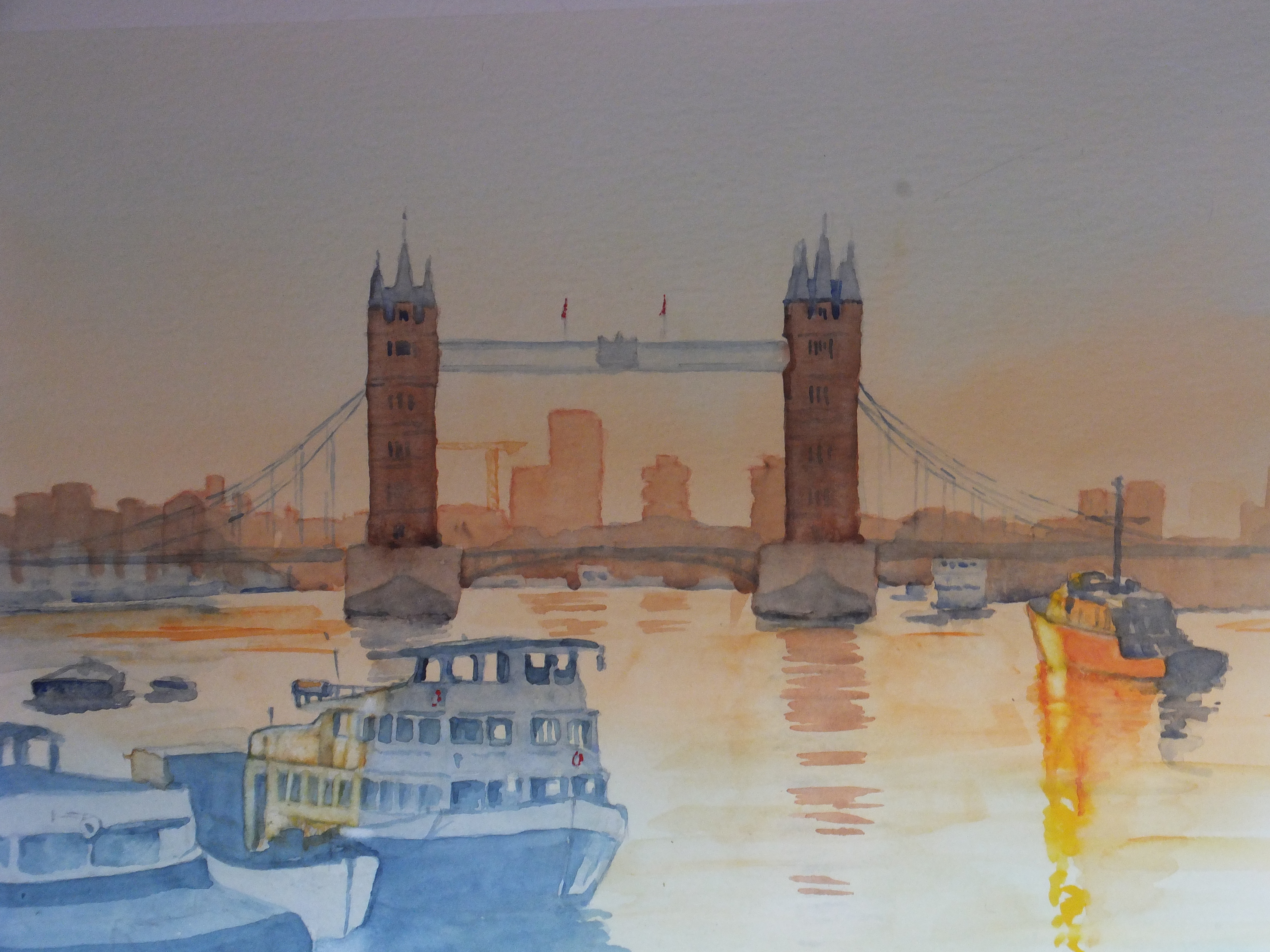
Tower Bridge, London in early light

Tower Bridge in early light

The original is actually brighter than this photograph. Annoyingly I couldn’t get the reproduction any lighter which is a pity

Tower Bridge is always a good subject. It stands across the river as an entrance to the Pool of London. It doesn’t seem so long ago that cargo ships docked here and loaded or discharged their cargo. The bridge became an icon of its time, when London was a hub of international trade. In my lifetime, with the advent of containerisation, traffic moved downriver to Tilbury, and the London docklands wound down as far as shipping was concerned. It became a financial centre instead, important obviously but perhaps not quite so stirring as shipping

I am grateful to Fietz Fotos for their permission to use their reference photograph. It really was a study in orange and blue. I have painted Tower bridge several times over the years, but not in these colours, so it was still challenging enough and seemed to take me quite a long time

There still is a real exhibition planned which I have entered. This will be at Denbies Winery near Dorking and starts on June 21st. If it isn’t cancelled at last minute, as it was at Christmas, this will be my first real show since lockdown 1. Online sales have been good and one must be grateful, but there is something of a buzz about a real exhibition.

We will keep fingers crossed

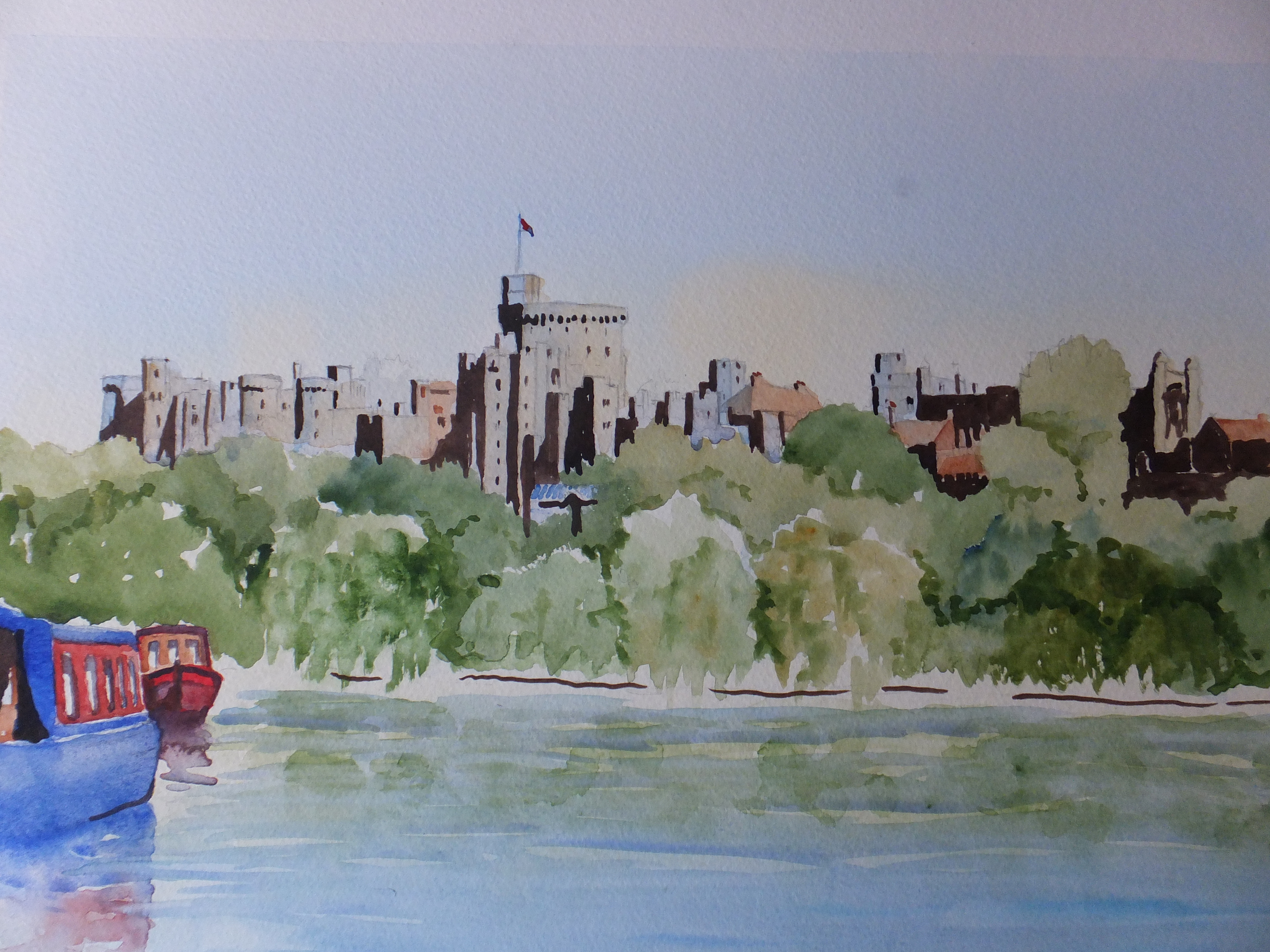
Windsor Castle – the finished painting

Windsor castle on the Thames

The finished item. Quite a lot of trees, relieved by the building to a certain extent, but nevertheless the greens took some sorting out. Mostly they are a mix of sap green with something else. Quite a lot with raw sienna, which is the one I use mostly for vegetation, and works I think for the lighter trees.

The boats have been useful, bringing in some red to relieve all that green, and also stop the eye going off the page. As I said in the last post, I have used sepia ink for the shadows on the castle. I was a little hesitant about that, but seems to have worked out ok.

I seem to be working my way through the list of paintings that I always wanted to do and couldn’t find the time. Lockdown plus very wet weather does keep us indoors a lot. Looking back at these favourite places does make us wonder if we’ll see them again. Vaccination programme seemed to be going well, but now they have found two tested positive for the South African variant, in our village, without them going to South Africa

Oh well. More incarceration

A Hidden Gem near London: The Dorich House Museum

Dorich House, Kingston

We went here a few days ago. An amazing gallery which I didn’t know existed, which had fallen into disrepair, was rescued by Kingston University, and stands a few feet from the wall around Richmond Park. A distance known as a “deer’s leap”

The house was designed by Dora Gordine, a Latvian sculptor, and completed in 1936. She lived there with her husband the Hon.Richard Hare, a scholar of Russian literature and art.

The house is a splendid example of a studio house of the period. The ground and first floor levels were designed for the production and display of her work. A more modest top floor apartment with a roof terrace overlooking Richmond Park, served the couple’s domestic needs

Richard Hare died in 1966. Dora lived until 1991, after which time the house was acquired and renovated by Kingston University. The house now holds the world’s largest collection of Gordine’s work as well as an important collection of Russian art acquired by Hare and Gordine.

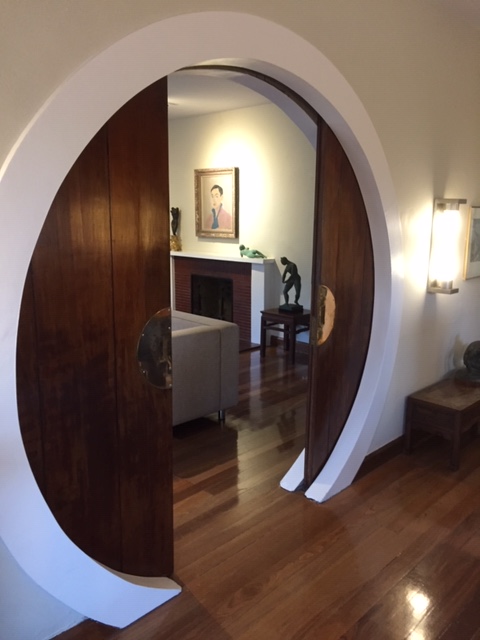
There are some wonderful architectural features in the house. My favourite is the Moon Door

Moon Door, Dorich House

The house is on Kingston Vale next to Richmond Park, and is worth a visit if you are able

Looking Back at Old Work

The London Eye

Do you ever look back at really old stuff? I don’t do that often, but I think it’s a good exercise to do sometimes. Sometimes you can see that you have improved, although looking at some of my old work, i sometimes wonder if I have.

That aside, I found this picture of the London Eye, which was a very good example of rescuing a painting from the jaws of disaster. This had been a much larger painting, crossing the Thames and including the Parliament buildings and some river boats as well,

. Frankly the end result was a mess and I put it away, thinking to reuse the back of the painting for some rough work later on. At another time, someone was talking about cutting down an old painting and using what was left as a presentable picture. I though of that Thames picture and ending up cutting the centre out, leaving out the rubbish, and concentrating on the image shown, which although not perfect, was not too bad.

The final image wasn’t much bigger than a postcard. It centred on the London Eye. I thought it worked well. So did the person who bought it.

So the moral is. Discard nothing until you’re sure there is nothing worth retrieving

St Katherine’s Dock Commission

This is the drawing so far of the boat I was commissioned to paint. Rather faint I am afraid, not only because it’s in pencil but also because she has had a wash of phthalo blue and cobalt mix. Some orange and vermillion went in to the tops of the boats to give that evening sun look, but that will need strengthening

I have already sketched this scene just to realise the composition and to get that agreed. This is the real thing. Just a tad apprehensive, as although I have painted boats enough times, this would be the first boat portrait that I have tackled.

So much of the boat is white, and not even many shadows to relieve the situation. The vessel is beautiful, streamlined and highly polished, in fact all the things that don’t work so well in watercolour. A rough-textured old steamer, dirty and rusty, with plenty of smoke really lets the watercolourist’s imagination run riot. 

But we don’t have that. We have a sleek yacht instead. In the background of the reference photograph which I haven’t published here, are a row of houses, which were not only superfluous, but actually crowded the composition, and didn’t look good against the boats. I have left them out altogether, and I have not regretted doing so. The depth of the painting has increased whilst still preserving the look of a marina

So for the moment I shall just carry on building up the colours on the items that matter. The yacht centre stage of course is the star attraction and needs to come forward

We shall see how this goes

Burne-Jones Exhibition at the Tate Art Gallery

Golden Stairs by Edward Burne-Jones (1833-1898)

One of many well-known paintings by Sir Edward Burne-Jones featured in a special exhibition currently at Tate Britain until February 2019 which is the first major retrospective to be held for forty years. Inspired by the church and the medieval period, his work represented the antidote to the ugliness and the materialism of the Victorian period.

We went there recently. As always a superlative exhibition. To be seen if you can

There were seven rooms of drawings and paintings. Burne Jones was a superlative draughtsman . The second room deals with his time in Fulham, when he finally had space enough to embark on major projects for which he needed countless preparatory drawings, each one of which could be considered a work of art in its own right.

Renaissance art and four visits to Italy encouraged his approach to the body. His male figures appeared troubled while women were portrayed beautiful yet sinister. About this time he was experimental with media, using gouache with chalk and later metallic pigments.

His attitude to the male figure caused him to resign from the Old Watercolour Society which had been shocked by his work. . He was becoming known as one of the most daring artists of his time. After a blissful period of working to his own pace, his exhibition pictures started to take London by storm, and later Paris, so that he became known throughout Europe.

Most impressive were the rooms containing his Series Paintings, massive works commissioned by serious clients with rooms that can show these works as they should be shown. This was of course the era of the seriously wealthy patron who could command works like these., such as the Perseus series, commissioned by the young future prime Minister Arthur Balfour for his London residence.  Curiously Balfour was later to be president of Woking Golf Club, close to where I live. The only prime minister to be president of a golf club. I wondered what these wonderful paintings would look like in the golf club lounge, but that was me being facetious.

I cannot describe the paintings of the Perseus Story, as they were too magnificent. Like wise the Briar Rose which is really the story of Sleeping Beauty. Wonderful illustrations of knights and princesses. Burne Jones I think today would have been in his element illustrating Game of Thrones or the Harry Potter stories.

He worked closely with William Morris, from whom he derived the bulk of his income. He became especially well-known for designing stained glass windows for churches and cathedrals the breadth of the land and indeed the old Empire.

One of the last great figures of the Pre-Raphaelite movement. This is a wonderful collection gathered together for a short time

Work Started on the Fountain of Love Commission

Fountain of Love Detail

I have been working on the drawing of the Fountain of Love commission, which has been testing to say the least. I have just included a detail here, otherwise the image would be too faint to show

The photograph of the fountain itself was included in my last post, and I may have explained that the fountain is in the grounds of Cliveden House in Buckinghamshire. The house is magnificent and is now an hotel but the grounds are run by the National Trust and are extensive.

Over the ages, Cliveden was associated with powerful women. One of the more recent being Nancy Astor, American heiress as well as an MP in Westminster, possibly the first woman MP. More recently still, Cliveden was the scene of the scandalous liaison between Christine Keeler and John Profumo, a married government minister

Again I have been balancing two commission projects, as I have just finished the sketch study of a rather lovely yacht in St.Katherine’s Dock, just to agree the composition with the client before going on the finished painting. I drew this with the help of a grid but there is something about the sleek almost feminine lines of a boat which seem to elude me, no matter how many measurements I take.

Dancing Girl Sketch

As usual the camera leaches out the colour but the essence is there. I did find it useful to make a sketch on this occasion. So many mistakes could be made and were made. At least these have been cleared out of the way, hopefully not to reappear

There is something about highly polished surfaces like plastic or metal, which don’t work well in watercolour. Give me some rough old wood or rusty iron any day, and that will look realistic enough to touch. Still, if you owned a rusty old tub, you probably wouldn’t want it commemorated in a painting

We will await the client’s comment to see whether I have got the composition right as a first step