Copenhagen Canal and other paintings

Back in the summer, we toured the Baltic. At one time we did eight shore excursions in eight days. Even by cruise ship, we found this tiring because of our age, especially my wife who has walking difficulties, so we might not attempt this sort of holiday again. Copenhagen was just one of the stops we made in Denmark

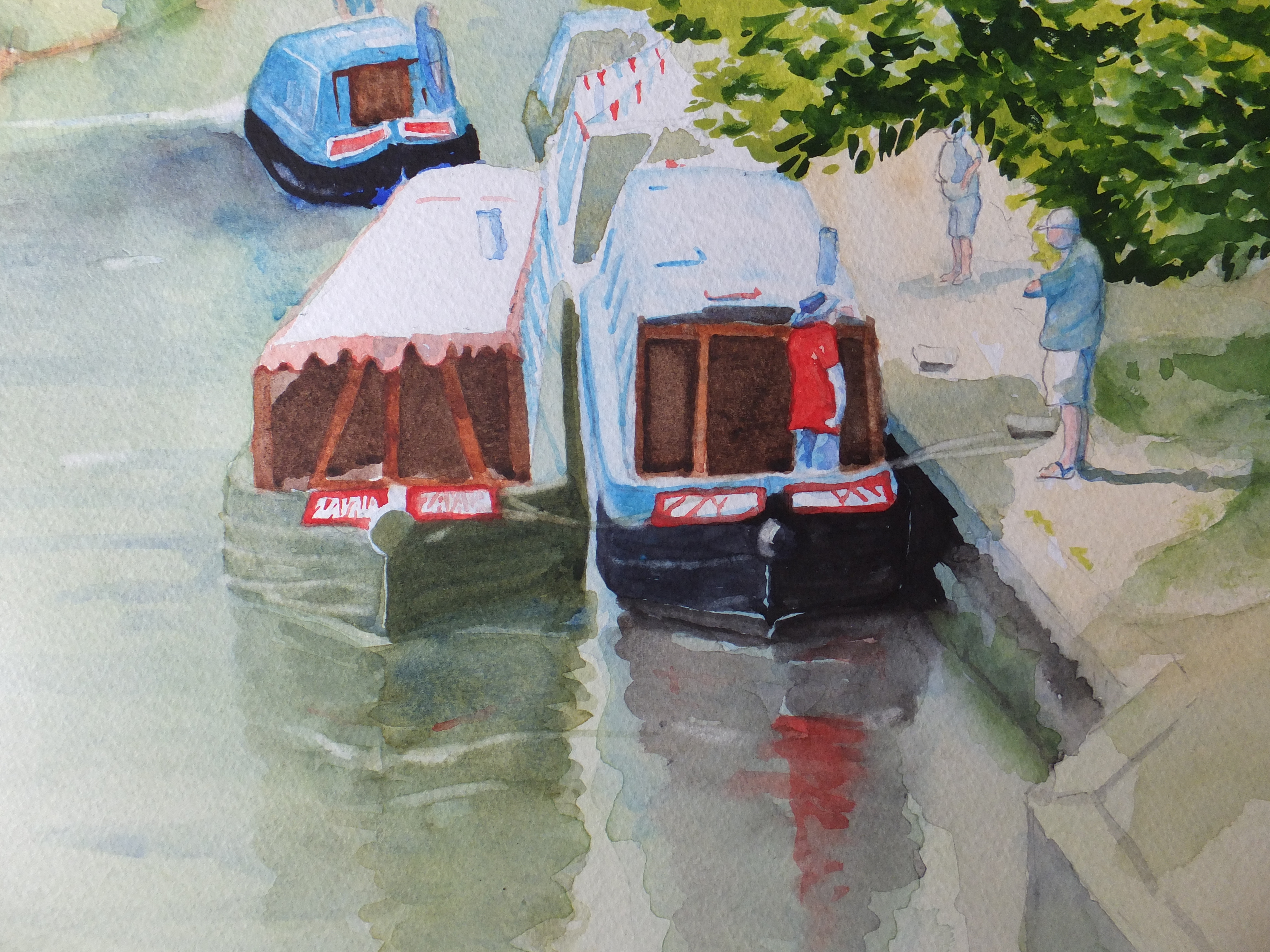
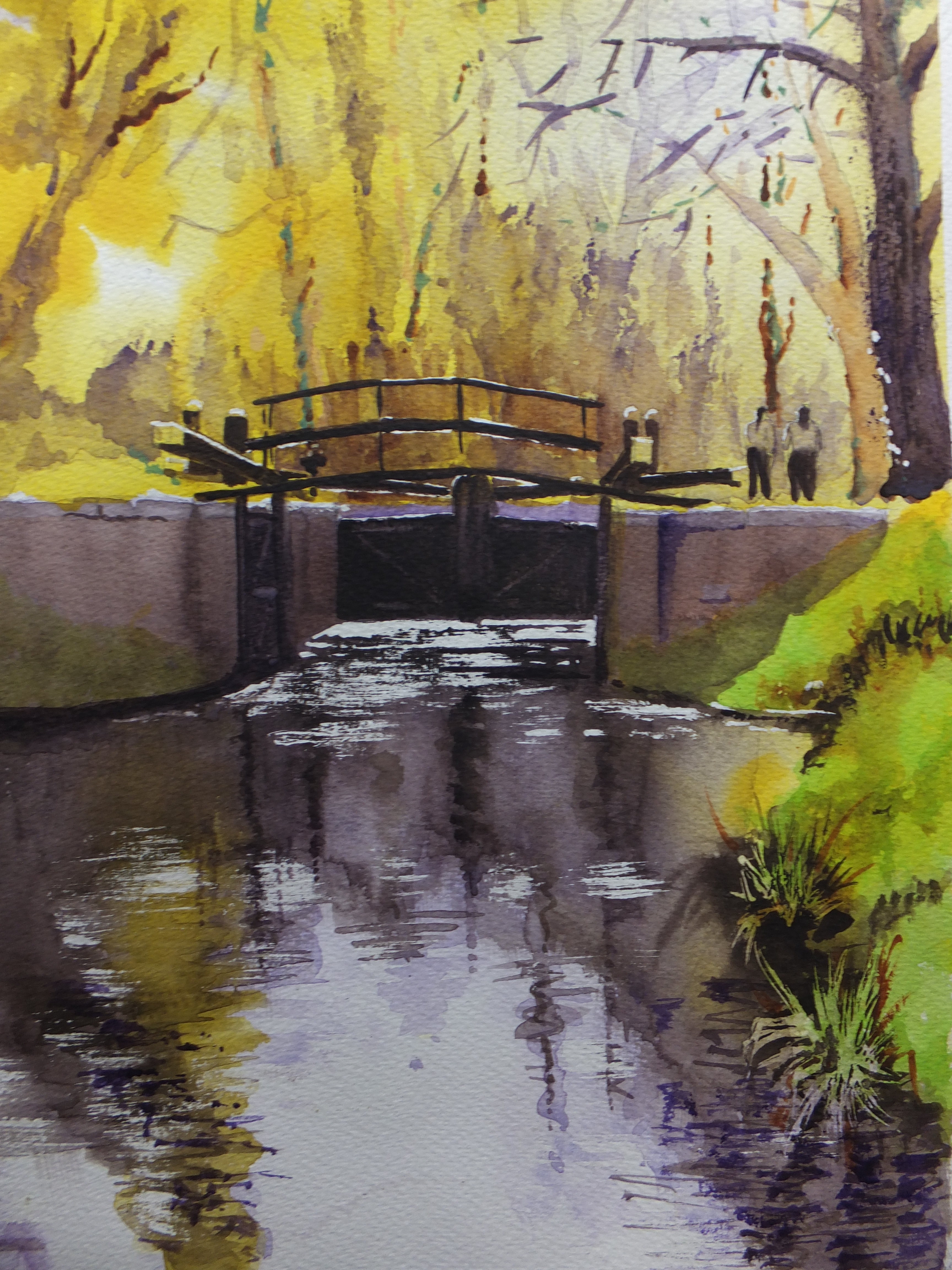
Touring the canal system was fun. i like painting boats and this was just one scene that I snapped for reference. Quite a lot of light and dark in this shot. The sun was very bright especially on the buildings in the background. Deep shadows were cast by the trees, which accentuated the boats. The figures on the canal side were reduced to silhouettes. It took me several glazes to get the water to be an acceptable colour, whilst at the same time still looking transparent. This was more of an exercise about light against dark, than anything else

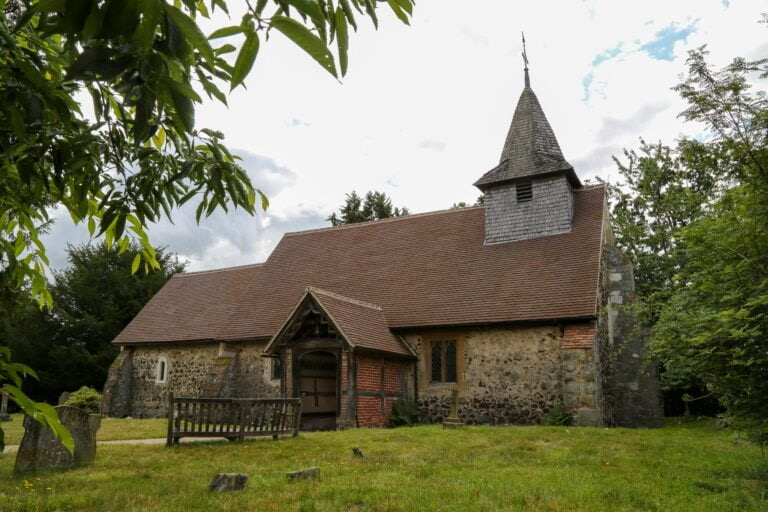
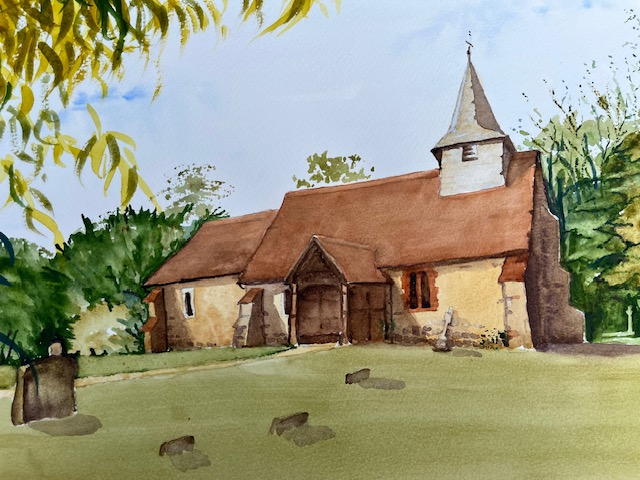
I have been commissioned to paint this church, the village church of Pyrford in Surrey. Ancient yet still in use as a parish church, it is set in a tranquil spot, and is quite charming. The lady who commissioned it no longer lives in the area. Her parents are buried here, so a meaningful place. I always feel very priviliged being asked to paint places that are so important in people’s lives. I am working on it at the moment and will post the result

This is how the painting turned out. I have put sunshine into the painting as the photograph was taken on a very dull day, so the colours are brighter. The lady who commissioned this painting was very pleased, which is always a relief

I have another commission now, quite different to the last, This one is a wedding venue, which I get asked to do from time to time. This one involves marqees and the newly wed couple strolling in the grounds around a lake, so quite a lot of different things to worry about, Still it’s good to have these commissions coming through as sales from my gallery are poor at the moment. Times are hard everywhere still and doubtless will be for some time

Turner in Surrey: the River Wey

Turner, Joseph Mallord William; Newark Abbey on the Wey; Tate; http://www.artuk.org/artworks/newark-abbey-on-the-wey-202538

Described as Newark Abbey which is in fact Newark Priory, and even Newark Priory Church. The priory was a huge complex, and the ruined church is all that is left after the Dissolution . It looks to me that Turner sketched this from the road. The view is much the same today. The land is privately owned so close inspection is not possible. Cows are in the field much the same as Turner’s sketch. Newark Abbey is near Ripley as a point of reference. This painting is in Tate Britain

After the dissolution it was said that the priory was bombarded by cannon from nearby Pyrford Hill. After that the site must have been robbed for stone, as the ruined church is all that remains, apart from the odd outcrop

Turner would row down the river. We know that he stayed at the White Lion in Guildford, and at another in inn in Walton-on-Thames. He also thought nothing of sleeping on his boat. He was also a prodigious walker, known to cover 25 miles in a day including making sketches on the way. Sometimes he would set out with company and leave them behind if they couldn’t keep up

This is the entrance to Quarry Street in Guildford today. It is not by Turner! This is my painting made about twenty years ago. There is a link with Turner albeit a tenuous one. In order to take the reference photograph for this painting, I had to step back into the White Lion Walk in order to keep the bright sunshine out of my lens. The White Lion Walk is the shopping arcade which now stands on the site of the old White Lion Hotel. Let’s look at the next picture.

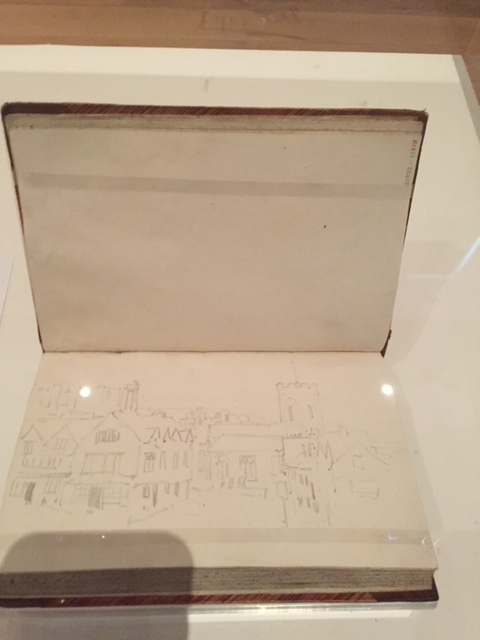
This is by Turner! It is one of his sketch books and shows the same view which I made years later, which still amuses me. I am sorry the image is so pale, but he worked in pencil. You can see the building on the left is much the same and the ancient church of St Mary stands in the background exactly as it does today On the right hand side is an inn much as today. Turner sketched this whilst staying at the White Lion in Guildford. Was he in the lounge relaxing or in his room. We know he didn’t like an audience so maybe the latter

We’ll leave it there for now and continue Turner’s drift down the Wey at some later date

Local Church in Morning Light

Pirbright Church in Early Morning

This is one of our local churches in the village of Pirbright, Surrey. In the grave yard is buried Henry Morton Stanley, the explorer who found Livingstone, and uttered the immortal phrase “Doctor Livingstone I presume”

I have painted this church a few times in all seasons and these have always proven popular locally. What to do, to do something differently? Always a problem, especially heading for a local exhibition, as I am in December. I have chosen an early morning light which sometimes bathes everything with a red light. I have been cautious with the colour , perhaps too much. \i could have used a dilute wash of Permanent Rose over the tree trunks which would have made them pop, as the word seems to be.

I used four colours in this painting. Quinacradone Gold with a slight Vermillion tinge to it for background, Burnt Sienna with vermillion mix and for the very dark shades , Transparent Brown again with a tinge of the red.

The painting is on display at the moment. The art club have taken over the old post office in the centre of the village which will be very helpful as a permanent exhibition

We shall see. We shall get opinions if nothing else

Painting again as means to recovery — finished painting of Bosham Church viewed from the sailing club

Bosham Church from the sailing club

It is now some time since I have posted anything, and it is good to be back. It is also extremely good to be painting again. My life for the past ten weeks, has centred round hospital visits and more recently consultations with the physiotherapist. Today I was discharged from hospital so trying to get back to normal after my accident

I started this painting about two weeks ago. It was to replace a gap in my range. I sold two Bosham paintings at my last exhibition in June, which was held in the gallery at Denbies Wine Estate near Dorking. I had a telephone call from a gentleman asking if by chance I had a painting available of Bosham which he wanted as a gift for a friend.. How fortunate. He was prepared to wait and is collecting the finished item tomorrow, so that is good

I have used sunset colours which always work with any subject involving water. The deep reflections are perfect for this size of painting. There are just four colours in the picture, red and cobalt blue, violet and transparent brown

There are more finished paintings to come. Roman Sunrise, which is a splendid early morning view of St Peter’s Basilica, and also the Bridges of Prague, which I am just finishing

Two exhibitions in December coming up so will need plenty. Fingers crossed that strict Covid restrictions aren’t reintroduced of course as they were last year at the last minute. Our infection rate is rising worryingly, with the government trying to avoid taking any action. It is as though they are taking some desperate gamble that herd immunity will kick in which will save them putting any curbs on the economy

Anyway sorry about my long absence. Hopefully I can get back into the swing again.

Bosham Harbour in Sussex: the finished painting

Bosham Harbour in Sussex

Before I put the background wash in, I scrubbed literally a good deal of the yellow away. On the original painting the yellow blends nicely as a sunset colour. In this photograph it stands out again, and I fail to see why. I can do no more with it, so must show it, warts and all.

The yellow scrubbed back down almost to white was probably the colour I was looking for originally. I did a faint yellow wash on the front of the white buildings, and that worked well too, but lost on the photograph. Oh well!

The composition extends further to the left including more boats and more sunset. I could put this in a long frame and it would work well. It could only be shown in a bricks and mortar exhibition though, but I have one booked in December, subject to virus spike. I will give it a showing on line first and see how it goes. If no interest, I will keep it framed for local shows

In the meantime, I will start thinking about my next subject

Bosham Harbour: along the Causeway

Bosham Harbour from the Causeway

I am starting another painting of Bosham, this time from a different angle. This started because I want something to use in one of those long frames I bought. Bosham has worked well in the past but I can’t repeating that same shot, so this time I am standing on the causeway which floods at high tide and which gives good possibilities for an interesting composition

So far I have drawn the cottages on the water’s edge and the church behind. I am not sure whether you can make that out and will include a close up at the end

What is that splash of yellow? Something I haven’t tried before. I have laid down the basis of a low sun across the water. The plan is to wash over that with the sky and sea colour. I may well live to regret doing that, but sometimes you have to try something a little different.

I shall wash over with a mix of blue and vermillion, and hopefully get a low lit subject. We shall see.I will leave the close up of the drawing

I hope that is a bit clearer. The wall on the corner is foreground. The posts mark the edge of the road which will be flooded in this picture

History of Langstone Harbour and Warblington,Hampshire Coast

Watchman's Hut Warblington.JPG

Just as a change from painting, whilst I work on my Alhambra picture, before I have anything else to say about it, I am at the same time, researching the history of Havant in Hampshire based on my postcard collection, for a talk I am due to give to my local history group in Guildford in November

Havant is an unprepossessing town. I say that as someone who grew up there and therefore has an affection for the place. Nevertheless there is plenty of interesting history around and about. I keep within the confines of my collection, and on the eastern periphery lies Warblington, a Saxon foundation, a remote place by the side of a marshy creek, eerily quiet when I was a boy and still the same today. A week or so back I went to the old church to take some pictures to back up my postcards, and wandered around the churchyard. We were within half a mile of the Havant by-pass with its buzz of traffic and yet within the churchyard you could hear a pin drop. In my mind, I went back to my childhood when I first discovered this place as a schoolboy

The church is c13 and something of an enigma. Why build it there in the middle of nowhere? It still stands in the middle of nowhere. We are told there was a Saxon settlement, and the word Warblington stems from the name of the chieftain, a woman apparently, and there are Saxon elements in the foundations of the church . The church served nearby Emsworth, which still doesn’t explain why it was built at Warblington. On the site of a holy place perhaps? We don’t know

More interesting than the church despite its age, are the two huts, in diametrically opposed corners of the churchyard. If I say they are c19, I am sure you will guess that they had something to do with bodysnatching.  They are nightwatchman’s huts used to watch out for bodysnatchers who had posed  a huge problem until the Anatomy Act of 1832, which required anatomy teachers to be licensed, which effectively put an end to this lucrative trade. Also the medical fraternity were allowed the bodies of executed criminals or even donations from poor families.

In the churchyard of this creekside church are gravestones of sailors drowned at sea, and I quote the one I have always found fascinating.

Sailor's Gravestone

This the gravestone of William Palmer, and perhaps we should start with the inscription

This is in the memory of William Palmer that lost his life and his vessel going into Dublin the 24th February 1750 aged 38 years

The carved relief is intriguing and the work of a very skilled mason. Even the rigging stands out and would need very careful carving. Huge waves are rolling and the ship obviously capsized. The object behind the capsized vessel, I cannot make sense of

So we have a local mariner, a master mariner with his own boat, most likely involved in coastal trade as so many around here and Langstone were, and with a small crew, perhaps ambitiously attempting the crossing of the Irish Sea, not to mention the treacherous rocks around Lands End, and coming to a sad end. Or perhaps this was his regular run, and he was unlucky due to treacherous weather conditions. Dublin was very English in those days, and would be looking to regular supplies of day-to-day items, so one can easily imagine mariners plying a regular and profitable trade.

There are several Palmers buried in the churchyard. William’s wife is buried in the same grave but I can’t make out the dates. I imagine them being a prosperous family, judging from the quality of William’s gravestone

I remember seeing this stone when I was about twelve. It fired my imagination then and still does. It doesn’t look any different

I had thought to talk about Langstone close by, but another time. I have painted Langstone often but never Warblington which perhaps I should add to my list

A different aspect of Bosham Harbour

DSCF3969

i think I may have mentioned ad nauseam that Bosham Harbour with its ancient church is a favourite subject for painting, and is widely known

If I am preparing for an exhibition, I usually like to have at least one view of this beautiful little place. The problem is that everyone wants the same shot, across the harbour with the church against the skyline, so painters, like me, are continually looking for a way to paint this view, and yet make it look different every time.

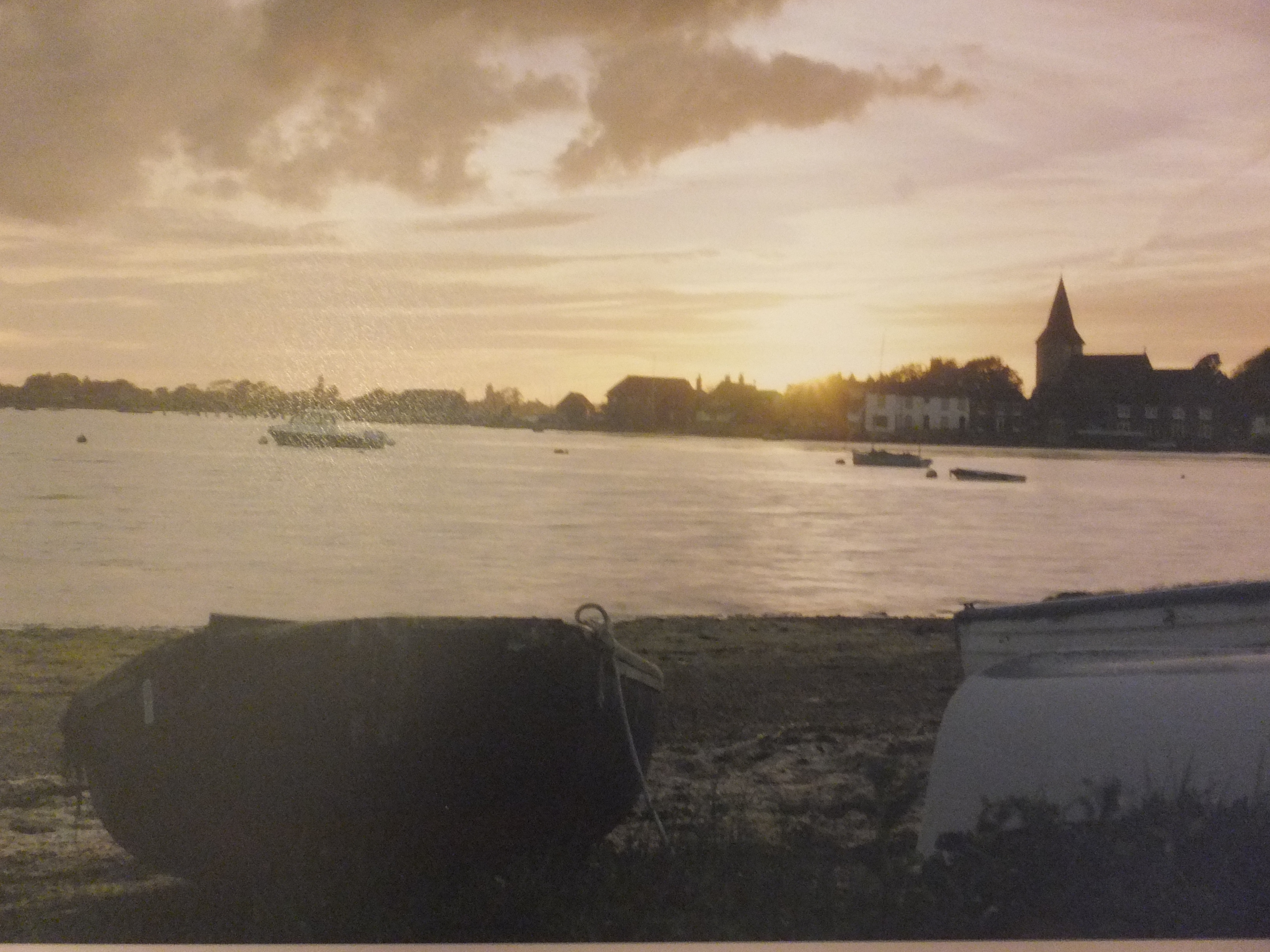
I came across the attached photograph a few months ago, which interested me. As you can see, it is a gentle evening shot, with some bright sky and some very deep silhouettes. The details are blurred, which is not something I usually do, but found myself intrigued nonetheless. The effect could be impressionistic, which again is not something I usually do. The other thing I liked, is that, when translating this into a painting, one could use a very limited pallette, which I find improves the effect very often. In this case, we are looking at yellow and violet basically, which generally work together very well.

I haven’t used these two colours for a while, so the idea is attractive

I am not sure about how I feel about the beached boats in the immediate foreground. They are certainly an aid to perspective, which I can appreciate, and yet in your face just a bit. I think I will draw some of these separately on tracing paper and chase them round the composition to see what I like best. I have been through my archives of boats too, and have sketched one or two of those, again to see what works.

Despite what I said about getting away from detail for a change, I don’t want meaningless shapes either, and unlike photographers, artists can choose what goes into a composition, which gives us an advantage, so I might be able to get away from that rather shapeless foreground.

I think there will be quite a lot of work with little bits of tracing paper, before we hit on the right composition, so we will see what happens. Yet another journey into the unknown.

Finished Bosham Panorama Painting

Finished Bosham Panorama

and there it is waiting to go into its long frame

That will then complete a collection of twelve paintings for the coming exhibition at the Guildford Institute from 19th of this month

Since the last post, really the work was purely detailing, using dark brown, white and cadmium red. I have drawn in some buoys and odd details like that

I bought a new detail brush the other day, designed by Matthew Palmer. It has a large bole which holds a good supply of water, but the tip comes to a very fine point, which produces a line rather like you’d expect from a pen. I think it was designed for painting very thin branches and twigs. It also works well for fine rope work, and window frames

Huge sigh of relief now that the exhibition collection is finished, all but framing the last one

I can now look at catching up with a few paintings for pleasure. I love doing horses and have made some initial sketches, from which I think I can put an interesting composition together. I have gone back to drawing by eye instead of using a grid, which not only saves time, but also is comforting to know I can still do it ( or think I can)

I will publish the horse drawings at another time

Bosham Panorama for the Long Frame

Bosham Panorama Starting to emerge

Emerging from the sea mist almost

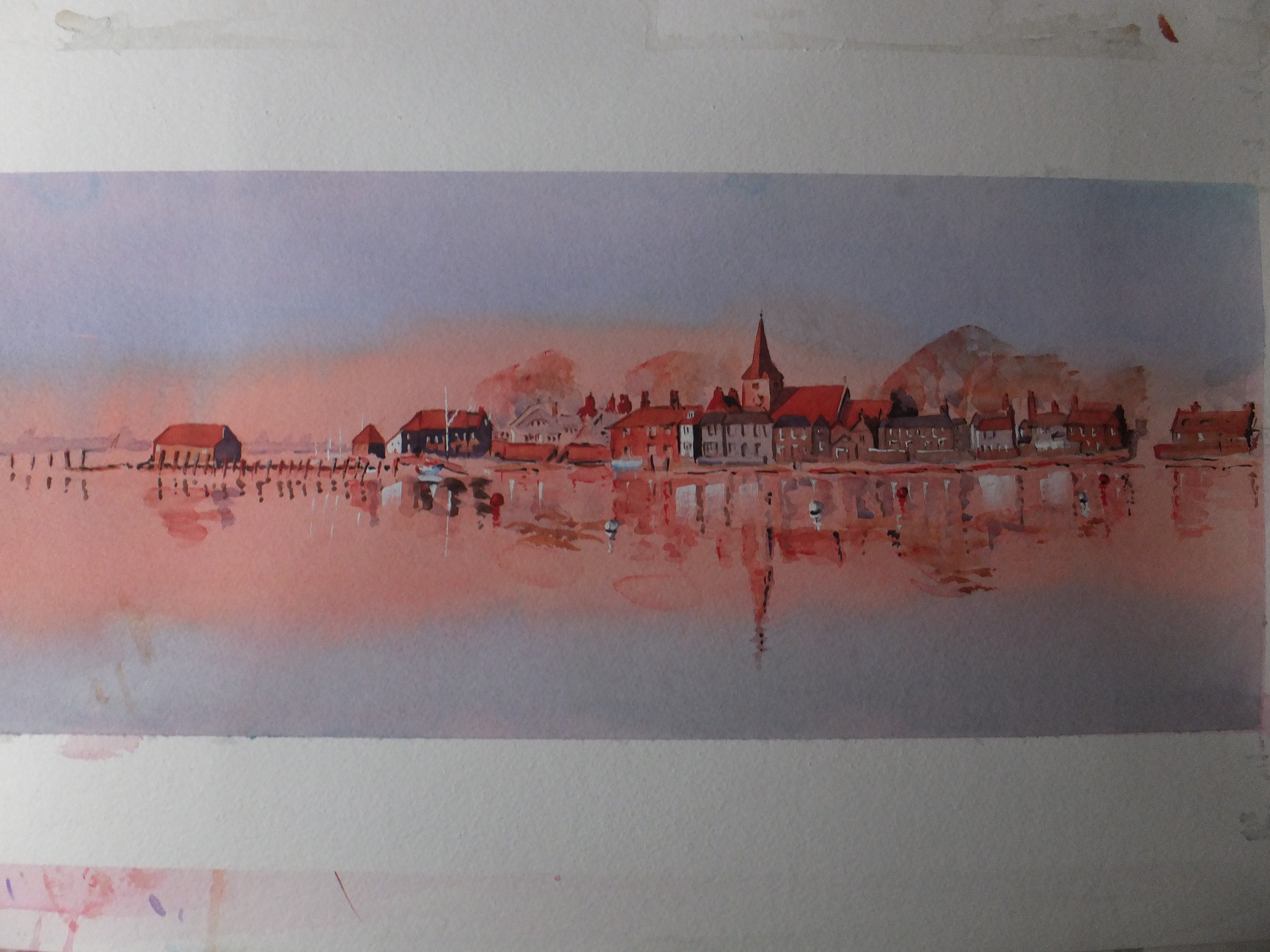
This is the start of the panoramic painting for the long frame which I mentioned recently, which I am hopeful for, but we shall see

For sky and sea I used a mix of phthalo blue and cobalt. For the sunset sky and reflection in the water, I have used a mix of Cadmium Orange and Permanent Rose. I was not pleased with the initial result, as the sky came up very orange indeed. I applied coat after coat of Permanent Rose, wet on dry, which when dry, appeared to have made very little impact. Eventually the sunset turned pinky red, and I quite liked the effect of the pink over the blue. Where the blue had gone on sparsely, the pink soaked in, and started to look like pink clouds on the blue sky. I am not sure whether this shows in the photograph.

In order to get the effect of the low sun on the rooftops, I will need to glaze the buildings with something like Light Red and if that goes too brown, then a thin wash of Cadmium Red. Sparingly, of course, as that is powerful stuff.

There is masking fluid to come off, where white buildings have caught the strong light. I should have mirrored that in the sea, but forgot, but I think I can rescue that with White Gouache.

Dark shadows to go in with dark Brown which will accentuate the light, I hope. Also some small boats for which I will use the same blue mix, and white masts, should add to the effect

I am hoping so, as exhibition time draws near