Turner in Surrey: the River Wey

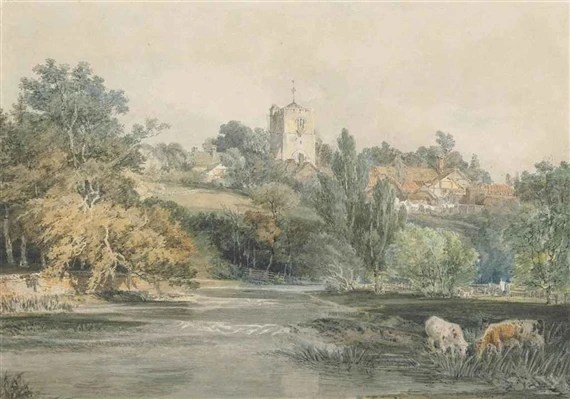
Turner, Joseph Mallord William; Newark Abbey on the Wey; Tate; http://www.artuk.org/artworks/newark-abbey-on-the-wey-202538

Described as Newark Abbey which is in fact Newark Priory, and even Newark Priory Church. The priory was a huge complex, and the ruined church is all that is left after the Dissolution . It looks to me that Turner sketched this from the road. The view is much the same today. The land is privately owned so close inspection is not possible. Cows are in the field much the same as Turner’s sketch. Newark Abbey is near Ripley as a point of reference. This painting is in Tate Britain

After the dissolution it was said that the priory was bombarded by cannon from nearby Pyrford Hill. After that the site must have been robbed for stone, as the ruined church is all that remains, apart from the odd outcrop

Turner would row down the river. We know that he stayed at the White Lion in Guildford, and at another in inn in Walton-on-Thames. He also thought nothing of sleeping on his boat. He was also a prodigious walker, known to cover 25 miles in a day including making sketches on the way. Sometimes he would set out with company and leave them behind if they couldn’t keep up

This is the entrance to Quarry Street in Guildford today. It is not by Turner! This is my painting made about twenty years ago. There is a link with Turner albeit a tenuous one. In order to take the reference photograph for this painting, I had to step back into the White Lion Walk in order to keep the bright sunshine out of my lens. The White Lion Walk is the shopping arcade which now stands on the site of the old White Lion Hotel. Let’s look at the next picture.
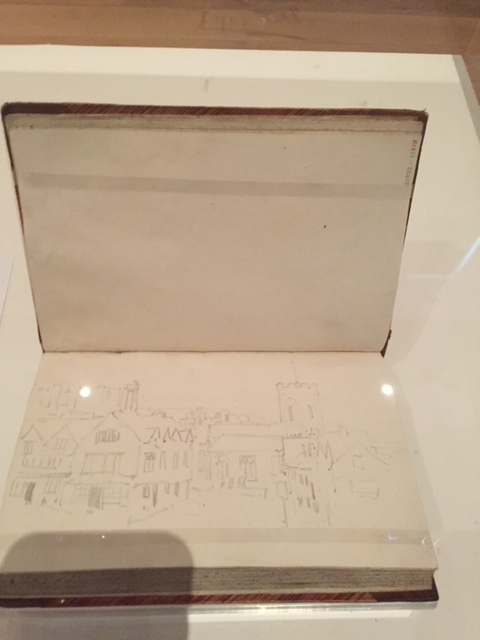
This is by Turner! It is one of his sketch books and shows the same view which I made years later, which still amuses me. I am sorry the image is so pale, but he worked in pencil. You can see the building on the left is much the same and the ancient church of St Mary stands in the background exactly as it does today On the right hand side is an inn much as today. Turner sketched this whilst staying at the White Lion in Guildford. Was he in the lounge relaxing or in his room. We know he didn’t like an audience so maybe the latter

We’ll leave it there for now and continue Turner’s drift down the Wey at some later date
Turner in Surrey

In a weak moment, I have allowed myself to be talked into researching the work that JMW Turner carried out in Surrey, and writing a talk on my findings, which I will then have to deliver to my history group at a given date in November. this sounds a long way off. I know from experience that it is not, so i have already started gathering stuff from books and internet. A visit to tate Britain when the weather improves will be necessary but enjoyable. The bulk of his bequest to the nation is there so must be something of use. Also Petworth House where he was a frequent house guest of Lord Egremont. Petworth is not in Surrey as we know but is close enough. What I am realising from the start, is that there is precious little written about Turner’s expeditions into Surrey. he did a number of paintings on these trips but none of them became his best known works and so consequently little written about them. perhaps my view will change as I get further into my searches

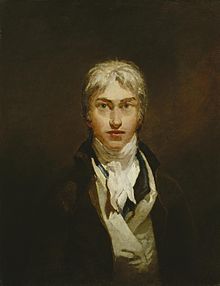
To start with a little background, the painting above is his self portrait. The only one he ever did in his lifetime. He was a private person as we know, and gave little of himself away. His birth date is given as 23rd April 1775, but this is disputed, as Turner would give different dates to different people. he had this aversion to people knowing his personal details. He lived with his parents, which was far from being satisfactory, as his mother had a violent temper, and was later incarcerated in Bedlam Hospital. So he as at School in Brentford and later in Margate, and this is where his love of the river started. He loved boats and messing about in boats. They figure in some of his paintings, and they are a frequent mode of travel on his painting expeditions. later he would row sometimes as far as Windsor on the Thames and down the Wey to Guildford, which we will look at later.

let’s start looking at some of his Surrey paintings and start in date order as far as we can

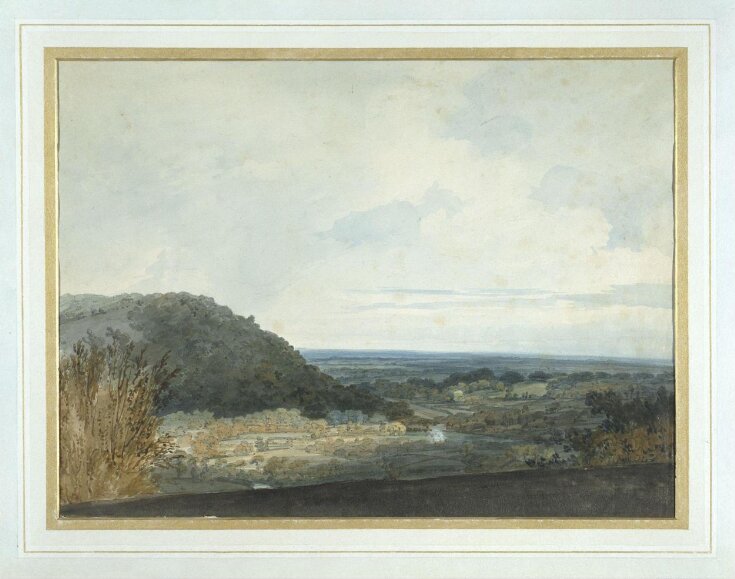
Possibly Box Hill Date….. previously attributed to Tom Girtin, and later to Turner. Girtin was contemporary to Turner, and they were in fact great friends. They would go on expeditions together, and on one of them painted the Savoy palace from a boat on the Thames. Girtin was an acclaimed painter, who sadly died at the age of 29. Turner held him in high esteem and his famous quote said ” if Tom had lived I would have starved”. Turner was definitely in the area that year, as the next painting of Leatherhead shows. This was his so called Student period.

At about the same time, we have this painting of Leatherhead

Leatherhead from the River Mole, with cattle in the foreground, dated 1796, and attributed to Turner. I find this an immature style compared to what we associate with Turner’s work, and it would be as this comes within his student period. Turner had been invited to Norbury Park, near Leatherhead, a place I associate with Fanny Burney who met her future husband there, Comte d’Arblay, an emigre from the French revolution. I wonder if they met Turner. Interesting to conjecture

I will publish so far and go on with this at a later date

Exhibition of Women Artists at Tate Britain

Magnificent exhibition at Tate Britain entitled Now You See Us is on until early next month. I wish I had gone sooner as this is an exhibition that needs more than one visit. It covers the work of women artists from 1520 – 1920, during ages obviously when women were subservient to men in most walks of life. Their work very often epitomises their struggle for recognition.

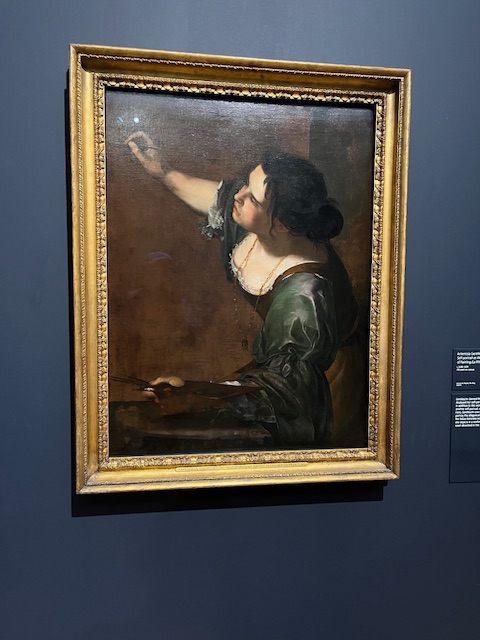
One of the earlier examples, a self portrait by Artemesia Gentileschi, an Italian artist working in London during the reign of Charles I, In London she worked for Charles I and Queen Henrietta Maria, and two works in this exhibition are from the Royal Collection. The other one is Susannah and the Elders, a popular Old Testament sory who was observed bathing by two of the elders, and sexually assaulted. The usual story, the elders tried to make out she was a whore but later her innocence was proved.

There were an amazing number of artists represented working through the ages. Very few did I recognise. Gwen John was one, and her self portrait was used in the exhibition publicity. In fact the work of hers shown was in my view some of the least inspiring.

During the 18c the work of the Royal Academy centred round oil paintings. Other media was looked down upon. Joshua Reynolds was especially sniffy about watercolour, pastel, embroidery and any sort of craft as being work that women did at home for their own amusement.

Gradually, and as we move into the c19 women are starting to meet men on equal ground. Two paintings which greatly impressed me were:

Colt Hunting in the New Forest by Lucy-Kemp Welch

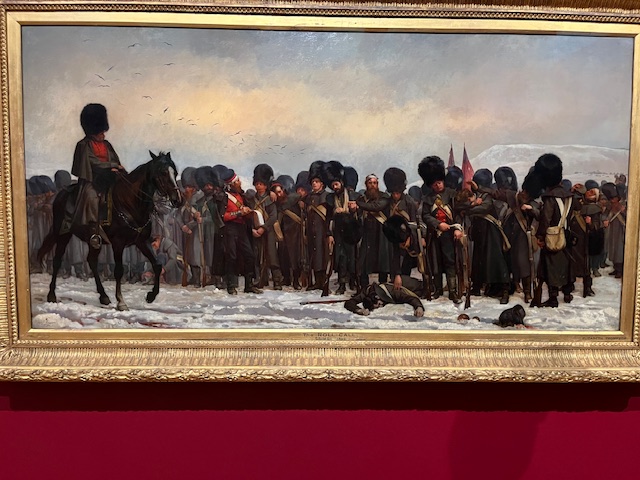
The Roll Call by Elizabeth Butler, a painting of Guards Regiment in the Crimea. This painting was summoned to the palace for a special viewing by Queen Victoria. It sold for the staggering sum of £1200

Both of these were sensations in the art world at the time. Both were hung “on the line”, which means they were hung at eye-level, a great tribute by the hanging committee of the Royal Academy

Colt Hunting in the New Forest which is an enormous painting

The Roll Call by Elizabeth Butler

My photographs are not very good alas, done quickly avoiding other viewers.

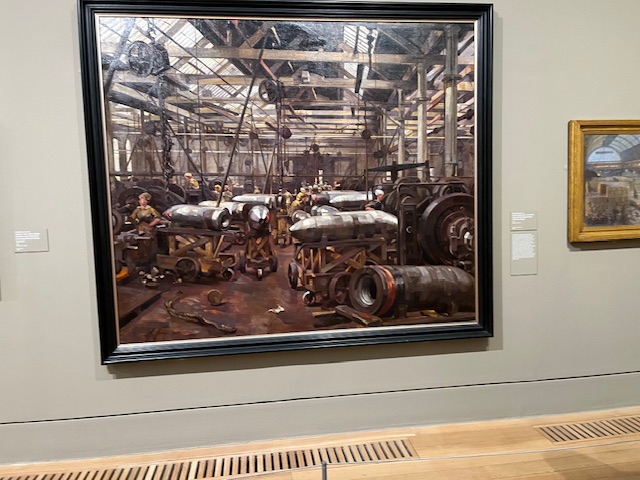
Finally. a painting by Anna Airy, commissioned by the Imperial War Museum, Shop for Machining 15″ Shells, shows women doing factory work in 1918. This was the old Singer sewing machine Company factory on Clydebank. Important work and an important painting

In the Style of Aubrey Beardsley

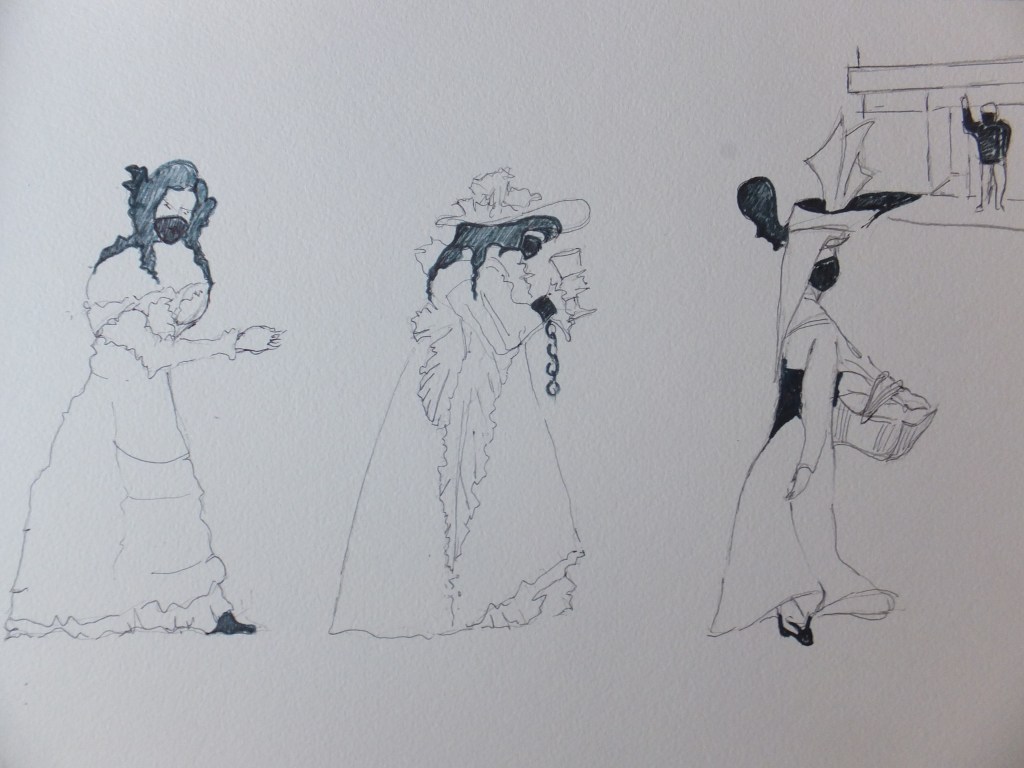
Social Distancing using the style of Aubrey Beardsley

During lockdown we formed a zoom art group within the family, mostly for fun, and yet some of the results were interesting. People who were new to art, were surprised at what they could produce. Old hands like me, who have painted in watercolour for some years, found, when they moved to other media, that they were beginners again. Digital painting was beyond me completely, whereas my grandchildren excelled.

We closed the group for various reasons, although the ground we had covered was amazing. My grandchildren had to devote more time to school work, and as lockdown eased different people were going on holiday

We have started the group up again, with grandparents and friends only. Grandchildren are now even more occupied with studies. How it works, one member of the group sets a task. The current one is to use the style of Aubrey Beardsley, the illustrator, within a scene that is topical. All these tasks make you scratch your head, I can tell you.

My effort is shown above. The topical scene is Social Distancing, some thing we are all familiar with, when queuing for the supermarket or any store.I haven’t been terribly original, as I have borrowed from Beardsley’s many drawings. I have added face masks, which is useful, as it saves you drawing faces. I have added the store front from his picture The Girl in the Red Gown

At the same time, we have to introduce another artist, whose work you were reminded of. I chose Utamaro the c18 Japanese artist who works in line like Beardsley. He, Beardsley was in fact influenced by Japanese art, as were many in the c19, especially the French Impressionists

My submission has gone in. We will see what happens and what the next task will be.

In between time, I am working on the Camargue horses. I have transferred the drawing to watercolour paper, which is the tedious part, and have applied the first wash

Tate Britain : William Blake Exhibition, on until 2 February 2020

The Ancient of Days 1827

Just by way of a change from house portraits, which can become monotonous, not for the painter, as each painting is a trip into the unknown, but for the reader of this blog

There is a wonderful exhibition of William Blake’s work at Tate Britain at the moment which runs until 2nd February next year. The painting above, possibly one of his most well known, was on display, and I took this photograph from the hip, whilst dodging other people who were trying to do the same. You were allowed to photograph, provided you didn’t use flash, but I still felt guilty nonetheless

I knew something about Blake, most of us do, but I still learned a lot. I think I will have to go back again, and do the last two rooms again. There was so much detailed stuff, prints, letters etc that the eyes become very tired. Not just his drawings but also his writings were on display. I managed to miss his manuscript of “Tiger, tiger burning bright” which I was cross with myself about.

He was a London lad, growing up in Soho. he enrolled at the Royal Academy, but like others before him, reacted against its rigid teaching. He was a visionary who shared the ideals of medieval Gothic artists

I had never realised that as a print maker he was way ahead of his time. His innovations allowed him to print in colour, and combine texts and images, a technique which enabled him to create a succession of visionary books. In them, he engaged with the most pressing questions of the day, the slave trade, sexual freedom and revolution.

His radical sentiments could have got him arrested, if only the authorities could have understood his obscure message

Through changing fortunes, he realised a burst of creativity near the end of his life, with such great works as illustrating Dante’s Divine Comedy. I found his vision of Purgatory, somewhat uplifting and comforting. Whether one believes in the concept or not,( and even some catholics, myself included, tend to kick this belief into the long grass), then Blake’s illustrations are helpful. I shall probably attract criticism for that remark

See the exhibition if you can

Van Gogh Exhibition at Tate Britain

Van Gogh Self Portrait

Superb exhibition of Van Gogh works as well as some of his influences currently at Tate Britain. We went there on Saturday. It was very crowded, and part of me wished that we had got up earlier and gone to the member’s preview at 8am. It was bound to be popular with so many famous paintings brought in from all over the world. The first Van Gogh exhibition since 1947!

He spent three years in London before he started painting. Firstly in the London office of Goupil, the art dealer, and some of the paintings he would have handled were on show. At Goupil he dealt in black and white prints, and himself became a collector, accumulating some 2000 prints. Whilst in England, he developed a fondness for literature, and especially for the works of Dickens. It is believed that he developed his social conscience through reading Dickens, and many of his works depict the misery of poverty.

He was a teacher and later a preacher in Isleworth before returning to the Netherlands and then moving to France to join his brother Theo, also a dealer.

In France he was painting, and from Paris moved to Arles, hopefully to found a colony of artists. Much of his work from this period is too well known to mention, and then sadly he was overtaken by mental illness, the need to self-harm and eventually to commit suicide

Also shown were some of the works of artists, who had been inspired by Van Gogh. Harold Gilman, Spencer Gore, and Matthew Smith led by Walter Sickert of the Camden Group were particular devotees, and it was said that Gilman would raise his brush to a picture of Van Gogh before he started to paint.

Famous paintings here, too many to mention. Sunflowers which was bought for the Tate in 1928 and then moved to the National, is now back. Also Shoes which was possibly the first painting of shoes to be used as a portrait of their owner. Others followed, and here I always think of our local painter and gardener, Gertrude Jekyll

I’ll finish with a bad photograph of Shoes

n

It’s on until 11 August

Burne-Jones Exhibition at the Tate Art Gallery

Golden Stairs by Edward Burne-Jones (1833-1898)

One of many well-known paintings by Sir Edward Burne-Jones featured in a special exhibition currently at Tate Britain until February 2019 which is the first major retrospective to be held for forty years. Inspired by the church and the medieval period, his work represented the antidote to the ugliness and the materialism of the Victorian period.

We went there recently. As always a superlative exhibition. To be seen if you can

There were seven rooms of drawings and paintings. Burne Jones was a superlative draughtsman . The second room deals with his time in Fulham, when he finally had space enough to embark on major projects for which he needed countless preparatory drawings, each one of which could be considered a work of art in its own right.

Renaissance art and four visits to Italy encouraged his approach to the body. His male figures appeared troubled while women were portrayed beautiful yet sinister. About this time he was experimental with media, using gouache with chalk and later metallic pigments.

His attitude to the male figure caused him to resign from the Old Watercolour Society which had been shocked by his work. . He was becoming known as one of the most daring artists of his time. After a blissful period of working to his own pace, his exhibition pictures started to take London by storm, and later Paris, so that he became known throughout Europe.

Most impressive were the rooms containing his Series Paintings, massive works commissioned by serious clients with rooms that can show these works as they should be shown. This was of course the era of the seriously wealthy patron who could command works like these., such as the Perseus series, commissioned by the young future prime Minister Arthur Balfour for his London residence.  Curiously Balfour was later to be president of Woking Golf Club, close to where I live. The only prime minister to be president of a golf club. I wondered what these wonderful paintings would look like in the golf club lounge, but that was me being facetious.

I cannot describe the paintings of the Perseus Story, as they were too magnificent. Like wise the Briar Rose which is really the story of Sleeping Beauty. Wonderful illustrations of knights and princesses. Burne Jones I think today would have been in his element illustrating Game of Thrones or the Harry Potter stories.

He worked closely with William Morris, from whom he derived the bulk of his income. He became especially well-known for designing stained glass windows for churches and cathedrals the breadth of the land and indeed the old Empire.

One of the last great figures of the Pre-Raphaelite movement. This is a wonderful collection gathered together for a short time

Impressionists in London Exhibition at Tate Britain

Charing Cross Bridge by Pissarro

Charing Cross Bridge by Camille Pissarro

I took my grandson to see this fascinating exhibition at Tate Britain, a week or so ago, as he is studying Pointillism as part of his Art GCSE syllabus. The work of Camille Pissarro was much in evidence, so a lot for him to have a look at. This was his first visit to a major gallery, so significant, and as he pointed out, we were looking at originals, so the actual canvases that these painters worked on. I sometimes lose sight of that fact myself.

The exhibition was centred around the work of French painters who fled to Britain in the 1870s to escape the horrors of the Franco-Prussian War. Napoleon III had been captured after the Battle of Sedan, and on his release went into exile with his wife, Eugenie, and their son the Crown Prince, in England, living in Chislehurst. All three are entombed in Farnborough, in the abbey founded by Eugenie. After the fall of the Second Empire the fight went on, culminating in the horrific Siege of Paris in 1871. Civil war followed after a popular uprising by the Paris Commune. Thousands died. Many of the Communards were amongst those who fled to Britain, and who were received without question or restriction.

Many well-known painters arrived and stayed in London. Claude Monet had a suite of rooms in the Savoy Hotel, and painted the Thames and Houses of Parliament in all its moods. He loved the London fog, as did Whistler, credited by Oscar Wilde with the “invention of the fog”

Camille Pissarro, whose house in Louceviennes was commandeered by the Prussians, fled to south London with his mother and other relatives, ruined by the conflict. He lived at Kew, and paintings of his, of the Gardens and Kew Green are on display. He was another fascinated by the Thames and painted similar views to Monet, of the Houses of Parliament through the mist, as well as Charing Cross Bridge in the picture shown.

Not all the arrivals were Impressionists. James Tissot having been introduced by his friend Thomas Bowles, made a name for himself as a painter of High Society. With a great eye for colour and fashion, his paintings of ball gowns and uniforms are magnificent.

Many well-known dealers also followed the painters, and there are many more names that one could mention, but in the final room, is displayed the work of Andre Derain, who was inspired by the London paintings of Monet. He was sent to London in 1906 by the dealer Vollard, and produced thirty canvases from this trip. These were in homage to Monet and covered the same subjects , Charing Cross Bridge, the Thames and the Houses of Parliament. Not to my taste, I think he belonged to a group called the Fauvistes, which believed in the arbitrary use of colour. However, his work is successful, and rounds off this exhibiton nicely

Paintings are on loan from galleries across the world, so a one-off opportunity for most of us to see them. Worth going to, more than once if you can


David Hockney at Tate Britain

Pool with Two Figures 1972 detail by Hockney

Pool with Two Figures 1972 detail

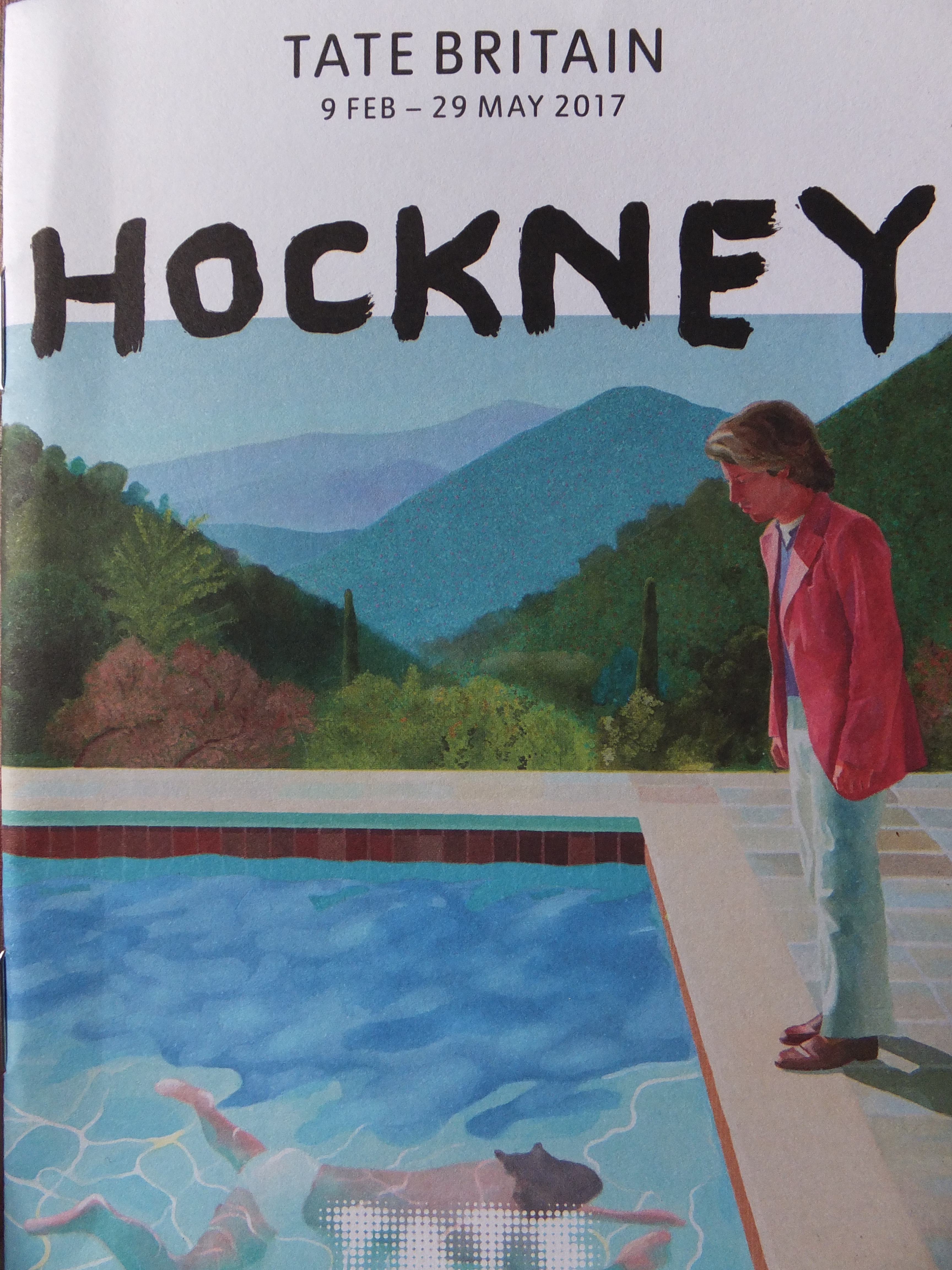
David Hockney is probably one of the most popular and widely recognised living artists of our time. His work spans the last 50 years from his student days, continually reinventing himself

We went there today. We like Tate Britain on a Saturday morning. Thanks to the kindness of the Borough of Kensington and Chelsea you can still park free on a meter on a Saturday. Also no congestion surcharge on a weekend. Anticipating correctly a heavy attendance for this exhibition, Tate Britain has been opening the doors two hours earlier than usual. We were early but not that early. The queues as we drew up looked daunting. This is where the member’s card comes into its own. We swept in effortlessly

Like most people, we have followed Hockney throughout each of his stages. Some of them leave me cold. In his student days he was influenced by Picasso. Everybody copies Picasso at some stage. It is very easy to tire of Picasso

One of my favourite Hockney periods is when he veered towards naturalism. I just like recognisable paintings. He was in Los Angeles for this time in his life, and so lots of swimming pool pictures of athletic young men. I particularly like his double portraits which explores the relationship between the two. Mr and Mrs Clark and Percy 1970 is a favourite. Especially touching is the affectionate portrait of his parents, especially the way they are posed

I remember his work with the Polaroid camera in the 1980s, producing myriads of small images to make up into a collage of quite a large picture. He was dissatisfied with the white border around each small image. I rather like that. The whole composition looked like a ceramic mural.

After many years in America, he moved back to his native Yorkshire, and produced some marvelous work. Massive tableaux of the Yorkshire Wolds. The colours are breathtaking. He moved from paint to video to produce a colossal work entitled The Four Seasons which as the name tells us, was of a single stretch of road in Spring, Summer, Autumn and Winter. Incredibly technical work

I am sorry I have no images. Vigilant attendants quite rightly moved in on me every time I tried to take a photograph discreetly with my phone. His charcoal drawings……….one can go on and on, my eyes ached after two hours. I shall go again

Paintings to Google are My Parents 1977, Mr and Mrs Clarke and Percy 1970,the Road to Thwing 2006, A Closer Winter Tunnel February-March 2006 and of course so many more

See it if you are in London. On until 29th May

Paul Nash Exhibition at Tate Art Gallery

the-menin-road-1918-19

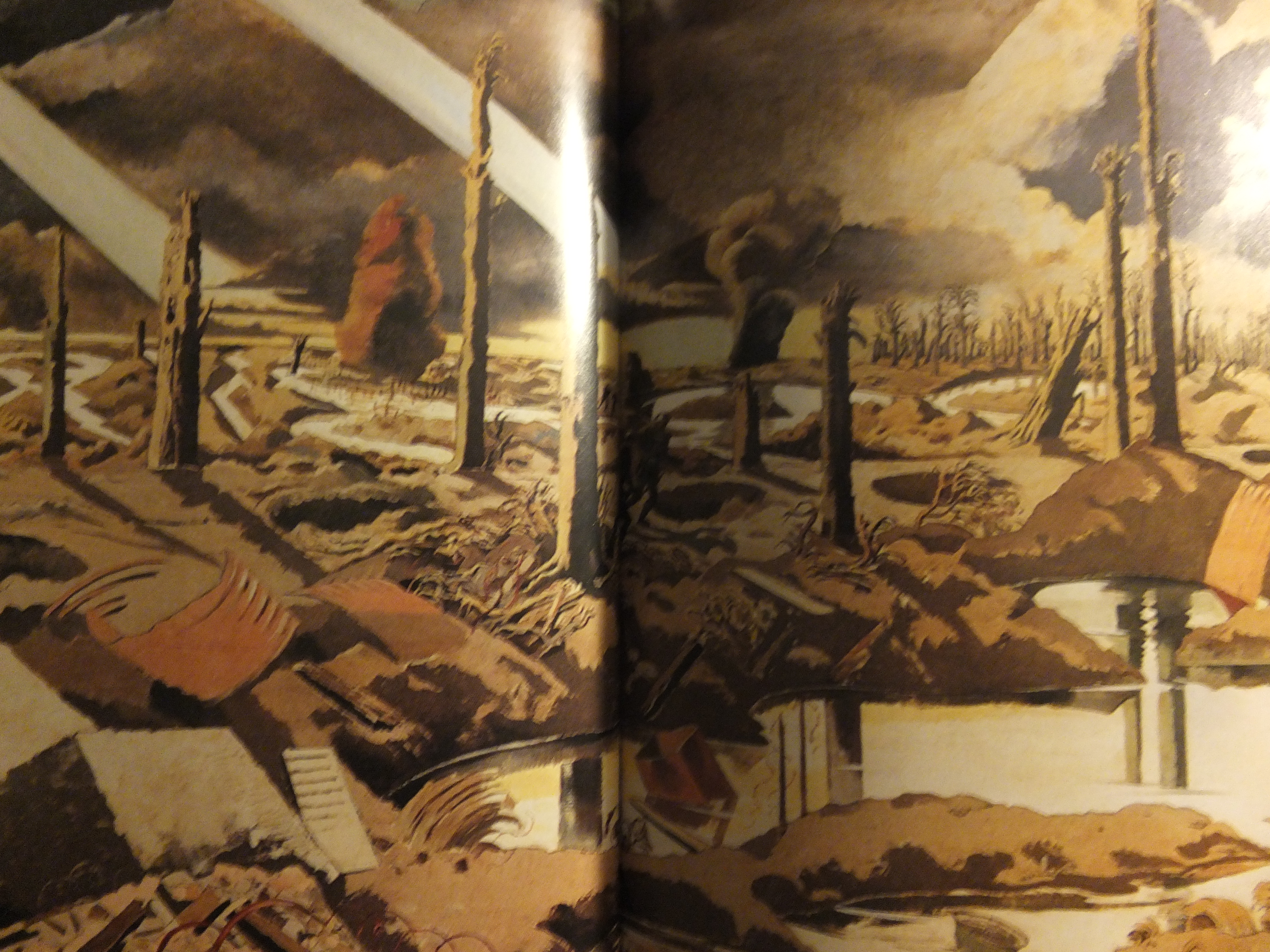
The Menin Road 1918-1919

This was the best picture I could get taken from my guide book. This was prominently displayed in the exhibition being one of his best known WW1 paintings. A very big painting and naturally surrounded by people, so no chance I could photograph the real thing, and nor should I.

This painting was commissioned by the Ministry of Information, and was destined for inclusion in a Hall of Remembrance, which was never built. Today it is part of the Imperial War Museum’s collection

His style is starting to alter. He has become fascinated by geometric shapes, which will take him down the road to cubism and abstraction

However, to start at the beginning, we drove into London yesterday in the driving rain. Fortunately you can still park just outside the Tate which was useful considering the weather

The first section dealt with his early work and his comparatively comfortable existence in Iver Heath, where he paints in the garden and starts to show his predilection for landscape, which was to govern his painting throughout his life.

WW1 transformed him and his painting. He described himself as a messenger bringing back word from the men fighting to those who wanted the war to continue. This time a ravaged landscape witnessing a violent emotional experience. The Menin Road which I have shown is the best example of this in my opinion

After the war, places took on an importance for him. He lived at one time in Dymchurch on the Sussex coast, where he painted the sea defences again demonstrating his interest in geometric shapes and becoming ever more cubist. He was also influenced by de Chirico, after visiting an exhibition in 1928, and his paintings started to show lonely places and tell mysterious narratives through isolated objects.

He also at this time became interested in interiors and in still life. These paintings again showed him exploring cubist ideas, with their dependence on geometric shapes. A painting called “Dead Spring” painted in 1929 best illustrates this and I am sorry that I don’t have a copy of this one

He went on to explore the life of the inanimate object, conveying on them human personages. Working closely with fellow artist Eileen Agar, on the Dorset coast, they both used found objects in their work,  both in paintings and in collage.

He became closely involved with Surrealists, and produced work like “Landscape from a Dream” which I can showdscf3496

Some of this was cropped to get it into the frame, but here on the Dorset coast, the hawk is looking at itself in the mirror and also watching itself flying

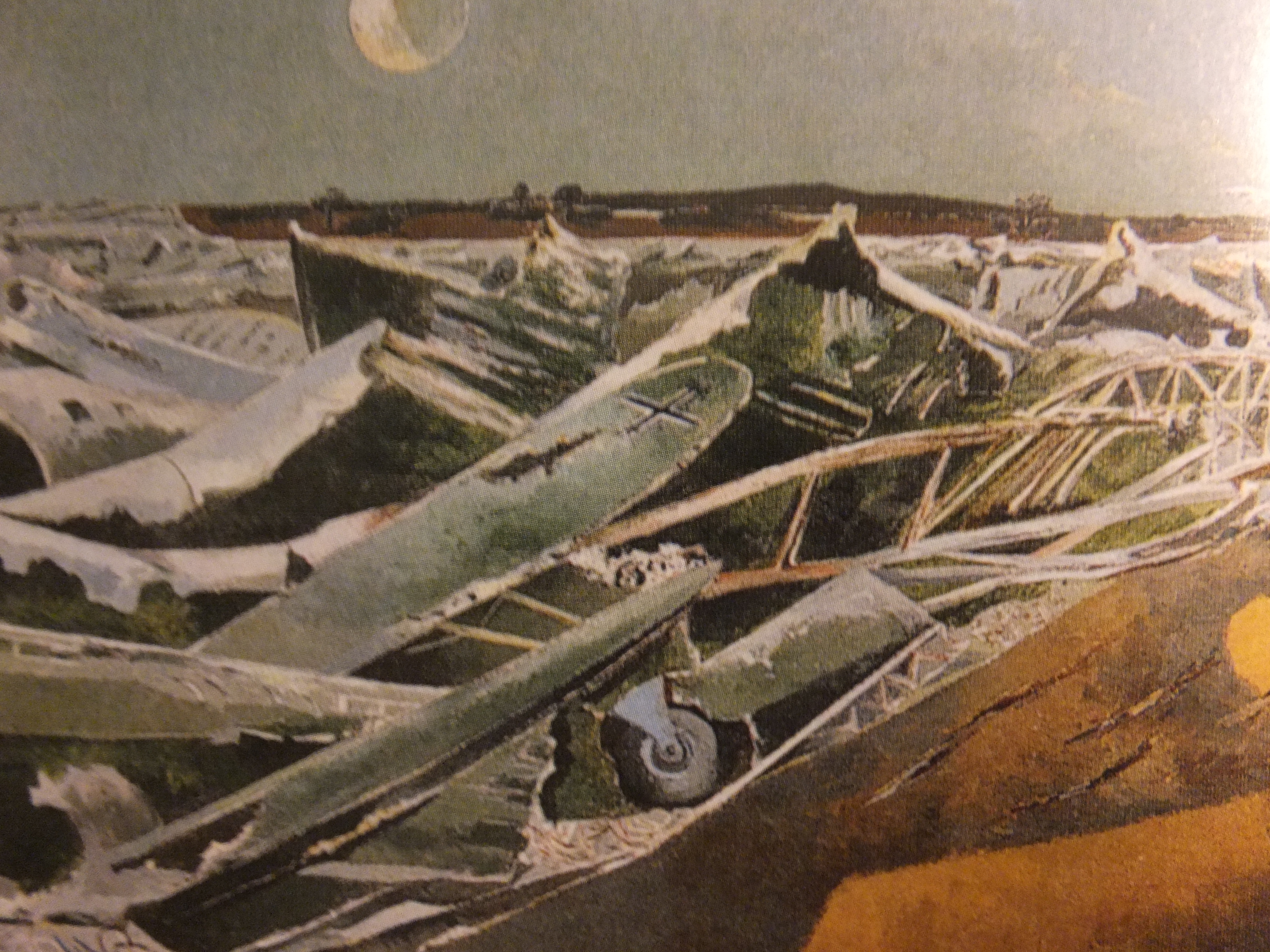
Then came WW2, and Nash was made an official war artist. He was equally terrified of and fascinated by bombers.He talked about the “sky was upon us all like a huge hawk hovering, threatening”. He was inspired by the imagery of crashed German bombers in the landscape, like sculpture, and also at the Cowley Dump where these parts were brought. He drew upon his surrealist ideas when he painted Totes Meer or Dead Sea, where the twisted mass of crashed planes metamorphosed into waves of a metal sea.

This painting I can show and it is probably the one we all think of,when we think of Paul Nashtotes-meer

By now his health is suffering. He returns to landscape painting. In 1946 he succumbs to pneumonia and heart strain, and can no longer stand at his easel. Severely depressed he dies at Boscombe near Bournemouth at the age of 57. He is buried at Langley Marsh