Rossetti Exhibition currently at the Tate

The Annunciation by Dante Gabriel Rossetti 1849-50

An early piece by this artist, may even have been his first

The exhibition covered the work and lives of the Rossetti family, from the father Gabriele Rossetti, a political refugee from Italy together with his four children. Gabriele was involved in translating Dante’s Divine Comedy into English, which was a work his children continued after his death. The family were poets and artists. Gabriel Rossetti is well known because of his association with the Pre-Raphaelit Brotherhood, but curiously his sister Christina the poet is better known. She was a prolific writer of poetry. Her poem In the Bleak Midwinter is very well known as a Christmas carol, and would appear in every Christian hymnal, regardless of sect.

Gabriel, his brother William, and five fellow art students founded the Pre Raphaelite Brotherood, the first art group to challenge the soulless painting found in the Royal Academy with its reliance on old master styles. They were to express themselves from their own experiences. They modelled for themselves based on their own interests,and Gabriel drew a portrait of Elizabeth Siddal, a fellow student, and later to be his wife. There is a wonderful collection of her work in this exhibition, as far as I remember the only time that I have seen her work on show. Sadly she caught cold whilst modelling for Rossetti’s painting Ophelia, when she had to lie in a bath of cold water. Colds were treated in those days with laudenum, a mix of opium and alcohol, and it was that that killed her. She was only 39 when she died.

Christina and her sister Maria both chose a single lifestyle. They lived together and worked in the community through an order of Anglican nuns. William would remain single until his 40s when he would marry the artist Lucy Madox Brown.

Christina was to become a celebrity after publishing Goblin Market in 1862 and William became a leading critic and editor alongside his civil service career. Gabriel went on to form a new group: the aesthetic movement , which would change art and design for a second time. he combined working-class women with feminine fantasy inspired by Renaissance portraiture.

The portraits were paired with poems. Double works of art.

Gabriels finalyears were dominated by his obsession with Jane Morris nee Burden. Gabriel met her outside a theatre and asked her to pose as Queen Guinevere. His team included William Morris the designer , as they were painting murals in the Oxford University Union . Morris and Jane were married shortly afterwards and set up house at the Red House at Bexleyheath

Gabriel and William Morris shared the tenancy of Kelmscott Manor, a country house in Oxfordshire. In the early 1870s Gabriel and Jane became lovers

Burne-Jones Exhibition at the Tate Art Gallery

Golden Stairs by Edward Burne-Jones (1833-1898)

One of many well-known paintings by Sir Edward Burne-Jones featured in a special exhibition currently at Tate Britain until February 2019 which is the first major retrospective to be held for forty years. Inspired by the church and the medieval period, his work represented the antidote to the ugliness and the materialism of the Victorian period.

We went there recently. As always a superlative exhibition. To be seen if you can

There were seven rooms of drawings and paintings. Burne Jones was a superlative draughtsman . The second room deals with his time in Fulham, when he finally had space enough to embark on major projects for which he needed countless preparatory drawings, each one of which could be considered a work of art in its own right.

Renaissance art and four visits to Italy encouraged his approach to the body. His male figures appeared troubled while women were portrayed beautiful yet sinister. About this time he was experimental with media, using gouache with chalk and later metallic pigments.

His attitude to the male figure caused him to resign from the Old Watercolour Society which had been shocked by his work. . He was becoming known as one of the most daring artists of his time. After a blissful period of working to his own pace, his exhibition pictures started to take London by storm, and later Paris, so that he became known throughout Europe.

Most impressive were the rooms containing his Series Paintings, massive works commissioned by serious clients with rooms that can show these works as they should be shown. This was of course the era of the seriously wealthy patron who could command works like these., such as the Perseus series, commissioned by the young future prime Minister Arthur Balfour for his London residence.  Curiously Balfour was later to be president of Woking Golf Club, close to where I live. The only prime minister to be president of a golf club. I wondered what these wonderful paintings would look like in the golf club lounge, but that was me being facetious.

I cannot describe the paintings of the Perseus Story, as they were too magnificent. Like wise the Briar Rose which is really the story of Sleeping Beauty. Wonderful illustrations of knights and princesses. Burne Jones I think today would have been in his element illustrating Game of Thrones or the Harry Potter stories.

He worked closely with William Morris, from whom he derived the bulk of his income. He became especially well-known for designing stained glass windows for churches and cathedrals the breadth of the land and indeed the old Empire.

One of the last great figures of the Pre-Raphaelite movement. This is a wonderful collection gathered together for a short time

Exhibition at Tate Art Gallery: Painting With Light

We went to see this exhibition recently. Painting with light explored the relationship between painting and photography, and was a thought-provoking exhibition. Purists still tend to be critical of painters who use photographs, and yet at the time, artists saw great merit in the use of the camera

John Ruskin was never easy to please, being most exacting in his standards. He drew meticulous architectural studies which would have taken him hours. I cannot remember the quote verbatim, but words to this effect he said that if he could have been saved many hours of detailed drawing with a device that did the job in half a minute, then there would have been no doubt in his mind as to which he would use.

Photography was invented in 1839, and was to lead to a development in new techniques and materials which were to influence painters

Edinburgh was home to a progressive movement amongst scientist and artists. In 1843 the young Robert Adamson was to establish one of the first photographic studios where he was joined by the painter David Octavius Hill and Jessie Mann. Together they took something like two thousand photographs during their four year partnership

Their photographic portraits were admired during their lifetime and their views of Edinburgh were an influence on Hill’s landscapes. These works came to be recognised as some of the earliest collaborations between photographer and artist

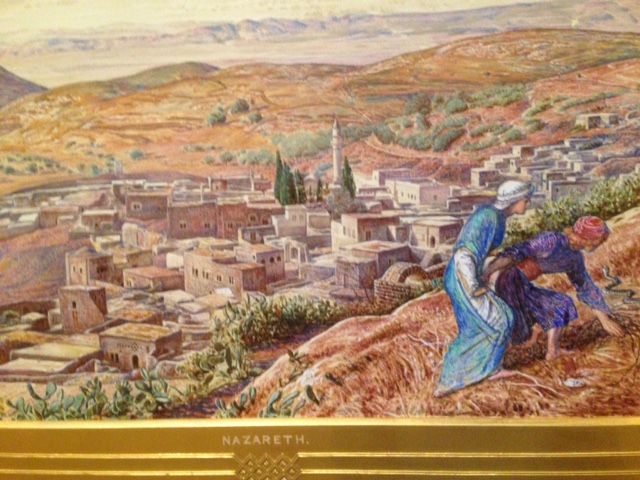
Holman Hunt painting of Nazareth

Holman Hunt’s painting of Nazareth

Photography was a gift to the Pre-Raphaelites  of which Holman Hunt was one of the founder members. They looked for inspiration to the medieval period, and their works are known for sharp detail and vivid colours. This was almost a quasi-religious movement, and partly because of the medieval influence and partly because of his deep Christian conviction, many of Holman Hunt’s pictures are of Biblical or religious subjects.

Together with his friend Thomas Seddon, he stayed in Jerusalem for two years at the home of James Graham, a pioneer photographer. Together they took many landscape photographs. The reference material that photographs gave artists certainly helped painters like Holman Hunt in their chosen philosophy of sharper detailing.

Many photographers had trained as painters, and had set up studios. They used models whose posing time was cut dramatically with the use of the camera, especially when complex or spontaneous poses were called for. Photographs were used for preparatory references, which meant that props, costumes and models could be dispensed with.

Thus began the successful collaboration between photography and painting, the former even becoming an art form in its own right.

For me the camera has become the sketch book, enjoyable as sketching might be. I shall never again feel bad about that