Paul Nash and the Turner Prize Finalists

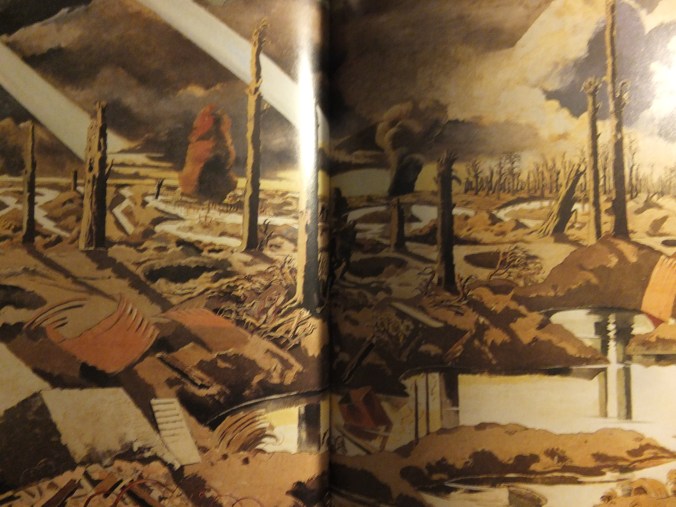
Hoping to go to the Tate Britain Art gallery tomorrow, weather and circumstances permitting to see amongst other things , the Paul Nash exhibition

Paul Nash, known as a war artist covering both world wars, not as a documentary reporter, but with his own surrealist style, was also a superb landscape artist in his own right

In fact an artist of many facets

I shall look forward to writing about him and his work when i have learned more myself

Exhibition in Woking Lightbox: The Camden Town Group

dscf3467

This painting is by Robert Bevan 1865-1925, one of the the Camden Art School, painting as the name suggests in North London during the Edwardian period

This painting is entitled Dunns Cottage and was painted in Devon, although Bevan was just as at home painting in London, usually horse fairs and horse drawn vehicles. Bevan studied in Brittany in Pont Aven painting alongside Gauguin, and the influence on this painting is plain to see, large blocks of flat colour and unrealistic shades

Other artists represented at this exhibition are Walter Sickert, sometimes known as the father of them all, Spencer Gore and Ginner

Rather like the French Impressionists a few decades before, the Camden group painted contemporary scenes of city life, the streets, theatres, places of entertainment like pubs and circuses. Sickert portrayed young women in the nude at their toilette rather in the style of Degas, who was a great influence. Non erotic portraits of women in dingy surroundings were something he often came back to, as though the flatness of their life was something which fascinated him.

Preparatory drawings of the figures for his famous painting Ennui are also there, a study of tedium and of people trapped in their lives

dscf3470

The Balcony, Mornington Crescent  by Spencer Gore (1878-1914)

dscf3475

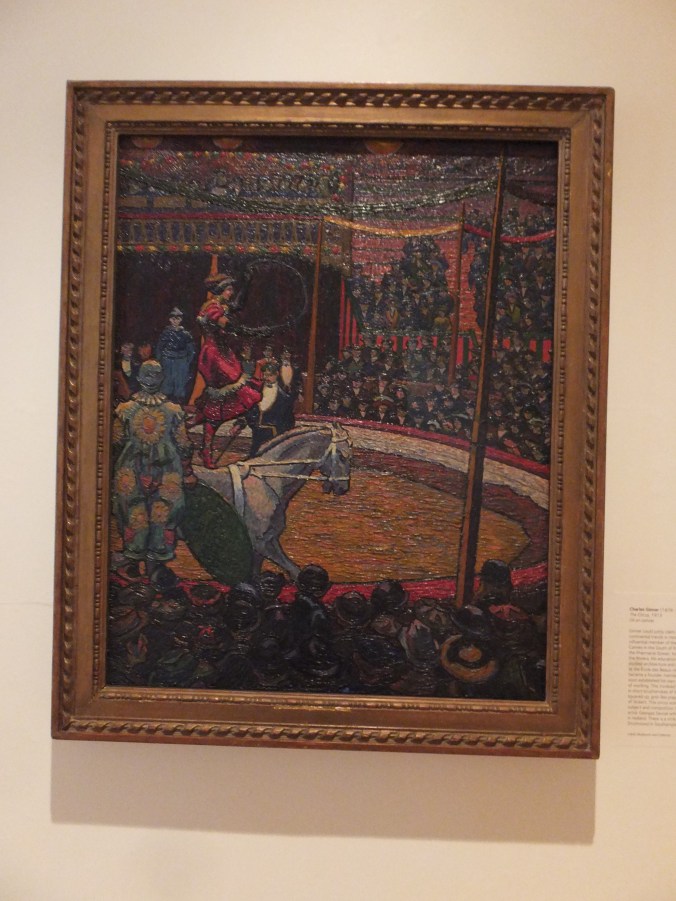
The Circus by Charles Ginner (1878-1952)

Ginner was born in Cannes of a British father who established the Pharmacie Ginner. His brother was a doctor on the Riviera . Ginner himself studied art at the Ecole des Beaux-Arts and was influenced by the French art of the day. The circus was a favourite subject, and this picture can be compared by one of Seurat, which is in the Kroller Muller Museum in Holland

Ginner moved to London and became an influential member of the Camden group

The quality of exhibitions at the Lightbox continues to improve, and well worth a visit if you are in striking distance. The other exhibition one floor below, on the History of the Comic, extremely informative and comprehensive for those interested in graphic art

Art and Empire: Following on from my post in February

Moslem Burial Ground

The Muslim Burial Ground near Woking built by the War Office in 1917 and restored beautifully in 2014 in time for the Centenary

If you read my post in February about the exhibition at the Tate Art Gallery, London, entitled Art and Empire, much of which had to do with India including the contribution of the Indian Army during World War 1, then you will remember that I finished with the story of the Muslim Burial Ground where Muslim soldiers who died of wounds in local hospitals, were interred.

There were 28 service personnel buried there from both world wars. Their remains were moved to the Brookwood War Graves in 1968, since when, the area within the walls was left barren. With the restoration, this area has now been turned into a Garden Of Remembrance, and includes a stone tablet with the names of the 28 fallen, inscribed on it.

Finally I have been again to look at it, and have taken some pictures so that I can conclude this post. It really is a very tranquil and, I think, sacred place

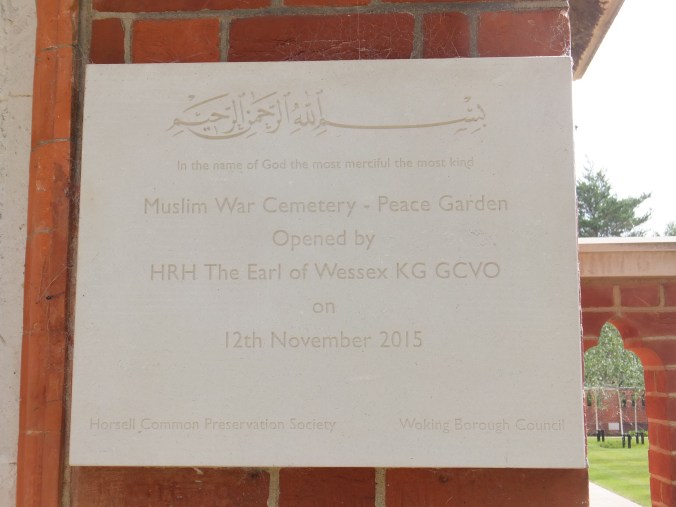
DSCF3077

The new plaque by the main entrance of the Muslim War Cemetery-Peace Garden. Let us hope the sentiment comes true

DSCF3082

This is the tablet commemorating the 28 service personnel who lost their lives in both world wars. You will need your zoom to read the names, I am afraid. This was as close as I could get

DSCF3085

Looking back towards the main gate, with the pool, landscaping and new trees. The water is being pumped round continuously, giving that delightful trickling sound. Certainly a place for meditation, and perhaps a prayer for peace. Not easy when there is an atrocity every day

I am still working on the painting of Shere Village and Church, which I would hope to finish within the next week or so

Exhibition at Tate Art Gallery: Painting With Light

We went to see this exhibition recently. Painting with light explored the relationship between painting and photography, and was a thought-provoking exhibition. Purists still tend to be critical of painters who use photographs, and yet at the time, artists saw great merit in the use of the camera

John Ruskin was never easy to please, being most exacting in his standards. He drew meticulous architectural studies which would have taken him hours. I cannot remember the quote verbatim, but words to this effect he said that if he could have been saved many hours of detailed drawing with a device that did the job in half a minute, then there would have been no doubt in his mind as to which he would use.

Photography was invented in 1839, and was to lead to a development in new techniques and materials which were to influence painters

Edinburgh was home to a progressive movement amongst scientist and artists. In 1843 the young Robert Adamson was to establish one of the first photographic studios where he was joined by the painter David Octavius Hill and Jessie Mann. Together they took something like two thousand photographs during their four year partnership

Their photographic portraits were admired during their lifetime and their views of Edinburgh were an influence on Hill’s landscapes. These works came to be recognised as some of the earliest collaborations between photographer and artist

Holman Hunt painting of Nazareth

Holman Hunt’s painting of Nazareth

Photography was a gift to the Pre-Raphaelites  of which Holman Hunt was one of the founder members. They looked for inspiration to the medieval period, and their works are known for sharp detail and vivid colours. This was almost a quasi-religious movement, and partly because of the medieval influence and partly because of his deep Christian conviction, many of Holman Hunt’s pictures are of Biblical or religious subjects.

Together with his friend Thomas Seddon, he stayed in Jerusalem for two years at the home of James Graham, a pioneer photographer. Together they took many landscape photographs. The reference material that photographs gave artists certainly helped painters like Holman Hunt in their chosen philosophy of sharper detailing.

Many photographers had trained as painters, and had set up studios. They used models whose posing time was cut dramatically with the use of the camera, especially when complex or spontaneous poses were called for. Photographs were used for preparatory references, which meant that props, costumes and models could be dispensed with.

Thus began the successful collaboration between photography and painting, the former even becoming an art form in its own right.

For me the camera has become the sketch book, enjoyable as sketching might be. I shall never again feel bad about that

Two White Rabbits

DSCF3028

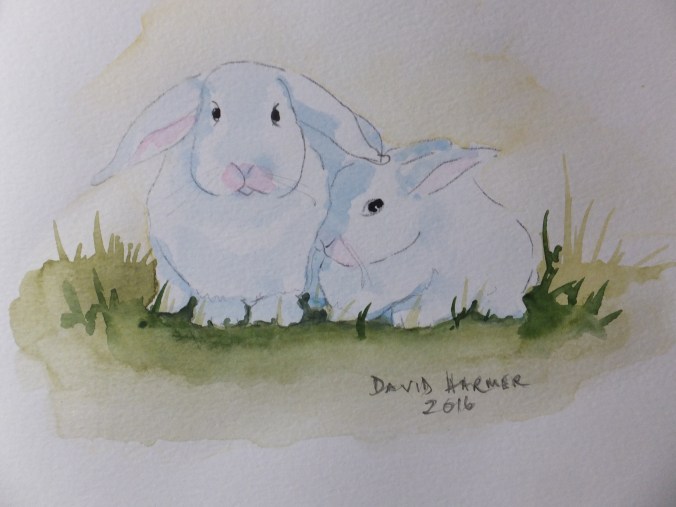
The two white rabbits

This was a project miles away from my usual comfort zone

I was asked if I could provide an illustration for a children’s story, which was flattering in itself, as not really something I am known for. I am usually doing something architectural. Occasionally I paint animals, but this exercise was rather different

The stipulation was to paint or draw two white rabbits, a mother and child. They were to be white but set against a white background, so tricky in itself. The storyline dictated that the picture had been painted by a child, albeit an art prodigy, as an entry to a competition. How to look through the eyes of a child? Not something I have ever been good at

After the drawing, which was simple enough, I shaped the rabbits with shading in a very pale blue. I think I used Cobalt as that is fairly flat anyway. White rabbits tend to have pink noses and pink inside their ears, which I added with very dilute Crimson

To give the forms some sort of identity, I washed round the edges with again very dilute green gold, which gave a little bit of a lift, without straying far from the original specification

So that the images didn’t float in mid air, I did put some darker green as grass, but otherwise stuck to the original premise

I am pleased to say that the young boy won first place in the competition, so all was worthwhile

The story is called The Poisoned Apple and is serialised on Pinterest

two white rabbits


Exhibition at Royal Surrey County Hospital

Brewery Dray

Brewery Dray in Guildford

When we were breaking down the exhibition on Friday morning, I sold this painting at the last minute. A young woman arrived breathless with the money and bought it. I was very pleased with this as it raised my score for the whole exhibition to four paintings sold. Not the best that I have ever done but not the worst either, and certainly quite respectable.

The other three were Strolling through Montmartre, Grand Canal Venice and Painshill Park

Paris and Venice are always popular, especially the well-known landmarks. I have almost lost count of how many of each that I have sold. Painshill Park is a new subject for me and I was heartened to sell this picture, as I now feel encouraged to paint some other views, of which there are many to choose from

Painshill is a local estate near Cobham in Surrey. It was laid out in the c18 by a man called Charles Hamilton. It was in the style of a natural landscape made popular at the time by garden architects like Capability Brown and Humphrey Repton. The views were sculpted, whole forests were planted, fake ruins were built and rivers were dammed to form lakes.

Hamilton worked a lot with American species of trees. It was interesting to note that you could import a “box” of plants from American nurserymen, suitably packed to withstand the rough and long sea voyage. Many did survive and are still flourishing in the park today.

Over the years, the place deteriorated and became overgrown. In the 1950s it was rediscovered and lovingly brought back to life. Every year there is a new project. Recently the old boat house was rebuilt using old photographs. The previous year one of the bridges was replaced using an old painting as a reference. I attach my painting

PainshilL Park, Surrey

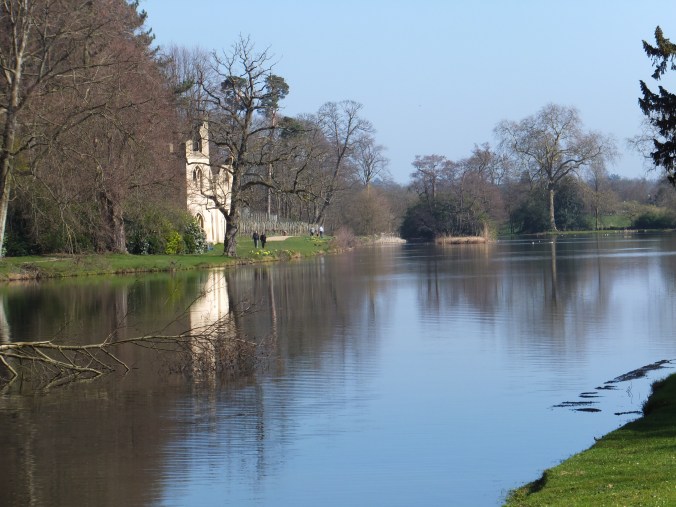
This was an unwary group of people feeding the Canada Geese by the lake at Painshill. There are literally flocks of geese of different species, as well as ducks and swans. Always a lot of activity on the water. In the background is one of the strategically placed follies, which I think is the Gothic Chapel

I am starting to whet my own appetite for painting here again!

DSCF0985

A different view of the lake with a different ruin which could make a good subject. Wants something in the foreground though. I have umpteen swan pictures from which to choose.

I have a commission to do and then I might tackle this one

Schlee Collection at Mottisfont Abbey

DSCF3027

Mottisfont Abbey near Romsey in Hampshire, UK, owned by the National Trust

We were at Mottisfont yesterday to see the roses which are magnificent now. These are grown inside the old walled kitchen garden, which give them a superb backdrop against old brickwork. I took some pictures of specimens, especially blooms which are about to fall, hopefully to do a rose study again. I haven’t done one for a long time. Not just the roses though. We had come to see the art, in the form of the Schlee Collection which is on loan from Southampton Art Gallery until July 3rd

There is an exhibition of the Schlee Collection of drawings and sketches, on loan from Southampton Art Gallery, which lasts until July 3rd. A private collection which was bequeathed to Southampton Art gallery in 2013, which includes work or should I say squiggles, by David Hockney, Henry Moore and Franz Auerbach, plus many others. I would like to say that I was thrilled by them, but I wasn’t. Heavily worked and corrected jottings are not very impressive, even if by one of the great names in British art. I was more pleased to see a drawing by Barbara Hepworth of an operating theatre, placed next to her mentor Henry Moore’s work. The Barbara Hepworth was borrowed from the Derek Hill collection which is in permanent residence at Mottisfont.

Derek Hill was a portrait and landscape painter of note, who became sought-after during the 1960s. From the south of England he moved to the west coast of Ireland and founded the Tory Island School of painting, where he taught the fishermen to paint the wild Irish landscape. He was also an avid collector of modern art, including the post-Impressionists. He was a friend of Maud Russell the last owner of Mottisfont, and bequeathed a portion of his collection there. These are always worth seeing, including many of his own works, time and again.

For me, however, the gem is still the Whistler room. Here we see Rex Whistler’s unfinished murals. Unfinished because he was killed in Normandy in 1944. His trompe l’oeil paint pot and brush high up on the coving below the ceiling, still makes me feel that I want to get a ladder and climb up and get it. I believe several have in the past

DSCF3021

Watts Chapel and Gallery, Compton

Watts Chapel,Compton

Watts Cemetery Chapel, Compton, Surrey designed by Mary Watts

The winter street scene of Guildford is going to take me some time. Not only do I have to use my imagination, which is not my strong point, I also have to do a fair bit of research and also calculation, which I have to take my time over.

This does give me an opportunity to post something local which we visited not that long ago, which is Watts Cemetery Chapel or sometimes known as the Watts Mortuary Chapel.This is in the village of Compton, near Guildford in Surrey. I painted the above after our visit. Financed by the famous Victorian painter, George Frederick Watts, through his paintings,he donated it to the village of Compton.The Watts Gallery is also nearby. Recently restored after years of dilapidation, it houses a wonderful collection of his paintings and sculpture. The chapel was designed by his wife Mary Watts who also oversaw the building

In 1895 Mary started giving evening classes to the villagers at their home Limnerslease, teaching them how to model the local clay, and producing decorative tiles in terra cotta. They modelled the symbolic and beautiful patterns that she had designed, which would be used in the interior decoration of the chapel. The chapel she designed is in the Arts and crafts Style, the nearest we get in England to Art Nouveau, although I maintain many of the interior details are really Art Nouveau

In England, we never really had an architect who epitomised Art Nouveau, as they did in Scotland with Rennie Mackintosh. I sometimes think Mary Watts was our Art Nouveau heroine.

Close by, her husband’s gallery. A very famous Victorian painter, G.F.Watts, known for allegorical and symbolic works. His paintings hang all over the world, yet many are here at Compton, and this gallery is so worth a visit.

If I were to be asked to pick a favourite painting, it would be that very famous one “Hope”. There are many to choose from, but this female allegorical figure, clutching a wooden lyre with only one string left, is very poignant.

There were two versions painted and when we were last there, the version from the Tate was on loan to Compton.

This painting has been an influence on many great names. On Picasso during his Blue Period for his hunched figure The Old Guitarist, is one example. Martin Luther King referenced it in his collection of sermons. Nelson Mandela allegedly had a copy on the wall of his cell in prison on Robben Island.

Later in the 1980s the painting was the subject of a lecture by one Dr.Frederick Sampson in Richmond, Virginia who described it as a study of contradictions. One Jeremiah Wright apparently attended the lecture and in his sermon in 1990 on Hope, coined the phrase “audacity of Hope”. Having attended the sermon, Barack Obama adopted the phrase later as the title for his 2004 Democratic National Convention keynote address, and more well-known to most of us, as the title of his second book.

I think the quote runs something like : to have one string left and to have the audacity to hope that you can still make music

How some things echo down the ages!800px-Assistants_and_George_Frederic_Watts_-_Hope_-_Google_Art_Project

Hope

Critics of the day called it Despair but obviously missed the point

H.G.Wells at the Lightbox

Neville Godden's Winning Artwork.JPG

Neville Godwin’s Winning Artwork

This year celebrates 150 years since the birth of Wells. He made Woking famous or infamous with his great work War of the Worlds, siting the landing of the Martians on nearby Horsell Common.

The Borough Council and its partners have launched the “Wells in Woking” cultural event programme

One of the first such events is an art exhibition in the Lightbox Gallery inspired by War of the Worlds, which runs now until May 1st. I went today, and there are some extremely imaginative entries by well-known local artists. The winning artwork I publish with this article. If you are local, this exhibition is worth seeing

He came to Woking in 1895, after the end of his first marriage, with student Amy Catherine Robbins, otherwise known as ‘Jane’. They married in the October of that year and lived happily at 141 Maybury Road, although the house was called Lynton at the time.

Wells lived in Woking for less than 18 months and yet it was his most productive time as an author. He worked at a prodigious rate to establish himself as a writer, which he did, as by the time he left, he was in his own words “fairly launched at last”

He wrote the Time Machine fairly soon after his arrival, his first science fiction work. He planned and wrote War of the Worlds, and sited the action in and around Woking, a most unlikely place for an extra-terrestrial invasion.

He followed up with the Invisible Man, completed the Island of Dr.Moreau, wrote and published both The Wonderful Visit and a pioneering cycling novel called The Wheels of Chance. He began writing When the Sleeper Wakes, another science fiction story, and started on Love and Lewisham. He worked in his own words at “a ghastly pace” in order to make his fortune

Reportedly, his literary earnings in 1896 were £1056, or £118,000 in today’s money

Later that summer, the couple moved to Worcester Park, and the story leaves Woking. He went on to international acclaim, meeting statesmen like both Presidents Roosevelt, Lenin and Stalin.

Later, there are talks at the Lightbox and two guided walks by historian Iain Wakeford, culminating in an International Conference in July at the H.G.Wells Conference and Events Centre in Woking

Sitges: the Transferred Drawing plus Preparation for Next Exhibition

Transferred Drawing of Sitges

This is the drawing now transferred onto watercolour paper. I hope you can make it out. Obviously only lightly pencilled in as I want it to be covered by the painting.

One or two areas are covered by the blue masking fluid, especially the building on the far left which is sparkling in the sunlight. I want a hard edge there, and likewise in one or two other places which are caught by the sun. I have denoted white foam in the sea where I might otherwise lose it, although I shall have to enhance later with white gouache.

I have kept the foreground figures to two plus dog. Hopefully I should get some pleasing reflections on the wet sand from the buildings which will need some space in the foreground

Spaces have been left amongst the buildings too, for large areas of shade and for trees. Soon I shall have to pick up a paint brush and start. I still get apprehensive until I get underway

As well as this I have been trying to finalise my entries for my next forthcoming solo exhibition, which will be in Guildford, a town near me, in one of the town’s best known venues, the Guildford Institute. Always an enjoyable place to show, albeit not especially busy, but nevertheless because of the prestige of the place, I am able to get good coverage in local papers, which is so very useful

I have been trying to get my framing up-to-date and these are two of the latest

Brewery Dray Framed

Brewery Dray on Guildford Bridge

Corfu Shopping Lanes Framed

Corfu Shopping Lanes in Kerkyra

You may well have seen these in earlier posts, but it is nice to see them framed, and ready to be exposed to an unsuspecting public. I am aiming to show between 12-14 pictures in total. I am almost there.Still time to make some revisions, and certainly if the Sitges painting turns out well, I shall want to include that too. The exhibition, if I haven’t said before has a theme entitled “Watercolour Wanderings”, so every picture will be of a place I have visited. Not just faraway places that I have been to on my travels but also local scenes as well, which are just as relevant. The name is a little bit corny, I know, but you are expected to give your exhibition a name, which I admit does give the show some sort of structure, rather than a motley collection of miscellaneous paintings.

The exhibition runs from 3rd to 20th May, so just under three weeks. We shall hope for a successful show. I shall be following up with another exhibition at the Royal Surrey Hospital starting on the 27th May and running for one month, so two bites at the cherry

Just while it goes through my mind, I get many “visits” to this art blog from all corners of the globe, and I am very grateful for your interest. It is so nice to feel that you are talking to someone. Comment if you want to. Thanks