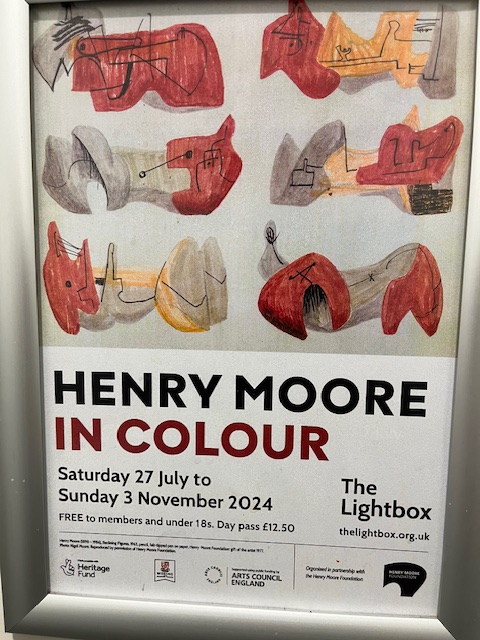
Yet another excellent exhibition at Woking’s Lightbox art gallery. Small, obviously, size dictated by the venue but focused and to the point. We, in Woking, are so pleased as following the bankruptcy of the town brought about by reckless investment, the fate of the Lightbox has been in the balance. Deep cuts are having to be made, and when difficult choices and sacrifices are having to be made, then difficult sometimes to make a case for our wonderful art gallery to be saved. So far it has been managed by the new local government and we are grateful for that. The Lightbox is relatively new, in a town with virtually nothing by the way of heritage or culture, so the rise in prominence of our gallery has been a matter of civic pride. We hope it will continue
Henry Moore is well known, and if like me you tend to remember his wonderful sculptures, then it is useful to be reminded that he painted as well, and some while ago too. When reminded, of course I remember his drawings and paintings of people taking shelter during air raids in London, in the underground railway stations. This exhibition highlights some of these works, known as the Shelter drawings commissioned by the War Artists Advisory Committee during the last war. These Shelter drawings were responsible for achieving widespread recognition for the artist following their display in the National Gallery. When you look at some of these drawings you start to see forming some of his later sculptures and I will show one if I can as an example
Certainly the first one I think I have seen as one of his sculptures!
Many years ago, there was a major exhibition of his sculptures in Kew Gardens, and I painted one of them that was placed in front of the Palm House. By way of light relief, I will end with it here
A figure stretching after a night on a cold platform? Might be
This is the centre of my local village, St John’s near Woking. The name St John’s was taken from the local church, built in the c19 by the then rector of Old Woking, as a chapel of ease for the village inhabitants. Quite a long walk to church otherwise in a century when no one had transport.
The village is mostly Victorian, and although surrounded by suburbia, does still retain its village atmosphere and integrity. Life started here in the late c18 when the canal was cut through open heathland. In the distance in my picture, the road makes a hump, as it crosses the canal. This is Kiln Bridge, where as the name suggests bricks were made from local clay, and these were used in the building of the canal. The canal was intended to link London with Southampton, but only reached Basingstoke before the railways were built and superseded canals. This was still a time when war with France was a possibility, and inland links with major south coast ports were desirable.
Today the Basingstoke Canal is maintained by Surrey and Hampshire County Councils. There is some leisure boating but not much. Wild life proliferates and the towpath is used for cycling and walking.
This is the very first time that I have painted my own village. I don’t know why. I put this painting on a local website and had more than 240 hits. All complimentary, I am pleased to say. No offers to buy though.
In the middle of the picture is our comparatively recent coffee shop, which has become the hub of village activity. Walkers and shoppers meet there to relax and catch up. We never had that before and it is a very welcome addition. We do have a pub but located going out of the village, so not so convenient. We have most shops so a useful selection.
At the bottom of my lane, we are blessed with a green open space, called St John’s Lye. Lye, lea or leigh means a green space. It is common land and so protected although we did have to physically resist Woking Borough Council who wanted to build a village hall on the Lye to replace the one that was starting to fall down. Eventually common sense prevailed and the new hall was built on the site of the old one. The Lye is available to all age groups for spontaneous activity including dog walking.
And so you have it. Not a place that many know, but loved by its local population
I shall publish a recent picture soon of this fascinating house, which Turner had a hand in designing together with his friend and near neighbout John Soane
And this is it in Sandycoombe Road in Twickenham, where we made a visit recently
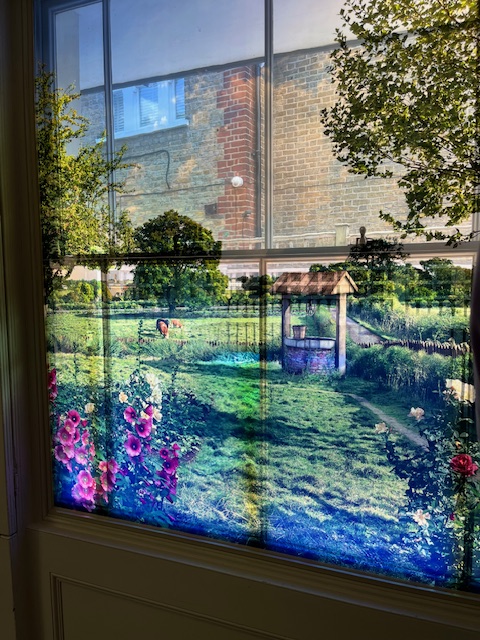
Turner built this house in the style of a small country villa, in 1813, for himself and his “old dad” William, where they spent much time relaxing away from his London gallery. At the time it was way out in the country. Later on in the latter part of the c19 it was surrounded by suburbia, as it still is today. Quite historic suburbia now of course, but suburbia nonetheless. If I can find it I have somewhere a recreated view from the dining room window at the time that Turner lived there.
And this is it. Tranquil pastoral countryside image on the window of the dining room. Quite clever. The garden with well,and meadows beyond. Ignore the brickwork showing through the upper part of the window. That is the house next door today in real life, which we can’t block out
How did Turner live at Sandycombe Lodge? Did he paint there? He always went with sketch book in hand, studying the landscape, and its changing moods. It was believed that he used the drawing room as a studio. It had French windows facing north-east from which friends recollect that Turner would refresh his eye.
He used a pony and gig for getting about on sketching trips.The pony was the “old crop-ear” who may have grazed on Turner’s nearby meadow, and whom Turner buried somewhere on his land. No stables are recorded on of the later maps, he must have been stabled elsewhere, perhaps at the nearby Crown Inn.
Fishing was a quiet pleasure shared with friends, many of them fellow artists.The Thames nearby provided an abundant supply.Turner made some beautiful watercolour studies of tench,trout and perch, the catches of some of these expeditions. Often he was accompanied by John Soane, who was also an enthusiastic eel catcher
One of the most prestigious acquaintances Turner made during his time at Twickenham,was the Duc d’Orleans later Louis Philippe, King of France, who lived with his brothers near the Thames at Highshot House in Crown Lane from 1800-1807. Turner met the Duc at a Royal Academy dinner in 1802. Later, between 1815-1817 the Duc was again in exile in “dear quiet Twick”, this time in a house which is still there, named Orleans House which today houses a prestigious art gallery. They must have become firm friends as Louis Philippe gave him a gold snuff box when he came to England for Queen Victoria’s coronation in 1837. Turner took his last continental excursion in 1845, and called on Louis Philippe, who had a chateau on the coast of Picardy, and enjoyed a convivial evening of chat about Twickenham.
The other incumbent of Sandycombe Lodge, was “old Dad”, Turner’s father William, retired barber of Maiden Lane, Covent Garden. He kept house and also opened up the gallery for his son in Queen Anne Street. They both enjoyed frugal living, as William complained about the cost of getting into London, easily affordable by Turner. He was overjoyed to find a market gardener who would take him in on his cart sitting on the vegetables, for the price of a glass of gin!
After 1815, and the Napoleonic Wares drawing to a close, Turner could at last travel on the continent, and we know well, his wonderful paintings of the Alps which he crossed into Italy. Likewise magnificent views of Venice. The Low Countries and Germany were on his list.
He kept Sandycombe on for his father, who enjoyed the life there, but by 1826, William’s health was failing, and indeed by 1829 died. Turner had removed him back to Queen Anne Street before then. Sandycombe had become an irrelevance by then and I believe was sold for a modest £500, ironically less than Turner might expect for a major oil painting. Old William’s death affected Turner greatly. They were very close.
The house enjoyed a long life after Turner, and has now been fully restored , brought back to life by Harold and Ann Livermore, who bought the house in 1947. Ann died in 1997, and Harold established the Sandy Lodge Trust, now Turner’s House Trust, to preserve and maintain the property, which is now open to visitors and certainly worth a visit.
Excellent exhibition on at the moment until June, featuring colourful tapestries designed by Grayson Perry and woven in Belgium. They echo the Rakes Progress series of paintings by Hogarth depicting the hero Tom Rakewell squandering his fortune on riotous living and plunging into debt and madness. The hero of the tapestries is Tim Rakewell, who becomes a computer genius, makes a fortune and moves socially upward. His nemesis comes when his luck affects his judgement and going too fast, drives his powerful car into a lamp post and goes through the windscreen. he was not wearing a seat belt. He dies at the roadside. As the attending medic says” with all his money and he dies in the gutter”
The first tapestry in the collection is The Adoration of the Cage Fighters with all its echoes of the Virgin Birth. The genius is born and is worshiped by the cage fighters who bring him gifts like the shepherds paying homage to the newborn Saviour. He will grow up into a man embarking on a journey of upward social mobility. I can’t see that he will benefit the world in any way but there it is.
This tapestry is said to be inspired by The Adoration of the Shepherds by Andrea Montegna
The other tapestry that I am showing is entitled The Agony in the Car Park. Here compare Gethsemane or the Agony in the Garden by Bellini. The scene is a hill outside Sunderland. The central figure is Tim’s stepfather, a night club singer. The scene hints at Grunewalds ‘Isenheim Altarpiece’. The large crane stands in for the crucifix. In the bottom corner Tim in school uniform blocks his ears with embarrassment. In his pocket a magazine betrays his interest in software. As we shall see, this will be his way out from a miserable childhood
These are just two panels from the complete story. There is the story of him leaving home after his girlfriend rows with his mother, his company which he sells for an enormous sum and then his demise at the roadside. What is the moral of the story. perhaps too much, too soon, or the dangers of moving upwardly mobile too quickly and being unable to cope. Woking Borough Council could perhaps learn from this story. Our town is officially bankrupt, through inept investment and squandering of people’s money. The townsfolk are looking at reduced services and increased costs. We shall never be solvent in my lifetime that is for sure. Even our beloved Lightbox is under threat and talks are ongoing about how to save it. Tragic to lose it. Woking is not a city of culture. The Lightbox gallery has been the jewel in the crown, and given us great prestige in the art world
I sold this painting a couple of weeks ago at a local exhibition. I painted it nearly ten years ago. It was admired by many people, several of them fellow artists, who thought that the portrayal of light and dark was skillfully done, and that detailing was first class. i didn’t show it often at exhibitions admittedly but it was on my website, and also on my online shops. Why did it take so long to sell?
I have the question but not the answer. Art is subjective we know. The decision is mostly an emotional one. How does a painting make you feel when you stand there and look at it. I have had online buyers write to me, obviously pleased with what they have bought, telling me they look at their painting every morning and it sets them up for the day. That is so satisfying for the artist when it happens. I have noticed recently that quirky paintings that make you smile, often sell at exhibitions. I sometimes think that mine are perhaps too traditional, and don’t provide an emotional response.
So art is subjective. One cannot stand there and point out the benefits of the product. They are in the eye and the mind of the beholder. Difficult to reach.
Yes, there are practical considerations as well, such as cost, and budgets are constrained at the moment, but they haven’t always been. My year has been comparatively bleak, I believe because of the economic climate, otherwise i would have to think I was losing my touch. Others say not though. Other painters I know are still selling and they are in a higher price bracket, possibly appealing to a market segment which hasn’t been too affected by market conditions, let us say, and good for them
Wall space or the lack of it is no mean consideration either. If the buyers have funds and wall space, you are in with a chance. Yet I believe the emotional value of a painting transcends these considerations. This is when you have something to say and you actually reach out to potential buyers of your work. That is not easy. I have started to include more meditative subjects hopefully bringing peace and tranquility to someone
This isn’t a rant, believe me. I am just trying to understand why sales switched off so abruptly after a promising start at the beginning of the year, and what to do about it. I have met this problem before when I was in business many years ago. Major customers take fright and switch off their development plans and suddenly you struggle to stay afloat. You just need to survive until normality returns, and people can afford their heating bills again.
Mercifully my income from painting doesn’t affect my lifestyle that much, but I do like to see them go out to a new home. That is the satisfying part.
Minotaur Sculpture in Wire Netting at Lightbox Gallery Woking
Closing soon unfortunately, this Sophie Ryder exhibition showing her amazing sculptures is on in the Upper gallery of the Lightbox in Woking. Not only sculpture but also her mosaics and tapestry are represented
I have never had the chance to look at her work close up before. I have seen individual pieces in places like the RHS garden at Wisley, where three dancing gigantic hairs amuse the onlookers. It baffled me as to how such detailed work could be done in wire netting, netting like chicken wire, but it has been. Different animal shapes are on show. Hares are obviously a favourite. The minotaur as you can see and I believe gigantic ones are set up in her sculpture park in Yorkshire. Dogs too, a re featured as she loves her dogs
I will attach towards the end a picture of a set piece featuring four hares contemplating a heap of scrap metal. I was told that this piece was inspired by 9/11. I fancied that I saw expressions of bewilderment and despair on the faces of the hares, as they tried to make sense of the destruction and needless loss of life. Whether it was there or not, nevertheless this piece has a meditative quality, and I stood there watching it for quite at time.
Sophie Ryder is renowned for developing the Lady Hare, with the body of a woman and the head of a hare, as a counterpart to the Minotaur in Greek Mythology. The female body is based on her own apparently.
Her work has been shown all over the world, and I believe 9/11 will be going to the United States.
This magnificent collection is on show at the Watts Gallery at Compton just south of Guildford
Watts Gallery, just to set the scene, is or was the gallery used by the famous Victorian portraitist George Frederick Watts. Not only known for his portraits but also his allegorical works, which often commented on the inequalities of the times he lived in. Plus ca change.. Many of his individual works became popular. A painting called Hope I believe is ex President Obama’s favourite painting. Today the gallery houses a considerable collection of his work, but other paintings of his are dotted around international galleries
Nearby is Limnerslease, the house he shared with is wife Mary. The house is open to visitors. Mary supported her husband in his work, but was famous in her own right for setting up manufacture of pottery locally to employ villagers from Compton and also to train them in producing items in clay. Many survive, especially terra cotta plaques for exterior work.
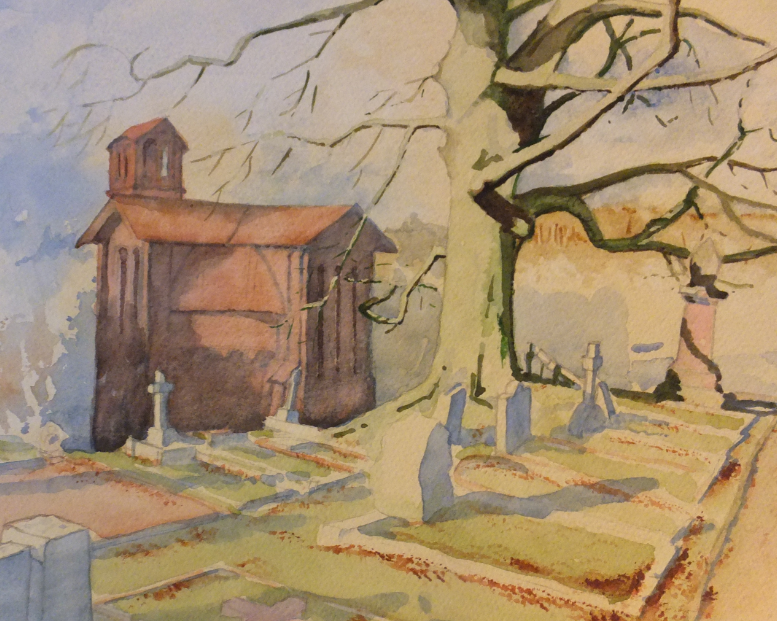
She also had built the magnificent chapel in the nearby cemetery. This was designed by her husband, and is a magnificent example of Art Nouveau design. I attach my own painting, as I don’t have a photograph. Actually I think my painting picked up the mood of the place especially on a winter’s morning
This special exhibition is housed in the main gallery
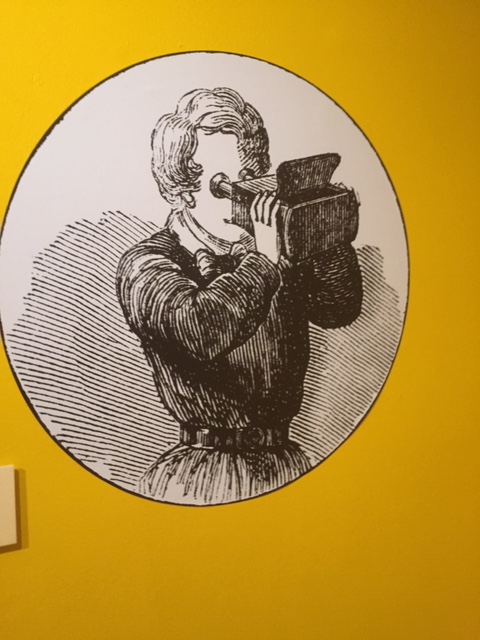
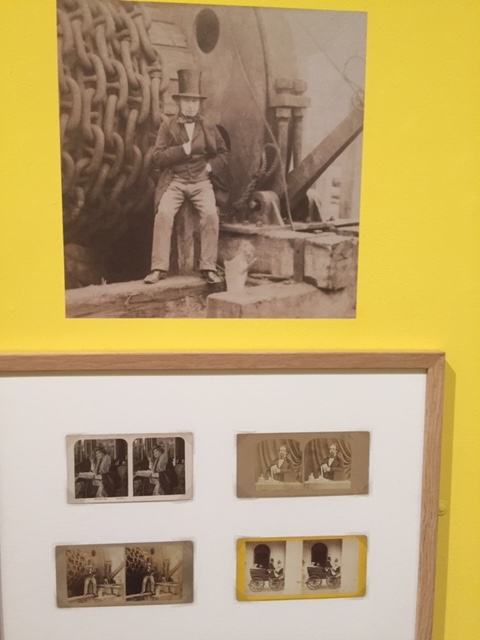
Sir Brian May started his collection as a boy with a freebie card out of a Weetabix packet. He sent for the viewer, and was amazed by the result in 3D. At the time as I remember, 3D was still high technology. He began taking his own pictures, and one of his father painting the ceiling is shown as an example. He took his pictures with a cheap camera from Woolworths. The name Woolworths has been consigned to history for some time, but it was the place to go for cheap goods. Quite tricky taking a second picture identical to the first, with the technology available at the time.
Having been hooked on the subject, he started collecting Victorian examples when he could find them at boot sales or auction houses. This was very much a Victorian pastime of course and many subjects were produced by card makers like Frith, covering famous names and places and many more
I attach a couple showing the iconic picture of Brunel the railway engineer, photographed alongside his famous steamship the Great Eastern. Also Charles Dickens preparing to deliver one of his readings,
A fascinating subject. I remember 3D as a boy, and being impressed looking at these cards through the viewer. There was also 3D cinema as well, although that was short lived as I remember, being replaced by new technology
The Annunciation by Dante Gabriel Rossetti 1849-50
An early piece by this artist, may even have been his first
The exhibition covered the work and lives of the Rossetti family, from the father Gabriele Rossetti, a political refugee from Italy together with his four children. Gabriele was involved in translating Dante’s Divine Comedy into English, which was a work his children continued after his death. The family were poets and artists. Gabriel Rossetti is well known because of his association with the Pre-Raphaelit Brotherhood, but curiously his sister Christina the poet is better known. She was a prolific writer of poetry. Her poem In the Bleak Midwinter is very well known as a Christmas carol, and would appear in every Christian hymnal, regardless of sect.
Gabriel, his brother William, and five fellow art students founded the Pre Raphaelite Brotherood, the first art group to challenge the soulless painting found in the Royal Academy with its reliance on old master styles. They were to express themselves from their own experiences. They modelled for themselves based on their own interests,and Gabriel drew a portrait of Elizabeth Siddal, a fellow student, and later to be his wife. There is a wonderful collection of her work in this exhibition, as far as I remember the only time that I have seen her work on show. Sadly she caught cold whilst modelling for Rossetti’s painting Ophelia, when she had to lie in a bath of cold water. Colds were treated in those days with laudenum, a mix of opium and alcohol, and it was that that killed her. She was only 39 when she died.
Christina and her sister Maria both chose a single lifestyle. They lived together and worked in the community through an order of Anglican nuns. William would remain single until his 40s when he would marry the artist Lucy Madox Brown.
Christina was to become a celebrity after publishing Goblin Market in 1862 and William became a leading critic and editor alongside his civil service career. Gabriel went on to form a new group: the aesthetic movement , which would change art and design for a second time. he combined working-class women with feminine fantasy inspired by Renaissance portraiture.
The portraits were paired with poems. Double works of art.
Gabriels finalyears were dominated by his obsession with Jane Morris nee Burden. Gabriel met her outside a theatre and asked her to pose as Queen Guinevere. His team included William Morris the designer , as they were painting murals in the Oxford University Union . Morris and Jane were married shortly afterwards and set up house at the Red House at Bexleyheath
Gabriel and William Morris shared the tenancy of Kelmscott Manor, a country house in Oxfordshire. In the early 1870s Gabriel and Jane became lovers
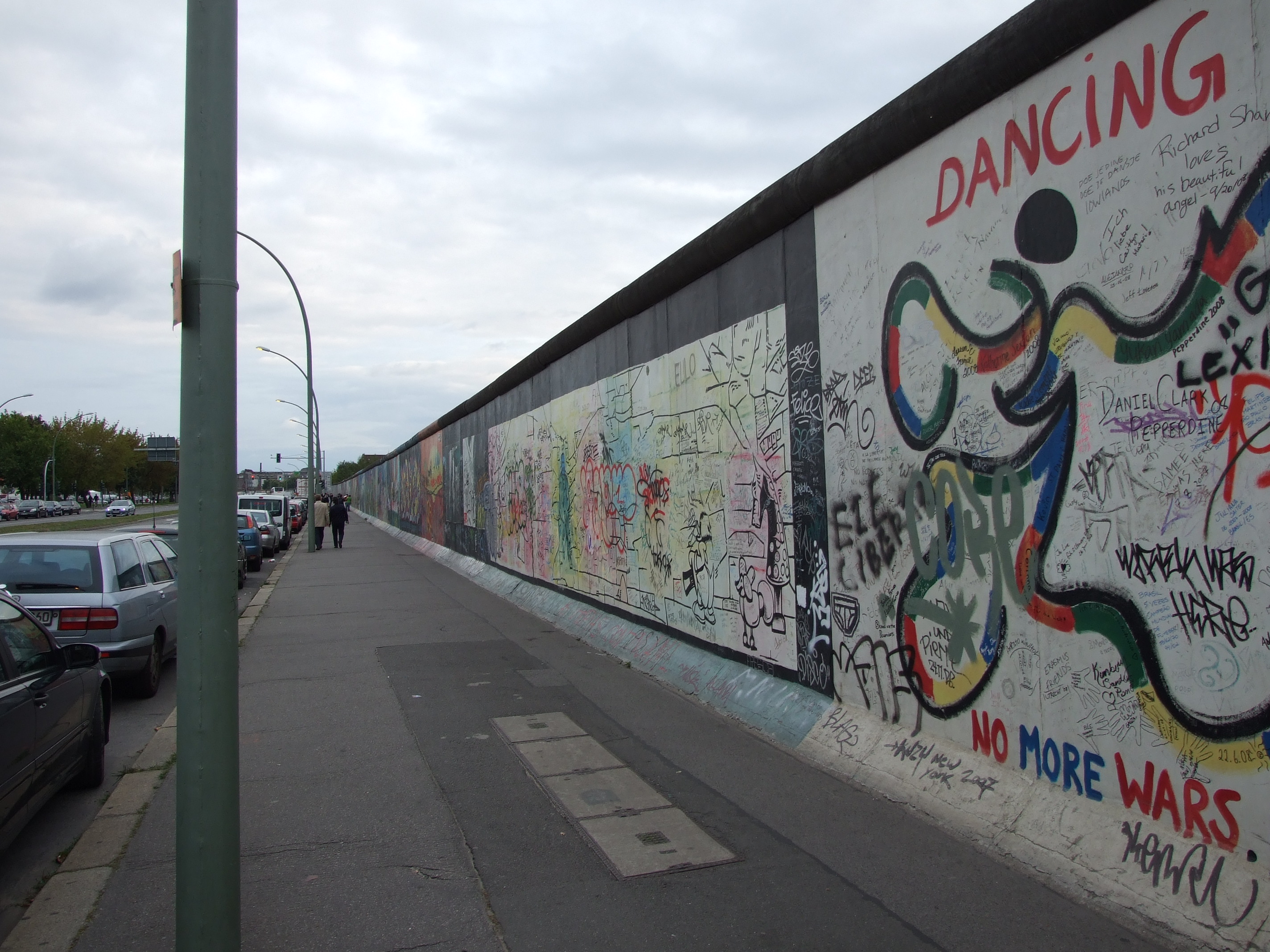
Part of what is left of the Berlin Wall (Der Mauer)
M
Explanation of pictures
m
Meaning is clear
m
I am conscious of the fact that I haven’t posted anything for a while. the reason being that i haven’t painted anything for a while, so have had nothing fresh to say
yet having said that, in my archives I have images that haven’t seen the light of day, for some years, and on reflection, are well worth dusting off and bringing into the sunlight. I found a number of pictures recently of the Berlin wall, that I had taken some years ago. We went to Poland by train, and on the way in and on the way out, we had a night in Berlin. There was so much to see. The Reichstag was incredible. We went to see Sir Morman Foster’s extension which was fairly new then. we went int he evening when it was lit up, and very dramatic
The most emotive experience though was looking at what had been left of the Wall, der Mauer. I took several pictures and can share a few here. I think the pictures will speak for themselves. The themes are clear. Oppression, loss of liberty, suppression of speech and thought, these came to an end in East Germany when the wall came down. Sadly we see them reappearing in 2022.
Just a few images from my collection. Food for thought perhaps
I did this painting in 2011, the year of the Royal Wedding, when William married Kate in Westminster Abbey. You may remember after the ceremony, that the Dean of Westminster did a cartwheel down the aisle, after the royal party had left, of course. Just something he did out of pure joy I imagine
The village of Pirbright, not far from where I live, and where I paint from time to time, used to put on an annual scarecrow festival, and the skill and artistry that went into making these scarecrows had to be seen. Tableaux usually of different things, book titles, events etc. In the parish church, a complete tableau of the wedding was created. It was amazing. I didn’t take a picture. I wish I had
Included in the scene, was the cartwheeling dean. I did photograph him and painted him later. I took him to local exhibitions, thinking someone would want him but nobody did. Eventually I sold him online and he went to someone in the north-east, and how strange is that. The man who bought him, wrote to me, and told me that he looked at this painting every morning and it made him smile. It was worth painting him just for that.
However, years later someone in the village is writing a book entitled ” Pirbright in Art”, and artists have been asked to submit paintings of, and around the village. I have sent in a selection, including the cartwheeling dean. It would be nice if he was included. We shall have to see.









 offtoafineart