Leaf Spirit Painting Completed

This is really complete. I can think of nothing to add

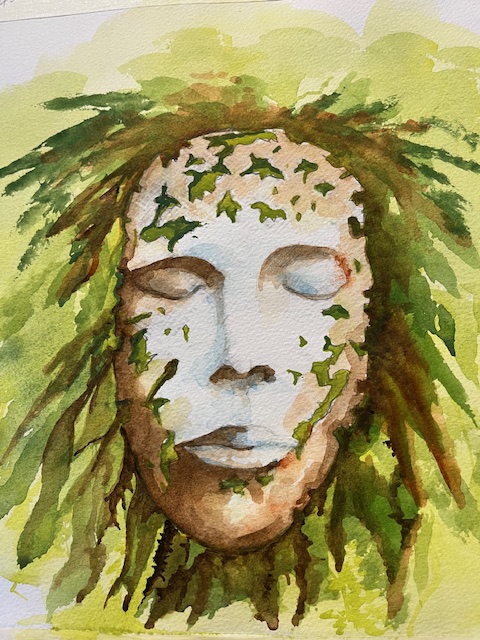
Inspired as I have said before by the amazing bronze sculpture in Kew Gardens, the work of Simon Gudgeon. I thought that I would try and paint from it. It took many years for me to try. Was it worth it. Well, I will let others judge

It is, what we call, outside of my comfort zone. Something that was suggested to me, in an age when selling paintings is as difficult as I remember. I was advised not to think of something that would sell and just paint something for satisfaction. Well, not a picture that everyone would want, and yet somehow I like it

We will have to see.

Leaf Spirit by Simon Gudgeon- a Tribute

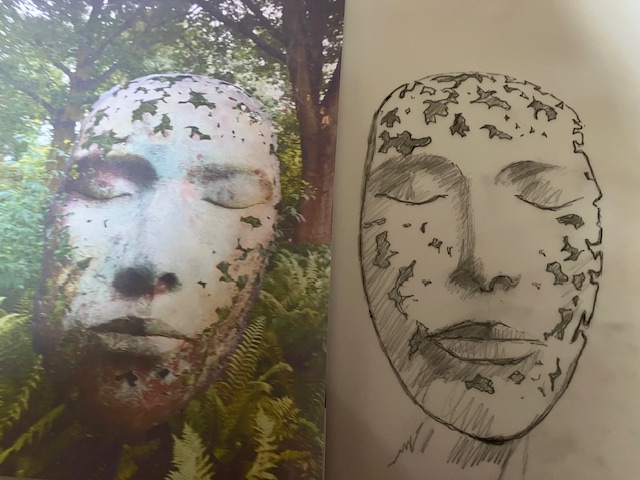
I have talked about this sculpture before. Leaf Spirit by the sculptor Simon Gudgeon, which is in Kew gardens. This isn’t the only example of this sculpture but the only one that I have seen. I did a blog about this some years back. It is in my opinion, an amazing piece of work, and I did wonder at the time whether I could attempt a painting of it, and in watercolour too, which will be a handicap in this instance.

This isn’t about the result, but more about the exercise and what I will learn from it. i suspect that it will be a steep learning curve, to coin a well worn phrase

I have found this to be a very hard year for selling paintings. I am not alone in this. There is a dearth of disposable income around the world. Competition for sales is fierce at the moment. Fortunately this is not my day job but for some artists life is tough. My mentor at our local art club has given me very good advice. Step out of your comfort zone, and paint things which challenge you. Don’t necessarily paint subjects that you expect to sell. So I have made a start on Leaf Spirit. I have done the drawing which has been surprisingly tricky. No matter how often I checked my measurements, the expression on my face is not quite the same as the one in the photograph. Mine looks more feminine for some reason, but it could change again with colour added.

I will go on with this at another date. I have some other projects queuing up and they too hopefully will take me in new directions. This could be the start of something totally different, a change of style even. For now, we will see where it takes us. Good I am starting to get inspired again

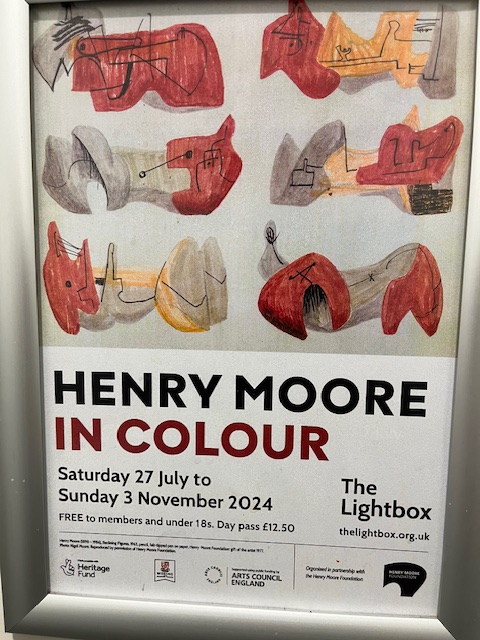
Henry Moore in Colour at the Lightbox

Yet another excellent exhibition at Woking’s Lightbox art gallery. Small, obviously, size dictated by the venue but focused and to the point. We, in Woking, are so pleased as following the bankruptcy of the town brought about by reckless investment, the fate of the Lightbox has been in the balance. Deep cuts are having to be made, and when difficult choices and sacrifices are having to be made, then difficult sometimes to make a case for our wonderful art gallery to be saved. So far it has been managed by the new local government and we are grateful for that. The Lightbox is relatively new, in a town with virtually nothing by the way of heritage or culture, so the rise in prominence of our gallery has been a matter of civic pride. We hope it will continue

Henry Moore is well known, and if like me you tend to remember his wonderful sculptures, then it is useful to be reminded that he painted as well, and some while ago too. When reminded, of course I remember his drawings and paintings of people taking shelter during air raids in London, in the underground railway stations. This exhibition highlights some of these works, known as the Shelter drawings commissioned by the War Artists Advisory Committee during the last war. These Shelter drawings were responsible for achieving widespread recognition for the artist following their display in the National Gallery. When you look at some of these drawings you start to see forming some of his later sculptures and I will show one if I can as an example

Certainly the first one I think I have seen as one of his sculptures!

Many years ago, there was a major exhibition of his sculptures in Kew Gardens, and I painted one of them that was placed in front of the Palm House. By way of light relief, I will end with it here

A figure stretching after a night on a cold platform? Might be

Sculpture by Simon Gudgeon in Kew Gardens

Leaf Spirit

Just by way of a change, and for some relief from my paintings, let me show this wonderful sculpture in Kew Gardens where we were yesterday

Not a sculptor whose work I know, although obviously world famous to others, I stood in admiration of this piece for quite a long while. Entitled the Leaf Spirit, it put me in mind of our familiar Green Man, the tree spirit that our ancestors worshipped long before Christianity. Not difficult to see why plant life evokes spiritual awakening in the minds of man

The belief persists. We still touch wood as an invocation to ancient spirits to protect us from harm, especially after saying something boastful, which might anger the gods, whichever one we believe in. Possibly a reflex action today, or do we feel uncomfortable if we haven’t done it

I am inspired to attempt a water colour of this piece. I think it would work. Would Simon Gudgeon feel happy about that or perhaps not. Maybe I will ask him, but not today

Leaf Spirit Profile

A Hidden Gem near London: The Dorich House Museum

Dorich House, Kingston

We went here a few days ago. An amazing gallery which I didn’t know existed, which had fallen into disrepair, was rescued by Kingston University, and stands a few feet from the wall around Richmond Park. A distance known as a “deer’s leap”

The house was designed by Dora Gordine, a Latvian sculptor, and completed in 1936. She lived there with her husband the Hon.Richard Hare, a scholar of Russian literature and art.

The house is a splendid example of a studio house of the period. The ground and first floor levels were designed for the production and display of her work. A more modest top floor apartment with a roof terrace overlooking Richmond Park, served the couple’s domestic needs

Richard Hare died in 1966. Dora lived until 1991, after which time the house was acquired and renovated by Kingston University. The house now holds the world’s largest collection of Gordine’s work as well as an important collection of Russian art acquired by Hare and Gordine.

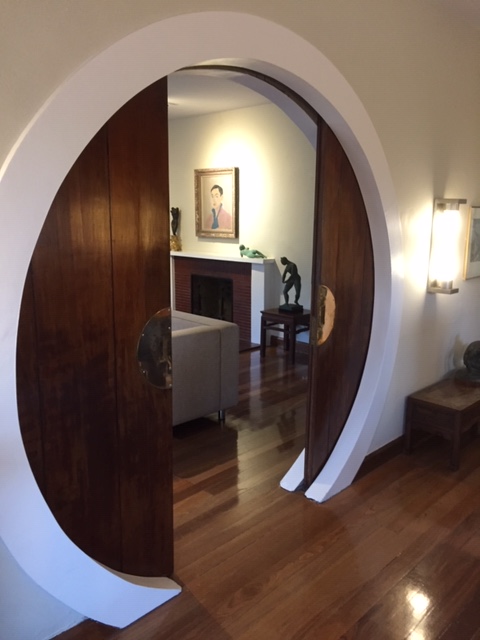
There are some wonderful architectural features in the house. My favourite is the Moon Door

Moon Door, Dorich House

The house is on Kingston Vale next to Richmond Park, and is worth a visit if you are able

Fountain of Love: the finished painting

The Fountain of Love 

Well, this painting is finally finished. Towards the end, although commissioned, it was starting to become a labour of love, no pun intended.

I found myself wondering whether I would finish or fall at the last hurdle. I feel pleased with it, which is dangerous to say, as the image for approval has only just gone to the client, and if it doesn’t match what he had in mind, then I shall be in difficulties. Worst case scenario, it will be rejected, but even then I would find this one useful for the web-site

In terms of technique, there isn’t much to add to the last post. The jets of water were achieved by flicking white gouache onto a blanked off section of the painting. Always a bit hit and miss, but mostly they have worked, and in some cases provided a realistic white mist

Unless I have to make any last-minute adjustments, I should be free to think of something else, for which I have built up a long list. I am at least at the end of my commissioned work ( for which I am truly grateful), and can now think of my next exhibition which is March/ April as I remember. I have paintings ready but will need more, and so we go on.

Henry Moore Exhibition at The Lightbox in Woking

henry-moore-reclining-figure-in-elmwood

The centrepiece of the current Henry Moore exhibition which we went to see recently.

The Reclining Figure in Elmwood.

If you have worked in elmwood, you will know it is notoriously  difficult to get a smooth finish. The grain is very knobbly for want of a better word, and resists efforts to sand it to a smooth finish. This piece is like satin and invites you to touch, which you mustn’t do, of course

Moore sculpts for the landscape with his monumental works, and developed in his pieces the “far-seeing gaze”, so that they could look out over long distances. With the space restriction at the Lightbox , this exhibition quite rightly concentrates on Moore’s drawings and smaller pieces, which sometimes don’t get the exposure that they deserve. Here we see the natural shapes and found objects that influenced the sculptor throughout his career, which in turn influenced his finished sculptures

The holes and negative spaces were intended to stimulate rhythm, tension, force and vitality. He was driven by this idea of the outer layer giving protection to the inner shape within.  His interest extended to helmets, armour and shells which also protect the interior.

A frequent theme is the mother and child image, which explores this idea. The big protecting the small. His Madonna and Child sculptures reflect Moore’s fascination with the interdependence felt between mother and child.  He was drawn to how things naturally fit together within the balance of nature, and of course he was not the first to notice that.

He was also influenced by the solidity of  ancient Greek statues which he sketched in the British Museum. He sought to reflect the weight of the stone through the strength of his mother figures.

The exhibition lasts until 7th May. Although not a large space, nevertheless because of the accent on his drawings and maquettes, there is much to study. Too much, perhaps, for my level of concentration, I intend to go at least one more time before the closing date to carry on where I left off.mother-and-child