Out of my Comfort Zone

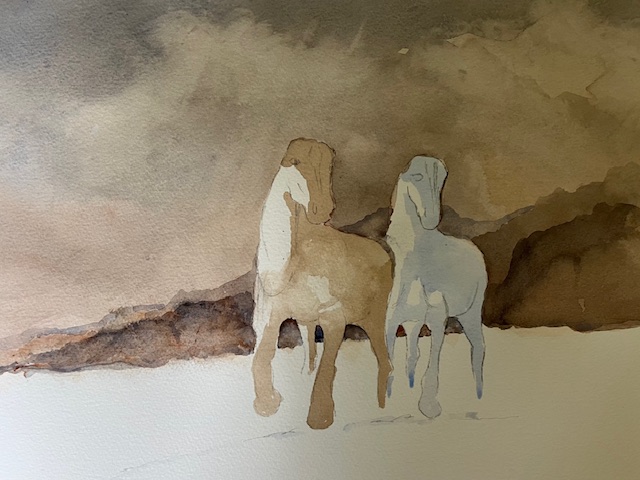
Usually I paint from some sort of photographic reference or even real life occasionally. I was advised to step out of my comfort zone when I was heard grumbling about not being able to think of something to paint. This is probably the closest that artists get to writer’s block.

So I started with a reference of a single horse which I duplicated, changing the colour of the second one. I put them in in a rough form.

I started on the background which I began with a coat of burnt sienna, diluted down. I let that go hard overnight, and then gave a glaze of lamp black, dabbing some out with paper towel to give cloud shapes. Lamp black is quite smoky looking and I like the effect it gives to winter clouds. Again I let that dry naturally overnight.

The clouds needed to go darker. I mixed Ultramarine Blue and Light Red and started from the top, adding more red as I reached the horizon line. I let that dry hard whilst I figured out what to do next. Remember I was on my own with no safety net!

I felt that the horizon could do with storm clouds rising. I used another mix of the red and the blue. The clouds didn’t work so they turned into distant hills which worked better

And that is where we are for now

Singer Sargent and Fashion

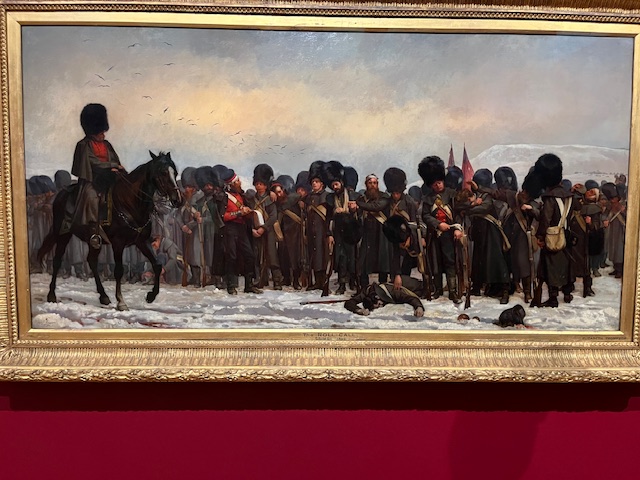
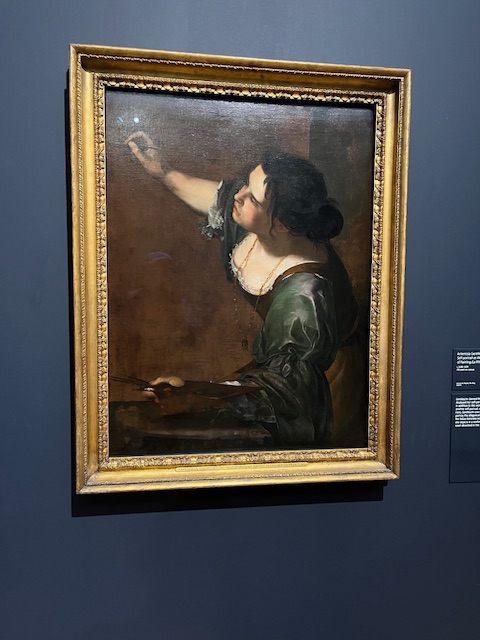
We went to the exhibition of Singer Sargent’s work at Tate Britain recently . His work is stunning. He was without doubt the leading society portrait painter of his day

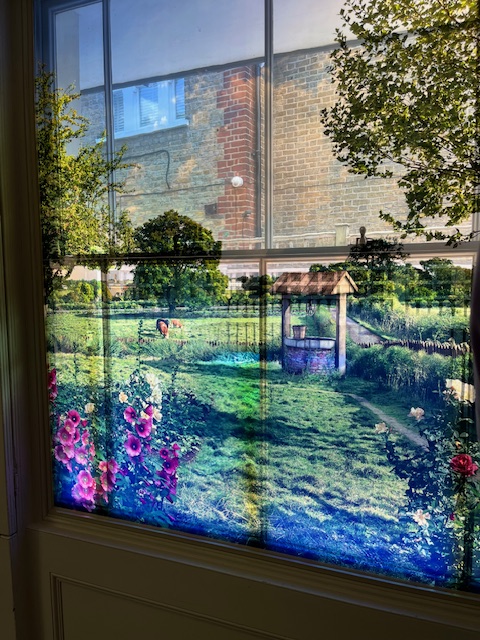
This was one of the first paintings that Sargent made after moving to London from Paris,and it helped make his reputation in Britain, when it was purchased for the nation by the Chantrey Bequest The painting was made over two years, mostly painted outdoors, when the light was as Sargent wanted it. He painted the work in the Cotswolds, in Broadway at the home of the Millets, who were friends of his.The sight of Chinese lanterns hanging in the trees and beds of lilies was his initial inspiration. The two girls were added later. The white dresses were made especially for the painting known as Carnation, Lily, Lily, Rose

I never knew how much attention to detail he made with the costumes of his sitters. He would apparently visit their home and go through their wardrobe and almost dress the sitter in the way that he wanted them. He created roughly 900 oil portraits and approximately 1200 watercolours. He was highly prolific adding drawings and charcoal sketches to this list

Born in Florence to North American parents, he was truly international.. Working first in Paris and then in London, he was successful as a career portraitist. His work was characterised by drawing with the brush which was novel, and drew admiration. He was also drawn to Impressionism for a short time and was a guest of Monet. He traveled widely after training in Paris with Carolus-Duran, visiting Spain where he was greatly influenced by Velazquez and later to Italy where he sketched in preparation for Venetian genre street scenes,

His works and influences are too numerous to mention. London became his home and he died there in 1925. He is interred in Brookwood Cemetery in Surrey, about ten minutes from where I live as it happens. I don’t know why he was brought out from London to be buried. He had no links with this area as far as I know. Brookwood is a vast cemetery probably the largest in Britain, built as an overflow to the overcrowded graveyards of London. Maybe that was the reason. I have not been able to find out

Memories of school years from 1954

I was asked about my school years. Something I don’t often think about. If I ramble, it’s because I am remembering things as I go along

In 1954, I sat and passed the infamous 11plus exam, which enabled me to move from the primary or first school, on to a grammar school. This was an iniquitous system which separated the sheep from the goats at a very early age. Grammar school places, so soon after the war, were limited and so most students were relegated to the so-called secondary modern system, where the subjects taught were less academic and more practical. Why people assumed that failure of the 11+ meant that students were good with their hands, I don’t know. Mercifully the system broke down and was replaced with the comprehensive system, which had its faults and needed amending, but all in all was fairer, and recognised that some blossomed later, and caught up and maybe overtook.

So there I was, with others ready to take on this great adventure of preparation for later life. It meant making a train journey for a start, on my own, as the grammar school, Churcher’s College was in the next town of Petersfield. This was a school steeped in tradition. Founded in the 18c by one Richard Churcher, an East India Merchantman, to train boys in mathematics and navigation, and to be employed later in the East India Company. A far cry from the classical education that most boys of that class were given. Although a grammar school, that is, state aided, the school was run along the lines of a public school. To us public schools were private and charged fees. Think Eton or Harrow. Some would say we had ideas above our station.

We learned Latin for starters. That was a shock to the system. I struggled with this subject, although later on when I took GCE O level I passed in Latin to the amazement of my teachers. I look back on it as a subject worth studying as a good groundwork for other European languages especially English. Each year was streamed into a and b streams. A stream learned Latin but the b stream did woodwork instead. Once again another group were written out of academic studies

The buildings were old. Masters were mostly old and caricatures. Corporal punishment was given out for minor offences with what seemed like relish, If you asked questions you were slow. Proficiency at games was venerated. Prowess at studies was not. There was a Combined Cadet Force at school, which was like an Officer’s Training Corps. This wasn’t long after the war ended, and conscription was still in force. You could join the CCF at age 14, which I did, and joined the army section, which I enjoyed thoroughly. Officers and NCOs from the regular army came in and drilled us, so all was taken very seriously. Once a term we had a field day and went to the nearby Longmoor Camp. We were issued with Lee Enfield 303 rifles, WW2 vintage, and a handful of blanks. Split into two teams we went off into the woods for mock battles. This was like glorified cowboys and Indians for 14 year olds, with real guns. Officers would fire live rounds over our heads and throw firecrackers at our feet. Amazingly nobody died.

So what was happening in the world in 1954 and were we aware, being without social media in those days. I was aware of some things because my father read aloud from the Daily Telegraph. Colonel Nasser took over Egypt and ousted the king Farouk. I did know about that at the time. I do not remember this being discussed at school, current affairs weren’t. Everyone was too steeped in the Classics. This led to the famous Suez Crisis. Nasser took control of the canal, and Britain and France sent in paratroops. This was a military failure. The Americans were furious as they had not been consulted and the British learned the hard way that they no longer ruled the waves. We were disengaging from our old empire throughout the world. India had become independent in 1947. The whole thing was horribly mismanaged by the British with tragic bloodshed and resultant misery. The word Empire was still around in 1954. I had a pair of Plimsolls which we wore for PE, and they were marked Empire Made. Woefully inadequate, my feet are deformed to this day. A friend of mine at school, Alan Disney, who claimed to be related to Walt and maybe was, had a wonderful stamp collection. He specialised in British Empire stamps. His collection was amazing. I wonder if he still has it.

I said earlier that my father read excerpts from the Daily Telegraph every day. Imagine a Puritan household where the head read from the Bible to assembled members including servants. It was like that. A reading from the word of the Daily Telegraph to start our day, although we didn’t have servants of course. The Daily Telegraph was, and still is, an Establishment newspaper veering to the right. Sometimes hysterical. Always supporting the Tories. There was very little information or opinion to balance our choices. One channel of TV from the BBC until mid fifties when ITV appeared as an independent channel, which my father refused to have as it was funded by advertising. I found that odd as he supported big business versus the state but not this time. So we plodded on with dear old BBC . There was only one radio in the house which he controlled, and would switch off without recourse to anyone else in the household. Some of my friends had transistor radios so could listen to Radio Luxembourg under the bedclothes. This was a pirate radio station broadcasting pop music which was starting to be the rage, but denied me I am afraid.

Prowess at games, I have already said, was admired. Good all-rounders were the heroes of the school. I was miserable at all sports, especially team games like rugby and cricket. I was forced to play and did so with bad grace. When I left school I vowed never to play team sports again, and have kept my vow.

So did I enjoy anything? I have mentioned the CCF which I did enjoy, despite preparing my uniform for inspection at the week end. Had I been left at school long enough, I might well have considered the military as a career. But I wasn’t . After my O levels which weren’t bad with six passes, I was removed to go into the family business, a decision I came to regret and moved out as soon as possible. I always resented being denied sixth form

Those are my few memories of grammar school years. Even the word ‘grammar’ is steeped in antiquity, for those who might not be familiar with the term. Grammar meant Latin grammar in this context, and such schools were set up in the c16, in the reign of Edward VI as I remember. There is a good one in Guildford near where I live, still flourishing today, but not teaching Latin as far as I know.

Did you know that when I was at school, in order to get into Oxford or Cambridge Universities for any subject whatsoever, you needed O level Latin? That stopped in 1960. I leave you with that as a flavour of how schooldays were in my day
Recent Commission

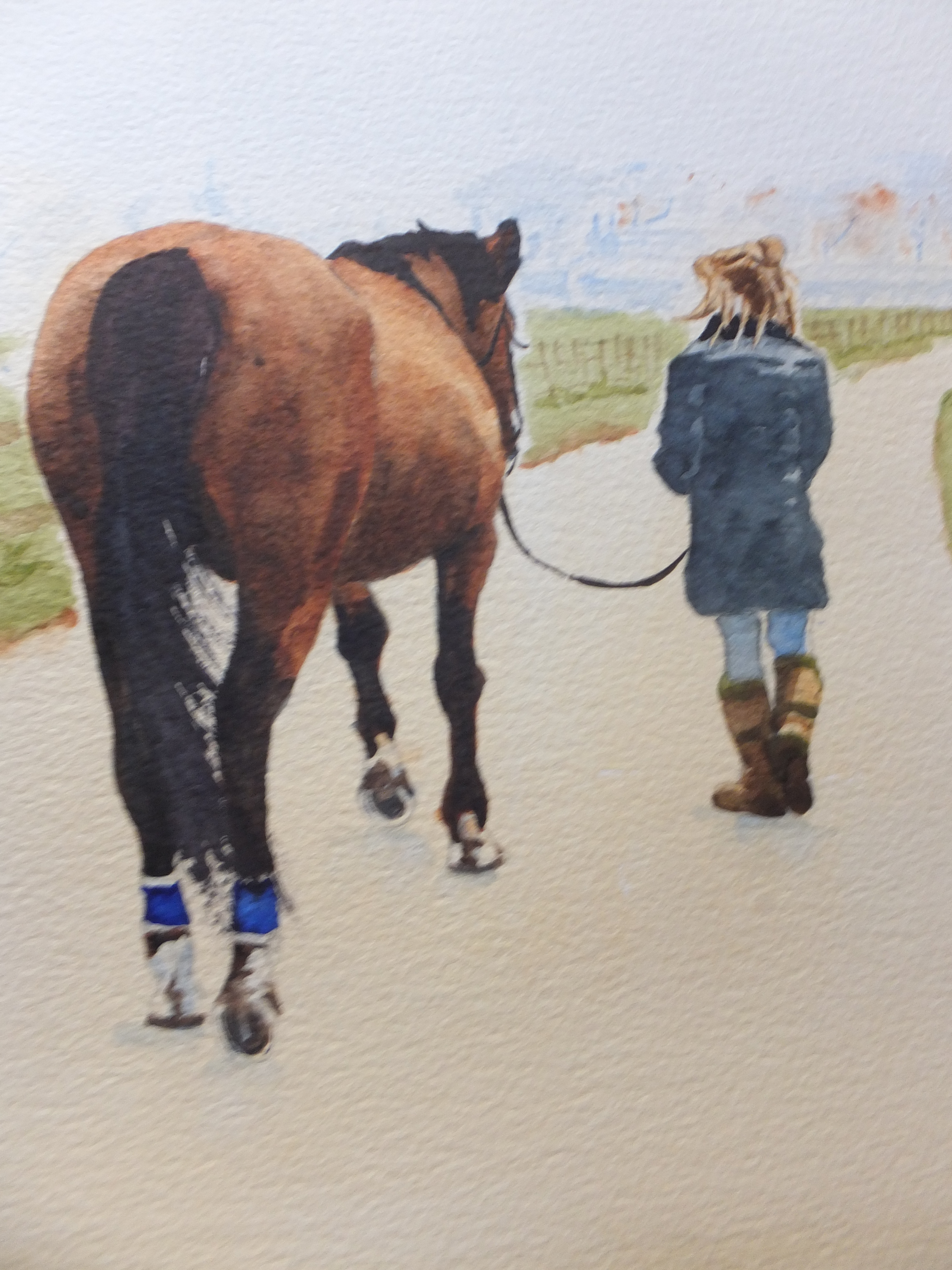
This is the type of commission that I enjoy doing. One of my favourite subjects, painting horses, and in this case, a charming composition, of a horse being brought in to the stables, possibly for saddling up, by her young owner.

One of the most difficult things to get right was the colour of the horse. A brown horse doesn’t sound very complicated but there are many shades of brown, and I needed to get close to the original reference photograph. This horse looked like a bay to me, with black mane and tail, and with black legs. I did the horse over several days, building up the colour and letting it dry overnight. Until the colour was dry, you just could not tell what it would look like. Eventually I was satisfied with the result

Most other things were relatively straightforward. I blurred out the background to increase the feeling of distance. Also in the photograph the background was in direct competition with the main subject.

The composition now worked well and told a story. I was a rider myself once long ago, and this picture reminded me of those days. My son and I would go north for a week to Northumberland, where there are some very open spaces. We would ride from place to place, and overnight the horses with local farms. They would stay out overnight, and in the morning we would have to go and find them, and bridle them up. Horses are cunning and when they saw you coming would make for the higher ground. You really worked hard to catch them. Once you got the bridle on, you could bring them down to be saddled for the day’s ride. This picture reminded me. Incidentally all this happened nearly forty years ago. My son is 53 now and me, well, I don’t ride anymore.

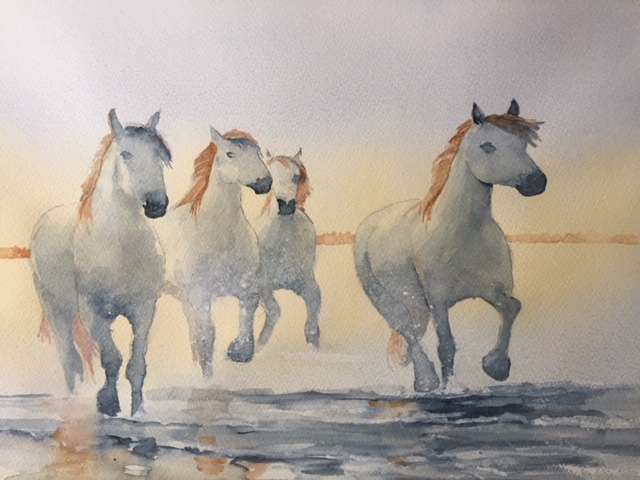
Latest Painting: Galloping Through the Surf

White horses galloping along the shore are always a stirring sight

I am getting paintings together for a new exhibition in March at Denbies Wine Estate near Dorking, and needed some new work. This one I am pleased with and will be putting it forward. This is the latest in my series of Camargue horses. I like this one more than previous horse pictures. perhaps I am getting better!

Recently I was given a commission to paint a horse with its owner. This will be given as a present so a special responsibility. I will let you know how I get on

Grayson Perry Exhibition of Tapestrys at Woking Lightbox Gallery

The Agony in the Car Park

The Adoration of the Cage Fighters

Excellent exhibition on at the moment until June, featuring colourful tapestries designed by Grayson Perry and woven in Belgium. They echo the Rakes Progress series of paintings by Hogarth depicting the hero Tom Rakewell squandering his fortune on riotous living and plunging into debt and madness. The hero of the tapestries is Tim Rakewell, who becomes a computer genius, makes a fortune and moves socially upward. His nemesis comes when his luck affects his judgement and going too fast, drives his powerful car into a lamp post and goes through the windscreen. he was not wearing a seat belt. He dies at the roadside. As the attending medic says” with all his money and he dies in the gutter”

The first tapestry in the collection is The Adoration of the Cage Fighters with all its echoes of the Virgin Birth. The genius is born and is worshiped by the cage fighters who bring him gifts like the shepherds paying homage to the newborn Saviour. He will grow up into a man embarking on a journey of upward social mobility. I can’t see that he will benefit the world in any way but there it is.

This tapestry is said to be inspired by The Adoration of the Shepherds by Andrea Montegna

The other tapestry that I am showing is entitled The Agony in the Car Park. Here compare Gethsemane or the Agony in the Garden by Bellini. The scene is a hill outside Sunderland. The central figure is Tim’s stepfather, a night club singer. The scene hints at Grunewalds ‘Isenheim Altarpiece’. The large crane stands in for the crucifix. In the bottom corner Tim in school uniform blocks his ears with embarrassment. In his pocket a magazine betrays his interest in software. As we shall see, this will be his way out from a miserable childhood

These are just two panels from the complete story. There is the story of him leaving home after his girlfriend rows with his mother, his company which he sells for an enormous sum and then his demise at the roadside. What is the moral of the story. perhaps too much, too soon, or the dangers of moving upwardly mobile too quickly and being unable to cope. Woking Borough Council could perhaps learn from this story. Our town is officially bankrupt, through inept investment and squandering of people’s money. The townsfolk are looking at reduced services and increased costs. We shall never be solvent in my lifetime that is for sure. Even our beloved Lightbox is under threat and talks are ongoing about how to save it. Tragic to lose it. Woking is not a city of culture. The Lightbox gallery has been the jewel in the crown, and given us great prestige in the art world

We await our fate

Postcard Auction

Entitled Tranquility

This was one of my entries for postcard sized entries for a charity auction to be held by a school catering for students of secondary age. These are youngsters who may have emotional problems or have suffered domestic abuse, and now need a stable and calming background in order to study and reshape their lives

The school wrote to me and asked me to provide artwork for their auction. I was very happy to help, not because I am a supporter of charities generally, quite the reverse, I am not known for helping people. This is the sort of project that I enjoy doing, so not exactly selfless

This is a fundraiser obviously and will take place during their summer break. The school is run as a charity and depends on donations from private donors. I feel a certain weight of responsibility on my shoulders and can only hope that my entries don’t let them down.

The initial reaction has been encouraging from the school who have received my entries, and are very pleased with them. An old friend of mine, John Griffiths, stage actor and writer, whose last book I illustrated, has already laid down a bid on one of the pictures, so we hope for great things

Midday in a Galician village

Just occasionally, going through folios of old paintings, I come across something I haven’t looked at for years, so much so that it looks new. Certainly I have never written about this one, as it was painted long before I started writing this blog

We were on our way to Santiago de Compostela, by coach so we couldn’t claim to be pilgrims. You still have to make the journey on foot or on horseback before you can do that. Nevertheless we had been making a most enjoyable journey from Madrid taking in cities like Burgos and Leon, when we stopped at this village, somewhere in Galicia. It was long ago and foolishly I didn’t keep a note of the name. All that I remember was that it was midday and it was very hot.

It was midday, and the sun was baking the ground we trod on. The place was deserted. Only the English were milling about. There were no mad dogs to be seen. The words of the Noel Coward song struck me immediately. Anyone with sense had taken cover, either eating lunch or probably having a siesta.

Later on I was moved to make this little painting. Siesta time, deserted streets, hopefully I have captured the intense heat. I will let others judge. Anyway nice to find it again

The Maunsell Sea Forts in the Thames Estuary

I have written about these magnificent structures before albeit many years ago. This is the second time that I have painted the towers, this time a different angle from the first. I think I prefer this one. It has more atmosphere. Certainly a very still and eerie place

It is now more years than I can remember that we took ship and sailed out to look at these forts. We were on an old paddle steamer called The Waverley which is a well-known vessel, and in those days, this boat would steam round the British Isles putting in at various ports, and running trips from there. This trip started in the Pool of London, which meant that the Tower Bridge had to raise its drawbridge to let us through, which was an experience in itself. The return journey took all day, calling in at Southend Pier to pick up more passengers, past car ferries mothballed which had been used to take cars from the Ford Motor Plant at Dagenham, and then out into the North Sea until we could see the sea forts

Designed by Guy Maunsell, the forts bear his name. Built in Gravesend they were towed to site on the sandbanks in 1942. There they protected the mouth of the Thames and prevented enemy aircraft using the river as a guide into central London. Decommissioned in 1950, they were later used as pirate radio stations until deemed unsafe. They stand as a nostalgic memorial

Painting a local Scene

Barges gathering on the Basingstoke Canal

The Basingstoke Canal runs through my village of St.Johns in Surrey. There is very little traffic nowadays as the canal doesn’t go very far, and the short distance there is, is punctuated by locks. Occasionally there is a gathering of barges which seem to tie up mostly at St Johns, where there is an old wharf

The canal was cut in the late c18. The intention was to link London with Southampton but the advent of the railways cut this short. Today the canal is a haven for wildlife and some leisure activities.

It is very near me, and I have painted there often. There are so many subjects. It was nice to go back recently and hopefully capture this meeting of barges and their owners. The colours are always fun and add to the atmosphere

Maybe I should walk along the towpath more often