Turner in Surrey Part 2

Thameside Ferry Crossing

This is a photograph I took myself trying to catch the little ferry crossing from Twickenham over to Ham on the other side. I just missed the ferry but my reason for keeping this picture, is that this must be one of the nearest points on the river from Turner’s house in Twickenham. I dealt with his house a few blogs ago so I won’t repeat that. Turner loved boats, he loved fishing, he loved the river, and he loved picnics with his friends. Was this the sort of spot he came to? We don’t know for sure about him fishing here, but he would have known this location.

I took this picture from the riverside of the grounds of Orleans House Gallery, where we go from time to time. The gallery is what remains of the original Palladian mansion built in the c18. Louis Philippe duc d’Orleans lived here in exile from 1813-1819. Turner met him and they became lifetime friends. Later in 1830 he became king of France, until he was toppled by another revolution, and went into exile in England once more. He died at Claremont in 1850. Turner went to see him in France near the end of his own life in 1845, one of his last visits to Europe, and they talked into the night about ‘Dear Old Twick’

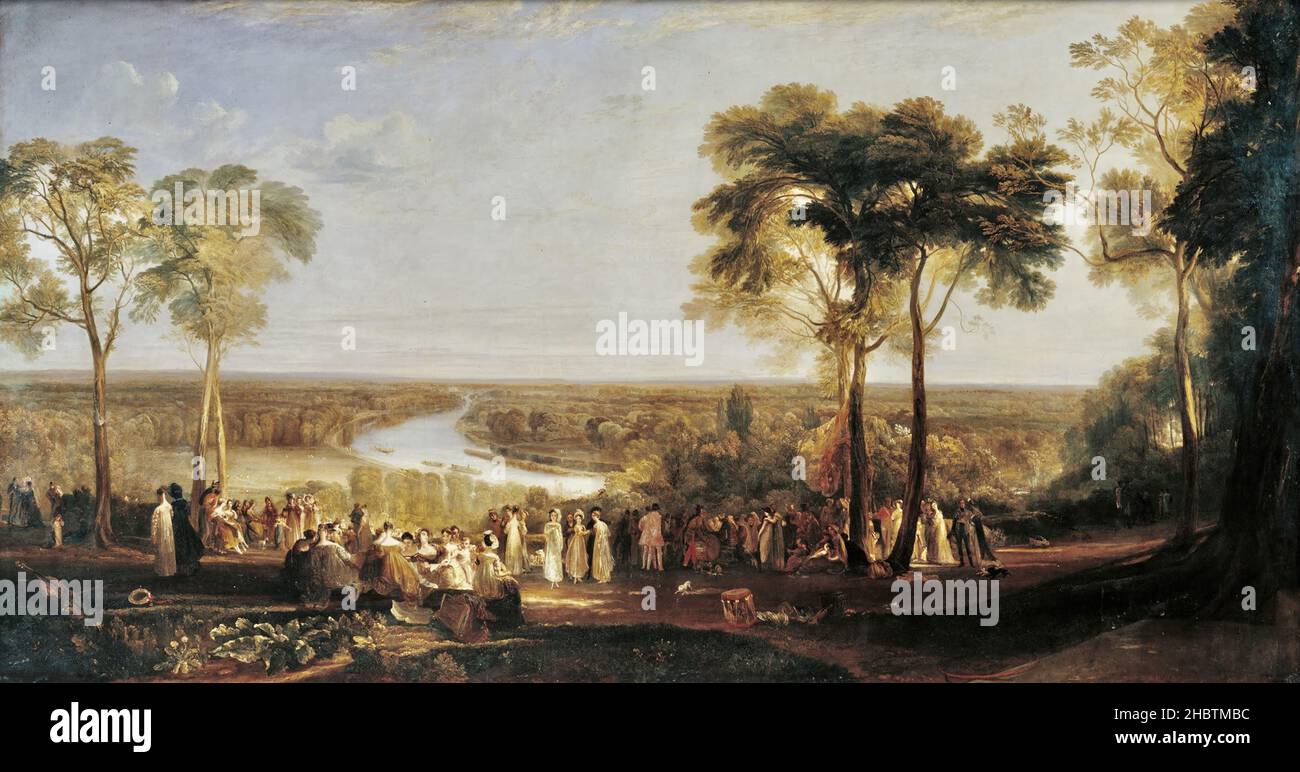
In the background on the hill is the Star and Garter, what used to be a retirement home for disabled service men, and more recently converted into apartments. Nonetheless a powerful landmark, and showing us where Richmond Hill starts. Turner painted the view from there, and I would like to look at one particular painting dated 1819, painted in honour of the Prince Regents birthday

I think that this was an unashamed bid for royal patronage, which was unsuccessful as I believe but nevertheless an interesting painting, which of course looked down on an area which he grew to love. Actually as King George 1V he was able to bestow a seascape on Turner in 1823, but to return to Richmond Hill

I will, if I may quote from Anthony Bailey’s biography, which talks about this painting in some depth. Travel and the proprietorship of Sandycombe Lodge, his country house in Twickenham, had occupied much of his time. His painting output had dropped, and he had no new commissions, so he needed new patronage, or may have felt so. In 1819 he had exhibited this great canvas, kingsize, measuring about six feet by eleven. This was England: Richmond Hill on the Prince Regent’s Birthday. It showed the winding Thames at Twickenham, and Sandycombe hidden in the trees, and on the further bank a game of cricket going on whilst in the foreground a group of partying people which could have been borrowed en masse from Watteau

There were mixed views. Some thought the painting to be unEnglish despite its title. There is a quotation from Bell’s Weekly Messenger (16 May 1819) where the writer admired the painting but qualified his praise.’ The distance, the foreground,the trees,and the figures are all Italian. On Richmond Hill, and on such a day, John Bull with his dame, with the rustic lads and lasses of the village, sporting under the sturdy oak, would have been more characteristic of England’ But this was to request a different nostalgia. Turner had not yet been to Italy and was perhaps looking forward to that country to paint

That is probably enough for writer and reader for now. I am getting some material together for his excursions down the River Wey taking him deeper into Surrey, so we can look at that another time

Turner in Surrey

In a weak moment, I have allowed myself to be talked into researching the work that JMW Turner carried out in Surrey, and writing a talk on my findings, which I will then have to deliver to my history group at a given date in November. this sounds a long way off. I know from experience that it is not, so i have already started gathering stuff from books and internet. A visit to tate Britain when the weather improves will be necessary but enjoyable. The bulk of his bequest to the nation is there so must be something of use. Also Petworth House where he was a frequent house guest of Lord Egremont. Petworth is not in Surrey as we know but is close enough. What I am realising from the start, is that there is precious little written about Turner’s expeditions into Surrey. he did a number of paintings on these trips but none of them became his best known works and so consequently little written about them. perhaps my view will change as I get further into my searches

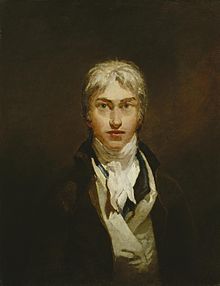
To start with a little background, the painting above is his self portrait. The only one he ever did in his lifetime. He was a private person as we know, and gave little of himself away. His birth date is given as 23rd April 1775, but this is disputed, as Turner would give different dates to different people. he had this aversion to people knowing his personal details. He lived with his parents, which was far from being satisfactory, as his mother had a violent temper, and was later incarcerated in Bedlam Hospital. So he as at School in Brentford and later in Margate, and this is where his love of the river started. He loved boats and messing about in boats. They figure in some of his paintings, and they are a frequent mode of travel on his painting expeditions. later he would row sometimes as far as Windsor on the Thames and down the Wey to Guildford, which we will look at later.

let’s start looking at some of his Surrey paintings and start in date order as far as we can

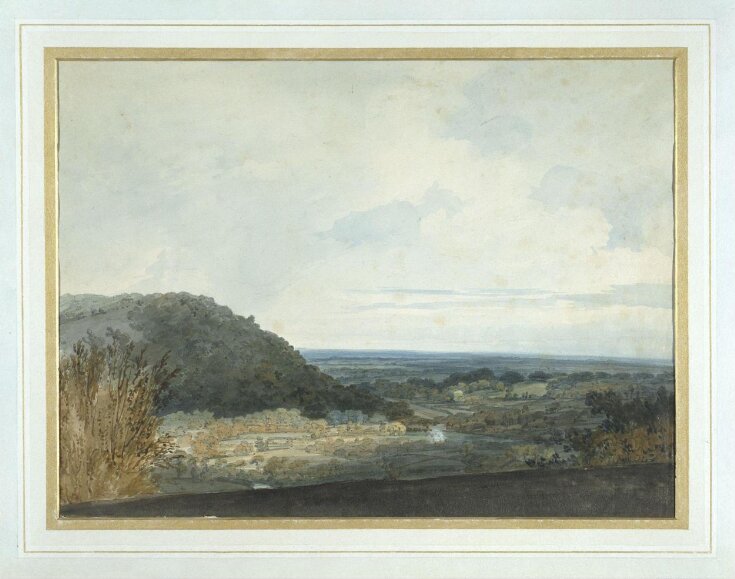
Possibly Box Hill Date….. previously attributed to Tom Girtin, and later to Turner. Girtin was contemporary to Turner, and they were in fact great friends. They would go on expeditions together, and on one of them painted the Savoy palace from a boat on the Thames. Girtin was an acclaimed painter, who sadly died at the age of 29. Turner held him in high esteem and his famous quote said ” if Tom had lived I would have starved”. Turner was definitely in the area that year, as the next painting of Leatherhead shows. This was his so called Student period.

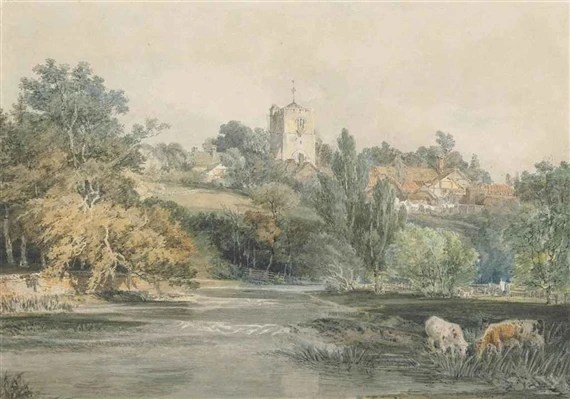
At about the same time, we have this painting of Leatherhead

Leatherhead from the River Mole, with cattle in the foreground, dated 1796, and attributed to Turner. I find this an immature style compared to what we associate with Turner’s work, and it would be as this comes within his student period. Turner had been invited to Norbury Park, near Leatherhead, a place I associate with Fanny Burney who met her future husband there, Comte d’Arblay, an emigre from the French revolution. I wonder if they met Turner. Interesting to conjecture

I will publish so far and go on with this at a later date

Memories of another age

It was suggested that I write about the early years of my life. I am 81. What do I remember, and how far back? I don’t remember the last world war. i was born in 1943 in London, and during an air raid, my mother told me. We called these raids the Blitz. We borrowed the German word, Blitzkrieg or lightening war. It was terrifying by all accounts and I arrived in the middle of it. Even today I jump at loud bangs.

So I don’t remember the war but I remember war damage. There was still plenty about as I started to form memories. We lived near Portsmouth about this time, so I remember the magnificent Guildhall gutted by incendiaries, and also the old Theatre Royal standing alone amidst the rubble, and as I recall still putting on plays. I can picture whole streets gone, what were once rows of shops, now identified solely by the names in mosaic in the doorway floor. I remember buddleia growing amongst the rubble, aptly named the bombsite plant.

I remember the late king George VI who died in 1952, and our late queen, then Princess Elizabeth being acclaimed queen on holiday in Kenya. I kept a scrap book of the king’s funeral, which didn’t seem strange at the time. Today it might be considered an odd thing for a child to do. I vividly recall a blood stained photograph of the monarch lying in state in Westminster Hall flanked by four soldiers. It had been used to wrap meat and I rescued it for my album. We didn’t have hygiene in those days and butchers and fish shops used old newspapers to wrap their wares. Fish and chip shops did the same. That is where we took our old newspapers. Eric Sadler was our local chippie. He stirred the boiling fat with an old piece of wood which looked as though he had found it on the seashore. Then he wrapped your fish and chips in someone’s old newspaper. No one was shocked by this. We had survived bombing, don’t forget.

About this time we were still living above our shop. I remember my brother being born in 1948, about the same time as King Charles, so a big gap between us because of my father being away in India and Burma from 1944 to 46. I remember bits about living there. I had measles and was ill for two weeks in a darkened room. Nobody was vaccinated against these diseases, dangerous as they were. They were called childhood diseases, measles, chicken pox, mumps etc and you had them and if you survived you were immune for life. I don’t remember having mumps. My father had it and was hospitalised, as this was a dangerous illness for men. My brother had whooping cough, very young, he was in his cot at the time. I can still see my father holding him upside down like a rabbit, while he struggled for breath. That was horrible to watch, but he survived, I am pleased to say

I started school at five years old. There was no pre-school or nursery school in those benighted times so we were later learning to read than children today. In fact I got off to a bad start, as I was enrolled in the local catholic school, which are very good today, but at the time was very poor. I was moved to the state primary school, and at six years old could not read or write. I caught up quickly enough, and was there until 1954, when I took the iniquitous 11-plus examination, and was one of the few that passed to go to a grammar school. Grammar schools, for those who don’t know the term, date back to the c16 when they were founded in the reign of Edward VI. Grammar meant Latin grammar, by the way, which in those days was the lingua franca throughout Europe. I was taught Latin incidentally, as it was essential to get in to some universities whatever subject you were studying. That changed in 1960

I say iniquitous, It was like separating the bright from the not-so-bright at a very early age. People like me were given an academic education learning Latin for example. The others went to so-called secondary modern schools, and their training included woodwork, domestic science etc as though they were destined for some form of artisan employment. This was to change with the advent of the comprehensive system, when it was recognised that children were all different, and developed at different speeds, and deserved the same training. Even this system needed modification until it was perfected to what we have today

I had intended only to write about my early years and what stuck in my memory. In 1951 when I was eight years of age, my father took us on the train to London to the Festival of Britain. That was a memorable day, and of course 100 years since the Great Exhibition in Hyde Park opened by Queen Victoria. i will try to keep to what i actually remember. I remember the Dome of Discovery which celebrated British achievement in science and technology. I don’t remember details. It would lack the sophistication of today naturally. We had shortly come out of a world war, and had not yet recovered. The festival was about optimism and hope for the future. Crown pieces were minted. I think I have one somewhere. I remember the Skylon, although what it did, goodness knows. I remember the Royal Festival Theatre which is still there today.

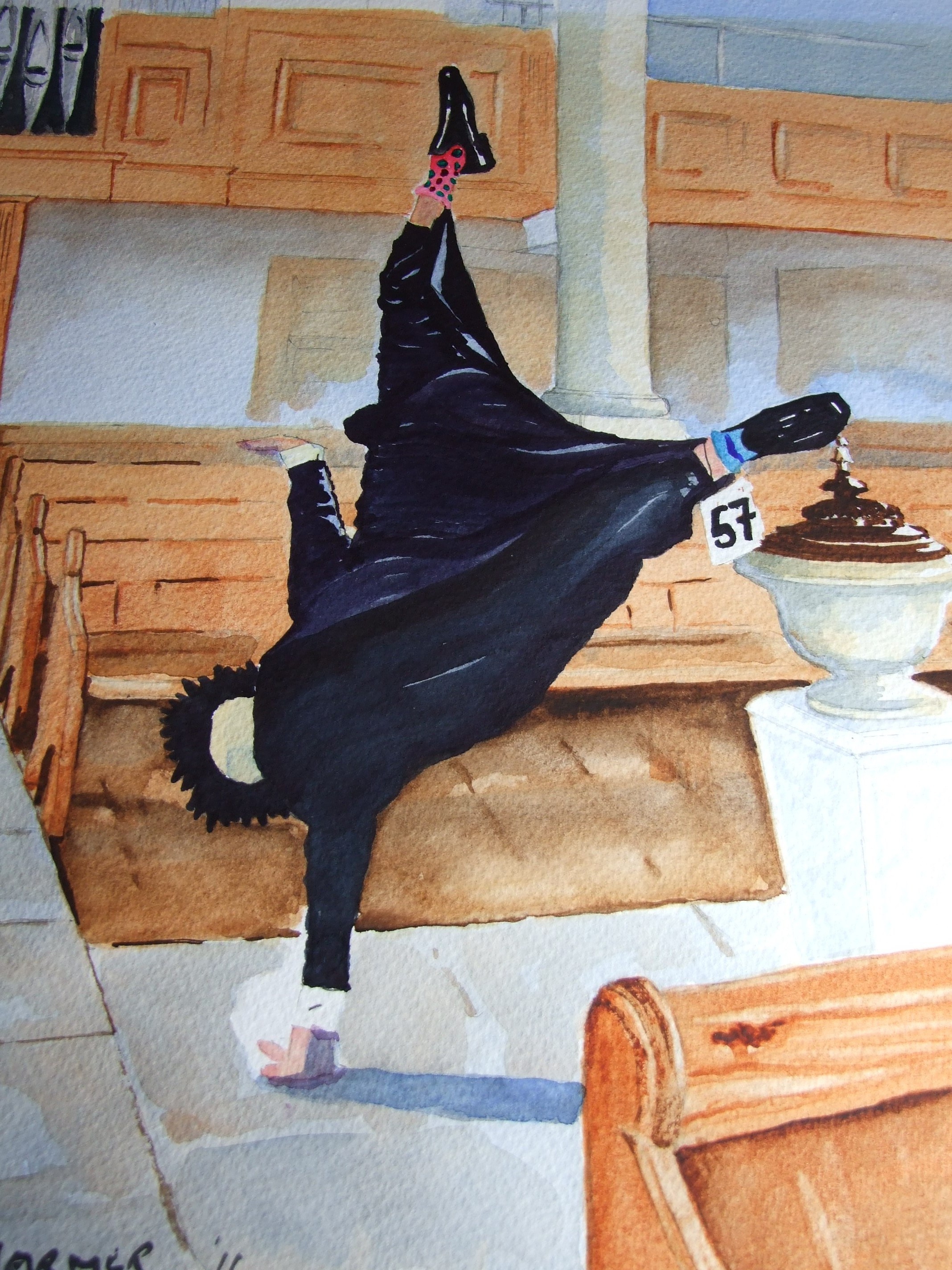
Between 1951 and 54 were my early school years before moving on to secondary education. I cannot think of anything worth talking about. I do remember kids with leg irons, due to deficiency in diet. terrible when you think about it. We had free milk daily which must have helped. That was stopped by Margaret Thatcher when Education Secretary in 19 seventy something. Thatcher Thatcher milk snatcher was the cry. Even today children’s diet is wrong only for different reasons. Girls did handstands against the wall, with gym slips tucked into their knickers. Boys didn’t do handstands, which was wise. Girls did a lot of skipping chanting doggerel to the beat. i don’t remember the doggerel. There was quite a lot of fighting in the playground, otherwise football. We were organised into work parties for gardening during lesson time. We dug out quite large tree roots. Imagine that today. parents would be apoplectic. Dancing round the maypole was something else that was done as a showpiece for visitors and quite accomplished as I remember.

Well th ose are a few snatches as they come to mind and take me up to 1954

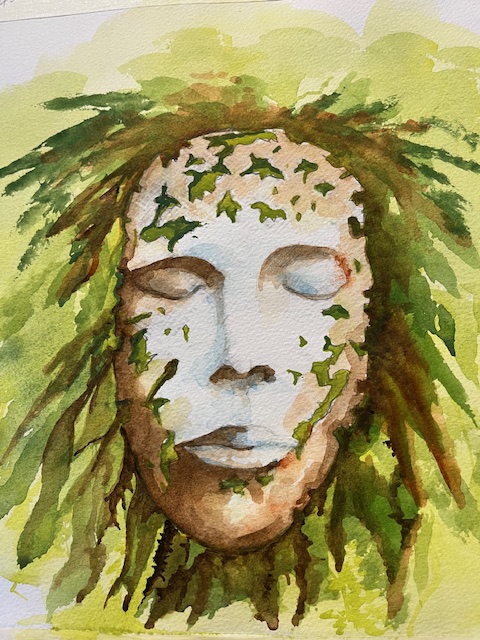
Leaf Spirit Painting Completed

This is really complete. I can think of nothing to add

Inspired as I have said before by the amazing bronze sculpture in Kew Gardens, the work of Simon Gudgeon. I thought that I would try and paint from it. It took many years for me to try. Was it worth it. Well, I will let others judge

It is, what we call, outside of my comfort zone. Something that was suggested to me, in an age when selling paintings is as difficult as I remember. I was advised not to think of something that would sell and just paint something for satisfaction. Well, not a picture that everyone would want, and yet somehow I like it

We will have to see.

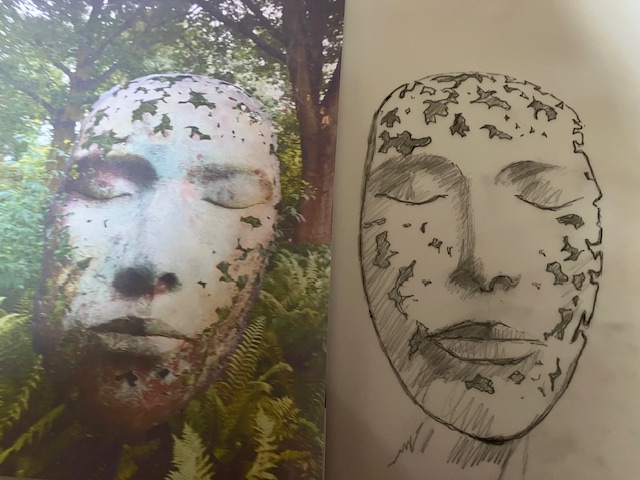
Leaf Spirit by Simon Gudgeon- a Tribute

I have talked about this sculpture before. Leaf Spirit by the sculptor Simon Gudgeon, which is in Kew gardens. This isn’t the only example of this sculpture but the only one that I have seen. I did a blog about this some years back. It is in my opinion, an amazing piece of work, and I did wonder at the time whether I could attempt a painting of it, and in watercolour too, which will be a handicap in this instance.

This isn’t about the result, but more about the exercise and what I will learn from it. i suspect that it will be a steep learning curve, to coin a well worn phrase

I have found this to be a very hard year for selling paintings. I am not alone in this. There is a dearth of disposable income around the world. Competition for sales is fierce at the moment. Fortunately this is not my day job but for some artists life is tough. My mentor at our local art club has given me very good advice. Step out of your comfort zone, and paint things which challenge you. Don’t necessarily paint subjects that you expect to sell. So I have made a start on Leaf Spirit. I have done the drawing which has been surprisingly tricky. No matter how often I checked my measurements, the expression on my face is not quite the same as the one in the photograph. Mine looks more feminine for some reason, but it could change again with colour added.

I will go on with this at another date. I have some other projects queuing up and they too hopefully will take me in new directions. This could be the start of something totally different, a change of style even. For now, we will see where it takes us. Good I am starting to get inspired again

Exhibition of Women Artists at Tate Britain

Magnificent exhibition at Tate Britain entitled Now You See Us is on until early next month. I wish I had gone sooner as this is an exhibition that needs more than one visit. It covers the work of women artists from 1520 – 1920, during ages obviously when women were subservient to men in most walks of life. Their work very often epitomises their struggle for recognition.

One of the earlier examples, a self portrait by Artemesia Gentileschi, an Italian artist working in London during the reign of Charles I, In London she worked for Charles I and Queen Henrietta Maria, and two works in this exhibition are from the Royal Collection. The other one is Susannah and the Elders, a popular Old Testament sory who was observed bathing by two of the elders, and sexually assaulted. The usual story, the elders tried to make out she was a whore but later her innocence was proved.

There were an amazing number of artists represented working through the ages. Very few did I recognise. Gwen John was one, and her self portrait was used in the exhibition publicity. In fact the work of hers shown was in my view some of the least inspiring.

During the 18c the work of the Royal Academy centred round oil paintings. Other media was looked down upon. Joshua Reynolds was especially sniffy about watercolour, pastel, embroidery and any sort of craft as being work that women did at home for their own amusement.

Gradually, and as we move into the c19 women are starting to meet men on equal ground. Two paintings which greatly impressed me were:

Colt Hunting in the New Forest by Lucy-Kemp Welch

The Roll Call by Elizabeth Butler, a painting of Guards Regiment in the Crimea. This painting was summoned to the palace for a special viewing by Queen Victoria. It sold for the staggering sum of £1200

Both of these were sensations in the art world at the time. Both were hung “on the line”, which means they were hung at eye-level, a great tribute by the hanging committee of the Royal Academy

Colt Hunting in the New Forest which is an enormous painting

The Roll Call by Elizabeth Butler

My photographs are not very good alas, done quickly avoiding other viewers.

Finally. a painting by Anna Airy, commissioned by the Imperial War Museum, Shop for Machining 15″ Shells, shows women doing factory work in 1918. This was the old Singer sewing machine Company factory on Clydebank. Important work and an important painting

Henry Moore in Colour at the Lightbox

Yet another excellent exhibition at Woking’s Lightbox art gallery. Small, obviously, size dictated by the venue but focused and to the point. We, in Woking, are so pleased as following the bankruptcy of the town brought about by reckless investment, the fate of the Lightbox has been in the balance. Deep cuts are having to be made, and when difficult choices and sacrifices are having to be made, then difficult sometimes to make a case for our wonderful art gallery to be saved. So far it has been managed by the new local government and we are grateful for that. The Lightbox is relatively new, in a town with virtually nothing by the way of heritage or culture, so the rise in prominence of our gallery has been a matter of civic pride. We hope it will continue

Henry Moore is well known, and if like me you tend to remember his wonderful sculptures, then it is useful to be reminded that he painted as well, and some while ago too. When reminded, of course I remember his drawings and paintings of people taking shelter during air raids in London, in the underground railway stations. This exhibition highlights some of these works, known as the Shelter drawings commissioned by the War Artists Advisory Committee during the last war. These Shelter drawings were responsible for achieving widespread recognition for the artist following their display in the National Gallery. When you look at some of these drawings you start to see forming some of his later sculptures and I will show one if I can as an example

Certainly the first one I think I have seen as one of his sculptures!

Many years ago, there was a major exhibition of his sculptures in Kew Gardens, and I painted one of them that was placed in front of the Palm House. By way of light relief, I will end with it here

A figure stretching after a night on a cold platform? Might be

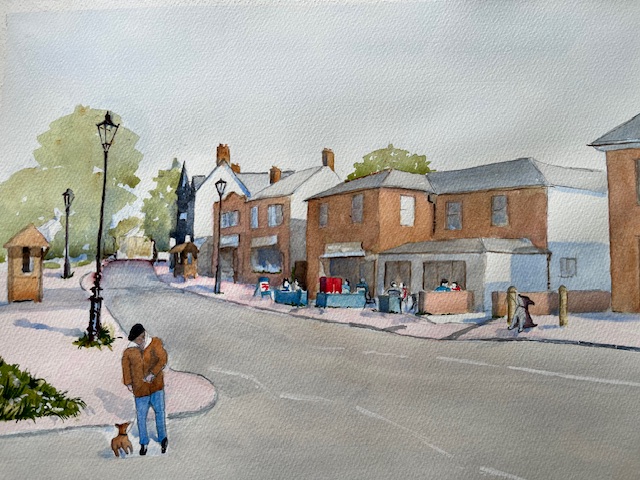
Painting of my home village

This is the centre of my local village, St John’s near Woking. The name St John’s was taken from the local church, built in the c19 by the then rector of Old Woking, as a chapel of ease for the village inhabitants. Quite a long walk to church otherwise in a century when no one had transport.

The village is mostly Victorian, and although surrounded by suburbia, does still retain its village atmosphere and integrity. Life started here in the late c18 when the canal was cut through open heathland. In the distance in my picture, the road makes a hump, as it crosses the canal. This is Kiln Bridge, where as the name suggests bricks were made from local clay, and these were used in the building of the canal. The canal was intended to link London with Southampton, but only reached Basingstoke before the railways were built and superseded canals. This was still a time when war with France was a possibility, and inland links with major south coast ports were desirable.

Today the Basingstoke Canal is maintained by Surrey and Hampshire County Councils. There is some leisure boating but not much. Wild life proliferates and the towpath is used for cycling and walking.

This is the very first time that I have painted my own village. I don’t know why. I put this painting on a local website and had more than 240 hits. All complimentary, I am pleased to say. No offers to buy though.

In the middle of the picture is our comparatively recent coffee shop, which has become the hub of village activity. Walkers and shoppers meet there to relax and catch up. We never had that before and it is a very welcome addition. We do have a pub but located going out of the village, so not so convenient. We have most shops so a useful selection.

At the bottom of my lane, we are blessed with a green open space, called St John’s Lye. Lye, lea or leigh means a green space. It is common land and so protected although we did have to physically resist Woking Borough Council who wanted to build a village hall on the Lye to replace the one that was starting to fall down. Eventually common sense prevailed and the new hall was built on the site of the old one. The Lye is available to all age groups for spontaneous activity including dog walking.

And so you have it. Not a place that many know, but loved by its local population

JMW Turner’s House in Twickenham

I shall publish a recent picture soon of this fascinating house, which Turner had a hand in designing together with his friend and near neighbout John Soane

And this is it in Sandycoombe Road in Twickenham, where we made a visit recently

Turner built this house in the style of a small country villa, in 1813, for himself and his “old dad” William, where they spent much time relaxing away from his London gallery. At the time it was way out in the country. Later on in the latter part of the c19 it was surrounded by suburbia, as it still is today. Quite historic suburbia now of course, but suburbia nonetheless. If I can find it I have somewhere a recreated view from the dining room window at the time that Turner lived there.

And this is it. Tranquil pastoral countryside image on the window of the dining room. Quite clever. The garden with well,and meadows beyond. Ignore the brickwork showing through the upper part of the window. That is the house next door today in real life, which we can’t block out

How did Turner live at Sandycombe Lodge? Did he paint there? He always went with sketch book in hand, studying the landscape, and its changing moods. It was believed that he used the drawing room as a studio. It had French windows facing north-east from which friends recollect that Turner would refresh his eye.

He used a pony and gig for getting about on sketching trips.The pony was the “old crop-ear” who may have grazed on Turner’s nearby meadow, and whom Turner buried somewhere on his land. No stables are recorded on of the later maps, he must have been stabled elsewhere, perhaps at the nearby Crown Inn.

Fishing was a quiet pleasure shared with friends, many of them fellow artists.The Thames nearby provided an abundant supply.Turner made some beautiful watercolour studies of tench,trout and perch, the catches of some of these expeditions. Often he was accompanied by John Soane, who was also an enthusiastic eel catcher

One of the most prestigious acquaintances Turner made during his time at Twickenham,was the Duc d’Orleans later Louis Philippe, King of France, who lived with his brothers near the Thames at Highshot House in Crown Lane from 1800-1807. Turner met the Duc at a Royal Academy dinner in 1802. Later, between 1815-1817 the Duc was again in exile in “dear quiet Twick”, this time in a house which is still there, named Orleans House which today houses a prestigious art gallery. They must have become firm friends as Louis Philippe gave him a gold snuff box when he came to England for Queen Victoria’s coronation in 1837. Turner took his last continental excursion in 1845, and called on Louis Philippe, who had a chateau on the coast of Picardy, and enjoyed a convivial evening of chat about Twickenham.

The other incumbent of Sandycombe Lodge, was “old Dad”, Turner’s father William, retired barber of Maiden Lane, Covent Garden. He kept house and also opened up the gallery for his son in Queen Anne Street. They both enjoyed frugal living, as William complained about the cost of getting into London, easily affordable by Turner. He was overjoyed to find a market gardener who would take him in on his cart sitting on the vegetables, for the price of a glass of gin!

After 1815, and the Napoleonic Wares drawing to a close, Turner could at last travel on the continent, and we know well, his wonderful paintings of the Alps which he crossed into Italy. Likewise magnificent views of Venice. The Low Countries and Germany were on his list.

He kept Sandycombe on for his father, who enjoyed the life there, but by 1826, William’s health was failing, and indeed by 1829 died. Turner had removed him back to Queen Anne Street before then. Sandycombe had become an irrelevance by then and I believe was sold for a modest £500, ironically less than Turner might expect for a major oil painting. Old William’s death affected Turner greatly. They were very close.

The house enjoyed a long life after Turner, and has now been fully restored , brought back to life by Harold and Ann Livermore, who bought the house in 1947. Ann died in 1997, and Harold established the Sandy Lodge Trust, now Turner’s House Trust, to preserve and maintain the property, which is now open to visitors and certainly worth a visit.

Out of my comfort zone part 2

This is the finished painting which I have called Windswept

I have done quite a lot of work on the horses as you can see. One horse in a familiar grey colour whilst the other in deep chestnut with black mane and tail, whilst also with black legs. Manes are swept out in one direction, as well as tails. Powdered snow is being kicked up by their hooves. The general effect I like to believe, is one of storm and threat even of chaos. I will let others judge

I have, I hope kept the strong light coming in from the left. The snow heightens that effect.

Not an easy one to put together. At times I was tempted to abandon, but I usually like to finish before condemning a painting to the bin. I am generally happy with this one, and comments on social media have been enthusiastic

So I will leave it there