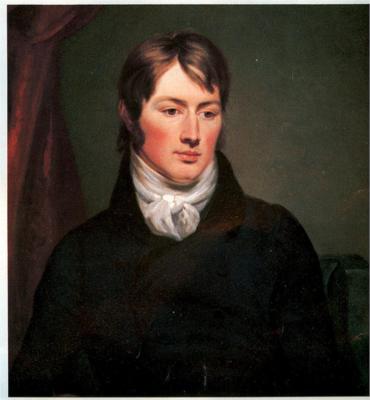
Constable was big in France

Something I didn’t know until I started reading about him with a view to preparing a talk later this year entitled Turner and Constable. In 1821 when he showed at the Royal Academy and showed The haywain in fact, he was wildly embraced by the French art market, not quite literally although he might have been. he was totally unprepared for all this enthusiasm which he certainly wasn’t used to at home

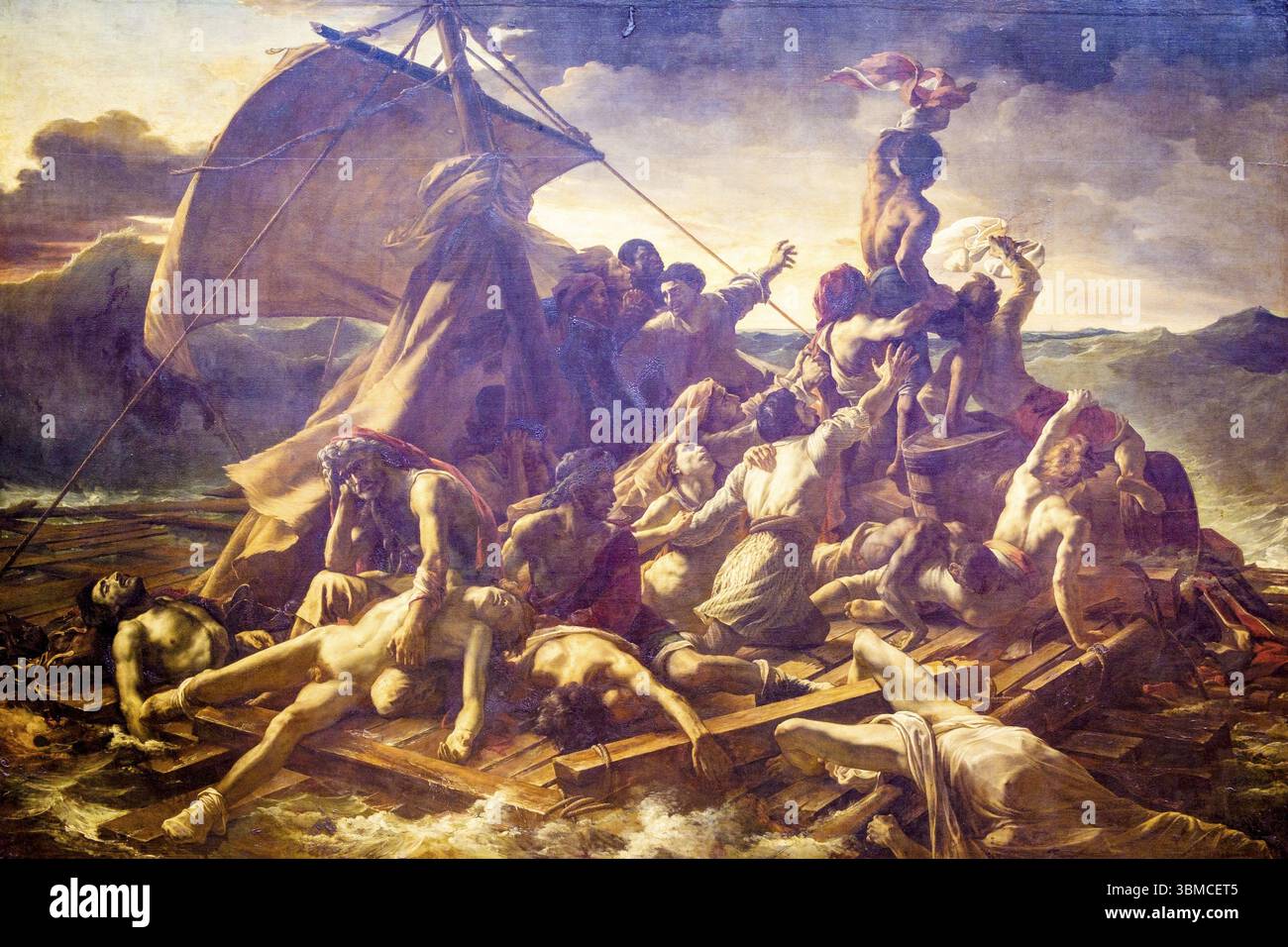
One of the first to discover him was the French Romanticist Theodor Gericault. He is probably best known for his famous painting The Raft of the Medusa, which he had brought to London, and which we are told thrilled 70,000 Londoners

And this is Gericault’s famous painting, which I will just talk about before talking about Gericault’s reaction to Constable’s work

This painting was based on a real incident which shocked the French nation. The French naval frigate ran aground off the coast of Mauretania on 2 July 1816. At least 150 people were set adrift on a hurriedly constructed raft. Only 15 survived and were picked up. The event fascinated Gericault and he could be said to have hooked into national grief. He undertook extensive research including visiting morgues for the skin colour of the dying and the dead. The painting was shown in the Salon of 1819 and received national approbation. He brought it to London where it thrilled Londoners including one Turner who went back to his studio and reworked his own great work The Shipwreck

Whilst in London Gericault visited the Academy exhibition and there discovered Constable. He thought that The Haywain was the best in the exhibition. Other French visitors thought the same and waxed lyrical.

Much to Constable’s surprise the interest quickly snowballed. A Parisian art dealer called Arrowsmith, French despite his name, offered to buy The Hay Wain and offered a derisory sum. The negotiations broke down but two years later, when Constable was short of money, he agreed to sell the painting to Arrowsmith for £250, as well as other pieces. The paintings caused a stir when they arrived in Paris.

The arrival of the Hay wain in 1824 was like a pebble dropping in a Parisian mill pond. The effect was immediate. At the epi-centre of the quake was another influential figure, Eugene Delacroix, who was so influened by the Hay Wain that he went back to his studio and repainted background on his great work The Massacre at Chios. He was blown away by Constable’s greens and tried to copy them. Critics viewing this picture at the time couldn’t find much evidence of green being used, but there we are.

If Delacroix was talking about the Hay Wain, then others were bound to be listening. A few weeks later it was these two paintings which received the greatest share of the attention at the Academie des Beaux-Arts, known as the Salon. The Salon dominated taste and opinion in France to an even greater extent than the Academy in Britain

Constable was embraced at the Salon in a way that had never happened to him at home. His large paintings were removed to positions of prominence, and Monsieur Constable, Peintre de Paysage was awarded a gold medal of excellence. His friend John Fisher couldn’t resist commenting that plain old Constable, who didn’t speak a word of French, was the talk and admiration of the French. His name entered the language. Landscapes were described as a la Constable!. More French exhibitions followed in Lille including another gold medal, Douai and the Salon again in1827, where there were plenty of landscapes a la Constable, with rustic cottages, wagons in ponds and open fields and skies.

Constable nevertheless refused to visit France, his attitude seemingly bloody-minded bordering on rude.

This is probably a good place to take a break. We are about half way, so a lot of writing and a lot of reading for you guys. It will take another post to complete the subject which I will do soonest

Turner and Constable, two heavyweights

I am reading a fascinating book at the moment, written by Nicola Moorby which is helping my research into the talk I am preparing on Turner in Surrey, and so am straying into the life of Constable as well. There are striking similarities although they have different characters. What they share in my opinion, is the distinction of starting off the Modern Art Movement.

I will start with an image of the Haywain, probably the best known of Constable’s work, and as an image is better known than any portrait of the artist himself. the scene is Flatford Mill, where you can go today and paint the same view yourself if you want to. Willy Lotte’s cottage on the left is still there, sadly the haywain itself is not. In my youth, I always thought the cart was being driven across a ford, but later realised in fact that it was the practice to drive carts into shallow water after the wooden wheels had got too dry. the wood would shrink and come away from the iron rim. Every so often the wheels would have to be soaked to expand the wheel back tight onto its rim

He was a master of skies. He studied clouds and became something of a meteorologist. East Anglia where he came from was flat, so almost all his paintings were skyscapes.

But we are talking about Turner and Constable together. Did they ever meet? I know of one recorded meeting, and there may have been many more. In June 1813, Constable sat next to him at an Academy dinner, and wrote to his wife Maria ” I was a good deal entertained by Turner….. he is uncouth, but has a wonderful range of mind”. Uncouth, yes I can imagine Constable saying that. An acerbic character, he was not generous to his fellow artists, quite the reverse. On hanging days, he would walk round criticising other artists work, which wasn’t appreciated. Artists naturally were sensitive and nervous on these occasions as much was riding on the outcome. Constable would sneer at London based artists or “the Londoners” as he called them, especially when they attempted rural scenes. He thought they should stick to what they knew. I don’t think he included Turner in these remarks, nor should he as Turner was well established whilst Constable was just starting to become known. Rather he stood in some awe of Turner, as well he might.

Did they cross swords? There was one recorded incident that I can think of. Constable was taking his turn on the Selection Committee, who decided on where paintings were hung at the Academy Exhibitions. This was an unenviable job calling for great diplomacy and tact, not Constable’s greatest talents. He made an unbelievably bad judgement by moving one of Turner’s paintings and replacing it with one of his own at an event in 1831. Turner was down upon him like a sledgehammer. It was no use Constable pleading that the move was to their mutual advantage. Turner kept at it all evening to the amusement of all, who conidered that Constable had brought his fate upn himself

Coming back to the Haywain, this was first shown in Paris which is not generally known, where it caused a sensation. That is one of the great ironies concerning these two great painters. Constable never left these shores. He didn,t want to, through xenophobia or sheer bloody mindedness, and yet he became big in France without making any effort. A French dealer called Arrowsmith, French despite his name , came to one of the Royal Academy exhibitions and discovered Constable and went into raptures. He organised an exhibition in Paris of Constable’s work which Constable did not attend. Great interest was shown but Constable did not follow this up. he was not one for net working. One cannot imagine Turner squandering an opportunity like this

People wanted to meet Constable, including the great Delacroix, who even came to London, but there is no evidence of a meeting taking place. His paintings were to be shown at the Acadamie des Beaux-Arts known as the Salon, the nearest equivelant to the Royal Academy. It was a great success and Constable sold more paintings in a short space of time than he had sold to British buyers in years. Despite all this, Constable refused to travel stating that ” he would sooner be a poor man at home than a rich man in France” be careful what you wish for. The moment passed and Constable failed to capitalise.

Turner on the other hand, despite all his travels throughout Europe from Copenhagen down to Italy, only sold pictures at home, He held two exhibitions in Europe, one in Germany and one in Italy and both were failures. Perhaps the Italians were too used to the deep landscapes of Poussin and others, and found nothing remarkable in Turner’s work

A great book which I am still reading.

John Constable Exhibition

Our local and comparatively new art gallery, the Lightbox in Woking is staging an exhibition entitled John Constable:Observing the Weather. No pictures from me, I am afraid so suggest the following link  thelightbox.org.uk. The exhibition opened yesterday and runs until May. We went today and will no doubt go again

Yet another triumph for the Lightbox, a provincial gallery with national recognition. Paintings, prints and watercolour sketches on loan from collections all round the country, tell us of Constable’s fascination with meteorology. Many sketches are from the years 1820-22 when he rented a house on Hampstead Heath to be near his studio in London, and these record cloud formations from different angles. They are really scientific observations which he drew from later when producing his oil paintings, such as Salisbury Cathedral from across the meadows which is the highlight of the show. This is one of nine giant oil sketches that he made which have become famous in their own right

Dismissed by the art world at the time, for not sticking to classical subjects painted in a studio, Constable stuck to painting en plein air, landscapes as he saw them uncontrived and true to nature. He was certainly an influence on the Barbizon School, with painters like Corot and Rousseau, and I always felt too, on the French Impressionists later on

Magnificent prints of Constable’s work by David Lucas are on display, such as The Drinking Boy and The Lock. This was about the time that printmaking moved away from the linear print to a representation that appeared like the painting, even down to brush strokes.

Obviously small by national standards but cleverly put together, and worth a visit, if you are able